

The mere presence of a controlled substance doesn't guarantee a conviction, even if the prosecution acts like it's an open and shut case. When you're facing serious allegations, the most effective drug crimes defense focuses on the legality of the investigation rather than just the evidence itself. It's completely normal to feel paralyzed by the fear of mandatory minimum prison sentences or the anxiety of a ruined career. You're likely wondering how any legal strategy can actually get these charges reduced or dismissed when the stakes feel so high.
This article provides the clarity you need to move from a state of uncertainty toward a position of strength. You'll discover how a strategic legal defense challenges the validity of search warrants, identifies constitutional violations, and safeguards your rights at every turn. We'll walk through the specific legal avenues available to avoid incarceration and protect your professional license. By understanding the process, you can begin to see a path forward where your future is no longer defined by a single mistake or a flawed police investigation.
Key Takeaways
- Understand how the specific type and quantity of a substance can dramatically shift the severity of the allegations you face.
- Learn how the 4th Amendment serves as a shield against illegal searches and why the Exclusionary Rule is a vital tool for your defense.
- Discover the legal nuances between actual and constructive possession and how they impact the prosecution's ability to prove its case.
- Explore why a comprehensive drug crimes defense must include a rigorous analysis of chemical testing and the integrity of the evidence chain.
- Gain clarity on why a personalized legal strategy is necessary to safeguard your professional license and long-term employment prospects.
Navigating the Severity of Drug Crime Allegations
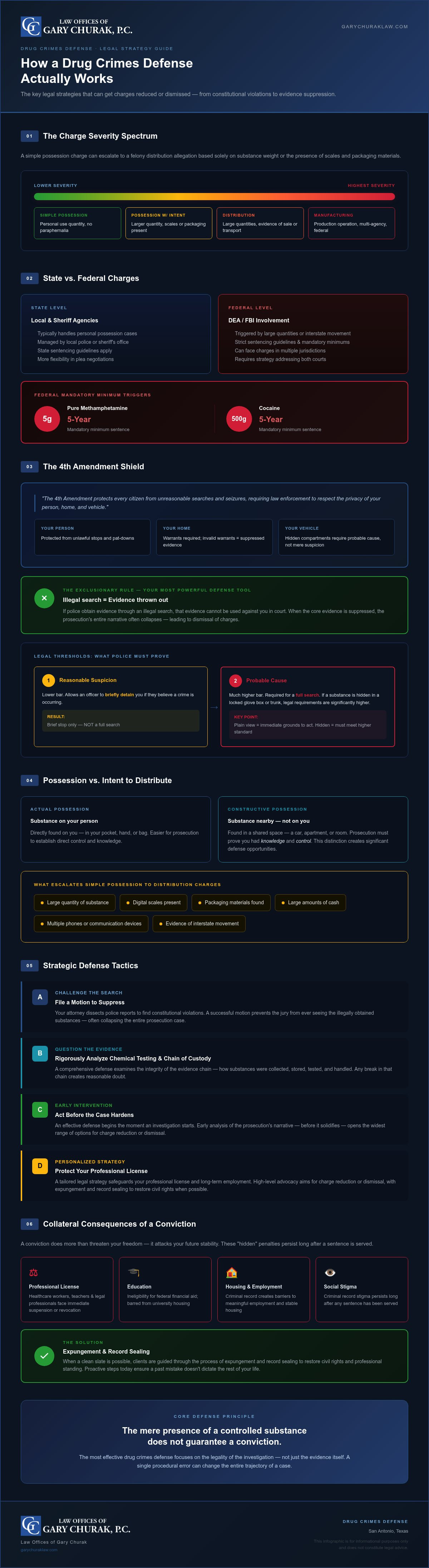
Drug allegations carry a weight that extends far beyond the courtroom walls. The legal system categorizes these offenses on a broad spectrum, ranging from simple possession for personal use to complex manufacturing and distribution operations. Law enforcement agencies don't just look at the substance itself; they scrutinize the context of the arrest. When someone is taken into custody, working with agencies like Optimal Bail Bonds to secure a swift release is often the family's first critical priority before mounting a courtroom strategy. A simple possession charge can spiral into a felony distribution allegation based solely on the weight of the substance recovered or the presence of digital scales and packaging materials. Because the stakes are so high, an effective drug crimes defense begins the moment an investigation starts. Early intervention allows for a thorough analysis of the prosecution's narrative before it hardens into a conviction.
The Legal Distinction Between State and Federal Charges
Understanding who is knocking at your door is the first step in building a defense. Local police departments and sheriff's offices typically handle state-level possession cases. However, if an investigation involves large quantities or interstate movement, agencies like the DEA or FBI may take the lead. Federal court operates under a different set of rules. Sentencing here is governed by strict guidelines and mandatory minimums that can be unforgiving. For instance, federal law often triggers a five-year mandatory minimum sentence for cases involving just five grams of pure methamphetamine or 500 grams of cocaine. Facing charges in multiple jurisdictions simultaneously complicates your situation, requiring a strategy that addresses both state and federal scrutiny. We rely on Fourth Amendment protections against unreasonable searches and seizures to challenge how these agencies obtained their evidence, as a single procedural error can change the entire trajectory of a case.
Collateral Consequences Beyond the Courtroom
A conviction does more than just threaten your freedom; it attacks your future stability. Healthcare workers, teachers, and legal professionals often face the immediate suspension or revocation of their professional licenses following a drug-related conviction. Students might find themselves suddenly ineligible for federal financial aid or barred from university housing. These "hidden" penalties persist long after a sentence is served, creating barriers to meaningful employment and stable housing. The social stigma associated with a criminal record can be suffocating. This is why we prioritize high-level advocacy aimed at charge reduction or dismissal. When a clean slate is possible, we guide clients through the process of expungement and record sealing to restore their civil rights and professional standing. Taking proactive steps today is the only way to ensure a past mistake doesn't dictate the rest of your life.
The 4th Amendment: Challenging Illegal Searches and Seizures
The 4th Amendment serves as your primary shield against government overreach. It protects every citizen from "unreasonable" searches and seizures, requiring law enforcement to respect the privacy of your person, home, and vehicle. In many cases, a successful drug crimes defense hinges on the "Exclusionary Rule." This legal principle dictates that if the police obtain evidence through an illegal search, that evidence cannot be used against you in court. When the core evidence of a case is suppressed, the prosecution's entire narrative often collapses, leading to a dismissal of charges.
Police officers frequently exceed their authority during high-pressure situations like traffic stops or home visits. They might pressure you into consenting to a search or claim they "smelled" something to bypass warrant requirements. A seasoned criminal defense attorney knows how to dissect police reports to find these constitutional violations. By filing a motion to suppress, your advocate can challenge the legality of the arrest and prevent the jury from ever seeing the illegally obtained substances.
Probable Cause vs. Reasonable Suspicion
Law enforcement must meet specific legal thresholds before they can interfere with your day. Reasonable suspicion is a lower bar that allows an officer to briefly detain you if they believe a crime is occurring. However, a full search requires "probable cause," a much higher standard of evidence. If an officer sees a substance in "plain view" on your passenger seat, they have immediate grounds to act. If that substance is hidden in a locked glove box or trunk, the legal requirements for a search become much stricter. Probable cause in the context of a drug dog alert is established when a certified canine provides a definitive signal to its handler, granting officers the legal authority to search a vehicle without a warrant.
Search Warrants and Their Limitations
A search warrant is not a blank check for police to tear through your life. It must be specific about the location to be searched and the items to be seized. We look for "fruit of the poisonous tree," which refers to evidence found because of an initially illegal act. If a warrant was obtained using false information or unreliable tips from confidential informants, every piece of evidence found afterward may be thrown out. The severity of the potential penalties often aligns with federal drug scheduling classifications, but the procedural rules remain constant. If you believe the police overstepped their bounds, requesting an immediate case analysis can help identify the best path toward protecting your rights and your freedom.
Possession vs. Intent: Analyzing Charge Classifications
The legal system doesn't just care about what was found; it cares about what you intended to do with it. Prosecutors often use circumstantial evidence to escalate a simple possession charge into a far more serious "intent to distribute" allegation. This shift can be based on the presence of digital scales, small plastic baggies, or large amounts of cash. A successful drug crimes defense requires a meticulous breakdown of these assumptions. We challenge the narrative that every individual with a specific quantity is a dealer, especially when the evidence suggests personal use or shared possession.
When high-level charges are at play, the strategy must be even more aggressive. We provide a tailored federal drug trafficking defense to counter the vast resources of government agencies. By analyzing federal drug scheduling and enforcement priorities, we identify where the prosecution has overreached in its classification of the offense. This level of scrutiny is a cornerstone of our drug crimes defense approach, ensuring that your rights aren't trampled by overzealous charging tactics.
Constructive Possession and Shared Spaces
You don't have to have drugs in your pocket to be charged with possession. Under the theory of "constructive possession," the state argues you had the knowledge of the substance and the power to control it. This often happens when items are found in a shared apartment, a glove box, or under a passenger seat. To secure a conviction, the prosecution must prove you knew the drugs were there and intended to exercise control over them. We work to distance our clients from illegal items by highlighting a lack of exclusive control or showing that other individuals had equal or greater access to the space.
Threshold Quantities and Charge Escalation
The weight of the substance recovered is often the single most important factor in sentencing. Specific thresholds, measured in grams or kilograms, can trigger mandatory minimum prison sentences that strip judges of their discretion. For example, federal guidelines often set different triggers for pure substances versus mixtures. Prosecutors may also attempt "stacking," where they add related offenses like money laundering or weapons charges to increase their leverage. We scrutinize the accuracy of weight measurements provided by the lab. Moisture content, packaging materials, and the precision of the scales used by law enforcement are all points of contention that can lead to a significant reduction in the level of the offense. For those seeking specialized representation in high-stakes criminal matters internationally, you can discover Meriño y Abogados Asociados for defense in high-complexity cases in Chile.
Strategic Defense Tactics: Beyond the Arrest Record
Effective drug crimes defense requires looking past the police report to find flaws in the scientific process. Law enforcement often relies on presumptive field tests that are prone to errors. These kits frequently fail to distinguish between illegal substances and common household items like sugar, soap, or drywall dust. We force the state to prove that what they seized is actually what they claim it is through rigorous scientific standards. Beyond the substance itself, we examine the conduct of the officers involved. Entrapment occurs when the government induces someone to commit a crime they weren't otherwise predisposed to commit. It isn't just providing an opportunity; it's using coercion or harassment to manufacture a crime that wouldn't have existed without police interference.
Expert witnesses play a pivotal role in this technical advocacy. We collaborate with forensic analysts who can testify about the high failure rates of testing equipment or the lack of proper calibration in state labs. This scientific scrutiny often reveals that the prosecution's evidence is based on a foundation of human error and faulty technology. This technical approach is especially critical when facing high-level charges that require a federal drug trafficking defense, where the complexity of the evidence increases significantly.
Lab Testing Errors and Scientific Validity
Field test kits are notoriously unreliable, often producing false positives that lead to wrongful arrests. These preliminary tests don't meet the standards required for a conviction, yet they are frequently used to pressure defendants into early plea deals. We insist on re-testing substances in independent laboratories where rigorous protocols are followed. By challenging the credentials of state forensic analysts, we often find that the individuals handling your evidence lack the necessary training or have a history of documented lab errors. Discrediting the scientific validity of the state's results is a powerful way to dismantle their case from the inside out.
Chain of Custody Breaches
The state must account for the location and handling of evidence every second it's in their possession. We scrutinize property room logs to identify gaps where the evidence was left unattended or handled by unauthorized personnel. Improper labeling or storage in a non-secure environment can render even the most incriminating evidence inadmissible. A missing signature on an evidence log can jeopardize a case by creating a window of time where the integrity of the substance cannot be verified. If you believe the evidence in your case has been mishandled, scheduling a strategic case review ensures that every procedural error is identified and utilized for your protection.
Securing Assertive Representation for Drug Offense Charges
A standard legal approach is rarely sufficient when facing the complexities of the modern justice system. Every drug case involves a unique set of circumstances, from the initial police encounter to the specific methods used in laboratory testing. A "one-size-fits-all" strategy fails because it ignores the nuances that can lead to a dismissal. When your future is on the line, you need a professional who understands how different legal issues overlap. This is particularly true in cases involving both substances and vehicles, where the expertise of a seasoned dwi defense attorney becomes invaluable. They can navigate the intersection of drug and alcohol allegations to ensure your rights remain protected across all fronts.
The process of choosing a criminal defense attorney for high-stakes litigation should center on their willingness to be aggressive. You need an advocate who isn't afraid to challenge the prosecution's evidence or take a case to trial if a fair resolution isn't offered. Aggressive advocacy doesn't always mean a courtroom battle; it often means having the leverage to negotiate a favorable plea deal from a position of strength. By demonstrating a readiness to litigate every procedural error, your defense team forces the prosecution to reconsider the validity of their own case.
The Value of Thorough Case Analysis
Gary Churak approaches every case with the precision of a battle-tested guide. He scrutinizes every police report, witness statement, and piece of physical evidence for even the smallest inconsistencies. With over 40 years of legal experience, he has developed a keen eye for identifying the procedural flaws that others might overlook. This depth of knowledge allows for a proactive rather than reactive drug crimes defense. Starting with a personalized consultation, he builds a narrative of protection that addresses your specific concerns, ensuring that no detail is left unexamined in the pursuit of your freedom.
Moving Toward a Favorable Resolution
Deciding whether to take a case to trial or enter plea negotiations is one of the most critical choices you'll make. We provide the data and analysis you need to evaluate the pros and cons of each path clearly. For many first-time offenders, we explore diversion programs or alternative sentencing that can keep a conviction off your record entirely. Our goal is always to secure the best possible outcome while minimizing the long-term impact on your employment and housing. If you're ready to take control of your situation and begin building a strategic defense, schedule your free consultation with the Law Offices of Gary Churak today.
Protecting Your Rights and Your Future
Facing drug charges can feel like an impossible battle, but a strategic drug crimes defense focuses on the procedural cracks in the prosecution's case. By leveraging 4th Amendment protections against illegal searches and scrutinizing the scientific validity of lab results, you can challenge the evidence before it reaches a jury. Understanding the distinction between actual and constructive possession allows for a defense that distances you from the allegations and protects your civil rights. You don't have to face this process without a clear plan for resilience.
Gary Churak brings over 40 years of criminal defense experience and a proven record in both state and federal courts to every case. He provides the aggressive and personalized advocacy necessary to safeguard your professional license and your freedom. If you're ready to transition from a state of anxiety to a position of strength, Contact the Law Offices of Gary Churak for a Free Case Analysis today. Your future is worth the fight, and the right legal strategy starts with a single proactive step.
Frequently Asked Questions
Can drug charges be dismissed if the police didn’t have a warrant?
Charges may be dismissed if a search occurred without a warrant and no legal exception applied. While police can search under plain view or exigent circumstances, many warrantless searches violate constitutional rights. If the court determines the search was illegal, the evidence is suppressed under the Exclusionary Rule. This often leaves the prosecution without a case, leading to a complete dismissal of all allegations against the defendant.
What is the difference between drug possession and possession with intent to distribute?
Possession with intent to distribute is a more severe charge than simple possession, often carrying much harsher penalties. Prosecutors look for indicators of sales, such as large amounts of cash, digital scales, small baggies, or multiple cell phones. While quantity alone can sometimes trigger this charge, a strong drug crimes defense challenges the assumption that these items prove a plan to sell rather than personal use.
What happens if the drugs belonged to someone else in the car?
You can still be charged under the theory of constructive possession even if the substances belong to a passenger. The state must prove that you had knowledge of the drugs and the ability to exercise control over them. Defense strategies often focus on showing that the driver had no awareness of the items or that the passenger had exclusive control, effectively distancing the driver from the illegal contraband found in the vehicle.
How much does a drug crimes defense lawyer cost?
Legal fees for a criminal case depend on the severity of the charges and the complexity of the required litigation. A federal trafficking case involves more resources than a state-level misdemeanor possession charge. Most firms, including the Law Offices of Gary Churak, offer a free initial consultation to discuss the specifics of your situation. This meeting allows you to understand the potential costs and the value of assertive representation before making a financial commitment.
Will I go to jail for a first-time drug possession charge?
Jail time is not a guaranteed outcome for a first-time drug possession charge, especially with proactive legal intervention. Many courts offer diversion programs, drug court, or deferred adjudication that allow individuals to avoid a permanent criminal record and incarceration. A successful drug crimes defense identifies these alternative sentencing options early in the process to protect your freedom and ensure that a single mistake doesn't result in a prison sentence.
What is a motion to suppress evidence in a drug case?
A motion to suppress is a formal request for the judge to exclude specific evidence from being used at trial. This is most commonly used when evidence was obtained through an illegal search or a violation of your 4th Amendment rights. If the judge grants the motion, the prosecution is prohibited from presenting that evidence to the jury. In many drug cases, suppressing the substance itself makes it impossible for the state to proceed.
How does a lawyer challenge a drug lab report?
Lawyers challenge lab reports by scrutinizing the scientific protocols and the background of the analysts involved. We look for gaps in the chain of custody or evidence that testing equipment was not properly calibrated. Requesting an independent analysis of the substance can also reveal errors in the state's chemical identification. If the lab's findings are shown to be unreliable, the weight or classification of the drugs can be successfully contested.
Can I lose my driver’s license for a drug conviction?
Yes, a drug conviction can lead to an automatic suspension of your driver's license in several jurisdictions. This penalty often applies even if the offense did not involve a vehicle. Losing your driving privileges can have a devastating impact on your ability to maintain employment and handle daily responsibilities. Navigating these administrative penalties requires a defense strategy that addresses both the criminal charges and the secondary consequences of a conviction.


