

What if a failed breathalyzer test wasn't the final word on your future, but rather a procedural hypothesis that can be systematically dismantled? You're likely feeling the weight of a heavy reality; the fear of losing your driver's license, the anxiety of a permanent criminal record, and the overwhelming confusion of the legal system are enough to paralyze anyone. It's natural to feel that the odds are stacked against you when facing an experienced prosecution. However, securing a seasoned dwi defense attorney means you don't have to face these high stakes alone.
With over 40 years of experience, a battle-tested guide knows that an arrest is just the start of a fight, not a foregone conclusion. You'll discover how a strategic, aggressive legal defense can challenge even the most difficult evidence to protect your rights and your freedom. This article outlines how thorough case analysis and professional advocacy can lead to a dismissal or reduction of charges, helping you retain your driving privileges and find a clear path forward.
Key Takeaways
- Learn why the first 48 hours after an arrest are critical for preserving evidence that could determine the ultimate success of your case.
- Understand how an experienced dwi defense attorney scrutinizes the legality of traffic stops and the administration of field sobriety tests to identify procedural errors.
- Discover how the "Exclusionary Rule" can be used to suppress evidence, proving that a failed chemical test is not an automatic conviction.
- Identify the specific qualities to look for in legal representation, prioritizing trial-tested experience over practitioners who rely on quick plea deals.
- See how four decades of aggressive advocacy and thorough case analysis create a foundation for protecting your future and your freedom.
The Critical Role of a DWI Defense Attorney After an Arrest
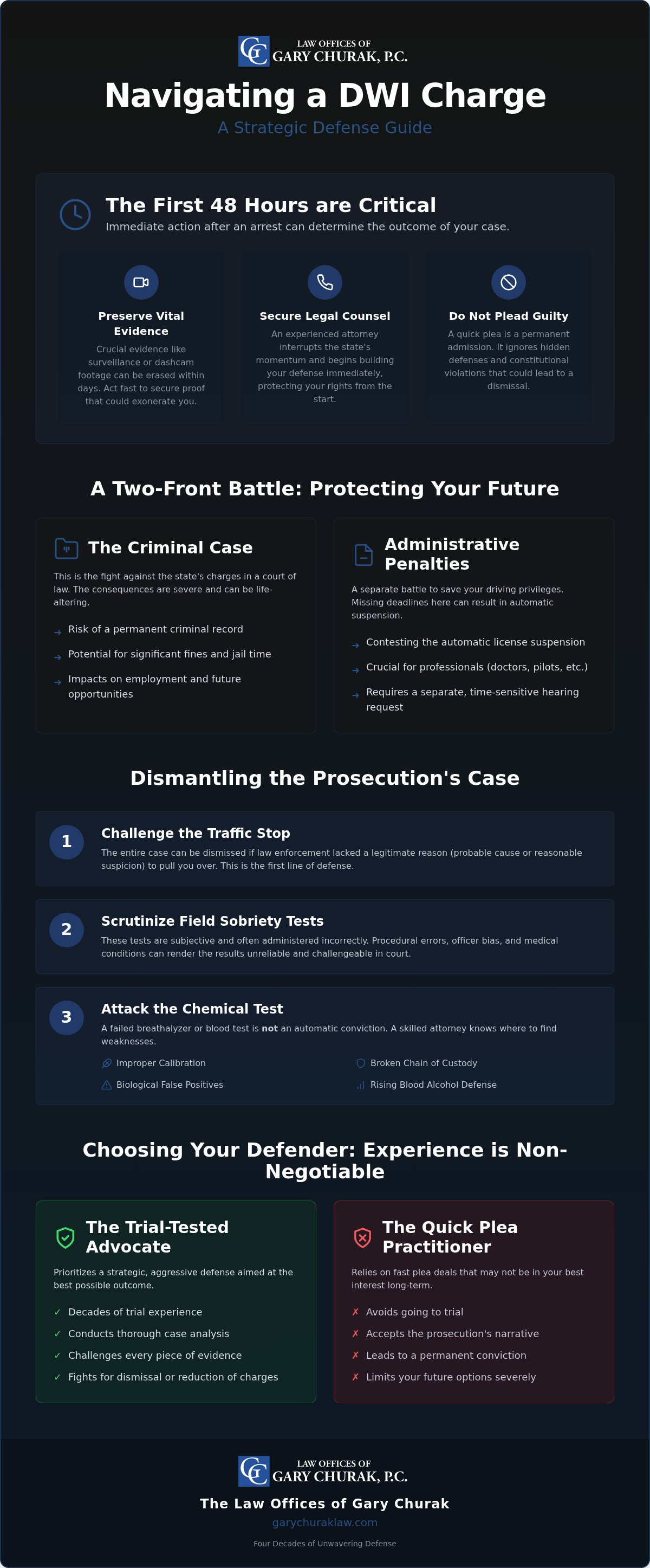
The moment the handcuffs click, the state begins building its case against you. It's a high-stakes environment where the prosecution holds the initial advantage. A seasoned dwi defense attorney with decades of experience, such as Gary Churak, acts as a vital shield. This legal protection interrupts the momentum of the state and forces a meticulous review of every claim made by law enforcement. The first 24 to 48 hours are not just for processing the shock; they're the most critical window for preserving evidence that could vanish. Surveillance footage from nearby businesses or dashcam recordings might be overwritten within days. Without immediate intervention, the very proof needed to exonerate you could disappear forever.
Understanding the Gravity of the Situation
Facing a charge involves navigating a dual-track system. You aren't just dealing with a criminal courtroom; you're also facing administrative penalties that target your driving privileges. The legal definition of driving under the influence covers a range of impairments, but the consequences for your professional life are universally severe. For those with professional licenses, medical certifications, or high-security clearances, a conviction can be career-ending. This is why the psychological shift from "defendant" to "strategist" is essential. You must stop reacting to the arrest and start preparing for a calculated defense.
Why You Should Not Plead Guilty Immediately
The temptation to "just get it over with" by pleading guilty is a dangerous trap. A quick plea is a permanent admission that limits all future options. It ignores the fact that police reports are often subjective and prone to error. An experienced dwi defense attorney conducts a thorough case analysis to find hidden defenses, such as improper calibration of breathalyzer machines or constitutional violations during the stop. These details are rarely obvious to the untrained eye but can change the entire trajectory of a case.
Across jurisdictions, a critical, limited timeframe exists for requesting an administrative hearing to contest the suspension of your driving privileges. Missing this deadline often results in an automatic license suspension, irrespective of your criminal case outcome. Aggressive advocacy means challenging the state at every turn. It involves a refusal to accept the prosecution's narrative as fact. By scrutinizing the timeline of the arrest and the officer's conduct, your legal team builds a wall between you and the potential for a life-altering conviction.
Dismantling the Prosecution's Evidence: Technical and Procedural Defense
The prosecution relies on a narrative of absolute certainty, but a skilled dwi defense attorney knows that every piece of evidence is subject to human error and mechanical failure. The defense begins with the initial traffic stop. Law enforcement must have probable cause or reasonable suspicion to pull you over; they cannot simply act on a whim. If the officer lacked a legitimate legal reason for the stop, any evidence gathered afterward, regardless of how damaging it seems, may be ruled inadmissible. This procedural gatekeeping is the first line of defense in protecting your rights. It's the moment where we stop the state's momentum in its tracks.
Terminology often varies by jurisdiction, and understanding the nuances between DUI vs. DWI can help clarify the specific technical standards the state must meet to prove its case. While the labels change, the burden of proof remains entirely with the government. A thorough case analysis involves interrogating the "Chain of Custody" for chemical samples. If a blood vial sat in an unrefrigerated locker or was handled by an uncertified technician, the integrity of that sample is compromised. We don't just look at the final number; we look at the journey that sample took to get there.
Challenging the Validity of Chemical Tests
Breathalyzers are not infallible scientific instruments; they are machines that require precise calibration and regular maintenance. An attorney will scrutinize the maintenance logs and calibration records of the specific device used in your case. These logs often reveal the "Achilles heel" of the prosecution's technical evidence. Additionally, biological factors such as GERD, diabetes, or even specific diets can trigger false positives. We also look at the "Rising Blood Alcohol" defense. This technical application argues that your BAC may have been below the legal limit while driving but rose during the time it took to transport you to the station and administer the test.
Scrutinizing Officer Conduct and Procedure
Standardized Field Sobriety Tests (SFSTs) are only valid if they are administered in strict accordance with NHTSA standards. Officers often take shortcuts, use coercive tactics, or ask leading questions that skew the results. By reviewing dashcam and bodycam footage, we can identify inconsistencies between the officer's written report and the actual events of the stop. If you're concerned about how these procedural errors impact your future, seeking a thorough case analysis from a seasoned professional is the first step toward a strategic defense. We look for the moments where the officer's narrative fails to match the visual evidence, turning their own records into tools for your advocacy.
Beyond the BAC: Why a 'Failed' Test Isn't an Automatic Conviction
Many defendants assume a high Blood Alcohol Concentration (BAC) reading is an insurmountable obstacle. It isn't. A skilled dwi defense attorney understands that "legal intoxication" is a legal conclusion, not a scientific certainty. The Exclusionary Rule serves as a powerful mechanism to suppress evidence obtained through illegal means. If the police violated your rights, that high BAC number might never see the inside of a courtroom. While NHTSA drunk driving statistics underscore the gravity with which the state views these offenses, those statistics don't strip you of your constitutional protections. We treat the state's evidence as a hypothesis that must be rigorously tested, not a fact to be accepted.
There is a significant gap between what a machine reports and what is scientifically accurate. Breathalyzers and blood tests are subject to margins of error that can be the difference between a conviction and an acquittal. Factors like the temperature of the machine, the presence of mouth alcohol, or even the specific software version used by the lab can all be scrutinized. We don't just look at the final result; we look at the process that produced it. If the process is flawed, the result is unreliable. A seasoned advocate knows how to expose these technical inconsistencies to create reasonable doubt.
Constitutional Violations and Your Rights
The Fourth Amendment protects you from unreasonable searches and seizures. If the initial stop or the subsequent search of your person or vehicle lacked proper legal footing, the entire case may collapse. Your Miranda Rights also play a pivotal role in your defense strategy. If law enforcement interrogated you while in custody without reading these rights, your statements could be suppressed. Early intervention by a dwi defense attorney ensures your right to counsel is protected from the start, preventing you from inadvertently providing the state with more evidence through coercive questioning or procedural intimidation.
The Burden of Proof: Beyond a Reasonable Doubt
The prosecution carries the entire weight of proving every single element of the crime. They can't just point to a test result; they must prove you were actually impaired while operating the vehicle. Circumstantial evidence, like a "stumble" or "slurred speech," can often be reinterpreted by a skilled defense. A stumble might be caused by uneven pavement, physical fatigue, or a medical condition rather than alcohol consumption. We force the state to prove their narrative is the only logical conclusion. The "beyond a reasonable doubt" standard is the highest burden in the legal system, requiring the jury to be convinced to a moral certainty of your guilt before they can return a conviction.
How to Evaluate and Choose the Best DWI Attorney for Your Case
The choice of legal counsel is the most significant decision you'll make following an arrest. It determines whether your case is treated as a routine file or a unique challenge to be won. You need a dwi defense attorney who views trial as a primary option, not a last resort. Many high-volume "law firm mills" focus on turnover, pushing clients toward quick pleas to clear their calendars. This approach prioritizes the firm's efficiency over your freedom. A battle-tested advocate with over 40 years of experience brings a level of strategic depth that a plea-heavy practitioner simply cannot match.
Familiarity with local court procedures and personnel is another critical factor. Knowing how a specific judge typically rules on a motion to suppress or understanding the negotiation style of a local prosecutor can be the difference between a reduction in charges and a full trial. This nuanced perspective only comes from decades of consistent presence in the same courtrooms. It allows your attorney to anticipate the state's next move before they even make it, creating an environment of preparedness rather than reaction.
Experience vs. Specialized Expertise
During your initial consultation, ask direct questions to gauge the attorney's depth. "How many DWI cases have you taken to a jury verdict?" "What is your specific plan for challenging the blood evidence in my case?" A general criminal defender might understand the law, but they often lack the technical training required to challenge complex forensic evidence. Specialized expertise means knowing the specific software versions used in breathalyzer machines and the exact protocols for blood storage. This depth of knowledge is what allows an attorney to identify the procedural cracks that lead to a dismissal. A generalist may handle a theft case one day and a DWI the next, missing the scientific nuances that a dedicated specialist identifies immediately.
The Strategy of Thorough Case Analysis
A proactive defense doesn't wait for the first court date to begin. It starts with an immediate, exhaustive review of every available detail. This includes coordinating with expert witnesses like toxicologists to challenge BAC results or accident reconstructionists to dispute the officer's account of a crash. These experts provide the scientific weight needed to counter the prosecution's claims. Transparency in this process is vital. You deserve a clear understanding of the logic behind every tactical move and a straightforward discussion about fees. If you're ready to secure a defense built on four decades of resilience, request a personalized consultation to discuss the specifics of your case. This direct, one-on-one approach ensures your future is protected by a seasoned expert, not a junior associate or a paralegal.
The Law Offices of Gary Churak: Four Decades of Unwavering Defense
Gary Churak isn't just an attorney; he's a fixture in the legal community with over four decades of experience. This tenure isn't just a number. It represents a deep, institutional knowledge of how the prosecution builds cases and where those cases typically fail. When you hire a dwi defense attorney with this level of experience, you aren't getting a junior associate learning on your time. You're securing a protector who has successfully navigated thousands of complex legal challenges. We don't approach cases with the intent to settle for the easiest path. Every file is opened with the goal of a dismissal or a significant reduction in charges, grounded in the belief that the state's narrative must be aggressively scrutinized.
Aggressive advocacy is the foundation of our firm. It means we don't take the police report at face value. We look at the calibration records of the breathalyzer, the lighting conditions during the field sobriety tests, and the exact wording used by the arresting officer. This level of thorough case analysis is what separates a routine defense from a strategic one. We understand that your future and your freedom are on the line. Our firm acts as a steady hand, providing the calm, professional confidence you need to move from a state of anxiety to a state of preparedness.
Strategic Advocacy Tailored to Your Situation
No two DWI arrests are identical. A commercial driver facing the loss of their livelihood requires a different tactical approach than a college student concerned about their future career prospects. We build a defense strategy as unique as your case. Our process involves identifying procedural errors that other practitioners often miss because they don't have the "battle-tested" perspective that 40 years in the courtroom provides. Throughout this process, we remain committed to keeping you informed. You won't be left wondering about the status of your case. We empower our clients by explaining the logic behind every motion we file and every argument we make.
Contact Us Today to Protect Your Future
Time is your most valuable asset after an arrest, but it's also the one you lose the fastest. In Texas, you have a strictly enforced 15-day window to request an Administrative License Revocation hearing to save your driver's license. If you miss this deadline, your suspension is automatic. Our firm handles this administrative side of the case with the same intensity as the criminal proceedings. We ensure that every procedural requirement is met so you don't lose your driving privileges simply because a deadline was missed. Don't let the state's momentum dictate your future. Schedule your free initial consultation with Gary Churak today to begin building a defense that is designed to win, not just settle. Taking immediate action is the first step toward regaining control of your life.
Take Control of Your Legal Narrative Today
A DWI charge feels like a definitive judgment, but it's actually the start of a complex legal process where your choices matter. We've explored how technical flaws in breathalyzer tests and procedural violations during a traffic stop can turn the tide in your favor. You now understand that a failed test is a hypothesis to be challenged, not a final verdict. Securing a dwi defense attorney who prioritizes aggressive, trial-ready advocacy is the most impactful step you can take to protect your driver's license and your professional future.
With over 40 years of legal experience, Gary Churak provides the seasoned perspective necessary to identify the procedural cracks that others miss. Our firm is committed to thorough case analysis and personalized protection for every client we represent. Don't let uncertainty dictate your next move when a strategic path forward is available. Secure Your Defense with a Battle-Tested DWI Attorney and take advantage of our free initial consultations to discuss your specific needs. There is always a way to fight back, and you don't have to navigate this journey alone.
Frequently Asked Questions
Will I lose my driver's license immediately after a DWI arrest?
Your license isn't revoked the moment you're arrested, but the state initiates an administrative suspension process right away. You have exactly 15 days from the date of your arrest to request an Administrative License Revocation hearing. If you fail to act within this narrow window, your driving privileges will be suspended automatically regardless of the outcome of your criminal case. A seasoned legal guide ensures this deadline is met to protect your ability to drive while the case proceeds.
Can a DWI charge be dismissed if the officer didn't read me my rights?
Failure to read Miranda rights doesn't lead to an automatic dismissal, but it can significantly weaken the prosecution's case. These rights specifically apply to custodial interrogation. If an officer questioned you while you were in custody without advising you of your rights, any statements you made may be suppressed and excluded from evidence. This often removes key admissions the state relies on, which can create a path toward a reduction or dismissal of the charges.
What happens if I refused to take the breathalyzer or blood test?
Refusing a chemical test triggers an automatic administrative license suspension under implied consent laws. In Texas, a first-time refusal typically results in a longer suspension period than if you had failed the test. However, refusing also means the state lacks direct chemical evidence of your blood alcohol concentration. This forces the prosecution to rely on more subjective evidence, such as officer testimony or field sobriety test performance, which a dwi defense attorney can more easily challenge in court.
How much does a high-quality DWI defense attorney typically cost?
The cost of a comprehensive defense depends on the unique complexities and high stakes of your specific situation. Factors that influence the investment include whether the case involves an accident, a high BAC reading, or the need for specialized expert witnesses like toxicologists. You're investing in a battle-tested advocate who conducts a thorough case analysis to protect your future. Professional firms typically discuss these costs transparently during an initial consultation to ensure you understand the value of a strategic defense.
Is a DWI considered a felony or a misdemeanor charge?
Most first and second DWI offenses are classified as misdemeanors, but specific aggravating factors can elevate the charge to a felony. For instance, a third offense is a third-degree felony in Texas. Additionally, driving while intoxicated with a passenger under the age of 15 is a state jail felony. If a drunk driving incident results in multiple fatalities, it can be charged as a first-degree felony, carrying a potential sentence of life imprisonment. The classification depends entirely on your prior record and the circumstances of the arrest. For those navigating these classifications in Michigan, you can check out Law Office of Kevin Bessant & Associates for aggressive representation in both misdemeanor and serious felony cases.
Can an old DWI conviction be expunged or sealed from my record?
Certain first-time DWI convictions in Texas are now eligible for a petition for non-disclosure, which effectively seals the record from public view. This is a vital tool for individuals worried about how a past mistake impacts employment or professional licensing. While a conviction typically can't be fully expunged unless you were acquitted or the charges were dismissed, sealing the record provides a significant layer of protection. This process requires a methodical legal approach to ensure you meet all eligibility requirements and waiting periods.
What is the difference between a DUI and a DWI?
In Texas, these two terms carry distinct legal meanings based on the age of the driver. "DUI" or Driving Under the Influence applies specifically to individuals under the age of 21 who have any detectable amount of alcohol in their system. "DWI" or Driving While Intoxicated is the more serious charge that applies to adults with a BAC of 0.08% or higher. It also applies to anyone, regardless of BAC, who has lost the normal use of their mental or physical faculties due to alcohol or drugs.
How long does a DWI case usually take to resolve in court?
A typical case can take anywhere from six months to over a year to reach a final resolution. The timeline depends on the complexity of the evidence, the court's current backlog, and the specific defense strategy employed. A methodical approach involves reviewing dashcam footage, analyzing lab reports, and filing necessary motions to suppress evidence. While it's natural to want a quick resolution, a rushed case often overlooks the strategic details required to secure a dismissal or a favorable outcome.


