

A federal criminal case is a sequence of decisions, not a single day in court. If you’re asking what to expect in federal court, it’s understandable to want a clear timeline and to know what each hearing could mean before making choices that may affect your case. Federal cases share common stages, but the order, timing, and issues addressed can vary with the allegations and circumstances.
This guide covers the broad path from an initial appearance through possible motions, plea proceedings, trial, and sentencing. You’ll learn who may be involved, what can happen at common hearings, and how federal proceedings may differ from state-court cases. It also offers practical ways to prepare and explains why decisions should be based on the evidence, the procedural posture of your case, and informed legal advice. A general roadmap can help you feel more prepared, but defense counsel can assess your situation and explain which next steps matter in your case.
Key Takeaways
- Understand which people and roles may shape a federal criminal case, from the judge and prosecutor to defense counsel and court staff.
- Learn what to expect in federal court at early hearings, while keeping in mind that the sequence and timing can vary by case.
- See how evidence review, pretrial motions, and plea discussions can influence the path toward trial or another resolution.
- Get a broad preview of the federal jury trial and sentencing process, without assuming every case reaches either stage.
- Use practical preparation steps to communicate with counsel, stay organized, and avoid sharing case details publicly or disregarding court instructions.
What to Expect in Federal Court: The Setting, the People, and the Basic Process
Federal criminal cases are heard in U.S. District Courts, but an allegation does not become a federal case simply because it is serious. Federal jurisdiction depends on the alleged conduct and the law that applies. A case may involve an offense defined by federal law or conduct connected to federal property or interests. The charges and facts determine whether federal court is involved.
To understand what to expect in federal court, start with the roles in the courtroom. The judge manages hearings, rules on legal issues, and imposes a sentence if the case reaches sentencing. A prosecutor from the U.S. Attorney’s Office represents the federal government and presents its case. Defense counsel advises and advocates for the defendant, examining the allegations and evidence and addressing legal and strategic choices. Court staff maintain records and support courtroom operations.
Who is in the courtroom during a federal criminal case?
The defendant is the person facing the charges. The judge, prosecutor, defense counsel, and relevant court staff may attend hearings, but the participants and purpose vary from one appearance to another. Jurors take part in a jury trial, where they hear evidence and decide whether the government has proved its case. They do not attend every court appearance. Many hearings address scheduling or legal matters for the judge to resolve.
How is federal court different from state court?
Federal and state courts operate under different laws and procedural rules. Federal courts may also follow local practices that affect how matters are handled. Although the broad stages can share familiar features, the governing rules, court procedures, and laws behind the charges may differ. An overview of U.S. criminal procedure can provide background, but it cannot predict how a particular case will proceed.
Not every serious crime belongs in federal court. Jurisdiction depends on the alleged offense and governing law, and some conduct may raise questions about which court system applies. For a closer comparison, see The Key Differences Between State and Federal Court.
The process may look like a straightforward sequence of hearings, but the charges, evidence, district procedures, and decisions made as the case develops all affect what happens and when. This section provides a general roadmap, not a case-specific prediction or legal advice. A lawyer familiar with the allegations and procedural posture can explain which parts of that roadmap apply to an individual case.
From First Appearance to Arraignment: What Happens at Early Federal Hearings?
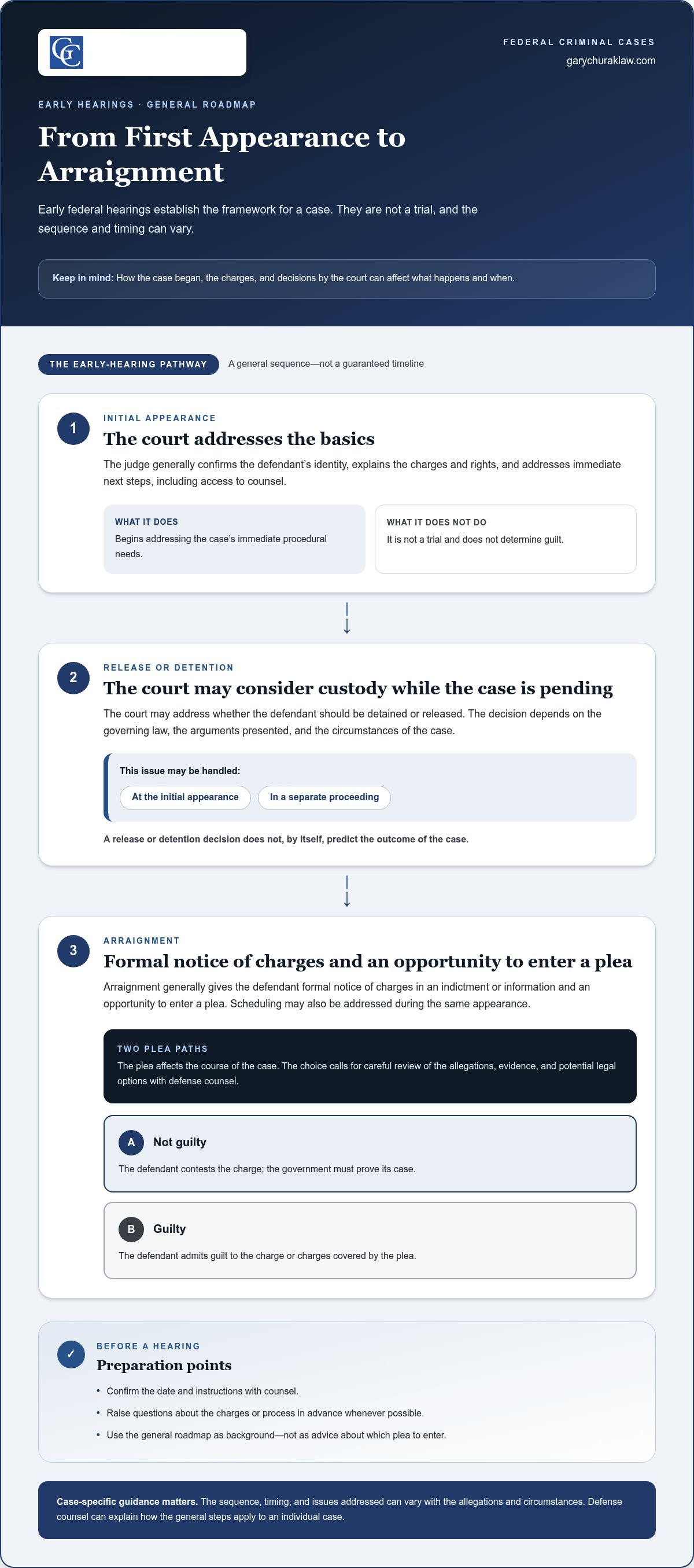
Early federal hearings establish the basic framework for a case, but they do not follow one guaranteed timeline. The sequence can depend on how the case began, the charges, and decisions by the court. The U.S. Department of Justice outlines the general Steps in the Federal Criminal Process. A case-specific review helps explain how those general steps apply to an individual defendant.
What happens at a federal initial appearance?
At an initial appearance, the judge generally confirms the defendant’s identity, explains the charges and rights, and addresses immediate next steps, including access to counsel. This is not a trial and does not determine guilt. Defense counsel can raise immediate concerns and clarify what the court is addressing, what remains unresolved, and what proceedings may follow.
The court may also consider whether the defendant should be detained or released while the case is pending. That decision depends on the governing law, the arguments presented, and the circumstances of the case. Release conditions or detention may be addressed at the initial appearance or in a separate proceeding. The appearance itself does not predict the outcome.
What are arraignment and a plea in federal court?
Arraignment generally gives the defendant formal notice of the charges in an indictment or information and an opportunity to enter a plea. A not-guilty plea means the defendant contests the charge and requires the government to prove its case. A guilty plea means admitting guilt to the charge or charges covered by that plea. Depending on the case, the court may address arraignment and scheduling during the same appearance.
A plea is consequential. It can affect the course of the case and the rights a defendant gives up, so the decision should follow careful review of the allegations, evidence, and potential legal options with defense counsel. Don’t treat a general description of what to expect in federal court as guidance about which plea to enter. The right advice depends on the specific case.
Before a hearing, confirm the date and instructions with counsel, and raise questions about the charges or process in advance whenever possible. The Law Offices of Gary Churak provides federal criminal defense and can discuss your circumstances. Learn more about federal criminal defense.
Discovery, Motions, and Plea Discussions: How the Case Develops Before Trial
After the early hearings, the case may move into a pretrial period focused on understanding the evidence and resolving legal questions. Discovery generally involves disclosure or exchange of information under applicable rules. Materials may include documents, recordings, or other evidence relevant to the allegations. What is disclosed, when it is provided, and how the case proceeds depend on the rules, court practices, and circumstances. The U.S. Courts’ overview of federal criminal cases provides context on how these cases enter the court system, but it does not predict the course of a specific prosecution.
How do discovery and pretrial motions shape a federal case?
Reviewing evidence involves more than reading what the government provides. Defense counsel can examine how the evidence relates to the charges, identify unanswered questions, and determine whether further investigation or legal analysis is warranted. For example, a discrepancy between two records may prompt closer review of how the evidence was collected or what it proves. Its significance depends on the full case record.
A pretrial motion asks the judge to decide a particular legal or procedural question. A motion might challenge how an issue is handled before trial or ask the court to assess whether certain evidence may be used. Filing a motion does not guarantee that the judge will agree, exclude evidence, or dismiss a charge. The court considers the relevant law and arguments, and some cases may involve few or no contested motions.
What should you understand about federal plea discussions?
Plea discussions may take place as the parties assess the evidence and possible paths forward, but they are not required in every case. If the government proposes plea terms, defense counsel can review which conduct and charges the proposal covers, explain potential consequences, and discuss how the terms compare with the risks and options of continuing to litigate. The defendant makes consequential decisions with case-specific legal advice; a general process guide cannot determine which option is right.
These parts of the process can overlap. Evidence review may inform a motion or discussions about resolving charges, while the outcome of a motion may affect later decisions. Timing, disclosures, and choices vary by case and court. For a broader look at the strategic demands of a federal defense, read Defending Against Federal Charges: Navigating Complexity.
Understanding the allegations, evidence, and procedural posture is essential before weighing options. The Law Offices of Gary Churak provides case analysis and federal criminal defense representation. You can learn more about federal criminal defense.
Federal Trial and Sentencing: What to Expect if the Case Moves Forward
A federal case may end before trial, including through a plea agreement or dismissal of charges. If it proceeds, the trial tests the government’s evidence under court rules and rulings. Understanding what to expect in federal court at this stage can make the process less unfamiliar, but it cannot predict a verdict or sentence.
What happens during a federal criminal trial?
A jury trial generally begins with jury selection. Once the jury is chosen, the prosecution and defense may give opening statements describing what they expect the evidence to show. The prosecution presents evidence and witnesses first. The defense may challenge that evidence and present its own case. The judge rules on legal and procedural questions, while the jury evaluates the evidence.
Evidence and testimony must be presented under applicable rules and the judge’s rulings. After closing arguments, the judge instructs jurors on the law they must apply. The jury then deliberates and returns a verdict. The prosecution must prove each element of the charged offense beyond a reasonable doubt. A trial’s length and details vary with the charges, evidence, and issues in dispute.
What happens after a federal conviction?
If a defendant is convicted at trial or enters a guilty plea, sentencing is a separate stage. The court considers legally relevant information about the offense and the defendant, along with arguments from the parties and the law that applies. Preparation may include gathering and reviewing information for the court’s consideration, and counsel can identify issues to address at sentencing.
The sentence depends on the statute, facts, arguments, and applicable rules. The Federal Sentencing Guidelines are advisory, while a statutory mandatory minimum, when applicable, can constrain the available sentence. The judge considers the relevant factors and circumstances of the individual case. No general guide can calculate or guarantee a particular outcome.
An appeal is distinct from sentencing. A defendant may have grounds to challenge a conviction or sentence, but an appeal is not automatic and follows its own procedures. Counsel can assess whether an appeal is available and explain the relevant issues and deadlines.
Trial and sentencing require close attention to the evidence, legal issues, and record. The Law Offices of Gary Churak provides federal criminal defense and courtroom representation. For case-specific guidance about a federal criminal charge or possible trial, learn about federal criminal defense.
How to Prepare for Federal Court and Make Informed Next-Step Decisions
Preparation starts with knowing what the particular hearing is meant to address. The steps that help before an initial appearance may differ from what matters before a motion hearing or trial. For a clearer sense of what to expect in federal court, use this sequence as a starting point, then follow instructions from your lawyer and the court.
- Confirm the logistics. Review the hearing date, time, location, and any instructions provided by counsel or the court. Raise questions promptly if something is unclear.
- Organize relevant materials. Gather court notices, paperwork you’ve received, and any documents counsel has asked you to bring. Keep them together for a private discussion.
- Prepare questions. Write down what you want to understand about the hearing, the charges, or the next steps. Share those questions with defense counsel rather than trying to resolve case issues in public.
- Follow courtroom instructions. Arrive as directed, listen carefully, and act respectfully. Don’t disregard a court instruction or discuss case facts publicly, including on social media.
What should you do before a federal court hearing?
Use counsel as your point of contact for questions about the case and what to expect at the hearing. Avoid contacting witnesses or discussing case details with others without legal advice. Even a conversation meant to clear something up can create complications, so ask your lawyer how to handle communications connected to the case. These steps do not replace advice tailored to your circumstances.
How can federal criminal defense counsel help you prepare?
Defense counsel can review the allegations, available evidence, procedural posture, and potential legal issues, then explain which matters are relevant to the upcoming hearing. Preparation may include discussing likely topics, reviewing documents, and clarifying what decisions may or may not be made that day. It should fit the charge and stage of the case, rather than follow a one-size-fits-all checklist.
Clear communication helps you make informed choices. Bring forward questions and relevant information privately, and ask counsel to explain unfamiliar terms or the possible significance of a hearing. For more on the broader role of defense counsel, see How a Criminal Defense Attorney Protects Your Future and Your Freedom.
A general guide can help you prepare, but a case-specific review connects the process to your allegations, evidence, and available options. The Law Offices of Gary Churak provides federal criminal defense, case analysis, and courtroom representation. If you’re facing federal charges or preparing for a hearing, discuss your federal criminal defense.
Take the Next Step With a Clearer Plan
Understanding what to expect in federal court can make an unfamiliar process feel more manageable. Early hearings address important questions and next steps, while evidence review, motions, or plea discussions may shape how a case develops. If a case goes to trial, the jury evaluates the evidence under the court’s instructions. Sentencing is a separate stage shaped by the law and the facts.
These are broad guideposts, not a prediction. The charges, evidence, and procedural posture of your case matter, and decisions about pleas, hearings, or trial deserve careful, case-specific legal guidance. The Law Offices of Gary Churak provides federal criminal defense, case analysis, and courtroom representation. Attorney Gary Churak brings more than four decades of experience.
If you’re facing federal charges, a focused review can help clarify the issues and choices ahead. Request a consultation about your federal criminal case to discuss informed next steps.
Frequently Asked Questions
What happens at the first hearing in federal court?
The first hearing generally addresses your identity, the charges, your rights, and immediate procedural matters. The court may also consider detention or release, depending on the circumstances and applicable law. This hearing does not decide whether you’re guilty. What happens can vary, so counsel who understands your charges and hearing can explain what to expect in federal court in your situation.
How long does a federal criminal case take?
There’s no single timeline for a federal criminal case. The pace can depend on the charges, the volume and complexity of evidence, motions, court scheduling, and plea discussions. Some cases resolve before trial, while others involve multiple hearings and a trial. A generic estimate is not a prediction. Defense counsel can review the case’s current posture and explain the likely next steps.
Is federal court different from state court?
Yes. Federal cases involve federal jurisdiction and federal procedural rules, while state cases generally proceed under state law and procedure. Both systems may include hearings and the presentation of evidence, but the governing rules and course of a case can differ. The alleged conduct alone does not establish which court will handle it. Jurisdiction depends on the charges and the legal basis for bringing the case.
Can a federal criminal case end without a trial?
Yes. A federal case may end through a plea agreement, dismissal, or another procedural outcome, but no resolution is guaranteed. Whether a particular path is available or advisable depends on the charges, evidence, legal issues, and the defendant’s circumstances. Plea discussions do not necessarily mean the parties have reached a final agreement or the court has resolved the case. Defense counsel can explain potential options and consequences.
What should I bring to federal court?
Follow the court’s and your lawyer’s instructions about appearance details and any documents to bring. Keep relevant paperwork, such as court notices and documents counsel has requested, organized. Prepare questions to discuss privately with your lawyer. Don’t assume every courthouse has the same procedures, and don’t bring prohibited items. If an instruction is unclear, ask your lawyer for guidance before the hearing rather than relying on a general checklist.
Do I need a lawyer for federal court?
A defense lawyer can help you understand the charges, review available evidence, explain legal options, and represent you in court. Federal criminal proceedings involve rules and decisions that can carry serious consequences, and the right approach depends on the specific case. If you’re unsure what a hearing or court document means, raise it with counsel. This article provides general information, not legal advice about an individual matter.
What happens if I plead not guilty in federal court?
A not-guilty plea generally means the case continues rather than ending at arraignment. Pretrial steps may include evidence review, motions, plea discussions, and further scheduling. The case may later go to trial or resolve through another process. Entering this plea does not predict the final result. Defense counsel can explain its implications and what may happen next based on the charges, evidence, and procedural posture in your case.


