

Refusing a breathalyzer is not a "get out of jail free" card. It is a calculated, high-stakes trade-off between administrative penalties and criminal evidence. You're likely feeling a surge of anxiety while standing on the shoulder of a dark highway, weighing the consequences of refusing a breathalyzer against the fear of immediate jail time. It's completely normal to feel paralyzed by the choice, especially when you're unsure if the officer is asking for a voluntary roadside screening or a mandatory station-house test.
This strategic guide provides the clarity you need to understand the immediate and long-term legal trade-offs of declining a breath test to protect your future. You'll gain a firm grasp of license suspension durations and learn how a refusal alters the trajectory of a criminal trial. We'll also outline the specific steps a battle-tested guide like Gary Churak uses to mitigate damage and restore your stability. By the end of this analysis, you'll move from a state of uncertainty toward a clear, actionable path forward with a professional advocate by your side.
Key Takeaways
- Recognize that a driver's license acts as a binding contract where you've already agreed to chemical testing under implied consent regulations.
- Navigate the immediate consequences of refusing a breathalyzer, including the automatic administrative license revocation process that often results in longer suspensions than a failed test.
- Prepare for how prosecutors use a refusal as evidence of guilt in criminal trials and understand the mechanics of "no-refusal" blood warrants.
- Act quickly to meet strict administrative deadlines, frequently within 15 days, to contest your license suspension and preserve your driving privileges.
- Learn how a strategic defense examines the legality of the initial traffic stop to identify flaws in the officer's reasonable suspicion.
Understanding Implied Consent and Your Right to Refuse
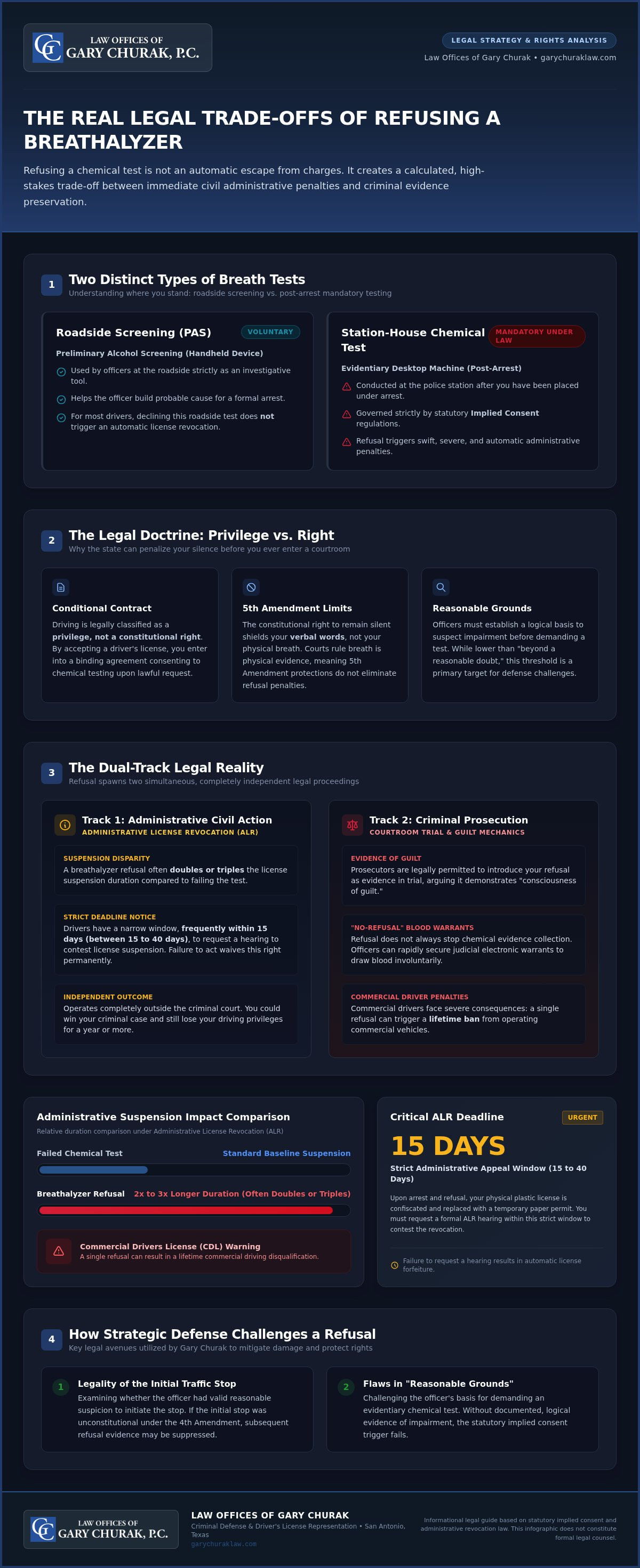
You possess the physical ability to say no to a breath test, but that choice triggers a complex legal mechanism designed to penalize your silence. Most drivers don't realize they signed away certain rights long before the police lights appeared in their rearview mirror. When you applied for your driver's license, you entered into a conditional contract with the state. Implied consent is a legal doctrine where driving is a privilege, not a right, conditioned on testing compliance. While you can physically decline the officer's request, the law attaches civil costs to that choice to discourage non-compliance.
This system creates a tension between your constitutional protections and your administrative obligations. The 4th Amendment shields you from unreasonable searches and seizures, yet implied consent laws effectively bypass the need for a warrant in many immediate scenarios. If you choose to withhold a breath sample, you aren't necessarily "breaking a law" in the traditional criminal sense at that moment, but you are violating the terms of your driving contract. This distinction allows the state to move against your license before you ever step foot in a courtroom.
Roadside PAS vs. Evidentiary Breath Tests
Confusion often arises during a traffic stop because there are two distinct types of breath tests. The first is the Preliminary Alcohol Screening (PAS), which is a portable, handheld device used at the roadside. For most drivers, this test is voluntary and functions as a tool for the officer to build probable cause for an arrest. You can often decline this without triggering an automatic license suspension. The stakes change entirely once you're placed under arrest and taken to the station. The large, desktop machine at the police station provides the evidentiary test. This is the mandatory procedure where the consequences of refusing a breathalyzer become most damaging, leading to swift administrative penalties that operate independently of your criminal case.
The Legal Theory of the Privilege to Drive
State governments view the issuance of a driver's license as a conditional agreement rather than an inherent right. Under this theory, you've already given your consent to be tested in exchange for the use of public roads. For an officer to trigger this requirement, they must meet the "Reasonable Grounds" standard. This means they must have a logical basis to suspect you're operating a vehicle while impaired. It's a lower threshold than the "beyond a reasonable doubt" standard used in court, but it's a critical point where a strategic defense can find flaws. You should also understand that the constitutional right to remain silent typically applies to your words, not your physical breath. Courts generally rule that breath is physical evidence, meaning you don't have a 5th Amendment right to refuse the test without facing the consequences of refusing a breathalyzer.
The Administrative Toll: License Suspension and Permits
The moment you decline a breath test, a civil enforcement mechanism known as Administrative License Revocation (ALR) triggers automatically. This process occurs entirely outside the criminal courtroom. You could win your criminal case and still lose your driving privileges for a year or more. One of the most severe consequences of refusing a breathalyzer is the disparity in suspension lengths. While a failed test might result in a shorter suspension, a refusal often doubles or triples that duration. Commercial drivers face even harsher realities. A single refusal can lead to a lifetime ban from operating a commercial vehicle, effectively terminating a career before a judge ever hears the evidence.
The state utilizes federal drunk driving enforcement standards to justify these swift administrative actions. You aren't necessarily being punished for a crime at this stage. Instead, you're being penalized for a breach of the contract you made when you accepted your license. This administrative battle requires a separate hearing where the burden of proof is much lower than in criminal court. Securing a personalized consultation provides the steady hand needed to navigate these twin legal tracks.
Automatic Revocation Timelines
You typically have a narrow window, often between 15 and 40 days, to request an administrative hearing to contest the revocation. If you fail to act within this timeframe, your right to a hearing is waived, and the suspension becomes final. At the time of your arrest and refusal, the officer usually seizes your plastic license and issues a piece of paper that serves as a temporary permit. This document is your only legal way to drive while you wait for your hearing date. Beyond the loss of mobility, a refusal on your record signals high risk to providers, leading to insurance premium hikes that can last for years.
Occupational and Restricted Licenses
Losing your license doesn't always mean you're grounded entirely, but regaining mobility comes with strict conditions. Many jurisdictions allow for a "hardship" or occupational license, which permits travel to essential locations like work, school, or medical appointments. These are not guaranteed. Courts often require the installation of an Ignition Interlock Device (IID) as a prerequisite, even if you haven't been convicted of a crime. This device requires a clean breath sample before the engine starts, adding a layer of daily scrutiny and expense to your life. While you navigate these administrative hurdles, it's equally important to understand how a lawyer helps with bail to ensure you remain free to manage your defense during the pre-trial phase.
Criminal Case Impact: Evidence, Warrants, and Penalties
Declining a breath test removes numerical data from the prosecution’s toolkit, but it doesn't leave them empty-handed. In fact, many drivers mistakenly believe that without a blood alcohol concentration (BAC) reading, the state cannot secure a conviction. This is a dangerous assumption. Prosecutors frequently pivot their strategy to focus on your physical behavior and the legal concept of "consciousness of guilt." They argue that a sober individual would have no reason to decline a test, suggesting your refusal is an admission that you knew you were over the limit.
The police will rely on sensory evidence to build their case. This includes testimony regarding the smell of alcohol, slurred speech, bloodshot eyes, and your performance on field sobriety tests. While you avoid the definitive "0.08" label, you face the consequences of refusing a breathalyzer through potentially harsher sentencing if convicted. Judges often view uncooperativeness unfavorably, which can lead to more stringent probation terms or higher fines compared to those who complied with the request. You're trading a scientific data point for a narrative battle where the officer's word carries significant weight.
The Forced Blood Draw and Search Warrants
Law enforcement agencies increasingly utilize "No-Refusal" initiatives to bypass your decline. Under the 4th Amendment, police must generally obtain a warrant to draw your blood against your will. In 2026, technology has streamlined this process through "tele-warrants," allowing officers to secure a judge's electronic signature in minutes while you're still in custody. This development is supported by National Highway Traffic Safety Administration drunk driving enforcement guidelines, which emphasize the use of warrants to ensure chemical evidence is preserved. In extreme cases, physical resistance to a valid blood warrant can even lead to additional obstruction of justice charges.
Consciousness of Guilt in the Courtroom
The most significant hurdle in a refusal trial is often the jury instruction. In many jurisdictions, the judge will explicitly tell the jury they can infer guilt from your refusal to provide a sample. This is where a seasoned criminal defense attorney becomes your shield. An advocate can counter the "consciousness of guilt" narrative by explaining alternative reasons for a refusal, such as a lack of trust in the machine's accuracy or simple confusion during a high-stress arrest. The absence of a breath test result is never a guaranteed acquittal; it's a strategic shift that requires an aggressive, evidence-based defense to protect your future.
Navigating the Post-Refusal Legal Landscape
Securing your release from custody is only the first step in a multi-front legal battle. Upon your discharge, you must immediately locate and safeguard the "Notice of Suspension" paperwork provided by the arresting officer. This document isn't merely a receipt of arrest; it serves as your temporary driving permit and contains the official record of your refusal. Understanding the immediate consequences of refusing a breathalyzer involves more than just fearing a courtroom; it requires managing a strict administrative timeline that begins the moment you're released.
Your next priority involves a meticulous review of the police report to identify "Probable Cause" errors. An officer can't legally stop your vehicle or request a breath sample based on a whim. If the initial traffic stop lacks a valid legal foundation, the subsequent request for a breath test may be invalidated. Engaging a seasoned dwi defense attorney ensures that both the administrative hearing and the criminal trial are handled with a unified, strategic approach. You shouldn't attempt to manage these parallel tracks alone when your mobility and reputation are at risk.
Deadlines You Cannot Miss
The administrative appeal window is unforgiving. In most jurisdictions, you have a strict 15-day deadline to request a hearing to contest your license revocation. Failing to submit this request in writing results in the automatic and total loss of your driving privileges, regardless of the eventual outcome of your criminal case. You must also distinguish this deadline from your arraignment date. The arraignment is your first formal appearance in criminal court to hear the charges against you, while the DMV hearing focuses solely on your license. Both require prompt, professional attention.
Reviewing the Evidence for Technical Errors
A refusal case often hinges on technicalities that a battle-tested guide can exploit. We scrutinize the "Statutory Warning" provided at the time of the request. Officers must accurately explain the specific penalties for declining a test; any deviation or coercion can render the refusal legally void. We also look for signs of "Involuntary Refusal." If a medical condition, injury, or extreme confusion prevented you from understanding the officer's request, the state's argument for a "willful" refusal weakens. To begin building your defense against the consequences of refusing a breathalyzer, reach out for a free initial consultation to discuss your specific situation.
Strategic Defense: How a Lawyer Challenges a Refusal Case
The Law Offices of Gary Churak utilizes a "Thorough Case Analysis" to dissect the prosecution’s narrative from every angle. While the consequences of refusing a breathalyzer include immediate administrative hurdles, the absence of a chemical test result often creates a unique strategic advantage in your criminal trial. Convicting a driver without a blood alcohol concentration (BAC) number requires the state to rely heavily on subjective observations and the officer’s personal memory. With over 40 years of legal experience, Gary Churak identifies the specific flaws in an officer’s "Reasonable Suspicion" that less seasoned attorneys might overlook. If the initial stop was legally unsound, every piece of evidence gathered afterward, including the refusal itself, can be suppressed and rendered useless in court.
A refusal case is often more winnable than one involving a high BAC reading, but it demands a higher level of trial skill and tactical precision. We frequently utilize expert witnesses to provide alternative, science-based explanations for a client’s behavior. Medical conditions like inner ear imbalances, neurological disorders, or even specific dietary states can mimic the physical signs of intoxication. By presenting a scientific counter-narrative, we shift the focus from "consciousness of guilt" to a logical, non-criminal explanation for your conduct during the high-stress environment of a traffic stop.
Challenging the Officer's Credibility
The officer’s testimony is the cornerstone of the state’s case, making their credibility the primary target for a strategic defense. We scrutinize body-cam and dash-cam footage to see if the recorded reality matches the written report. If an officer describes "slurred speech" or "unsteadiness" that isn't visible or audible on the video, their entire narrative begins to crumble under cross-examination. We also analyze the exact language used during the "Implied Consent" warning. If they failed to read the warnings verbatim or added coercive threats, the refusal cannot be used against you in a criminal proceeding. To ensure you're ready for this level of scrutiny, you should focus on preparing for a criminal defense consultation by gathering every document provided during your arrest.
The Future Impact: Expungement Possibilities
Your defense isn't just about the current trial; it's about protecting your long-term career and your reputation. Many clients worry that navigating the consequences of refusing a breathalyzer will haunt their background checks forever. Depending on the final disposition of your case, you may eventually be eligible to have the records sealed or expunged. While the criteria vary by jurisdiction, understanding how to get a record expunged and secure a clean slate provides a general framework for how the law allows for a fresh start. A seasoned protector doesn't just fight the immediate charge. They look ahead to ensure a single night on the road doesn't define your professional future.
Secure Your Future Against the Impact of a Refusal
Navigating the complex consequences of refusing a breathalyzer requires more than just a basic understanding of the law; it demands a strategic, battle-tested approach. You've learned that while a refusal triggers immediate administrative challenges and license suspension risks, it also shifts the battleground of your criminal trial toward subjective officer testimony rather than scientific data. This shift creates critical opportunities for a defense that scrutinizes every technical detail, from the legality of the initial stop to the accuracy of the officer’s report.
Time is your most valuable asset right now. With narrow windows to contest license revocations and preserve your mobility, you need a steady hand to guide you through the process. The Law Offices of Gary Churak brings over 4 decades of aggressive criminal defense experience to your side, offering a personalized strategy for every DWI refusal case. We focus on results and resilience, acting as a fierce protector for your rights and your reputation. Protect your future with a free consultation from the Law Offices of Gary Churak. You don't have to face this uncertainty alone; professional advocacy is within your reach.
Frequently Asked Questions
Is it better to refuse or fail a breathalyzer test?
Choosing between refusing or failing involves weighing a longer license suspension against the creation of scientific evidence for the prosecution. Refusal removes the "0.08" number from the criminal case but triggers harsher administrative penalties. A failed test provides a data point that is difficult to challenge in court but often results in a shorter suspension. Each path carries risks that require a battle-tested guide to navigate effectively based on your specific situation.
Can I still be charged with a DWI if I refuse the breathalyzer?
You can absolutely face a DWI charge even without breathalyzer results. Officers rely on their observations of your physical state, including slurred speech, the smell of alcohol, and your performance on field sobriety tests. These subjective factors form the basis of the state's case when chemical evidence is absent. The consequences of refusing a breathalyzer don't include immunity from prosecution; they simply shift the state’s focus to sensory evidence and officer testimony.
How long will my license be suspended for a first-time refusal?
For a first-time refusal, your license is typically suspended for 180 days to one year depending on your specific jurisdiction. This administrative penalty is separate from any criminal court outcome and usually lasts much longer than the suspension for a failed test. Missing the strict deadline to contest this revocation means the loss of your driving privileges becomes automatic. Immediate action is required to request a hearing and protect your ability to remain on the road.
Can the police force me to take a blood test if I refuse the breath test?
Police can force a blood draw if they secure a search warrant from a judge. In many modern jurisdictions, "no-refusal" initiatives allow officers to obtain electronic warrants in minutes. Once a warrant is signed, you no longer have the legal right to decline the test. Resisting a court-ordered blood draw can lead to additional criminal charges, such as obstruction of justice, compounding the existing legal challenges you already face.
Will refusing a breathalyzer make me look guilty in court?
Prosecutors often use a refusal to argue that you had a "consciousness of guilt," implying you declined the test because you knew you were impaired. This narrative is a common tactic in the courtroom to influence a jury. However, an aggressive advocate can present alternative explanations, such as a lack of trust in the machine's accuracy or medical conditions. A refusal doesn't guarantee a conviction; it creates a narrative battle that requires strategic defense.
What is an ALR hearing and why do I need one?
An Administrative License Revocation (ALR) hearing is a civil proceeding where you challenge the state's attempt to suspend your license. This is your primary opportunity to cross-examine the arresting officer and identify flaws in their reasonable suspicion for the initial stop. You must request this hearing within a very short window, often 15 days, or you waive your right to fight the suspension. It is a critical step in mitigating the consequences of refusing a breathalyzer.
Can I get a restricted license to drive to work after a refusal?
You can often obtain a restricted or occupational license that allows you to drive to essential locations like work, school, or the grocery store. This process usually involves a court petition and the mandatory installation of an ignition interlock device (IID) in your vehicle. While this allows for necessary mobility, it comes with strict compliance rules and additional costs. A seasoned attorney helps you navigate these requirements to ensure you maintain your employment and daily responsibilities.
Do I have the right to call a lawyer before deciding to take the test?
In most jurisdictions, you don't have the right to consult an attorney before deciding whether to submit to a chemical test. Implied consent laws typically require an immediate decision once the officer makes the request at the station. If you insist on calling a lawyer before blowing into the machine, the officer will likely record your delay as a formal refusal. Understanding this procedural rule is vital to making an informed choice during a high-stress stop.


