

If you’re wondering what happens at an arraignment, expect the judge to address the charges, explain your rights, ask for a plea, and consider release conditions. It’s a consequential hearing, but it isn’t a trial: the court doesn’t decide guilt or innocence that day. The hearing is usually about making sure you understand the accusation and establishing what happens next.
It’s understandable to worry that one wrong answer could hurt your case, or that you’ll leave court facing jail or unaffordable bail. Knowing what to expect and having legal counsel can help you protect your rights, understand your options, and present relevant circumstances to the court.
This guide explains the typical arraignment sequence, questions the judge may ask, and what guilty, not-guilty, and no-contest pleas mean. You’ll also learn how bail and other release conditions may be addressed, what to do before your appearance, and why early defense strategy matters. Attorney Gary Churak brings more than four decades of criminal defense experience, thorough case analysis, and steady advocacy to this high-stakes first step.
Key Takeaways
- Understand what happens at an arraignment, from the court’s opening steps to the formal reading of charges.
- Learn why your plea can shape what happens next and why it’s important not to rush your decision before reviewing your options.
- See how judges may weigh release options and conditions, and what information can help your attorney advocate for release.
- Prepare for court with practical guidance on courtroom conduct and communicating with your attorney.
- Learn how early legal representation can help protect your rights and establish a considered strategy for the case.
The Purpose of an Arraignment in the Criminal Justice System
An arraignment moves a criminal case into its formal court process. The judge or court clerk identifies the charge, confirms the defendant is the person named in the case, and addresses the next procedural steps. The hearing also gives the defendant an opportunity to understand the accusation before responding. That notice matters: the Sixth Amendment protects the right to be informed of the nature and cause of the accusation.
So, what happens at an arraignment is more than a first meeting with a judge. The proceeding creates a record of the charges and helps the court confirm it is addressing the right person and case. An arraignment does not, by itself, prove the allegations or determine guilt. For a general overview of the term and how procedures may differ, see Arraignment.
Arraignment vs. Initial Appearance: What Is the Difference?
The first court appearance may happen soon after an arrest, especially when a person is in custody. An initial appearance commonly addresses immediate matters such as the person’s rights, access to counsel, and release or detention. An arraignment focuses on formally notifying the defendant of the charges and taking a plea. Courts and state rules differ, and some combine these steps into one hearing. The order and timing depend on the jurisdiction and case.
An arraignment is also different from a preliminary hearing. A preliminary hearing generally considers whether the prosecution has shown enough evidence for the case to proceed, rather than deciding guilt. An arraignment is not an evidence-testing hearing. It establishes the procedural starting point for responding to the charge.
The Legal Objectives of the Hearing
At the hearing, the court may read the complaint or indictment into the record, or confirm that the defendant has received and understands the charging document. The court may also confirm the defendant’s identity and contact information so notices and future proceedings can be handled properly. If a detail is incorrect or a charge is unclear, counsel can raise the issue through the appropriate process.
The court must also address representation. A defendant may appear with retained counsel or, if eligible, ask the court to appoint an attorney. Having counsel present helps protect the defendant’s rights while the charges and immediate procedural decisions are addressed. The court’s authority does not come simply from reading charges aloud. Rather, the hearing confirms the case is moving forward in the proper court and gives the defendant formal notice and an opportunity to respond.
A Step-by-Step Breakdown of the Arraignment Hearing
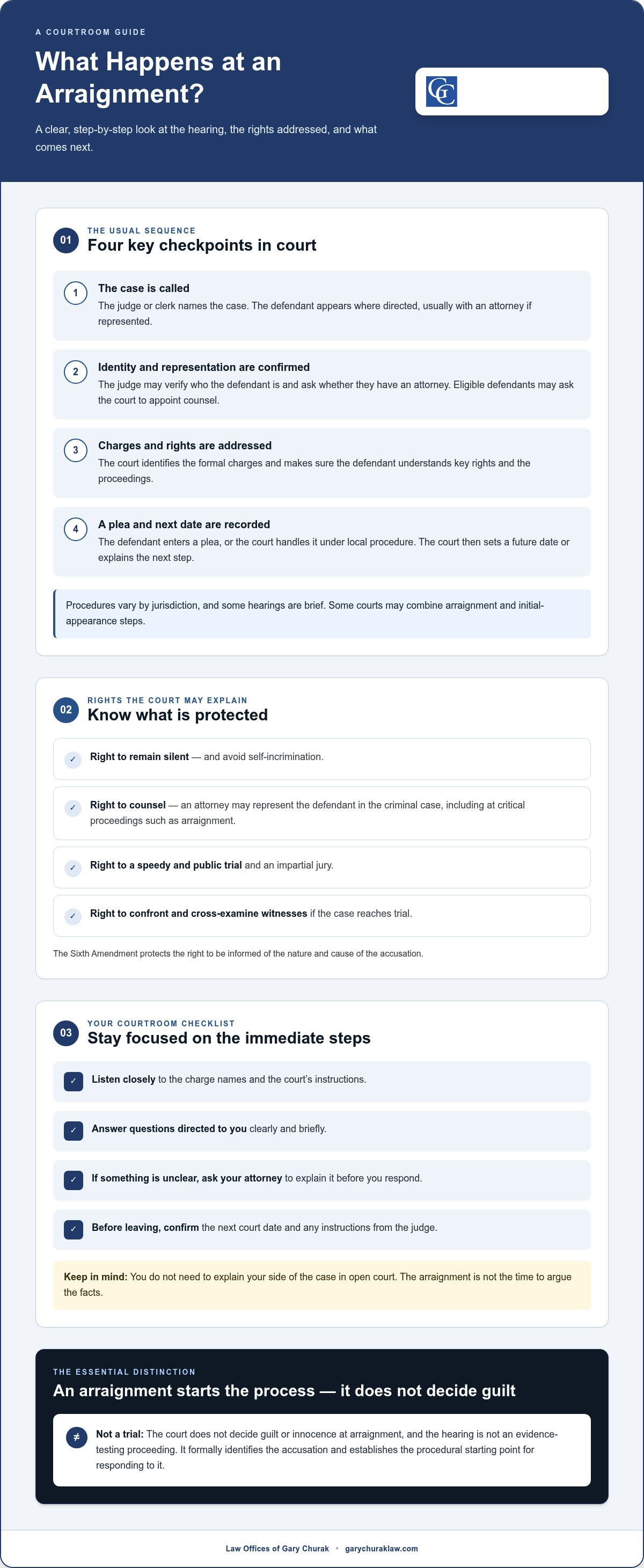
The courtroom process can feel unfamiliar, but it generally follows a clear sequence. The judge calls the case, confirms who is present, addresses the charges and rights, then turns to the plea and the next court date. Procedures vary by jurisdiction, and some hearings are brief. For a general overview, see what happens at an arraignment; court procedures may differ elsewhere.
A Typical Sequence in Court
- The case is called. The judge or clerk names the case. The defendant approaches the bench or appears where directed, usually with their attorney if represented.
- The court confirms identity and representation. The judge may verify the defendant’s identity and ask whether they have an attorney.
- The charges and rights are addressed. The judge or clerk identifies the formal charges, and the court ensures the defendant understands key rights and the proceedings.
- A plea and next date are recorded. The defendant enters a plea, or the court handles it under local procedure, then sets a future court date or explains the next step.
Listen closely, but don’t feel that you need to explain your side of the case in open court. Answer questions directed to you clearly and briefly. If you don’t understand a charge or instruction, ask your attorney to clarify it before you respond.
Reading of the Formal Charges
An arrest report describes an officer’s account of the arrest; it isn’t necessarily the formal charging document. Prosecutors may file charges that differ from the initial arrest allegations, subject to applicable procedures. At arraignment, the court identifies the complaint or indictment and the specific offenses alleged. Pay attention to the charge names and cited statutes. Your attorney can explain what the language means and flag discrepancies for follow-up.
Establishing Your Constitutional Rights
The judge may explain rights that apply as the case proceeds. These can include the right to remain silent and avoid self-incrimination, as well as the rights to a speedy and public trial, an impartial jury, and to confront and cross-examine witnesses if the case reaches trial. You don’t have to argue the facts at arraignment; the hearing is not a trial.
The Sixth Amendment right to counsel means you may have an attorney represent you in the criminal case, including at critical court proceedings such as arraignment. If you don’t have counsel, tell the court; eligible defendants may request appointed representation. Counsel can help you understand the charges, protect your rights, and address procedural concerns before you respond to the court.
Once the plea is entered, make sure you know the next date, any instructions from the judge, and how to comply with them. Gary Churak’s criminal defense practice represents people facing criminal charges and can help you prepare for the hearing and respond strategically.
Understanding Your Plea Options: Not Guilty, Guilty, or No Contest
Your plea is a formal response to the charge, not a moment to guess or make a rushed decision. At arraignment, a not-guilty plea is commonly entered while the defense reviews the case. It doesn’t claim that the charge is false; it keeps the case open so your attorney can examine the evidence and advise you about how to proceed.
Why “Not Guilty” Is the Strategic Standard
A not-guilty plea generally preserves the opportunity to request and review discovery, assess the prosecution’s evidence, and investigate the circumstances of the arrest. That review may reveal issues that deserve further investigation or legal challenge. An attorney can conduct a thorough case analysis before recommending whether to pursue motions, negotiate, or prepare for trial.
The plea also avoids resolving the case before those choices have been evaluated. Depending on the facts and applicable law, the defense may later challenge evidence, seek dismissal, or negotiate a resolution. A not-guilty plea does not guarantee a particular outcome, but it leaves room to assess these options. For many defendants, that time to review the case is important.
The Risks of Pleading Guilty or No Contest Early
A guilty plea is an admission to the charge. If the court accepts it, the case may move to sentencing immediately or at a later hearing, depending on the court and circumstances. A conviction can create a criminal record and other consequences. A guilty plea also generally gives up the right to trial and may waive many issues that could otherwise be raised before trial, including challenges to evidence. Appeal rights after a plea can be limited, though the rules and exceptions vary.
A no-contest plea, also called nolo contendere, means you aren’t contesting the charge and accept the court’s authority to impose a judgment or sentence. It is not always treated the same as a guilty plea in later civil proceedings; whether it can be used in a related civil case depends on jurisdiction and circumstances. Don’t assume it prevents civil consequences. Discuss both criminal and potential civil implications with counsel before entering this plea.
What If You Stand Silent?
If you refuse to enter a plea, the court may enter a not-guilty plea on your behalf under local procedure. That does not resolve the case or replace legal advice. If you’re unsure what to say, tell the judge you need to speak with your attorney rather than guessing or discussing the facts of the accusation. Because plea procedures and consequences vary, make this decision only after you understand the charge and your options.
Bail, Pre-Trial Release, and Court-Ordered Conditions
Release decisions can determine whether you return home while your case is pending or remain in custody. At an arraignment or a related hearing, the judge may release you on your own recognizance, set financial bail, impose conditions, or order detention where permitted by law. Procedures differ by jurisdiction, but courts commonly assess whether proposed terms address court appearances and community safety.
How Judges Determine Bail and Release
A judge may consider the seriousness of the alleged offense, the person’s prior record, history of appearing in court, and ties to the community. These factors help the court evaluate potential risks; an accusation alone is not proof of guilt. In some jurisdictions, a separate “dangerousness” hearing may determine whether detention is permitted under local law.
An attorney can present relevant information, challenge unsupported assumptions, and argue for release without financial bail or for a lower amount. That may include explaining community ties, a record of court appearances, or how proposed conditions could address the court’s concerns. Read more about how a lawyer can help with bail.
- Personal recognizance (PR): Release based on a promise to return to court, without paying a cash amount upfront.
- Cash bail: Release may depend on posting money as directed by the court.
- Surety bond: A bond company or another surety may guarantee payment under the court’s terms.
The available options and consequences vary. Bail isn’t always set at arraignment, and some courts use non-financial release conditions instead of, or alongside, money.
Managing Release Conditions
Release may come with rules such as travel limits, drug testing, check-ins, or restrictions on contact with specific people. Read and follow every condition carefully. A suspected violation can lead to a court hearing and may result in stricter terms, revocation of release, or detention, depending on the circumstances and applicable law.
If a condition creates a practical problem, don’t ignore it or change your routine without guidance. Your attorney can ask the court to modify the terms and explain why an adjustment is appropriate. A request isn’t automatically granted, so continue following existing conditions unless the court changes them.
Missing a court date can lead to a warrant and may affect release status or any bond, depending on the jurisdiction. If an emergency threatens your ability to appear, tell your attorney promptly so they can advise you on the proper steps. Preparing for an arraignment also means understanding these immediate release decisions. For more information about bail and release concerns, see the criminal defense services of the Law Offices of Gary Churak.
How to Prepare for Your Arraignment with Your Attorney
Preparation gives you a clearer plan for a high-pressure court date. Before the hearing, review the charge and your questions with your attorney, confirm where and when to appear, and learn what the judge may ask. Understanding the general process can reduce uncertainty, but your lawyer’s guidance should shape how you respond to the specific allegations and court procedures.
Courtroom Etiquette and Professionalism
Choose clean, modest clothing that shows respect for the court. Arrive with enough time to pass through courthouse security and find the courtroom. Silence your phone, follow instructions from court staff, and stand or sit when directed. Keep your demeanor calm, even if the allegations are upsetting. Speak when the judge addresses you, answer clearly, and direct legal questions or concerns to your attorney. Avoid discussing your case with other people in the courtroom.
Bring your court notice, identification, relevant paperwork your attorney has requested, and a short list of questions. Documents about your contact information or circumstances relevant to release may also help your lawyer prepare. Don’t bring weapons, contraband, or items prohibited by courthouse rules. Policies for phones and other personal belongings vary, so review the court’s instructions before you leave.
The Role of Private Defense Counsel at Arraignment
Early representation can help you understand the accusation and make informed decisions before the case advances. Counsel can review the charging document for possible errors or legal issues, explain what the allegations mean, and speak on your behalf when appropriate. If release is being considered, your attorney can present relevant information and argue for reasonable terms. A steady advocate can also help you understand each step instead of feeling pressured to guess.
After the hearing, use a follow-up meeting to review what happened, confirm the next court date and any conditions, and plan what information your attorney needs to assess the case. A criminal defense consultation can help turn the court’s instructions into a practical next-step plan.
Attorney Gary Churak brings over four decades of criminal defense experience and thorough case analysis to the early stages of a case. Choose counsel who can explain your options, protect your rights, and prepare a considered strategy from the start.
Take Your First Court Date with a Clear Strategy
An arraignment is a pivotal first step, not a trial. Knowing what happens at an arraignment helps you understand the charges, protect your rights, and avoid making a rushed plea before your attorney has reviewed the case. Release decisions and court-ordered conditions also deserve careful attention because they can shape your day-to-day life while the case moves forward.
Preparation matters. Work with counsel to understand the process, respond appropriately in court, and plan the next steps. Attorney Gary Churak brings over four decades of criminal defense experience and advocates for clients facing criminal charges, including state and federal offenses. Experienced counsel can help you approach the hearing with greater confidence and make sure your concerns are heard.
Contact the Law Offices of Gary Churak for a consultation about protecting your rights from the first hearing. You don’t have to face the process without guidance. With a clear plan and experienced counsel, you can take the next step with greater confidence.
Frequently Asked Questions
Do I have to say anything at my arraignment?
You may need to answer the judge’s questions about your identity and enter or confirm a plea, but you generally don’t need to explain the facts of the case. If you’re unsure what to say, pause and ask to speak with your attorney. Your answers should be brief and truthful. Don’t discuss the allegations in open court without legal guidance.
What happens if I cannot afford a lawyer for my arraignment?
Tell the judge you can’t afford an attorney and ask whether you qualify for appointed counsel. The court generally considers eligibility before appointing a lawyer, and the rules vary by jurisdiction. If you’re in custody or your hearing is approaching, raise the issue promptly. An attorney can help you understand the charges and protect your rights, so don’t assume you must enter a plea without first addressing representation.
Can the charges be dropped at the arraignment?
Charges can sometimes be dismissed, but an arraignment usually isn’t where the court evaluates the evidence in depth. The hearing primarily addresses the formal charges, the plea, and immediate procedural matters. A prosecutor may dismiss a charge, or the defense may later challenge legal or evidentiary issues through the proper process. Whether dismissal is possible depends on the facts and applicable law, and it isn’t guaranteed at the first hearing.
How long does an arraignment hearing typically last?
There’s no single length for every arraignment. A straightforward hearing may take only a short time once the case is called, while questions about counsel, charges, release, an interpreter, or other procedural issues can extend it. Court calendars also affect how long you’ll wait before your case is heard. Plan to be available for the court’s instructions and any next steps rather than scheduling a tight appointment immediately afterward.
Will I go to jail immediately after my arraignment?
Not automatically. The judge may release you, set bail, impose conditions, or order detention, depending on the case and local law. If you’re already in custody, you may remain there if the court doesn’t order release or you can’t meet the release terms. Having an attorney present can help ensure the judge hears relevant information about release. Follow every condition the court imposes and confirm what applies before leaving.
What happens if I miss my scheduled arraignment date?
Missing court can lead to a warrant, changes to your release status, or other consequences under local law. If you realize you can’t attend, contact your attorney immediately and follow their guidance about notifying the court. If you’ve already missed the date, don’t ignore the problem or assume it will resolve on its own. Acting promptly may help address the missed appearance through the appropriate court process.
Can I change my plea later in the case?
In some cases, a defendant can ask the court to change a plea, but the judge’s approval and applicable rules matter. A plea change may have serious consequences, especially if you’re asking to withdraw a guilty or no-contest plea after the court has accepted it. Discuss the reason for any change with your attorney as early as possible. Don’t assume a plea can be changed automatically or without court permission.
Is an arraignment the same thing as a trial?
No. An arraignment is an early court proceeding where the defendant is informed of the charges, addresses representation and a plea, and may have release or scheduling matters considered. A trial is a later proceeding in which the prosecution presents evidence and the defense can challenge it. At arraignment, the judge generally doesn’t decide guilt or innocence. The hearing starts the court process, but it doesn’t resolve the case by itself.


