

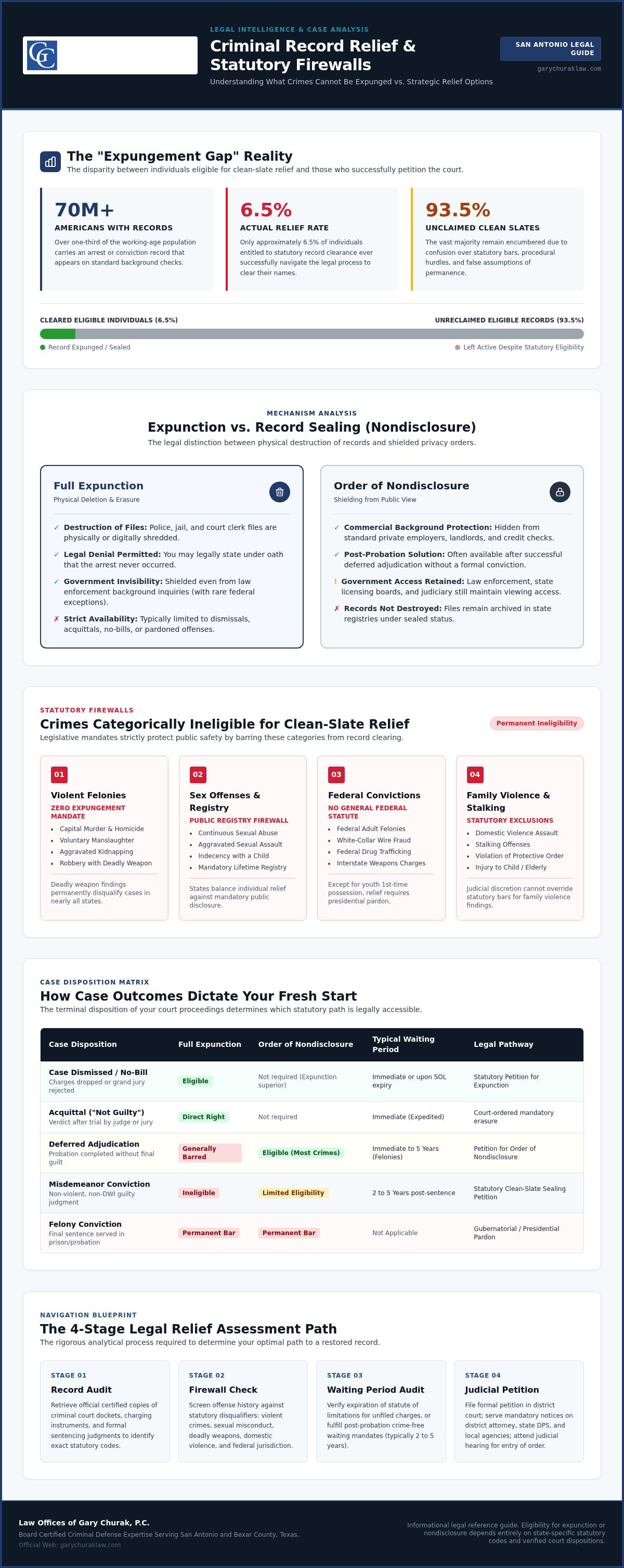
Did you know that while over 70 million Americans carry a criminal record, only about 6.5% of those eligible for relief ever successfully clear their names? This "expungement gap" often stems from confusion over what crimes cannot be expunged, leaving many to assume their past is a permanent life sentence. You've likely felt the weight of background checks or the quiet sting of social stigma, and you deserve to know where you actually stand.
In this 2026 guide, we'll help you identify the specific offenses that remain on a permanent record and explore the strategic legal alternatives available to protect your livelihood. While certain crimes are ineligible for traditional relief, a "no" from the state isn't always the final word for a determined advocate. We understand the high stakes of your situation and provide the grounded, steady hand needed to seek a resolution.
We'll provide a clear list of ineligible offenses, clarify the confusing distinctions between sealing and expungement, and outline the specific criteria you must meet to regain your reputation. This roadmap offers the professional clarity you need to move forward with confidence and strength, ensuring you aren't held back by a record that could be addressed through precise legal strategy.
Key Takeaways
- Identify the specific statutory "firewalls" that determine what crimes cannot be expunged, including violent felonies and offenses requiring sex offender registration.
- Distinguish between the physical destruction of records and record sealing to choose the most effective strategy for your specific situation.
- Understand how case outcomes—such as dismissals versus convictions—dramatically shift the legal hurdles you must overcome to clear your name.
- Explore the 2026 landscape of "Clean Slate" laws and waiting periods that dictate when you can petition for a fresh start.
- Learn why a professional case analysis is vital to uncovering eligibility windows that DIY filings and standard background checks often miss.
Understanding the Limits of a Fresh Start
Expungement serves as a powerful legal mechanism designed to physically destroy or "erase" a criminal record from public view. It offers a vital path forward for those who've moved beyond their past mistakes. However, you must recognize that record clearing is a statutory privilege granted by the state, not a constitutional right. This means the legislature has the authority to decide exactly what crimes cannot be expunged based on perceived risks to the community. States maintain these records to balance individual rehabilitation with public safety, ensuring that certain historical data remains accessible for background checks in high-stakes environments.
When legislators draft these laws, they prioritize the "right to know" for employers in sensitive sectors like childcare, finance, or healthcare. This creates a legal firewall around specific offenses. The state views a criminal record not just as a historical document, but as a tool for risk management. Because of this, the criteria for eligibility are often rigid and unforgiving. You aren't just fighting a piece of paper; you're navigating a complex set of rules designed to protect the collective interest.
The outcome of your case dictates your eligibility more than any other factor. A "dismissed" case generally places you in a strong position for immediate relief. Conversely, a "conviction" creates a much higher barrier, often triggering mandatory waiting periods or absolute bars to relief. While a dismissal suggests the state couldn't or didn't prove its case, a conviction remains a formal judgment of guilt that the law is less eager to overlook. We've seen how this distinction can change the entire trajectory of a client's future.
The 'Permanent Record' Myth vs. Reality
The fear that every arrest remains a permanent stain is often exaggerated. Most jurisdictions utilize a "waiting period" that requires you to remain crime-free for a set number of years before applying. This period varies by the severity of the charge and the specific state laws involved. The "favorable termination" rule states that you're generally eligible for expungement only if your case ended in an acquittal, dismissal, or a similar outcome that didn't result in a conviction. Understanding this rule is the first step in dismantling the myth of permanence.
Why Some Records Are Shielded from Public View
Courts must weigh your personal privacy against the public's right to know about potential risks. This balance is complex and often shifts as new legislation is passed. Even after a record is successfully cleared, it isn't always gone for good. Law enforcement agencies and judicial officers often maintain access to these files to prevent recidivism and inform future sentencing. The legal framework for expungement in the United States varies wildly by state, but the underlying goal remains the same: protecting the community while allowing individuals to reclaim their lives through aggressive advocacy.
Serious Offenses That Typically Bar Expungement Eligibility
While legislative reforms have opened doors for many, the legal system remains rigid regarding specific categories of offenses. Understanding what crimes cannot be expunged requires looking at how states prioritize public safety over individual rehabilitation. Generally, violent felonies such as murder, voluntary manslaughter, and aggravated assault are permanently barred from record clearing in nearly every jurisdiction. These offenses are viewed as too severe to be removed from public view, as the state maintains a vested interest in tracking individuals with a history of significant violence.
Federal convictions present an even steeper hurdle. Unlike state laws, there's no general federal statute allowing for the expungement of adult felony convictions. The primary exception remains the Federal First Offender Act, which only applies to specific first-time drug possession charges for individuals under age 21 at the time of the offense. For everyone else, a federal conviction is a life-long record unless you receive a rare presidential pardon.
Violent Crimes and Public Safety Mandates
Aggravated assault and kidnapping are almost universally excluded from record clearing. These crimes often involve a "deadly weapon" finding, which acts as a permanent disqualifier in the eyes of the court. A conviction involving violence doesn't just impact your background check; it often results in the permanent loss of firearm rights and disqualification from professional licensing in fields like medicine or education. National Institute of Justice research on criminal record barriers highlights how these permanent markers create systemic obstacles that last decades. If you're facing these barriers, exploring expungements and record sealing alternatives with a professional is the only way to ensure you aren't missing a narrow window of eligibility.
Sex Offenses and Registry Requirements
Sex offenses, especially those involving minors, are the most strictly guarded records in the country. Because these convictions often trigger mandatory registration under the Sex Offender Registration and Notification Act (SORNA), they're legally ineligible for expungement. The law views these as "crimes of moral turpitude," a classification that suggests a fundamental lack of honesty or social responsibility. As long as an individual is required to remain on a public registry, the underlying criminal record must remain accessible to law enforcement and the general public. This ensures that the state's duty to inform the community outweighs the individual's desire for a clean slate.
Conviction vs. Dismissal: How Case Outcomes Dictate Your Future
The outcome of a criminal case serves as the primary gatekeeper for record relief. A guilty verdict creates a formidable barrier, often moving the charge into the category of what crimes cannot be expunged depending on the severity of the offense. While a misdemeanor conviction might require a five-year crime-free waiting period, a felony conviction often carries a decade-long wait or an absolute bar to relief. Understanding what crimes cannot be expunged requires a deep dive into the specific language of the court's final judgment.
Having multiple convictions on a single record compounds these difficulties. Many states apply "prior conviction" rules that disqualify a petitioner if they've been adjudicated guilty of more than one offense in their lifetime. The way a case is originally disposed of in court, whether it ends in a dismissal, a plea, or a verdict, dictates the legal path available years down the line. We emphasize that the original disposition is the foundation of your future eligibility.
The Power of a Dismissal or Acquittal
Records involving an arrest without a subsequent charge or a case that resulted in an acquittal are the most straightforward to clear. If a grand jury issues a "no bill," it signifies that there was insufficient evidence to proceed, which typically allows for immediate expungement of the arrest record. A strategic criminal defense attorney understands this long-term goal. They work to secure a dismissal or acquittal during the trial process specifically to ensure the client remains eligible for record clearing later. These "arrest-only" records shouldn't haunt you, yet they often appear on commercial background checks until formally addressed.
When Probation and Deferred Adjudication Complicate Things
Many individuals mistakenly believe that completing probation automatically wipes their record clean. This is a dangerous assumption. In many jurisdictions, "deferred adjudication" allows a defendant to plead guilty while the court withholds a formal finding of guilt during a probationary period. While this avoids a final conviction, it doesn't result in an automatic expungement. As noted in the NCSL guide to criminal record clearing, the terminology used by the court determines your next steps. For those who complete deferred adjudication, the remedy is often an order of nondisclosure rather than a full expunction. This seals the record from the general public but leaves it visible to law enforcement and specific state agencies.
Alternatives to Expungement: Sealing and Nondisclosure Orders
When you discover that your specific offense falls under the category of what crimes cannot be expunged, it's easy to feel defeated. The legal system often provides a strategic "Plan B" through record sealing or nondisclosure orders. While expungement physically destroys the record, sealing simply hides it from the general public. This distinction is critical. It allows many individuals who are ineligible for a full expunction to still reclaim their privacy and move forward with their lives.
A sealed record remains visible to law enforcement, judicial officers, and certain state-licensing agencies. Despite this, it's effectively invisible to private landlords and the vast majority of commercial background check companies used by employers. This creates a protective barrier between your past and your future opportunities. For those who successfully completed community supervision, a nondisclosure order serves as a powerful shield that prevents the general public from viewing the details of a past mistake.
What Does it Mean to 'Seal' a Record?
Sealing a record significantly impacts your daily life by removing the obstacle of private background checks. In many jurisdictions, once a record is sealed, you possess the legal right to deny the existence of the arrest or conviction on job and housing applications. Certain misdemeanors that are technically ineligible for full destruction often qualify for this level of protection. It's a pragmatic solution for those who've demonstrated rehabilitation but are barred from a total expunction. This process ensures that your history doesn't dictate your future housing or employment options.
The Path of Executive Clemency and Pardons
When all judicial paths are closed and you're facing a charge that resides on the list of what crimes cannot be expunged, executive clemency remains the final option. This involves a direct appeal to the state Governor or, for federal offenses, the President. A pardon acts as an official act of forgiveness. While it may not always erase the physical record, it frequently restores civil rights, such as the right to vote or hold public office. You should be aware that in 2026, pardons remain exceptionally rare and difficult to obtain. They often require years of demonstrated rehabilitation and a compelling case for mercy. If you're navigating these complex waters, you need an expert to review your options. Contact our office for professional help with expungements and record sealing to determine your best path forward.
Navigating the Legal Path to Clearing Your Name
Identifying what crimes cannot be expunged is only the beginning of your journey. The real work starts with a deep dive into the specifics of your case history. A thorough analysis by an expungement lawyer serves as your first line of defense against a permanent record. We don't just look at the charge; we examine the original court transcripts and final judgments to find eligibility windows that others miss. This methodical approach ensures we aren't just guessing about your future.
You should avoid the temptation of a DIY expungement. One mistake in your filing can lead to a dismissal with prejudice, effectively barring you from seeking relief for a significant period. The legal system in 2026 is increasingly automated, but it's also less forgiving of procedural errors. We provide the aggressive advocacy required to stand before a judge and argue for your right to a fresh start. This isn't just about paperwork; it's about having a battle-tested guide who knows when to push and when to negotiate.
Why Experience Matters in Record Clearing
Digital record-keeping has made it harder than ever to truly erase a past mistake. Private data aggregators pull information from across the web, meaning a cleared court record is only one part of the solution. A seasoned attorney prepares for a criminal defense consultation by reviewing these digital footprints alongside your official files. We advocate for a clean slate because we believe in fundamental fairness. You shouldn't be defined by a single moment for the rest of your life, especially when legal avenues for relief exist.
Next Steps: Taking Control of Your Future
You can start the process today by gathering "Certified Copies" of your final judgment from the county clerk. These documents are the primary evidence needed to support your petition. Once we identify the specific agencies that must be notified, we move quickly to ensure every database reflects the clearing of your record. Contact the Law Offices of Gary Churak for a strategic evaluation. We'll help you determine if your record falls under the list of what crimes cannot be expunged or if a path to freedom remains open through aggressive, personalized advocacy.
Reclaiming Your Reputation and Future
Identifying exactly what crimes cannot be expunged represents the first step toward reclaiming your privacy. While violent felonies and specific federal offenses may remain on a permanent record, the legal system often provides alternative paths like record sealing or nondisclosure. We've seen how a strategic review of a case's original disposition can uncover eligibility windows that a standard background check might overlook. Your situation deserves a thorough, professional analysis to ensure no opportunity for relief is missed.
You don't have to navigate these high-stakes decisions alone. With over 40 years of legal experience, the Law Offices of Gary Churak provide the aggressive advocacy and personalized, one-on-one strategy you need to challenge a record's status. Whether you're dealing with a dismissed charge or a completed probation, we offer a grounded hand to lead you through the process. Schedule your free consultation with Gary Churak today to see if your record can be cleared. Your past shouldn't dictate your future when a battle-tested guide can help you find a path forward.
Clear Answers for Your Record Clearing Questions
Can a felony ever be expunged?
Yes, but it depends on the nature of the felony and your state's specific statutes. Non-violent felonies and cases that resulted in an acquittal or dismissal are the strongest candidates for relief. However, violent felonies like murder or aggravated sexual assault often fall under the category of what crimes cannot be expunged. Each jurisdiction sets its own rigid limits. You'll need a precise case review to determine if your specific conviction qualifies for a fresh start.
What is the difference between expungement and record sealing?
Expungement typically results in the physical destruction of the criminal record from government databases. It's as if the arrest never happened. Record sealing, or nondisclosure, simply hides the record from the general public, including private landlords and employers. While sealing offers significant privacy, law enforcement and judicial agencies can still access the information. Choosing the right path depends on your eligibility and your long-term professional goals for your future.
How long do I have to wait before I can apply for expungement?
Waiting periods vary significantly based on the severity of the offense and the final court disposition. Dismissed charges often allow for immediate petitioning in many jurisdictions. Misdemeanor convictions usually require a waiting period of one to five years of remaining crime-free. Felonies often demand five to ten years. These timelines are strictly enforced. Filing too early can lead to a summary denial of your petition, wasting valuable time and resources.
Will an expunged record show up on a background check for a job?
A properly expunged record shouldn't appear on standard commercial background checks used by private employers. Once the court order is signed, it's sent to various agencies to ensure the data is scrubbed. However, private data aggregators can sometimes lag behind official court updates. We work to ensure all relevant parties are notified. This prevents old data from resurfacing during a high-stakes job interview or a housing application that requires a clean history.
Can a DWI or DUI be removed from my record?
Eligibility for clearing a DWI or DUI depends heavily on your jurisdiction's specific laws. In many states, a first-time conviction can be sealed but not fully expunged. If the charges were dismissed or you were acquitted, you're usually eligible for full relief. Understanding what crimes cannot be expunged in your area is vital. Some states treat impaired driving as a permanent public safety marker that the law refuses to hide from the public.
Do I need a lawyer to get my record expunged?
While you aren't legally required to hire an attorney, the process is fraught with procedural traps. A single error in your petition can result in a denial that bars you from reapplying for years. We bring over 40 years of experience to ensure your filing is technically perfect. We identify the specific eligibility windows and handle the aggressive advocacy needed during court hearings. This protects your time and ensures your case receives the scrutiny it deserves.
What happens if my petition for expungement is denied?
If a judge denies your petition, you may have the right to appeal the decision or reapply after a specific period. A denial often happens due to procedural mistakes or a misunderstanding of statutory eligibility. We analyze the court's reasoning to determine if a different legal strategy, such as record sealing, is a viable alternative. A "no" from the court isn't always the end of the road if you have a seasoned, battle-tested guide.
Does expungement restore my right to own a firearm?
Expungement can sometimes restore firearm rights, but this isn't universal across all jurisdictions. Federal law and state statutes often conflict on this issue. Even if a state clears your record, federal agencies may still view a past felony as a disqualifier. You must obtain a specific legal opinion regarding your rights before attempting to purchase a weapon. We provide the thorough analysis needed to navigate these complex and high-stakes regulations with total confidence.


