

When the government initiates a case against you, your only shield is a strategic federal drug trafficking defense that challenges every piece of evidence they've gathered. You're likely feeling the overwhelming weight of the DEA's resources and the looming threat of mandatory minimum sentences that can strip away decades of your life. It's a position of extreme vulnerability. You deserve a protector who understands that the government's power isn't absolute, even when it feels like the odds are stacked entirely against you.
A successful defense is about more than just showing up in court; it's about dismantling the government's narrative through meticulous scrutiny of their procedures. We'll show you how to navigate the complexities of the federal justice system with a plan designed to protect your freedom and challenge the prosecution's foundation. This article outlines the path toward avoiding mandatory minimums, suppressing illegally obtained evidence, and managing strategic plea negotiations when a trial isn't the viable option. By understanding the mechanics of federal sentencing and agency overreach, you can begin to regain control over your future.
Key Takeaways
- Learn the critical differences between state and federal jurisdiction under 21 U.S.C. § 841 to understand the specific legal landscape you're facing.
- Discover how a robust federal drug trafficking defense utilizes the "lack of knowledge" strategy to challenge the government's ability to prove intent beyond a reasonable doubt.
- Identify how a Motion to Suppress can dismantle the prosecution's case by exposing procedural errors or invalid search warrants that violate your 4th Amendment rights.
- Gain clarity on the Federal Sentencing Guidelines and learn strategic methods used to navigate around harsh mandatory minimum prison sentences.
- Understand why aggressive, battle-tested advocacy is essential when confronting the vast investigative resources and unlimited power of federal agencies.
Understanding Federal Drug Trafficking Allegations
Federal drug trafficking is primarily governed by 21 U.S.C. § 841. This statute makes it illegal to manufacture, distribute, or possess with intent to distribute a controlled substance. Unlike local drug charges, federal allegations often involve massive investigations led by the DEA, FBI, or Homeland Security Investigations (HSI). These agencies don't just stumble into cases. They build them over months or years, utilizing vast resources to target distribution networks. While simple possession might be handled in state court, federal prosecutors step in when they see "intent to distribute." This intent is usually inferred from large quantities of drugs, high purity levels, or the presence of distribution tools like digital scales, packaging materials, and bulk cash.
The Scope of Federal Jurisdiction
Jurisdiction often hinges on the interstate nature of the alleged crime. If the government suspects drugs crossed state lines or were moved via the U.S. Postal Service, the case immediately enters the federal arena. The Controlled Substances Act provides the legal framework for these prosecutions, categorizing drugs into "schedules" based on their potential for abuse and medical utility. The federal government chooses to prosecute cases that involve significant quantities or international connections because these convictions carry heavy mandatory minimums. It's a strategic decision by the Department of Justice to leverage harsher federal sentencing guidelines against defendants. You're not just fighting a charge; you're fighting a system designed for maximum impact.
Common Drugs Involved in Federal Indictments
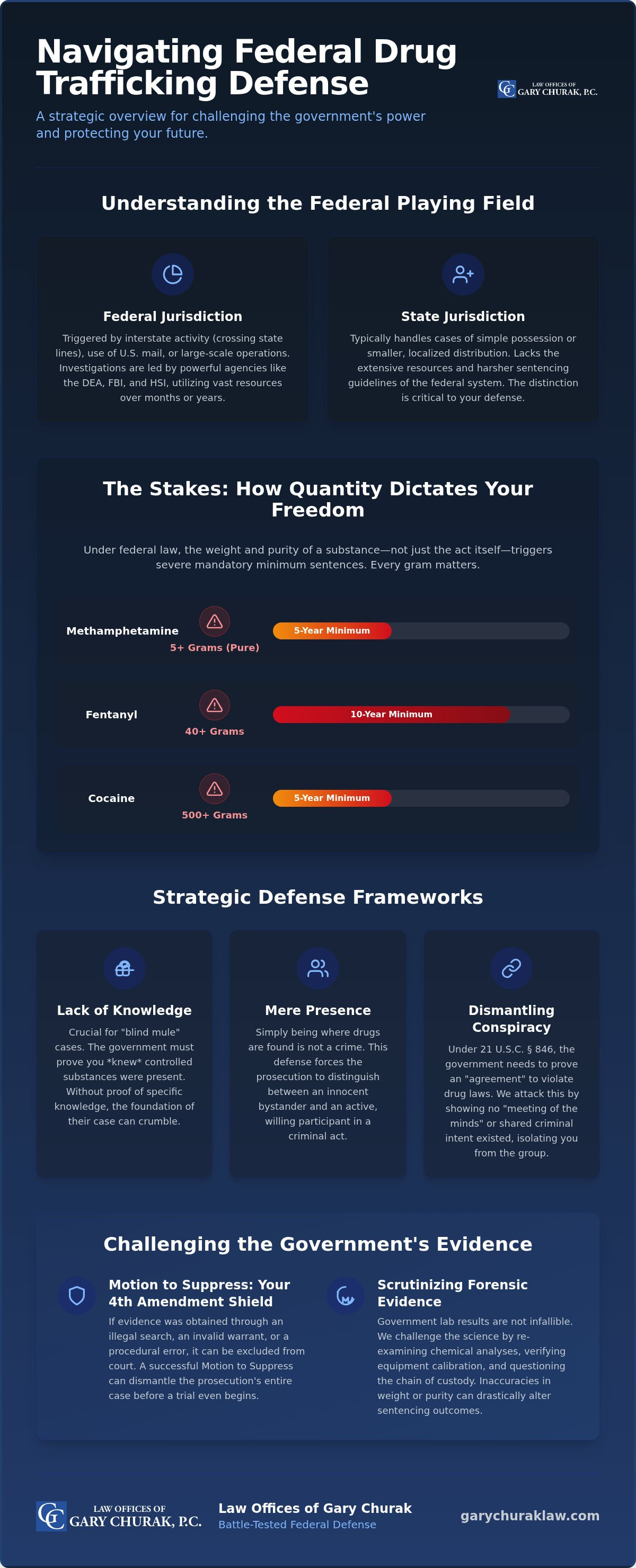
Federal indictments frequently center on high-priority substances like fentanyl, methamphetamine, and cocaine. The stakes are incredibly high because the weight of the substance directly dictates the potential prison sentence. For example, just five grams of pure methamphetamine can trigger a five-year mandatory minimum sentence. Purity matters too. Federal labs test substances to determine if they are "mixtures" or "actual" drugs, which can significantly alter the offense level. A robust federal drug trafficking defense must scrutinize these laboratory results for any inaccuracies. Understanding how schedule classifications affect your case is the first step in building a shield against the government's aggressive tactics. Every gram counts when your freedom is on the line. You need a defense that understands the science as well as the law.
Strategic Defense Frameworks for Federal Drug Cases
Federal prosecutors carry a heavy burden. They must prove every element of a charge beyond a reasonable doubt, which is the highest standard in our legal system. A robust federal drug trafficking defense begins by identifying the cracks in the government's narrative. One of the most effective strategies is the "lack of knowledge" defense. This is particularly relevant in cases involving "blind mules" or individuals who were unaware that a package or vehicle contained controlled substances. If the government cannot prove you had specific knowledge of the drugs, their case loses its primary foundation. We also frequently employ the "mere presence" defense. Simply being in a location where drugs are found or where a transaction occurs does not constitute a crime. We force the jury to see the distinction between being a bystander and being a participant.
Challenging the government's technical evidence is equally vital. The weight and purity of the seized substances dictate the severity of the charges under various Federal Drug Statutes. We utilize independent expert witnesses to re-examine chemical analyses and verify the accuracy of the government's lab results. If the DEA's laboratory skipped protocols or if the scales used were improperly calibrated, we can challenge the very basis of the sentencing guidelines. Scientific accuracy is not a suggestion; it is a requirement that we hold the government to in every case.
Dismantling Federal Drug Conspiracy Charges
Under 21 U.S.C. § 846, the government can convict you for conspiracy even if they never seized a single gram of drugs from your person. They only need to prove an "agreement" existed to violate drug laws. This is the backbone of most federal trafficking cases, yet it is often the most vulnerable to attack. We dismantle these allegations by showing there was no "meeting of the minds" or shared criminal intent. By isolating your actions from the "overt acts" of co-conspirators, we can prove you weren't a member of the alleged enterprise.
Entrapment and Government Misconduct
Federal investigations often rely on confidential informants (CIs) who are trading information for their own leniency. This creates a massive incentive for them to embellish or even manufacture evidence. If a CI or undercover agent induced you to commit a crime you weren't otherwise predisposed to commit, we can mount an entrapment defense. We also look for "outrageous government conduct" where federal agencies overstep their legal bounds. When the government's own tactics violate your rights, it can lead to a complete dismissal of the indictment. If you are caught in the crosshairs of such a complex investigation, consulting a criminal defense attorney is the most critical step you can take to protect your future.
Challenging Evidence: 4th Amendment and Procedure
The 4th Amendment serves as your primary shield against the overwhelming reach of the federal government. It prohibits unreasonable searches and seizures, ensuring that agents cannot simply invade your privacy without a valid legal basis. A centerpiece of any effective federal drug trafficking defense is the Motion to Suppress. This strategic legal filing asks the court to throw out evidence that was obtained through constitutional violations. If we can prove the government broke the rules, the judge may exclude the drugs, cash, or statements from the case entirely. When the prosecution's core evidence is suppressed, their narrative often collapses before it ever reaches a jury.
We start by scrutinizing the "four corners" of any search warrant used in your case. Federal agents must demonstrate probable cause to a neutral magistrate to obtain a warrant. If the affidavit relied on stale information, anonymous tips without corroboration, or deliberate falsehoods, the warrant is invalid. We also aggressively challenge warrantless searches. While exceptions like "plain view" or "exigent circumstances" exist, agents frequently overstep these narrow boundaries. On the highway, vehicle stops and K-9 sniffs are common tactics. However, if an officer prolongs a traffic stop without independent reasonable suspicion just to wait for a drug dog, it's a violation of your rights that can lead to a dismissal.
Wiretap and Electronic Surveillance Challenges
Federal investigations often rely on Title III wiretaps, which are subject to strict "necessity" requirements. Agents must prove that traditional investigative methods, such as physical surveillance or standard search warrants, have already failed or are too dangerous to attempt. If the government took a shortcut and failed to exhaust these options, the wiretap evidence should be suppressed. We also analyze whether agents followed "minimization" rules, which require them to stop recording when conversations are clearly personal and non-incriminating. Evidence obtained through an unconstitutional wiretap is legally classified as fruit of the poisonous tree, meaning that any subsequent evidence derived from that initial illegal act is also inadmissible in court.
Chain of Custody and Lab Errors
The integrity of the physical evidence is a frequent point of failure for the prosecution. We track the movement of seized substances from the crime scene to the evidence locker to ensure there are no gaps in the chain of custody. Any period of time where the drugs are unaccounted for creates a window for tampering, contamination, or loss. Furthermore, DEA laboratories aren't infallible. We investigate equipment calibration records and the specific testing protocols used by government chemists. If the lab technicians used flawed science or failed to maintain their equipment, their "expert" testimony becomes unreliable. We hold the government to a standard of absolute precision because your freedom depends on it.
Sentencing Mitigation and Mandatory Minimums
The Federal Sentencing Guidelines operate as a complex mathematical grid that determines the trajectory of your life. We calculate your "offense level" based on the drug quantity involved and specific enhancements, such as the use of a weapon or a leadership role. However, the most daunting aspect of a federal drug trafficking defense is the statutory mandatory minimum. These are fixed prison terms of 5, 10, or 20 years that a judge cannot ignore unless specific legal triggers are met. Your Pre-Sentence Investigation (PSI) report becomes the roadmap for your final outcome. This document, prepared by a probation officer, details your entire history and the "relevant conduct" of the offense. Relevant conduct is particularly dangerous because it allows the court to sentence you for drug quantities or actions that weren't even part of your formal conviction. It's a system designed to maximize incarceration, requiring a strategic response to find any available leniency.
The Safety Valve Provision (18 U.S.C. § 3553(f))
The "Safety Valve" is the most powerful tool for first-time or low-level offenders to bypass harsh statutory minimums. It allows a judge to sentence you based on the guidelines rather than the mandatory floor. To qualify, you must meet five specific criteria: you don't have more than four criminal history points; the offense didn't involve violence or a credible threat of violence; the offense didn't result in death or serious bodily injury; you weren't an organizer or leader; and you provided a truthful proffer to the government. Having a limited criminal history is vital, as even minor prior convictions can disqualify you from this protection. A truthful proffer requires you to honestly disclose everything you know about your own role, which can protect you from decades of imprisonment.
Substantial Assistance and 5K1.1 Motions
If you don't qualify for the Safety Valve, a 5K1.1 motion is often the only remaining path to avoid a decade behind bars. This process involves providing "substantial assistance" to the government's investigation of other individuals. It's a high-stakes decision that carries significant rewards but also inherent risks. We negotiate the terms of these cooperation agreements with extreme care to ensure your safety and maximize the resulting downward departure. A successful motion allows the judge to ignore the mandatory minimum and reward your level of help with a significantly reduced sentence. If you're facing these life-altering decisions, you need the guidance of a seasoned federal crimes defense attorney to navigate the negotiation process safely.
Why Choose Gary Churak for Federal Defense
Facing the federal government requires more than just a legal representative; it demands a fierce protector with the wisdom to outmaneuver seasoned prosecutors. Gary Churak brings over four decades of legal experience to every case he handles. This depth of knowledge is essential because the federal system is unforgiving. When you're up against the unlimited resources of the DEA and the Department of Justice, aggressive advocacy is the only way to level the playing field. A successful federal drug trafficking defense relies on a lawyer who doesn't just react to the government's moves but anticipates them. Gary’s thorough case analysis identifies procedural flaws and constitutional violations that less experienced attorneys might overlook. You won't be passed off to a junior associate. You'll work directly with a seasoned federal crimes defense attorney who understands the gravity of your situation.
A Battle-Tested Approach to Federal Court
The firm’s philosophy is built on preparedness and resilience. We believe that every piece of evidence must be scrutinized and every government witness must be challenged. Having an attorney who understands the nuances of drug crimes defense is critical when navigating the Federal Sentencing Guidelines. We don't wait for an indictment to start working. Early intervention during the investigative stage is often the most critical window for success. By engaging a criminal defense attorney before charges are even filed, we can sometimes influence the direction of the investigation or prevent an indictment entirely. Our goal is to provide a grounded, steady hand while fighting for the best possible outcome in a high-stakes environment.
Schedule Your Confidential Federal Case Review
Your constitutional rights are too important to leave to chance. If you're under investigation or have already been charged, you must take immediate action to secure your future. We offer free initial consultations for federal matters, providing you with a clear understanding of the challenges ahead and the strategies available to you. Don't let the government's power intimidate you into silence. This is the moment to prioritize your freedom and build a strategic shield against the prosecution's case. Secure your defense with the Law Offices of Gary Churak today. We're ready to stand between you and the government's reach, offering the unwavering advocacy you need.
Secure Your Future Against Federal Prosecution
Federal drug charges carry the weight of the entire U.S. government, but they aren't insurmountable. Success requires a proactive approach that prioritizes the suppression of evidence and the dismantling of conspiracy allegations. By leveraging procedural protections and navigating the nuances of sentencing mitigation, you can effectively challenge the prosecution's narrative and protect your liberty. You deserve a defense that is as relentless as the agencies investigating you.
The Law Offices of Gary Churak provides the aggressive federal advocacy needed to confront these high-stakes charges. With over 40 years of legal experience, Gary Churak utilizes thorough case analysis to identify the weaknesses in the government's evidence that others might miss. You don't have to face this overwhelming system alone. A strategic federal drug trafficking defense starts with a single step toward regaining control. Take that step today to ensure your rights are protected by a battle-tested expert who understands exactly what's at stake.
Request a Free Consultation for Federal Defense and begin building your shield against federal overreach. You have the right to a fierce defense; it's time to exercise it.
Frequently Asked Questions
What is the difference between state and federal drug trafficking charges?
State charges usually involve local distribution or possession handled by local police and district attorneys. Federal jurisdiction triggers when drugs cross state lines, involve mail services, or exceed specific weight thresholds. A federal drug trafficking defense must account for the fact that federal agencies have significantly more resources than local police. Federal convictions lead to time in federal prison, where there's no parole. This makes the stakes much higher than a typical state-level case.
What are the mandatory minimum sentences for federal drug trafficking?
Mandatory minimums are statutory floors of 5, 10, or 20 years. These terms depend on the drug's schedule and the quantity seized. For example, 50 grams of actual methamphetamine triggers a 10-year minimum. A judge doesn't have the discretion to go below these numbers unless you qualify for specific legal exceptions. Understanding these triggers is a primary component of a strategic federal drug trafficking defense designed to protect your freedom.
Can a federal drug trafficking charge be dismissed before trial?
Dismissal is possible if your attorney successfully suppresses the prosecution's evidence. If a judge rules that federal agents violated your 4th Amendment rights during a search, that evidence becomes inadmissible. Without that evidence, the government's narrative often falls apart. We also look for procedural errors in grand jury indictments or cases where the government overreached. Protecting your constitutional rights is the most direct path to a pre-trial dismissal.
What is a federal drug conspiracy charge under 21 U.S.C. § 846?
A conspiracy charge focuses on the agreement rather than the act itself. Under 21 U.S.C. § 846, the government doesn't have to prove you actually distributed drugs. They only need to show you agreed with at least one other person to participate in the trafficking operation. This allows prosecutors to sweep in low-level participants and hold them responsible for the entire quantity of drugs moved by the conspiracy.
Does the "Safety Valve" apply to all federal drug defendants?
No, the Safety Valve only applies to non-violent offenders with minimal criminal history. You must have four criminal history points or less to qualify. You can't have used violence or possessed a firearm during the offense. Additionally, you must provide a truthful statement to the government about your involvement. If you meet all five criteria under 18 U.S.C. § 3553(f), the judge can ignore the mandatory minimum and follow the lower sentencing guidelines instead.
How does the government prove "intent to distribute" in federal court?
Intent is rarely proven with a direct confession. Prosecutors point to "tools of the trade" like digital scales, baggies, and multiple cell phones. They also emphasize the quantity of the substance. If you possess more drugs than a typical user would consume in a short period, the government argues distribution was the goal. Expert witnesses from the DEA often testify to explain how these items relate to professional drug trafficking operations.
What should I do if federal agents want to "talk" about a drug investigation?
You shouldn't speak to federal agents without an attorney present. Agents often use "informal" meetings to lock you into a story or gather incriminating admissions. Even if you believe you're innocent, a single misstatement can lead to charges of lying to a federal officer. Your best protection is to assert your right to counsel immediately. This stops the questioning and allows your lawyer to manage all future communication with the government.
How do federal sentencing guidelines work for drug offenses in 2026?
Guidelines in 2026 continue to use a base offense level determined by drug quantity. Judges then add "enhancements" for factors like using an encrypted app or possessing a weapon. While these guidelines aren't mandatory, they remain the primary reference point for every federal judge. Current trends show that courts are increasingly focused on the purity of synthetic drugs, which can lead to significantly higher offense levels and longer prison sentences.


