

You’re sitting at home when you receive word that a Motion to Revoke has been filed against you. The knot in your stomach tightens as you realize a single missed check-in or a technical oversight has put your entire future in jeopardy. It’s a high-stakes moment where the sense of security you felt after your initial case suddenly evaporates. You likely feel the crushing weight of a potential arrest and the anxiety that the consequences of violating a plea agreement in Texas will cost you your hard-earned freedom and a clean record.
We know that mistakes happen, but the legal system is rarely forgiving on its own. While the prosecutor might push for the maximum sentence, a violation isn't an automatic ticket to prison. This 2026 guide will walk you through the difference between technical and substantive violations, the mechanics of the Motion to Adjudicate Guilt, and the strategies used to advocate for reinstating your probation. You'll discover exactly what happens when a breach occurs and how a seasoned defense can still shield your liberty and provide a path forward.
Key Takeaways
- Identify why the state only needs a "preponderance of evidence" to prove a violation, making the consequences of violating a plea agreement in Texas much harder to fight without a proactive strategy.
- Distinguish between Straight Probation and Deferred Adjudication to understand if your conviction is already on record or remains pending.
- Uncover how a "Capias" warrant triggers the revocation process and the specific steps you must take to prevent a permanent mark on your record.
- Evaluate specialized defenses, including chain-of-custody challenges for failed drug tests and the "due diligence" defense for reporting failures.
- See how a battle-tested guide with four decades of experience uses independent case analysis to seek the reinstatement of your community supervision.
Understanding Plea Agreement Violations in the Texas Legal System
A plea agreement functions as a binding legal contract between you and the State of Texas. When you accept a deal, you aren't simply "getting off easy"; you're entering a formal arrangement where the state agrees to a specific punishment in exchange for your waiver of constitutional rights. Understanding Plea Agreements helps clarify that by signing this document, you surrender your right to a jury trial and the right to cross-examine witnesses. In return, the court places you under its jurisdiction for a set period. If you fail to uphold your end of the bargain, the consequences of violating a plea agreement in Texas can be swift and severe, potentially undoing all the progress you've made.
The Contractual Nature of Texas Pleas
When you finalize your plea, the judge signs an order for Community Supervision. Most people call this probation, but in the Texas legal system, it's a specific status where your sentence is suspended or your guilt is deferred. You'll receive a detailed list of "terms and conditions" that act as the rules for your life during the supervision period. This document is the roadmap for your freedom, outlining exactly what you can and cannot do. Community Supervision is a conditional release subject to strict judicial oversight. If you deviate from these rules, the state views it as a breach of contract, giving the prosecutor the leverage to ask for your incarceration.
Common Ways Plea Agreements are Breached
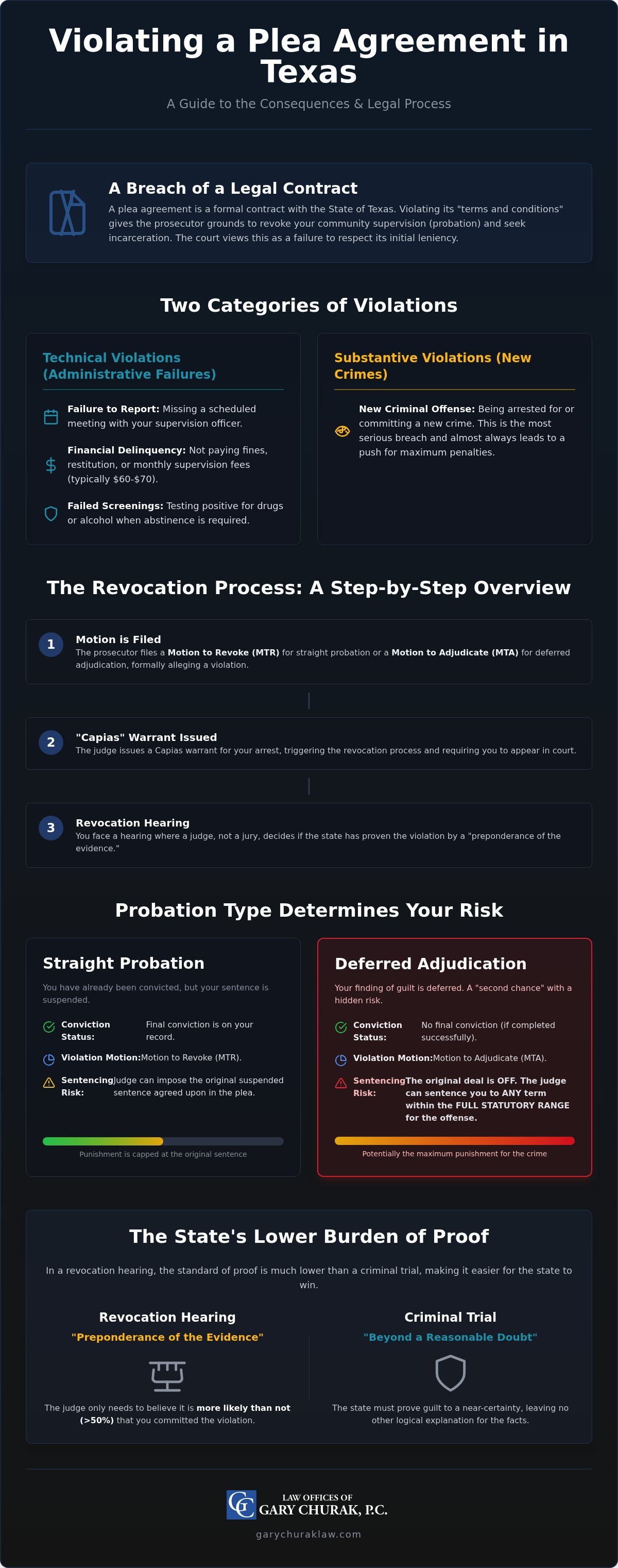
Violations typically fall into two categories: technical and substantive. While one involves administrative failures and the other involves new criminal activity, both can trigger a Motion to Revoke. Understanding the consequences of violating a plea agreement in Texas is vital because even a minor administrative slip-up can lead to a warrant. Common breaches include:
- Failure to report: Missing a scheduled meeting with your supervision officer is often the first red flag for the court.
- Positive drug or alcohol screenings: Many agreements require total abstinence; a single failed test can lead to immediate legal action.
- Financial delinquency: Failing to pay court-ordered fines, restitution, or the monthly supervision fee, which typically ranges from $60 to $70 in 2026, is a common technical violation.
- New criminal offenses: Committing a new crime is the most serious breach and almost always results in a push for maximum penalties.
The court retains full jurisdiction over your case until the very last day of your supervision term. This means the judge has the power to alter your life at any point if they believe you've broken the agreement. Whether the violation is a missed payment or a new arrest, the legal system views it as a failure to respect the court's initial leniency.
Immediate Consequences: Revocation vs. Adjudication
The path the state takes after a breach depends entirely on the type of community supervision you received during your initial plea. While both paths lead to potential incarceration, the legal mechanisms and the range of punishment vary significantly. Understanding these differences is the first step in mounting a defense against the consequences of violating a plea agreement in Texas. Legal scholars at Cornell explain that Violating a Plea Bargain allows the state to seek remedies that were previously suspended, effectively putting your freedom back in the hands of the court.
When a violation is alleged, the prosecutor will file one of two documents. For those on straight probation, the state files a Motion to Revoke (MTR). For those on deferred adjudication, they file a Motion to Proceed with Adjudication (MTA). Both documents serve as a formal request to the judge to end your supervision and impose a jail or prison sentence. A strategic defense starts with a thorough review of your original sentencing order, which is why seeking a professional case analysis is critical the moment you suspect a motion has been filed.
The Danger of Deferred Adjudication Violations
Deferred adjudication is often viewed as a second chance because it allows you to avoid a permanent conviction. However, it carries a massive hidden risk. If the state proves a violation, the original "deal" is off the table. The judge is no longer bound by the initial sentence length you negotiated. Instead, they can sentence you to any term within the full statutory range for the underlying crime. For example, if you were on a 10-year deferred sentence for a first-degree felony, a single violation could technically result in a life sentence. Additionally, an adjudication of guilt permanently removes your ability to later seek a nondisclosure, ensuring the crime stays on your record forever.
Revocation of Straight Probation
In straight probation cases, the conviction is already on your record, and the sentence was set at the time of the plea. The judge has already "sentenced" you to a specific term but suspended the execution of that time in favor of probation. If the court grants a Motion to Revoke, the judge simply orders the execution of that original suspended sentence. You face the immediate reality of going to jail for the exact time specified in your plea paperwork. It is also vital to understand that Texas law generally does not grant "credit for time served" for the months or years you spent on probation. This "street time" is lost, and your prison clock starts at zero the day you are revoked.
The Legal Process: Motions to Revoke and Hearing Rights
The legal machinery starts moving the moment your probation officer notifies the District Attorney's office of a suspected breach. This notification triggers the filing of a formal motion, which quickly results in a judge signing a "Capias"—a specialized warrant for your arrest. According to the Texas Code of Criminal Procedure, this process moves much faster than the initial criminal charges. You aren't entitled to a new jury trial to determine if you violated the terms. Instead, your fate rests with a single judge who will decide if the state has met its burden of proof.
The most alarming aspect of this process is the standard of proof required. In a criminal trial, the state must prove guilt beyond a reasonable doubt. In a revocation hearing, the state only needs to prove a violation by a "preponderance of the evidence." This means the prosecutor only needs to show it's more likely than not, roughly 51% certainty, that you breached your agreement. Because the bar is so much lower, the consequences of violating a plea agreement in Texas can be triggered by even minor administrative errors if they aren't properly challenged.
The Capias and Initial Appearance
When a Capias is issued for a probation violation, it's frequently a "no bond" warrant. This means you may be required to remain in custody until your hearing date, which can take several weeks. If you're in custody, the court typically schedules the hearing within 20 days, but that's still a significant amount of time to lose your liberty before a judge hears your side. This reality makes choosing a criminal defense attorney an immediate priority. At your first appearance, the judge will perform a formal "reading of the allegations," where you'll learn exactly which terms the state claims you failed to meet.
The Revocation Hearing Mechanics
The hearing itself is a streamlined proceeding where the state's primary witness is almost always your probation officer. They'll testify about missed meetings, failed drug tests, or unpaid fees. Your defense team has the right to cross-examine this officer, scrutinizing their records and testing the accuracy of their testimony. Once the evidence is presented, the judge has three primary options. They can continue your supervision as is, modify the terms to include stricter conditions, such as additional community service or drug treatment, or revoke your supervision entirely and sentence you to jail. Having a battle-tested guide to argue for modification over revocation can be the difference between returning home and going to prison.
Strategic Defenses: Can You Fight a Violation Allegation?
Receiving notice of a probation violation often feels like an immediate sentence, but it's actually the start of a new defensive phase. The consequences of violating a plea agreement in Texas are not set in stone the moment an allegation is made. We approach these cases by scrutinizing the state’s evidence for procedural errors or factual inaccuracies. A violation is only a claim until a judge rules on it, and several powerful defenses can stop a revocation in its tracks.
One of the most effective tools is the "Due Diligence" defense. If the state alleges you failed to report, they must prove they made a legitimate effort to contact and locate you. If your supervision officer simply waited for you to miss a meeting without attempting to reach out, the court may find their efforts insufficient. Additionally, we frequently challenge the scientific validity of drug screenings. Lab errors, improper chain of custody, or even certain prescription medications can trigger a false positive. Finally, the "Inability to Pay" defense protects those who genuinely cannot afford court fees; the state cannot revoke your freedom solely because you are indigent, provided you haven't willfully refused to pay.
Challenging Technical Violations
Technical violations, such as missing a single appointment or failing to complete community service hours on time, are often the result of life’s unpredictable hurdles. We help you gather "good faith" evidence to show the court you intended to comply. Employment records showing a mandatory shift or medical documents proving an emergency can transform a "willful violation" into an excusable oversight. Technical compliance is often a matter of documentation rather than intent. By presenting a clear paper trail, we can often persuade the judge that your supervision should continue without further penalty.
Negotiating for Modification Instead of Revocation
When a violation is admitted or proven, the goal shifts to "Reinstatement." We leverage our deep experience, including insights from federal drug trafficking defense, to negotiate for intermediate sanctions. Rather than prison, we may propose a "Sanc Week," which is a short-term jail stay followed by a return to probation, or increased reporting requirements. This strategic advocacy aims to keep your original plea agreement alive. If you are facing a motion to revoke, contacting a battle-tested guide for an immediate case analysis is your best chance at avoiding the maximum sentence.
Mitigation is also a vital strategy. Even if a violation occurred, proving *why* it happened can significantly impact the judge's decision. A medical crisis or a sudden job loss doesn't excuse a breach, but it provides the human context that judges need to justify leniency instead of a harsh prison term.
How an Aggressive Defense Attorney Protects You Post-Violation
When the state moves to revoke your supervision, the legal landscape shifts from cooperation to active combat. The Law Offices of Gary Churak bring more than 40 years of tactical experience to these high-stakes moments. We understand that the consequences of violating a plea agreement in Texas are often dictated by the quality of your representation in the days immediately following a warrant. Our firm acts as a shield, intervening before the court makes a final determination that could end your freedom. We focus on immediate action to secure a bond or a favorable hearing date, preventing you from languishing in jail while the prosecutor prepares their case.
Our primary objective is to humanize you to the judge. In many violation hearings, the court only sees a list of missed requirements or failed tests. We change that narrative by presenting the human context behind the allegations. By projecting professional confidence and preparedness, we alleviate the anxiety of the process while providing the steady hand needed to navigate a system that often feels stacked against you. We don't just defend a case; we protect a person's future.
The Power of Thorough Case Analysis
Gary Churak doesn't take the probation department’s records at face value. We scrutinize every entry in your supervision file to identify clerical errors, missed communications, or procedural lapses that the state might be trying to exploit. Our thorough case analysis approach allows us to develop a comprehensive "rehabilitation plan" to present as an alternative to prison. This plan proves to the judge that your continued supervision is more beneficial to the community than incarceration. We work tirelessly to ensure your constitutional rights remain protected during a summary hearing process where the rules of evidence are often relaxed.
Aggressive Advocacy in the Courtroom
A forceful stance is mandatory when a prosecutor is pushing for the maximum sentence. We leverage decades of experience to predict how specific judges handle violation cases, allowing us to tailor our arguments to their unique tendencies. Our battle-tested guide knows when to negotiate for a modification and when to take a more assertive position to challenge the state's evidence. Whether you are facing a technical breach or a new charge, we provide the quiet strength and strategic wisdom needed to fight for reinstatement. Facing a Motion to Revoke? Contact the Law Offices of Gary Churak for a free consultation.
Secure Your Future Against a Motion to Revoke
A single mistake shouldn't dictate the rest of your life. While the consequences of violating a plea agreement in Texas are serious, they are not insurmountable when you have a strategic defense in place. You've learned how the state utilizes a lower burden of proof and how the distinction between deferred adjudication and straight probation fundamentally changes your sentencing risks. Navigating these complexities requires more than just luck; it demands a battle-tested guide who understands how to negotiate with prosecutors and humanize your case before a judge.
Gary Churak offers over 40 years of criminal defense experience and aggressive advocacy for high-stakes matters. We focus on thorough case analysis to find the procedural errors or mitigating factors that can save your freedom. Don't wait for a warrant to change your life forever. Protect your freedom—schedule a free consultation with Gary Churak today. You have the right to fight for your future, and we are here to provide the steady hand you need to move forward with confidence.
Frequently Asked Questions
Can I get a bond if I have a warrant for a probation violation in Texas?
You don't automatically receive a bond for a probation violation warrant in Texas. Most Capias warrants are "no bond" orders, meaning you remain in custody until the judge hears your case. An experienced attorney can petition the court for a bond or a "bond reduction" hearing. This process requires a strategic approach to convince the judge that you aren't a flight risk and will comply with future court dates.
What is the difference between a technical violation and a substantive violation?
A technical violation involves failing to meet administrative requirements like missing a meeting or failing to pay monthly fees. A substantive violation occurs when you're arrested for a new criminal offense. Both categories trigger the consequences of violating a plea agreement in Texas, but substantive breaches are viewed much more severely by prosecutors. Judges often have more flexibility to offer leniency for technical errors if they're properly explained.
Will I go to prison for a first-time probation violation?
Incarceration isn't an automatic result of a first-time violation. The judge possesses the authority to continue your probation, modify your terms, or order a short stay in county jail as a sanction. Your defense team's goal is to prove that you remain a good candidate for community supervision. Providing documentation of a "good faith" effort to comply can often prevent a first-time mistake from turning into a prison sentence.
How long does the state have to file a Motion to Revoke?
The state must file a Motion to Revoke before your period of community supervision expires. If the prosecutor files the motion and a warrant is issued before your end date, the court retains jurisdiction to hear the case even after your probation term would have normally ended. You can't simply "wait out" the clock if a motion is already on file; the legal process will proceed regardless of the calendar.
Can my plea agreement be reinstated after a violation?
Reinstatement is absolutely possible and is a primary objective for many defense strategies. When a judge reinstates your plea agreement, they allow you to remain on community supervision instead of going to jail. They might add new conditions, such as extra community service or drug treatment, but the original deal stays intact. This outcome allows you to finish your term and potentially protect your record from a final conviction.
Do I have a right to a jury trial for a plea agreement violation hearing?
You do not have a right to a jury trial for a violation hearing. These proceedings are held strictly before a judge, who acts as both the finder of fact and the sentencing authority. Because the burden of proof is only a "preponderance of the evidence," the state doesn't have to prove its case beyond a reasonable doubt. This lower bar makes aggressive legal advocacy essential for protecting your freedom.
What happens if I commit a new crime while on deferred adjudication?
Committing a new crime while on deferred adjudication is extremely high-stakes. The prosecutor will file a Motion to Proceed with Adjudication, asking the judge to find you guilty of the original charge. If the judge grants this, the consequences of violating a plea agreement in Texas include being sentenced to any term within the full statutory range for that crime. You lose the benefit of the original negotiated sentence length.
Can an attorney help if I already admitted to the violation to my probation officer?
An attorney can still provide vital assistance even if you've already admitted a violation to your officer. Admissions made without legal counsel can sometimes be mitigated by explaining the circumstances or challenging how the statement was obtained. We focus on humanizing your situation to the judge and arguing that a single admission shouldn't lead to revocation. Strategic negotiation can still result in a modification rather than a prison sentence.


