

A "minor" misdemeanor conviction is often anything but small when it starts to dismantle your professional and personal life. You're likely feeling a crushing sense of anxiety right now, caught between the fear of immediate jail time and the uncertainty of whether you'll still have a job tomorrow. It's a common misconception that these charges are just a slap on the wrist, but the reality is that the consequences of a misdemeanor conviction can ripple through your background check for years. You deserve to know exactly what you're up against and how to fight back effectively.
We understand the high stakes you're facing and the confusion that comes with navigating the legal system. This guide reveals the full scope of legal, professional, and personal repercussions you might encounter, providing a clear path to protecting your future. You'll learn how these offenses differ from felonies in the eyes of employers, what recent legislative shifts like California's 2025 AB 321 mean for judicial discretion, and how to mitigate the long-term damage. By the end of this article, you'll have a strategic understanding of how to keep your record clean and move forward with professional confidence.
Key Takeaways
- Recognize that while jail sentences for misdemeanors are shorter, the permanent nature of the criminal record carries the same weight as a felony in many background databases.
- Discover how the consequences of a misdemeanor conviction act as an "invisible sentence," creating barriers to professional licensing in fields like nursing, teaching, and real estate.
- Identify the personal fallout of a public arrest record, including its potential to complicate child custody disputes and damage your reputation through the "Google effect."
- Learn how a seasoned defense attorney uses aggressive advocacy and thorough case analysis to seek dismissals or reductions to non-criminal infractions.
- Gain insights into recent legislative shifts, such as 2025 laws regarding "wobbler" offenses, that provide judges with more flexibility to protect your future.
Defining the Misdemeanor: Why 'Minor' Charges Carry Major Weight
The legal system categorizes crimes into distinct tiers, but the distinction between a "minor" offense and a major one often blurs once a background check begins. Many individuals ask, What is a misdemeanor? and assume it represents a temporary setback or a simple mistake. In reality, a misdemeanor is a criminal offense more serious than a simple traffic infraction but less severe than a felony. While the immediate penalties might seem manageable, the long-term consequences of a misdemeanor conviction include a permanent digital footprint that follows you into every job interview and housing application. A misdemeanor is a conviction that creates a permanent criminal record regardless of the sentence length.
The Classification of Misdemeanors
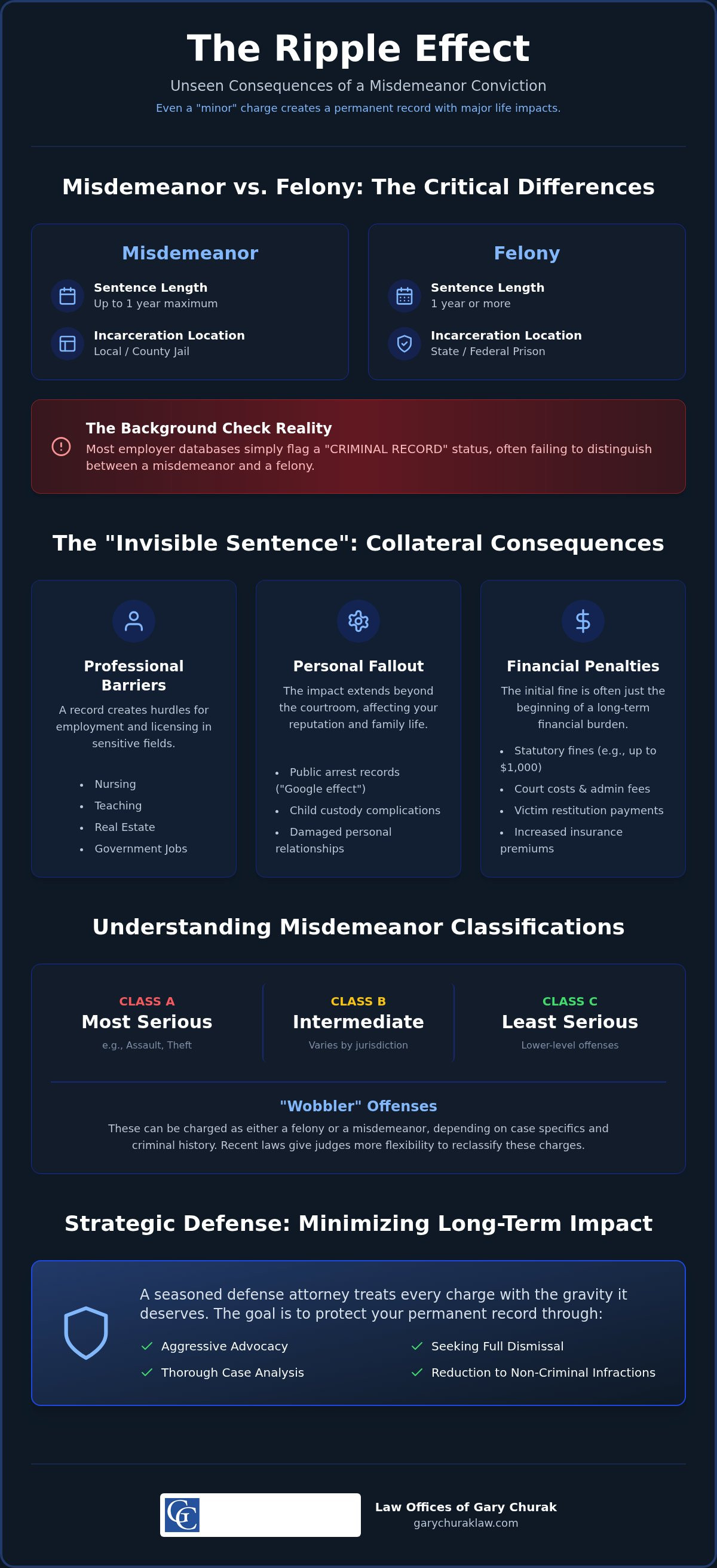
Most jurisdictions organize these offenses into classes to determine the severity of the punishment. Class A misdemeanors represent the most serious tier, often involving acts like assault or theft, while Class C covers lower-level offenses. You must also account for "wobbler" offenses. These are specific crimes that a prosecutor can charge as either a felony or a misdemeanor depending on the facts of the case and your criminal history. Recent legal shifts, such as California's 2025 AB 321, allow judges more flexibility to reclassify these wobblers at any point before trial. However, even a low-level conviction stays on your record. This record acts as a "prior," meaning any future legal encounter will carry much steeper penalties because you are no longer a first-time offender.
Misdemeanor vs. Felony: The Critical Differences
The primary distinction between these two categories lies in the potential for incarceration and the location where you serve that time. While they feel different during sentencing, their impact on your record is remarkably similar.
- Sentencing Limits: Misdemeanors typically carry a maximum sentence of one year or less. Felonies involve multi-year prison terms.
- Incarceration Locations: If sentenced to time, misdemeanor defendants serve their terms in local county jails. Felony convictions usually lead to state or federal prisons.
- The Background Check Reality: This is where the differences disappear. Most employer databases don't distinguish between the two when flagging a "criminal record" status.
The consequences of a misdemeanor conviction are felt most acutely when you realize that a "minor" charge produces the same red flag as a felony during a standard screening. Whether you spent one day in jail or 364, the label remains the same. You are a convicted criminal in the eyes of the law, and that status requires an aggressive defense to prevent life-long collateral damage. Protecting your record requires a strategic approach that treats even the smallest charge with the gravity it deserves.
Immediate Legal Penalties: Beyond Jail and Fines
Jail time for a misdemeanor might be shorter than a felony sentence, but its impact on your life is instantaneous and severe. In Florida, for example, a first-degree misdemeanor can result in up to one year in county jail, while a second-degree offense carries a 60-day limit. Even a brief stay in a local facility is enough to cause you to lose your current employment. Most employers won't hold a position for someone who disappears for weeks or months. Your family faces immediate financial instability, and the emotional toll of your absence can create lasting fractures in personal relationships. These immediate consequences of a misdemeanor conviction are often just the beginning of a cascade of legal hurdles.
Financial Impact and Court Costs
The statutory fine listed in a law book is rarely the final price you'll pay. While a simple misdemeanor fine might be capped at $1,000, court costs, lab fees, and administrative surcharges can quickly double that amount. Indiana's 2026 Senate Bill 252, for instance, recently established new prosecuting attorney compensation fees that add to the defendant's burden. If your case involves property damage or injury, the judge will likely order restitution, requiring you to pay the victim directly for their losses. Beyond the courtroom, you'll face the long-term cost of increased insurance premiums. This is especially true for DWI misdemeanors, where your rates can remain elevated for years. Seeking a free initial consultation can help you understand the full financial scope of your specific charges before you enter a plea.
The Reality of Community Supervision
Probation is frequently viewed as a lenient alternative to jail, but it's a rigorous form of government oversight that dictates your daily movements. You'll deal with mandatory check-ins, random drug testing, and travel restrictions that require written permission to leave the county. Many individuals fall into "probation traps," where a minor technical violation, such as missing a meeting because of a work conflict, leads to immediate incarceration. The long-term consequences of a conviction often start with these restrictive supervision terms that drain your time and resources. You'll also likely face mandatory classes, such as DUI school or anger management, which come with their own enrollment fees. Community service requirements further complicate your work-life balance, forcing you to find hours for unpaid labor while trying to maintain your career and household responsibilities.
The Invisible Sentence: Collateral Consequences of a Misdemeanor Conviction
The judge closes the case, but for many, the true punishment is just beginning. These penalties, known as "collateral consequences," are the legal and regulatory restrictions that flow from a conviction but aren't part of the court's formal sentence. The collateral consequences of convictions can last a lifetime, often proving more restrictive than the original fines or jail time. For those in professional fields, a misdemeanor isn't just a mark on a record; it's a direct threat to their license. State boards for nursing, teaching, and real estate frequently view a conviction as a breach of professional ethics, which can lead to the suspension or denial of your right to practice.
Beyond your career, the consequences of a misdemeanor conviction extend into your civil and educational life. If you're a student, certain drug-related misdemeanors can jeopardize your eligibility for federal student loans, while university admissions offices may rescind offers based on a criminal history. Perhaps most significantly, domestic violence misdemeanors carry a federal prohibition on firearm possession. This federal "invisible sentence" applies even if the state judge never mentions your Second Amendment rights during the hearing. These restrictions effectively strip you of rights without the fanfare of a high-profile felony trial.
Employment and Career Obstacles
While "Ban the Box" legislation has gained momentum, these laws typically only delay the inevitable disclosure of your history. They might prevent an employer from asking about your record on an initial application, but they don't stop a comprehensive background check later in the hiring process. If you're pursuing a high-trust position or a role involving government contracting, a misdemeanor flag often results in an immediate disqualification. This is why aggressive advocacy is vital from day one. Understanding how a criminal defense attorney protects your future is the first step in preventing these invisible barriers from taking root.
Housing and Financial Stability
Your ability to secure a safe place to live is also at risk. Private landlords often implement zero-tolerance policies, viewing any criminal record as an indicator of liability or future trouble. If you rely on federally subsidized housing, a recent conviction can make you ineligible for assistance, leaving you with few options. These financial ripples continue into your personal banking. Lenders may perceive a criminal history as a sign of instability, leading to higher interest rates on personal loans or outright denials for credit applications. These obstacles create a cycle of instability that far outweighs the "minor" nature of the original charge.
Personal Fallout: Reputation, Family, and Future Rights
The social stigma attached to a criminal record often persists long after you've paid your court fees. In the digital age, the "Google effect" means your arrest record is a public document accessible to neighbors, colleagues, and extended family members. This loss of privacy is one of the most painful consequences of a misdemeanor conviction. It colors how people perceive your character and can lead to social isolation or fractured relationships. For non-citizens, the stakes are even higher. Certain misdemeanors classified as "crimes involving moral turpitude" can trigger deportation proceedings or the denial of naturalization, regardless of how long you've lived in the country. These federal immigration laws don't care that your local court called the offense "minor."
Family Law and Custody Implications
Family court judges prioritize the best interests of the child, and a misdemeanor assault or drug charge can significantly impact your parental fitness. These records often shift the burden of proof during custody or visitation disputes. An opposing party may use your conviction to argue that you are an unstable influence, potentially leading to supervised visitation or restricted access. Protecting your relationship with your children requires aggressive advocacy from the moment you're charged. A strategic defense aims to prevent a conviction that could be used as leverage against you in future family law proceedings. You cannot afford to let a misdemeanor charge dictate your role as a parent.
Firearm Rights and Domestic Violence
One of the most misunderstood legal traps involves the Lautenberg Amendment. This federal law imposes a lifetime firearm ban on anyone convicted of a misdemeanor crime of domestic violence. Many defendants accept a "minor" domestic battery plea to avoid jail, unaware they are permanently surrendering their Second Amendment rights. This national ban applies even if the underlying state law classifies the offense as a low-level misdemeanor. You must understand these hidden traps before signing any plea agreement, as the loss of your rights is often irreversible. Even if a judge doesn't mention it during sentencing, the federal government will enforce the ban the moment you attempt a background check for a purchase.
Don't let a single mistake redefine your family life or strip you of your constitutional rights. Protect your reputation and your future by scheduling a free initial consultation with a battle-tested advocate who understands the high stakes involved.
Strategic Defense: How an Attorney Minimizes Long-Term Impact
A misdemeanor charge doesn't have to result in a life-altering conviction. While the prosecution builds a case to secure a quick plea, a strategic defense focuses on dismantling that case through meticulous scrutiny. You need an advocate who treats these "minor" charges with the same intensity as a felony. By identifying constitutional violations and procedural errors early, it's often possible to prevent the most severe consequences of a misdemeanor conviction before they ever take effect. Taking a passive approach is dangerous; you need a battle-tested guide to navigate the complexities of the courtroom.
Challenging the Evidence
The foundation of a strong defense lies in a thorough case analysis that examines every detail of the arrest. We scrutinize the legality of the initial police contact to determine if your rights were violated through an illegal search or seizure. If evidence was obtained unlawfully, we move to suppress it, often leaving the prosecution with no choice but to dismiss the charges. We also question witness credibility and the reliability of police reports, looking for inconsistencies that create reasonable doubt. These procedural errors often provide the leverage needed to protect your future.
Negotiating for the Future
When a dismissal isn't immediately available, the focus shifts to strategic negotiation. Prosecutors often prioritize convictions, but your attorney prioritizes your record. We explore alternatives like deferred adjudication or "no contest" pleas, which can prevent a formal judgment of guilt. This is vital for individuals in high-stakes careers, as we negotiate for specific charge language that won't trigger professional license revocations or immigration issues. While a "not guilty" verdict is the ultimate goal, securing a path to a clean record is the strategic priority in every misdemeanor case.
Many jurisdictions offer diversion programs for first-time offenders. These programs allow you to complete specific requirements, such as community service or education, in exchange for a dismissal. Once you've successfully navigated the immediate legal challenge, the final step is pursuing Expungement or record sealing. This process effectively erases or hides the incident from public view, ensuring the consequences of a misdemeanor conviction don't haunt you for decades. Taking aggressive action now is the only way to safeguard your freedom and your reputation.
Protecting Your Future Beyond the Courtroom
A misdemeanor charge is a pivotal moment that requires a decisive response. You've seen how the consequences of a misdemeanor conviction extend far beyond the courtroom, threatening your professional licenses, your housing stability, and even your parental rights. These "minor" offenses carry the weight of a permanent record, but they don't have to define your life. By prioritizing a thorough case analysis and aggressive advocacy, you can challenge the evidence and pursue a path toward a clean slate.
Gary Churak brings over 40 years of battle-tested legal experience to your defense. We provide a personalized strategy for every client, ensuring your rights remain protected at every stage. Whether we're negotiating for a dismissal or navigating the complexities of record sealing, our goal is to restore your peace of mind. Don't leave your reputation to chance. Secure your future with a free defense consultation today and take the first step toward reclaiming your freedom. You have the power to change this outcome.
Frequently Asked Questions
Will a misdemeanor show up on a background check 10 years later?
A misdemeanor conviction remains on your public record indefinitely unless a court orders it expunged or sealed. While some states have "seven-year rules" for credit reporting, criminal background checks used by employers and landlords often look back much further. This digital footprint stays accessible through private databases and government records. You should assume that any conviction will be visible ten years later without proactive legal intervention to clear your name.
Can I lose my job over a misdemeanor conviction?
Your employment status is often at risk following a conviction, particularly in "at-will" employment states. Many companies maintain internal policies that mandate the termination of any employee who acquires a criminal record. Even if you aren't fired immediately, the consequences of a misdemeanor conviction can prevent future promotions or disqualify you from high-trust roles. Professional reputation is fragile, and a conviction often signals a liability that many corporate HR departments are unwilling to accept.
Does a misdemeanor conviction affect my right to travel or get a passport?
A standard misdemeanor conviction usually doesn't prevent you from obtaining a U.S. passport, but it can severely restrict your ability to enter other countries. Canada, for example, often denies entry to individuals with even a single DUI conviction. If you're on probation, travel restrictions are even tighter, as you generally need court permission to leave your jurisdiction. You must consult with an advocate to understand how your specific charge might impact your international mobility.
Is it possible to get a misdemeanor removed from my record?
Expungement and record sealing are the primary legal tools used to remove a conviction from public view. While the specific eligibility requirements vary significantly across different states, many jurisdictions allow for the destruction or hiding of records after a specific waiting period. Successfully navigating this process means that your record will no longer appear on standard background checks. This is a critical step in restoring your civil rights and ensuring your past doesn't dictate your future.
Do I really need a lawyer for a first-time misdemeanor?
You should never face the legal system alone, even for a first-time offense. A seasoned attorney identifies procedural errors and constitutional violations that a layperson would likely miss. Without professional counsel, you might succumb to the long-term consequences of a misdemeanor conviction that could have been avoided through diversion programs. Investing in a strategic defense now prevents a permanent criminal record that would cost you far more in lost wages over several decades.
What happens if I plead guilty to a misdemeanor just to get it over with?
Pleading guilty to "get it over with" is a dangerous decision that results in a permanent criminal record. You're effectively waiving your right to challenge the evidence and accepting every collateral penalty associated with the charge. These consequences often include job loss, housing denials, and professional licensing bans that you didn't anticipate. It's always better to take a methodical, strategic approach to your defense rather than rushing into a plea that carries lifelong weight.
Can a misdemeanor conviction prevent me from getting a professional license?
Professional licensing boards for careers in healthcare, education, and finance often maintain strict character requirements. A misdemeanor conviction, especially one involving theft or violence, can trigger an automatic review or revocation of your license. These boards view a criminal record as a breach of professional ethics and public trust. Protecting your career requires an aggressive defense that seeks to avoid a conviction entirely, ensuring you remain eligible for the credentials you've worked hard to earn.
Will a misdemeanor affect my ability to rent an apartment?
Landlords frequently use criminal background checks as a primary screening tool for new tenants. A misdemeanor on your record can lead to an automatic denial of your rental application, especially in competitive urban housing markets. Property managers often view any criminal history as an indicator of potential liability or risk to other residents. Securing safe and stable housing becomes significantly more difficult when you have a conviction flagging your profile during the application process.


