

A single mistake from a decade ago can suddenly resurface to threaten your freedom today because Texas law treats intoxication history as a permanent record. Facing felony DWI charges in Texas isn't just a legal hurdle; it's a direct assault on your professional license, your right to own a firearm, and your very liberty. You're likely feeling overwhelmed by the state's aggressive stance and the confusing "forever" lookback period that turns old misdemeanors into modern-day felonies. It's a heavy burden to carry, but a charge is not a conviction, and the prosecution’s path is rarely as clear as they want you to believe.
This 2026 strategic guide helps you navigate the intricate web of Texas felony laws and identify the defense pathways available to safeguard your life. You'll gain a clear understanding of the specific felony category you're facing and the tactical strategies used to challenge blood warrants or roadside evidence. We'll preview the methodical steps required to dismantle the state's case, providing a logical roadmap from initial uncertainty toward a position of strength. With over 40 years of legal experience as a foundation, we focus on the thorough analysis needed to turn the tide in your favor.
Key Takeaways
- Learn how specific aggravating factors escalate a standard misdemeanor into a high-stakes felony and what this shift means for your defense strategy.
- Identify the four specific legal pathways that lead to felony DWI charges in Texas, including the severe implications of repeat offenses and child passengers.
- Uncover the full scope of potential penalties, from significant prison terms to the permanent loss of your civil liberties and professional licenses.
- Discover how to dismantle the prosecution’s narrative by challenging the validity of prior convictions and the "probable cause" used for your initial traffic stop.
- Understand the critical role of a thorough case analysis in navigating the grand jury process and securing a protective legal defense.
Understanding Felony DWI Charges in Texas
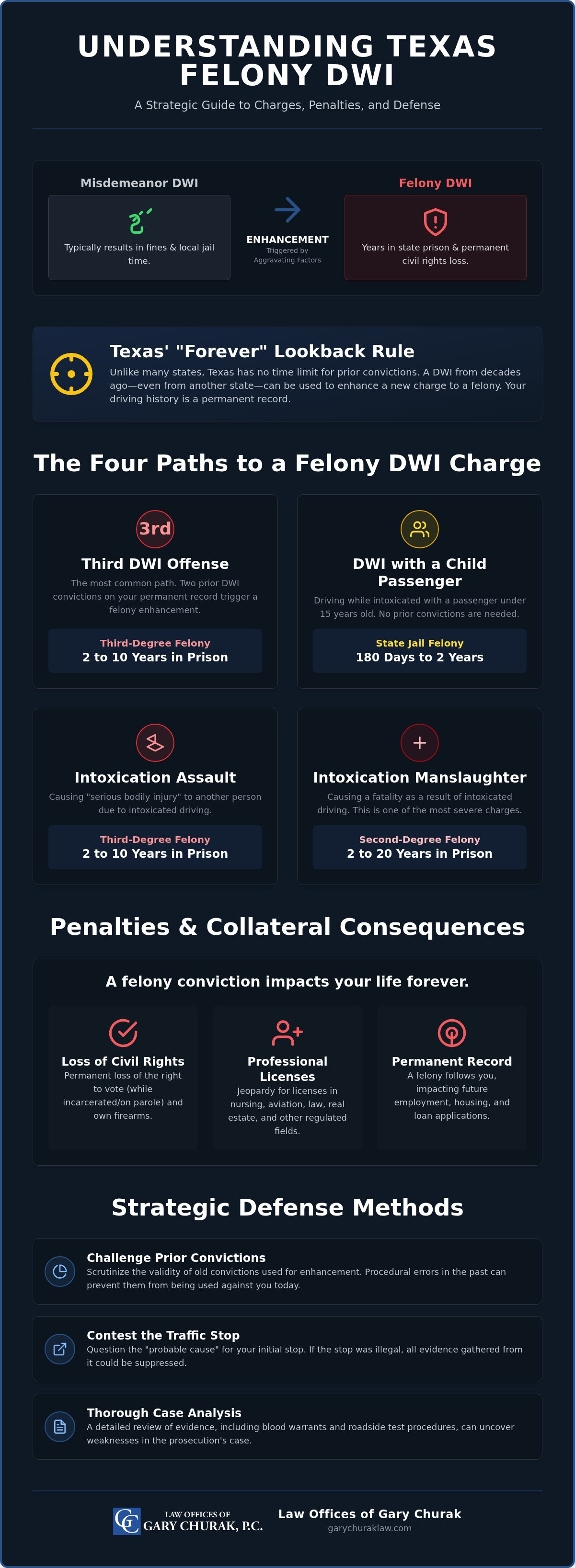
Facing felony DWI charges in Texas marks a critical turning point where the state stops treating a driving error as a lapse in judgment and begins treating it as a serious crime against the public. Most drivers expect a DWI to result in a fine and a short stay in local jail. However, specific aggravating factors trigger an "enhancement," a process that moves your case from the misdemeanor courts into the felony division. This transition isn't just a change in terminology; it shifts the potential punishment from days in county jail to years in state prison. The stakes change because a felony conviction carries a permanent stigma that can strip you of your civil rights and professional standing.
The Legal Mechanism of DWI Enhancement
The Texas Penal Code classifies offenses based on severity, and prosecutors use your history or the circumstances of your arrest to climb the ladder of punishment. While Texas alcohol laws establish the foundational rules for consumption and possession, the criminal statutes determine when a "detectable amount" of alcohol leads to a life-altering felony. You typically face a third-degree felony if you have two prior DWI convictions on your record. Other situations, such as having a passenger under 15 years old in the vehicle, result in a state jail felony regardless of your past history. The distinction is vital because a state jail felony carries a sentence of 180 days to two years, while a third-degree felony can lead to a decade behind bars.
The "Forever" Rule and Prior Convictions
Texas is one of the few states that adheres to a "forever" lookback policy. Many people believe that if they stayed out of trouble for ten or twenty years, their old mistakes would "wash out" and not count against them. That isn't the case here. A conviction from decades ago can be used to enhance a 2026 arrest into a felony. Enhancement is the legal process of using a person’s permanent criminal history to escalate the severity and punishment range of a current offense. This policy also applies to out-of-state convictions; if you were convicted of a similar offense in another state, Texas prosecutors will often count it toward your total number of priors to secure a felony indictment.
Prosecutors act quickly to secure these enhancements, often before you've even had your first court date. They look for any leverage to ensure the highest possible penalties. This aggressive approach makes early intervention and a thorough case analysis essential. By scrutinizing the validity of those prior convictions or the legality of the initial stop, a strategic defense can sometimes block the enhancement entirely, keeping your case in misdemeanor territory and protecting your future.
The Four Paths to a Felony DWI Charge
Texas law identifies four specific scenarios where a standard DWI escalates into a felony. While a third offense is the most common trigger, certain aggravating factors can create a felony charge even for a first-time offender. Understanding which path the prosecution is taking is the first step in mounting a successful defense. Under Texas Penal Code Chapter 49, the severity of these charges depends on your history or the specific harm caused during the incident. A third DWI conviction is classified as a third-degree felony, carrying a prison sentence of two to ten years. If you're facing a fourth offense, the penalties can escalate further, potentially resulting in up to 20 years in prison.
DWI with a Child Passenger (Under 15)
Texas defines a "child" as anyone under the age of 15. If a child is in the vehicle during a DWI arrest, the state charges it as a state jail felony. This is a particularly aggressive charge because it requires no prior criminal history to be triggered. Even a first offender faces a mandatory minimum of 180 days in state jail. The implications extend far beyond the courtroom; this charge often triggers investigations by Child Protective Services, creating a dual-front battle for your family and your freedom. Protecting your parental rights becomes just as urgent as protecting your liberty.
Intoxication Assault and Manslaughter
When an accident occurs, the prosecution shifts its focus from your blood alcohol level to the resulting harm. Intoxication assault involves "serious bodily injury," which the law defines as an injury creating a substantial risk of death or causing permanent disfigurement or loss of function. This is a third-degree felony. If a fatality occurs, the charge becomes intoxication manslaughter, a second-degree felony punishable by up to 20 years in prison.
Defense in these cases often hinges on the legal concept of "causation." The state must prove your impairment actually caused the crash, rather than it being an unavoidable accident. We scrutinize the prosecution’s accident reconstruction data, looking for mechanical failures, poor road conditions, or the actions of other drivers that the police might have overlooked. Navigating these high-stakes felony DWI charges in Texas requires an assertive legal protector who knows how to challenge the state's narrative. If you are facing one of these four paths, seeking a personalized consultation for complex felony cases is your first step toward building a resilient defense.
The Severe Penalties and Collateral Consequences
A felony conviction in Texas carries a weight that persists long after your final court date. While the immediate threat of incarceration is terrifying, the secondary effects can dismantle a career and social standing just as effectively as a prison sentence. The state views these offenses as serious threats to public safety, and the resulting penalties reflect that severity. Understanding the full scope of these consequences is essential for anyone currently facing felony DWI charges in Texas, as the stakes involve much more than just a fine.
Statutory Penalties for Felony Convictions
The immediate physical and financial toll of a conviction is immense. If you're convicted of a third-degree felony, you face a prison sentence ranging from two to ten years in the Texas Department of Criminal Justice. These are not short stays in a local jail; they are significant terms in the state prison system. Financial penalties are equally aggressive, with fines reaching up to $10,000. Beyond the initial sentencing, the state imposes mandatory license revocation periods of 180 days to two years. Even after regaining your driving privileges, you will likely be required to install and maintain an ignition interlock device (IID) at your own expense, adding a layer of constant surveillance to your daily life.
Collateral Consequences Beyond the Courtroom
The damage extends deep into your civil and professional life. A felony conviction triggers a permanent loss of your Second Amendment rights, and you will lose your right to vote until your sentence, including any parole or probation, is fully discharged. For professionals, the impact is often a career-ending event. Licensing boards for nursing, law, and medicine frequently revoke or suspend the licenses of those with felony records. Commercial Driver’s License (CDL) holders face a permanent disqualification from their profession, effectively ending their livelihood.
The "felon" status creates persistent barriers in the private sector as well. Many landlords and employers utilize background checks that flag felony convictions, leading to immediate rejections in housing and job applications. International travel also becomes restricted; many countries, including Canada, often deny entry to individuals with intoxication-related felonies. It's vital to recognize that expungement and record sealing options are extremely limited for felony convictions. In most cases, these records remain public and permanent, making the initial defense strategy your only real opportunity to prevent a lifetime of professional and social stigma.
Strategic Defense Methods for Felony Charges
A felony indictment is a starting point, not an inevitable conclusion. To protect your future, we move beyond simple denial and begin a methodical deconstruction of the state's evidence. Facing felony DWI charges in Texas requires a defense that attacks both the legal foundation of the charge and the technical methods used to gather evidence. We don't just wait for the trial; we proactively seek out the weaknesses that lead to dismissals or charge reductions. Lab results aren't gospel. We scrutinize every link in the chain of custody to ensure the state hasn't cut corners with your freedom.
Dismantling the Enhancement: Challenging Priors
The most effective way to beat a felony is to prove it shouldn't be a felony in the first place. Because the state relies on your past record to escalate the charge, we scrutinize the constitutionality of every prior conviction. We investigate whether you were properly represented by counsel in those old cases and if the court followed all procedural rules during the plea process. Prosecutors often rely on incomplete paperwork or "clerk's summaries" that don't meet the evidentiary standards required for enhancement. Identifying a constitutional defect in a previous judgment can effectively strip the prosecution of its enhancement power, forcing the state to reduce the felony to a misdemeanor.
Technical and Procedural Defense Strategies
Science plays a central role in modern intoxication cases, yet laboratory procedures are frequently flawed. Gas chromatography, the method used to test blood alcohol levels, requires strict adherence to protocol. We look for signs of sample fermentation, improper storage, or machine maintenance failures that could result in a falsely high reading. Similarly, understanding your breath test rights is essential for challenging the reliability of roadside data. If the police failed to observe the required waiting period or if the device wasn't properly calibrated, the results can be suppressed.
Defending against intoxication assault or manslaughter also requires a focus on the Fourth Amendment. We review every second of dash cam and body cam footage to determine if the officer had a valid, legal reason for the initial stop. If the stop was illegal, everything that followed, including the blood draw, might be thrown out. For cases involving accidents, we utilize independent experts to reconstruct the scene, often proving that intoxication wasn't the cause of the harm. If you're ready to start this methodical defense, you should request an aggressive advocacy consultation to analyze the specific details of your arrest.
Navigating the Legal Process with Professional Advocacy
The Texas legal system is built to process cases toward conviction with relentless efficiency. When you face felony DWI charges in Texas, you're entering a multi-stage process that requires immediate, strategic action. The state’s machinery moves quickly, from the initial arrest to the formal indictment, leaving little room for hesitation. Navigating felony DWI charges in Texas demands a proactive stance that begins the moment you're released on bond. A thorough case analysis serves as your first line of defense. By scrutinizing the evidence early, we can often uncover the procedural failures that the prosecution hopes you'll overlook.
The Grand Jury and Indictment Process
Every felony case in Texas must be presented to a grand jury to determine if there's enough evidence for a formal indictment. This stage is often misunderstood as a mere formality, but it's actually a vital window for defense intervention. An assertive attorney can present exculpatory evidence or highlight constitutional violations to the grand jurors before they vote. Securing a "no bill" from the grand jury means the case is dismissed and the felony charges are dropped entirely. We manage the complex timeline of the Texas court system to ensure every opportunity for a pre-indictment dismissal is explored and utilized before the state can solidify its position.
Choosing a Battle-Tested Protector
The outcome of your case often hinges on the reputation and experience of your legal counsel. District attorneys handle thousands of files, and they prioritize cases where the defense is passive or unprepared. When you have an advocate with 40+ years of legal experience, the prosecution knows they're in for a rigorous fight. This depth of knowledge is invaluable during high-stakes negotiations, where knowing the specific tendencies of the local courts can mean the difference between prison and a reduced misdemeanor charge. We provide the quiet strength and professional confidence needed to lead you through this crisis toward a clear resolution.
Protecting your civil rights and your livelihood requires more than just a standard defense; it requires a tailored strategy. We offer personalized legal consultations to dive deep into the facts of your arrest and identify the best path forward. Your future is too valuable to leave to chance or an inexperienced negotiator. Secure your future today by contacting the Law Offices of Gary Churak to ensure you have a fierce protector by your side throughout the legal process.
Safeguarding Your Liberty and Reputation
Facing felony DWI charges in Texas is a high-stakes battle for your freedom, but it's a battle you don't have to fight alone. We've explored how the state uses "forever" lookback periods and technical evidence to build their cases. However, we've also seen how a methodical defense can dismantle these claims by challenging the validity of prior convictions or the accuracy of lab results. Your future depends on the decisions you make right now. A charge is merely an accusation, and with the right strategy, it can be contested with resilience and precision.
The Law Offices of Gary Churak provide the assertive protection you need during this critical time. With over 40 years of battle-tested legal experience, we focus on a thorough case analysis for every high-stakes charge to identify the most effective path forward. We remain committed to the unwavering protection of your civil and constitutional rights. Don't let a legal crisis define the rest of your life. Request a Strategic Consultation for Your Felony Defense today and take the first step toward a secure future. You have the power to fight back, and we have the expertise to lead the way.
Frequently Asked Questions
Is a 3rd DWI always a felony in Texas?
Yes, a third DWI offense in Texas is classified as a third-degree felony. This remains true regardless of how much time has passed since your previous convictions. The state uses these prior offenses to enhance the charge from a misdemeanor to a felony. A conviction can lead to a prison sentence of two to ten years and a fine of up to $10,000. This makes the stakes of a third arrest significantly higher than previous encounters.
Can a felony DWI be reduced to a misdemeanor?
It's possible to have a felony DWI reduced to a misdemeanor if the defense successfully challenges the validity of prior convictions. If we prove a previous plea was unconstitutional or that the state lacks proper documentation of your history, the enhancement may be removed. Additionally, suppressing key evidence like blood test results can force the prosecution to offer a lesser charge to avoid a total loss at trial or during the grand jury process.
What is the "lookback period" for DWI priors in Texas in 2026?
Texas doesn't have a "wash-out" period, meaning the lookback period for 2026 is essentially forever. Any prior intoxication conviction from your past, even if it happened thirty years ago, can be used to enhance a current arrest into a felony. This permanent record policy makes it critical to scrutinize the details of every previous case to ensure they meet the legal standards for enhancement in your current situation and protect your future liberty.
Will I lose my gun rights if I am convicted of a felony DWI?
Yes, a felony conviction results in the permanent loss of your right to own or possess a firearm under both Texas and federal law. Unlike some other rights that might be restored after completing a sentence, Second Amendment restrictions for felons are extremely difficult to overturn. Protecting your right to bear arms is one of the primary reasons to pursue an aggressive defense against felony DWI charges in Texas.
What happens if I have a child in the car during a DWI arrest?
Driving while intoxicated with a passenger under the age of 15 is a state jail felony in Texas. This charge applies even if it's your first offense and you have a clean criminal record. Penalties include a mandatory jail sentence of 180 days to two years and a fine of up to $10,000. This situation also frequently leads to an investigation by Child Protective Services, which creates additional legal challenges for your family.
Can I get a felony DWI expunged from my record?
You generally cannot get a felony DWI conviction expunged or sealed in Texas. Expunction is typically reserved for cases that resulted in an acquittal, a "no bill" from a grand jury, or a dismissal where no probation was served. Because felony records are permanent and public, the only reliable way to keep your record clean is to prevent the conviction from happening through a methodical and assertive legal defense before the final judgment.
How much prison time do you get for intoxication assault in Texas?
Intoxication assault is a third-degree felony that carries a prison sentence of two to ten years in the Texas Department of Criminal Justice. The state may also impose a fine of up to $10,000. To secure this conviction, the prosecution must prove your intoxication directly caused serious bodily injury to another person. Challenging the "causation" element is often a vital strategy in reducing or dismissing these high-stakes charges during the trial process.
Does a prior out-of-state DUI count toward a Texas felony charge?
Yes, Texas prosecutors use out-of-state convictions to enhance a local charge to a felony. If the other state’s statute is substantially similar to Texas law, it counts toward your total number of priors. We carefully analyze these out-of-state judgments to ensure they meet Texas evidentiary standards. If the prior conviction is flawed, it can help dismantle felony DWI charges in Texas by removing the necessary enhancement for the state's case.


