

Your first meeting with a lawyer isn't just an interview; it's the first tactical maneuver in a comprehensive defense strategy. Most people walk into a law office feeling overwhelmed by the weight of their situation and uncertain about what to share. It's natural to feel anxious when your future is on the line and the legal system feels like an impenetrable maze. However, preparing for a criminal defense consultation effectively can transform that initial uncertainty into a position of professional strength.
We understand that the stakes are high and you need a steady hand to guide you through this process. This strategic guide ensures you master the preparation process so your rights remain protected and your defense is fortified from the very first hour. You'll learn exactly which documents to bring, how to organize your account of events, and what specific questions to ask to gauge an attorney's expertise. We'll move from the chaos of the unknown toward a concrete list of next steps. By the end, you'll have a clear understanding of your legal standing and the confidence to choose a battle-tested advocate for your defense.
Key Takeaways
- Define the initial consultation as a confidential assessment of legal risks to establish a resilient defense foundation from day one.
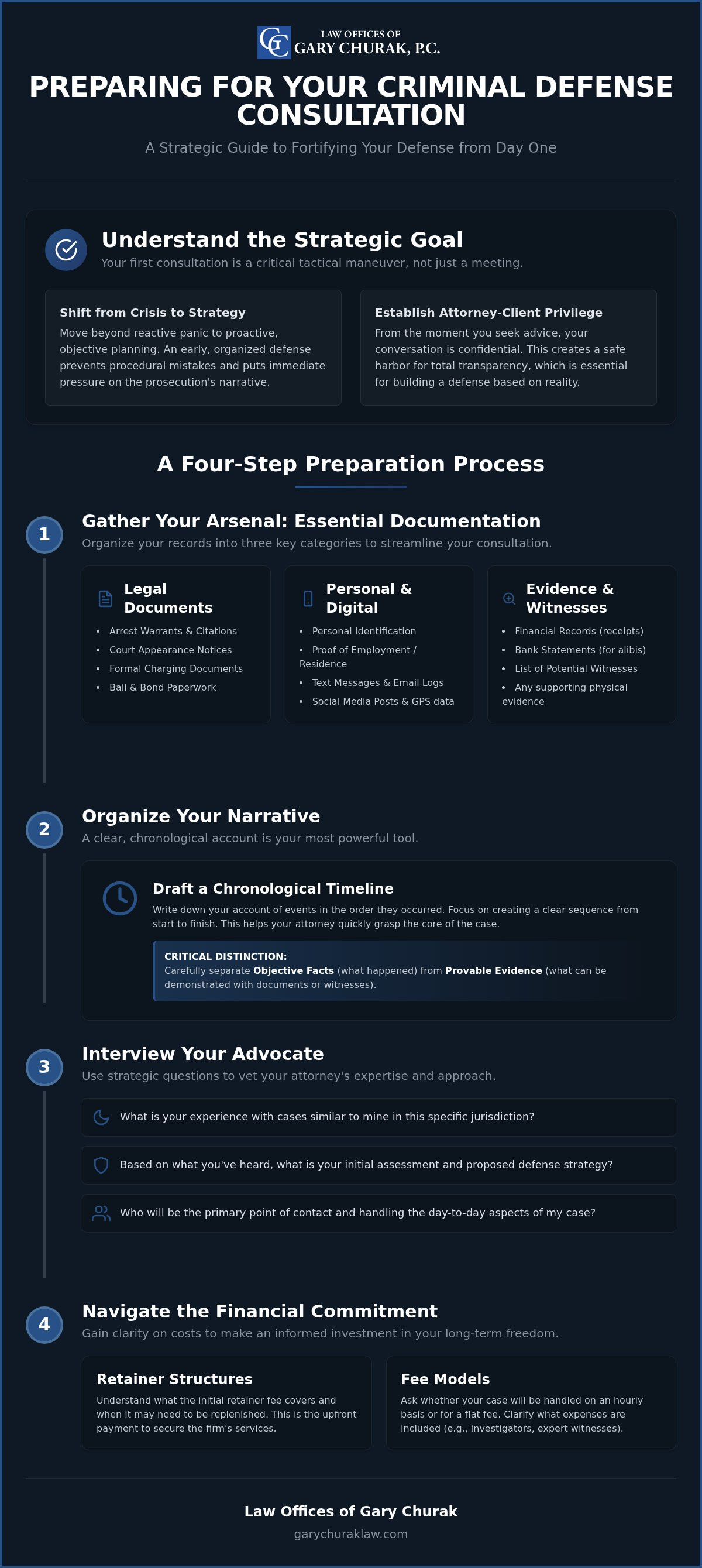
- Streamline the process of preparing for a criminal defense consultation by categorizing your documentation into legal, personal, and evidentiary groups.
- Learn how to draft a chronological timeline that separates objective facts from provable evidence to sharpen your legal narrative.
- Use a prioritized list of strategic questions to vet your advocate's experience and depth of knowledge before committing to a partnership.
- Gain clarity on retainer structures and fee models to ensure you're making an informed investment in your long-term freedom.
Understanding the Strategic Goal of Your Initial Consultation
A criminal defense consultation is far more than a simple meet-and-greet. It is a confidential, high-stakes assessment of legal risks and strategic opportunities. When you begin preparing for a criminal defense consultation, you are essentially laying the groundwork for every tactical maneuver that follows. This first meeting serves as the foundation for your entire defense. It isn't the day you win your case. Instead, it is the day you map out how a win becomes possible through methodical planning and thorough case analysis. By prioritizing the process of preparing for a criminal defense consultation, you signal to the legal system that you are ready to mount a serious, organized defense.
Early legal intervention acts as a vital shield. It ensures that your rights are not eroded by aggressive prosecution or procedural errors before your defense even begins. By engaging an expert early, you create a buffer between yourself and the state, allowing a professional to scrutinize the evidence with 40 years of battle-tested experience. This proactive approach changes the dynamic of the case from one where you are defending yourself to one where the prosecution's narrative is under immediate, expert pressure. You aren't just seeking advice; you're securing an advocate who begins neutralizing threats from the moment you sit down.
Shifting from Crisis Management to Legal Strategy
The shock of an arrest often leaves individuals in a state of reactive panic. Effective defense requires moving past this emotional crisis toward objective planning. An experienced attorney works immediately to neutralize threats to your freedom, such as challenging restrictive bail conditions or securing perishable evidence. This transition is vital for long-term success. Early preparation prevents common procedural mistakes, like talking to investigators without counsel or missing critical filing deadlines. By shifting your focus from the "why" of the arrest to the "how" of the defense, you regain a sense of control over your future.
Establishing Attorney-Client Privilege from the Start
One of the most powerful tools in your arsenal is attorney-client privilege. This legal doctrine ensures that everything you discuss during your consultation remains strictly confidential. This protection applies from the moment you seek legal advice. It covers your communications even if you don't eventually hire the firm. Total transparency is required for a successful defense strategy. Your advocate needs to know the unvarnished truth to anticipate the prosecution's moves. Without full disclosure, your attorney is fighting with one hand tied behind their back. Privilege creates a safe harbor where you can be honest, allowing your legal team to build a defense based on reality rather than surprises.
Gathering the Essential Documentation and Evidence
Organizing your records is the first step in preparing for a criminal defense consultation. Your attorney needs to see the exact language used by the state to allege a crime. This documentation jumpstarts the discovery process, allowing your legal team to identify flaws in the prosecution's case before they have a chance to solidify their narrative. Bringing a complete file ensures your time is spent on strategy rather than tracking down paperwork. Digital evidence is particularly fragile. You should preserve text messages, social media posts, and GPS logs immediately before they're overwritten or deleted by automated systems.
To ensure a productive meeting, aim to provide the following items:
- Legal Documents: Warrants, citations, and court appearance notices.
- Personal Records: Identification and proof of employment or residence.
- Communication Logs: Printed threads of relevant emails or text messages.
- Financial Records: Receipts or bank statements that establish your location at specific times.
Mandatory Legal and Court Paperwork
You must bring every official document issued by law enforcement or the court. This includes arrest warrants, citations, and formal charging documents. These papers contain specific penal codes and officer names essential for case analysis. Additionally, provide all bail and bond paperwork. Understanding the terms of your release is vital, as bail bonds often come with strict conditions that, if violated, can jeopardize your entire defense. If you're struggling to locate these forms, a seasoned legal professional can often help you navigate the court's records system to retrieve them.
Supporting Evidence and Potential Witness Lists
Start by listing everyone present during the incident. Include names, phone numbers, and a brief note on what they saw. Don't wait for the state to interview them first. Collect physical evidence such as receipts that prove your location or GPS logs from your phone or vehicle. Surveillance footage from nearby businesses is often deleted within 24 to 48 hours; notify your attorney immediately if you believe such footage exists. Taking these steps while preparing for a criminal defense consultation allows your advocate to act with precision and protect evidence that might otherwise be lost forever.
Organizing Your Narrative: How to Present Your Facts
Your memory is a powerful tool, but in a legal context, it must be structured to be effective. When preparing for a criminal defense consultation, your goal is to transform a chaotic series of events into a coherent, objective narrative. A seasoned attorney doesn't just need the highlights; they need the granular details that define the legal landscape of your case. By organizing your thoughts before you walk through the door, you allow your advocate to focus on analysis rather than basic fact-finding. This preparation creates a tactical advantage, enabling your lawyer to immediately spot procedural errors or weaknesses in the state's claims.
It is vital to distinguish between "what happened" and "what can be proven." Your personal experience is the starting point, but the legal system operates on evidence. A clear, detailed narrative allows an attorney to identify circumstantial evidence examples that may actually support your defense. Often, details you believe are irrelevant, such as the weather, the lighting in a room, or the specific demeanor of an officer, become the pivot points for a successful challenge. Don't filter your story; provide the raw data and let your protector determine what carries weight in court.
The Power of the Chronological Timeline
Constructing a step-by-step timeline is the most effective way to document the 24 hours surrounding the incident. Start well before the event occurred and continue through your initial contact with law enforcement. Precise times and locations are critical. They form the basis for alibi defenses and can highlight procedural violations. By laying out the facts chronologically, you make it easier to spot inconsistencies in the prosecution’s version of events. This methodical approach ensures that your defense is built on a foundation of verified facts rather than vague recollections.
Full Disclosure: Why Honesty is Your Best Defense
The natural instinct to hide "bad facts" can be a fatal mistake in a criminal case. Addressing sensitive information during your consultation is the only way to ensure your attorney isn't blindsided later. Bad facts are much easier to manage when they are identified early and integrated into a proactive strategy. Remember that your communications are protected by privilege. Surprising your attorney during a hearing or trial leaves them unable to protect you effectively. Total transparency allows your advocate to build a resilient defense that accounts for every possible angle the prosecution might take.
Interviewing Your Advocate: Questions You Must Ask
Once you've organized your narrative, the focus shifts to evaluating the professional who will stand between you and the prosecution. When preparing for a criminal defense consultation, you must remember that you are hiring a protector, not just a legal technician. You need an advocate who prioritizes thorough case analysis over quick, easy resolutions. The questions you ask should reveal their strategic depth and their willingness to fight aggressively for your future. A seasoned expert will welcome this scrutiny. It demonstrates your commitment to your own defense and ensures that your goals are aligned from the start.
Prioritize these questions to gauge their level of "aggressive advocacy":
- How many cases similar to mine have you taken to trial in the last two years?
- What specific weaknesses do you see in the state's current evidence?
- What is your immediate tactical plan to protect my rights this week?
- Do you personally handle the investigation, or is it delegated to junior staff?
Assessing Experience and Specific Case History
Inquire directly about the attorney’s history with your specific charge, whether it involves federal crimes, drug offenses, or assault. You need a realistic assessment of the best and worst-case scenarios based on current legal trends and local court behavior. It's vital to understand the difference between a "plea lawyer" who focuses on settlements and a "trial lawyer" who prepares every case for a courtroom battle. If an attorney suggests a plea deal before reviewing the evidence, they aren't providing the protection you deserve. You want a battle-tested guide who knows when to negotiate and when to take a more forceful stance.
Communication and Tactical Expectations
Clear communication is the antidote to the anxiety of facing criminal charges. Ask how the firm will update you as the case progresses and who your primary point of contact will be. You shouldn't have to chase your lawyer for updates when your freedom is at stake. Ask about their philosophy on negotiating with prosecutors. Some attorneys prefer a collaborative approach while others utilize a more confrontational, high-pressure strategy. Ensure their tactical style matches the gravity of your situation. If you need a fierce protector who focuses on results, contact an experienced defense attorney to begin building your strategy.
Navigating the Financial Commitment and Next Steps
Discussing money is often the most stressful part of the legal process, but clarity here is vital for a stable partnership. When you finish preparing for a criminal defense consultation, you should have a baseline understanding of how legal billing works. Most firms utilize one of three structures: hourly rates, flat fees for specific stages of the case, or a retainer system. A retainer acts as a security deposit for future work. As the attorney performs tasks, they draw from this fund. You must also account for ancillary expenses. High-stakes cases often require private investigators, forensic analysts, or expert witnesses to challenge the prosecution's narrative. These are separate from legal fees but are essential for a comprehensive defense.
Investing in a high-quality criminal defense attorney is an investment in your future and your freedom. While the upfront cost may seem daunting, the long-term consequences of an inadequate defense, such as incarceration or a permanent criminal record, are far more expensive. A battle-tested advocate provides the scrutiny and aggressive representation necessary to navigate complex legal hurdles that a budget lawyer might overlook. You aren't just paying for time; you're paying for 40 years of expertise and a strategic shield against the state.
Understanding Fee Structures and Retainer Agreements
A clear, written fee agreement is your primary protection against future disputes. This document should outline exactly what the retainer covers, how often you'll receive billing statements, and when the fund needs replenishment. Avoid lawyers who are vague about their costs. The cheapest option often leads to higher expenses later if mistakes are made or if the attorney lacks the resources to conduct a thorough investigation. Quality defense requires a steady hand and a well-funded strategy to ensure no stone is left unturned during the discovery phase.
Defining the Immediate Path Forward
Once the consultation concludes, the clock starts ticking. You'll need to meet immediate deadlines for hiring and filing initial motions to preserve your rights. If law enforcement attempts to contact you after this meeting, you must refer them directly to your advocate. Don't engage in "friendly" conversations; they're looking for evidence, not clarity. Your attorney will now begin the process of preparing for your first court appearance, ensuring you walk into that room with a clear plan and a fierce protector by your side. Finalizing your choice and preparing for a criminal defense consultation follow-up is the final step in moving from a state of crisis to a state of resilience.
Securing Your Defense Strategy from Day One
Mastering the process of preparing for a criminal defense consultation is the first step toward reclaiming control over your future. By arriving with organized documentation and a clear, chronological narrative, you provide your legal team with the tools needed for a thorough case analysis. This meeting isn't just a discussion; it's the beginning of an aggressive defense strategy designed to shield your rights from the state's reach.
The Law Offices of Gary Churak brings over 40 years of battle-tested experience to every case. We provide personalized strategic planning and aggressive advocacy for both misdemeanor and felony charges, ensuring your side of the story is heard with precision and strength. Don't leave your freedom to chance when you can have a seasoned protector in your corner. Secure your future with an aggressive defense. Schedule your consultation with the Law Offices of Gary Churak today.
You have the power to influence the outcome of your case by taking decisive action now. With the right preparation and a committed advocate, you can navigate the legal system with confidence and resilience.
Frequently Asked Questions
Is my first criminal defense consultation truly confidential?
Yes, your initial meeting is protected by attorney-client privilege even if you don't hire the firm. This legal shield ensures that everything you disclose remains strictly confidential. It allows for the total transparency required to build a resilient defense. You can speak freely about the facts of your case without fear that the information will be shared with prosecutors or law enforcement. This protection is a cornerstone of the legal system.
How long does a typical legal consultation last?
Most initial meetings last between 30 and 60 minutes. This timeframe allows for a concise overview of the charges and a preliminary review of your documents. While preparing for a criminal defense consultation, organize your paperwork to ensure every minute is used for strategic analysis. If your case involves complex federal charges or multiple counts, the session might extend longer to ensure no critical detail is overlooked during the first assessment.
Should I bring a family member or friend to the meeting for support?
It's usually best to attend the meeting alone to protect your legal rights. While having support is comforting, the presence of a third party can technically waive your attorney-client privilege. This means the prosecution could potentially force that friend or family member to testify about what was said during the meeting. To keep your defense strategy secure, save the emotional debrief for after you've left the lawyer's office.
What happens if I cannot afford the attorney after the consultation?
You should be direct about your financial situation during the meeting. Many firms offer structured payment plans or retainers that can be paid in installments. If the costs are genuinely beyond your reach, the attorney may refer you to other resources or explain how to request a court-appointed lawyer. Investing in a high-quality defense is vital, so always ask about available options before assuming a firm is completely out of reach.
Can I have a consultation if I haven’t been arrested yet but expect to be?
Yes, seeking legal advice before an arrest is a highly effective tactical move. This is often called pre-file representation. An attorney can sometimes intervene with investigators to prevent formal charges from being filed or to arrange a voluntary surrender. By preparing for a criminal defense consultation early, you gain a fierce protector who can influence the case before the prosecution even finalizes their charging decisions.
What should I do if the police try to talk to me before my consultation?
You must politely but firmly decline to answer any questions and state that you're seeking legal counsel. Your right to remain silent is your most powerful tool before a case begins. Anything you say to investigators can be used against you, even if you believe you're explaining your innocence. Simply tell the officers that your lawyer will handle all communications. This prevents you from making procedural mistakes that could jeopardize your future.
Will the lawyer tell me exactly what my defense strategy will be in the first meeting?
You won't receive a finalized trial strategy in the first meeting because the attorney hasn't seen the state's full evidence yet. Instead, you'll get a strategic roadmap and a preliminary assessment of your legal standing. The lawyer needs to review police reports and witness statements through the discovery process before committing to a specific tactical path. The goal of the first meeting is to identify immediate risks and establish a solid foundation.
What are the red flags to look for during a criminal lawyer consultation?
Be wary of any lawyer who guarantees a specific outcome or promises a dismissal. The legal system is unpredictable, and ethical attorneys avoid making such claims. Other red flags include a lack of trial experience, a failure to explain fee structures clearly, or an attorney who seems distracted during your meeting. You need a battle-tested guide who provides undivided attention and demonstrates a commitment to aggressive advocacy from the very first interaction.


