

Most people believe clearing a criminal record is a simple matter of filing paperwork and waiting a few weeks. In reality, your journey toward a clean slate is a two-phase strategic operation that demands absolute precision. If you're currently facing employment rejection or housing denials, you're likely asking the same urgent question: how long does the expungement process take? The answer isn't a single date on a calendar; it's a combination of statutory eligibility periods and administrative court cycles that typically span between 90 and 180 days once the petition is active.
It's exhausting to live under the shadow of an old record while bureaucratic delays keep your future on hold. You deserve a clear path forward that replaces anxiety with actionable intelligence. This 2026 guide provides a definitive timeline for your recovery, detailing exactly how long you must wait to file and the specific duration of the legal process. By understanding the difference between waiting for eligibility and waiting for a judge's signature, you'll gain the confidence to start this process now. We'll explore how a thorough case analysis prevents common filing errors and ensures your petition moves through the system without unnecessary friction.
Key Takeaways
- Distinguish between the two separate clocks of expungement: the statutory waiting period required for eligibility and the actual administrative court processing time.
- Learn why cases resulting in dismissals or acquittals often allow for an accelerated filing timeline compared to convictions.
- Discover exactly how long does the expungement process take once your petition is submitted, with most jurisdictions averaging between 90 and 180 days.
- Identify the common administrative errors and incomplete petitions that force the legal clock to restart, and how thorough case analysis prevents these delays.
- Understand the risks of "partial expungement" and how a strategic approach ensures your record is cleared across all relevant jurisdictions and databases.
Understanding the Two Distinct Timelines of Expungement
The legal process of expungement serves as a vital mechanism for sealing or destroying criminal records; it effectively grants individuals a second chance at professional and personal growth. However, many people struggle to answer the question: how long does the expungement process take? This confusion often stems from the failure to distinguish between two completely separate clocks. You aren't just waiting for a judge to sign a paper; you're navigating a multi-stage journey that begins long before you ever set foot in a courtroom.
As we navigate 2026, digital standards for background checks have evolved. Private databases now scrape public records faster than ever. If you wait too long to begin your analysis, you risk allowing outdated, damaging information to propagate across hundreds of third-party screening sites. Starting your case analysis early ensures you don't miss your eligibility window, which is the first and often most frustrating hurdle in the timeline.
Phase 1: The Statutory Waiting Period
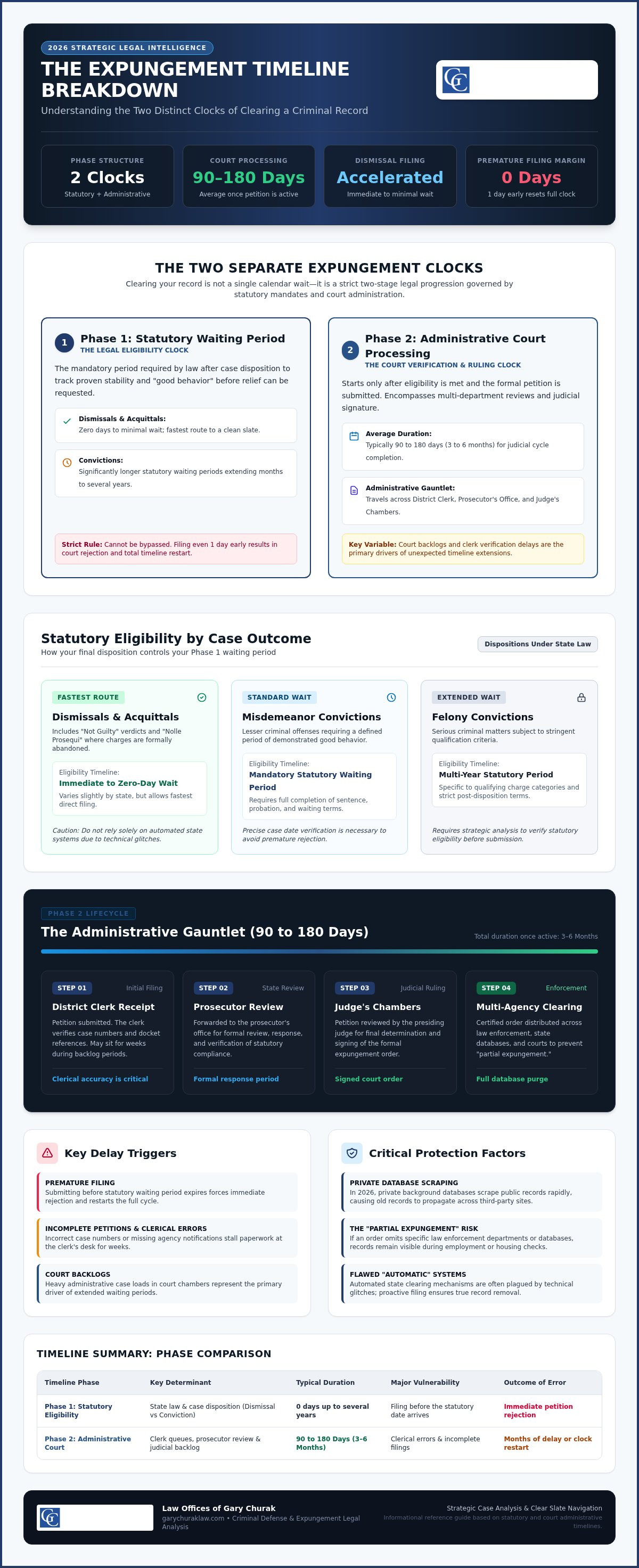
Laws require a specific amount of time to pass after a case is "disposed" before you can even ask for relief. These waiting periods exist because the state maintains an interest in tracking "good behavior" over a set duration. Essentially, the statutory waiting period is the time required before a petition is legally valid. Depending on the nature of the charge, this could range from zero days for certain acquittals to several years for specific convictions. You cannot bypass this clock; you can only prepare to strike the moment it expires. Precise case analysis during this phase is what separates successful petitions from those that are rejected for being premature.
Phase 2: The Administrative Processing Timeline
Once you're eligible and your petition is filed, a new clock starts. This is the administrative phase where your paperwork travels through a gauntlet of desks, including the district clerk, the prosecutor’s office, and finally, the judge’s chambers. Even in 2026, court backlogs remain the primary reason for unexpected delays. A petition might sit for weeks simply waiting for a clerk to verify a case number. Professional criminal defense attorney oversight prevents clerical errors that would otherwise force you to restart this entire timeline from scratch. When you account for these administrative hurdles, the answer to how long does the expungement process take usually lands between three and six months for the court phase alone.
Statutory Waiting Periods: How Long Until You Are Eligible?
Before the court ever reviews your petition, you must satisfy the statutory waiting period. This is the "eligibility clock" that dictates when you are legally permitted to ask for relief. Determining how long does the expungement process take begins with identifying your eligibility date, which is set by state law rather than court schedules. According to the Legal Information Institute's overview of expungement, the authority to clear a record is strictly governed by these statutory standards. If you file even one day before this period expires, the court will likely reject your petition, forcing you to restart the entire administrative cycle.
The state demands a period of proven stability before granting relief. If you're unsure which clock applies to your case, a personalized consultation provides the clarity you need to avoid premature filing errors. Your specific timeline depends heavily on the final disposition of your case; whether it was dismissed, acquitted, or resulted in a conviction.
Timelines for Dismissed Charges and Acquittals
Cases that end in a "Not Guilty" verdict or a dismissal are generally the fastest route to a clean slate. In many jurisdictions, you are eligible to file for expungement immediately or shortly after the final judgment is entered. This includes cases marked as "Nolle Prosequi," where the prosecutor formally abandons the charges. While some states in 2026 have introduced "automatic" expungement for these scenarios, these systems are often plagued by technical glitches. You shouldn't rely on the government to fix your record automatically; proactive filing remains the only way to guarantee your background check is cleared.
Waiting Periods for Misdemeanors vs. Felonies
Convictions carry much longer waiting periods, typically requiring three to ten years of "clean" time. For misdemeanors, you might wait one to five years after successfully completing all terms of your probation. Felonies are more complex. High-level offenses often require a decade of perfect conduct, and some may even require a governor’s pardon before expungement is an option. A critical factor here is "Waiting Period Tolling." If you incur new charges during your waiting period, the clock often stops or resets entirely. This makes maintaining a clean record during the wait non-negotiable.
You must also account for the "Unit Rule." If you were charged with multiple offenses during a single incident, many courts treat them as a single unit. If one charge in that unit is ineligible for expungement, it can prevent the others from being cleared, regardless of how much time has passed. Thorough case analysis is the only way to navigate these jurisdictional traps and secure a successful outcome.
The Step-by-Step Administrative Process and Filing Timeline
Once you confirm your eligibility, the focus shifts from statutory waiting to administrative action. This phase is where many individuals lose momentum because they underestimate the logistical demands of the court system. To accurately answer how long does the expungement process take, you must look at the administrative gauntlet that follows your initial decision to file. This journey involves multiple government agencies, each with its own internal schedule and potential for delay. Understanding the court procedures for cleaning a record is essential to ensure your petition doesn't languish on a clerk's desk for months.
Gathering Necessary Documentation
Thorough case analysis begins with obtaining every law enforcement and court record related to your incident. You must gather certified copies of your final disposition, which typically takes between two and four weeks. This timeline can extend significantly if your records are archived in older, manual systems or stored in off-site facilities. When a court relies on paper files from a decade ago, retrieval becomes a manual task for a busy clerk. A seasoned expungement lawyer expedites this document retrieval phase by knowing exactly which agencies hold the specific data points required for a valid petition.
The Role of the Court Hearing
After filing the formal petition with the court of record, the state enters its review period. Most jurisdictions grant the prosecutor a 30-to-60-day window to file a formal objection. If the prosecutor agrees with the petition, the case may proceed via an "Agreed Order." In these instances, the judge signs the order without a formal hearing, which is the fastest way to conclude the court's portion of the timeline. However, if the prosecutor objects, a hearing becomes mandatory. This often adds three to six months to the schedule as you wait for an available slot on the court's contested docket.
The judge's signature on the final order officially ends the court's involvement. It is a moment of profound relief, but it doesn't mean your record disappears instantly from every database. This signature triggers the final administrative stage: the notification of law enforcement agencies and private background check companies. While the court's work is done, the practical effect of the expungement relies on the thoroughness of these final notifications. Ensuring every relevant agency receives and processes the judge's order is the final hurdle in your strategic timeline.
Factors That Can Accelerate or Delay Your Petition
While the national average for court processing typically falls between 90 and 180 days, several variables can drastically alter your specific schedule. When clients ask how long does the expungement process take, they're often surprised to learn that the "human factor" plays a massive role. Clerk's office staffing levels, judicial vacation schedules, and even the start of a new fiscal year can shift your timeline by weeks or months. For instance, filing at the start of a fiscal year when budgets are refreshed sometimes helps move paperwork through administrative channels more efficiently than during year-end lulls.
Incomplete petitions are the primary reason for administrative rejection. If a single case number is transcribed incorrectly or a prior alias is omitted, the court will likely return the filing, forcing a complete timeline restart. This risk increases significantly with multi-jurisdictional records. If you have charges in different counties, you aren't managing one clock; you're managing several. Each county operates on its own calendar, and a delay in one jurisdiction won't necessarily pause the other, creating a complex web of overlapping deadlines.
Common Administrative 'Black Holes'
Paperwork often falls into "black holes" due to simple clerical oversight. Aggressive advocacy is required to ensure your file stays on top of the stack. A major hurdle is the notification phase. Once an order is signed, the court must notify agencies like the FBI, state police, and local law enforcement. A single missing agency notification can leave the record visible to certain employers, effectively nullifying the expungement's benefits. Furthermore, you must account for the "Post-Expungement Gap." Private background check companies often take an additional 30 to 90 days to update their databases after the official court order is processed.
Methods to Expedite the Process
You can take proactive steps to move your petition to the front of the line. Securing a "Waiver of Objection" from the prosecuting attorney is the most effective way to skip the 60-day waiting period for a hearing. Additionally, you should ensure all fines, fees, and restitution are paid in full months before you file. If the court discovers an outstanding balance of even five dollars, they'll likely halt the process immediately. To identify these red flags before they become delays, scheduling a criminal defense consultation is a critical first step. Professional scrutiny ensures your filing is bulletproof from day one.
Don't leave your future to chance or bureaucratic whim. If you're ready to clear your record without the typical delays of a DIY filing, contact the Law Offices of Gary Churak for a thorough case analysis today.
Securing Your Future: Why Professional Advocacy Matters
Navigating the court system alone carries a significant risk: the "Partial Expungement." Many DIY filers believe they've succeeded once a judge signs an order, only to discover months later that secondary records still appear on background checks. When you ask how long does the expungement process take, you must consider the time it takes to achieve a result that's both complete and permanent. Professional advocacy ensures every law enforcement agency, from the local precinct to federal databases, is properly served with the final order. This precision is what prevents a record from lingering in the shadows of a background check.
Your professional reputation is your most valuable asset. In 2026, where digital data is traded like currency, a single error in your petition can leave you vulnerable for years. By leveraging over 40 years of legal experience, the firm provides a streamlined, error-free process that addresses the root cause of record persistence rather than just the surface-level court filing.
The Post-Expungement Update Gap
The "Private Database Problem" remains one of the most frustrating aspects of the legal journey. Even after a court clears your record, private data aggregators may continue to sell outdated information to employers. A strategic legal approach doesn't end in the courtroom; it involves ensuring the "Order of Expungement" reaches these private entities effectively. You should set realistic expectations for the 30 to 90 days following a judge's order. During this window, your advocate monitors the transition to ensure the public record reflects your new status, preventing old mistakes from resurfacing during a critical job interview.
Aggressive Advocacy for a Permanent Solution
Protecting your future requires a battle-tested guide who understands the final bureaucratic hurdles. We prioritize a thorough case analysis that identifies potential pitfalls before they cause a timeline restart. We don't just aim for a sealed record; we work to make it effectively invisible to public scrutiny. This level of scrutiny is what separates a temporary fix from a permanent solution. You deserve the peace of mind that comes with knowing the job was done correctly the first time.
Taking the first step is often the most difficult part of the journey. However, a personalized consultation provides the strategic roadmap necessary to navigate the complexity of the court system with confidence. You don't have to face the state's attorneys or the clerk's office alone. Contact the Law Offices of Gary Churak today for a strategic case review and begin the process of reclaiming your future.
Take Control of Your Criminal Record Timeline
A criminal record shouldn't be a life sentence that dictates your professional potential. By distinguishing between statutory eligibility and administrative court cycles, you've already gained a strategic advantage over the bureaucratic system. Understanding exactly how long does the expungement process take is the first step toward reclaiming your freedom. You now know that while the court phase typically spans 90 to 180 days, the precision of your initial filing determines whether you cross the finish line or face a frustrating restart.
Success in these high-stakes situations requires more than just filling out forms; it demands a battle-tested guide. With over 40 years of legal experience, the Law Offices of Gary Churak provides the aggressive advocacy and personalized case analysis needed to navigate complex court systems. Don't let administrative errors or "partial expungements" jeopardize your second chance. Schedule your free strategic consultation with Gary Churak today to ensure your record is sealed correctly the first time. Your clean slate is within reach, and the right preparation makes all the difference.
Frequently Asked Questions
How long do I have to wait if my case was dismissed?
Dismissed cases often allow for immediate filing, but the administrative processing still takes time. If the prosecutor entered a "Nolle Prosequi" or the judge dismissed the charges, you don't face the multi-year statutory waiting periods associated with convictions. You can submit your petition as soon as the final judgment is entered. However, the court still requires the standard 90 to 180 days to process the paperwork and notify relevant law enforcement agencies.
Can I speed up the expungement process if I have a job offer?
There is no official "fast track" for job seekers, but strategic actions can reduce delays. You can't force a judge to move faster, but securing a "Waiver of Objection" from the prosecutor can eliminate the mandatory 60-day waiting period for a hearing. Ensuring your petition is error-free prevents the administrative clock from restarting. Aggressive advocacy ensures your file doesn't sit idle on a clerk's desk while your start date approaches.
What is the average total time from filing to a clean record?
The national average for court processing usually falls between 90 and 180 days. When calculating how long does the expungement process take, you must include the two weeks needed to gather records and the 30 to 90 days for private background check companies to update their databases. Total time from your initial decision to a completely clear background check often spans six to nine months depending on court backlogs.
Will an expungement clear my record with the FBI and federal agencies?
A state-level expungement order directs the state's central repository to notify the FBI to update their records. While the FBI generally complies by sealing or removing the specific state entry, this process does not clear federal criminal convictions. Federal crimes require a separate, much more difficult process through the federal court system or a presidential pardon. State advocacy ensures the notification reaches federal aggregators, but it only applies to state charges.
What happens if my expungement petition is denied?
If a judge denies your petition, the reason is usually procedural or statutory. Common issues include filing before the eligibility window opens or failing to disclose a prior alias. You can often refile after the specified waiting period or once the clerical error is corrected. A thorough case analysis before your first attempt prevents these denials, saving you months of wasted time and additional filing fees in the future.
Does the expungement process take longer for felonies than misdemeanors?
Felony cases generally have a longer total timeline due to extended statutory waiting periods. While the administrative court phase is similar for both, a felony conviction might require a 10-year wait compared to just one year for a minor misdemeanor. The complexity of felony records also increases the risk of prosecutor objections. This adds time to the schedule because a contested hearing becomes more likely than an "Agreed Order" signed in chambers.
How long does it take for a background check company to update their records?
Private background check companies typically take 30 to 90 days to update their records after a judge signs the order. These companies buy data in bulk and don't always refresh their systems daily. Even after the court clears your name, an outdated report might still appear during a screening. Providing a certified copy of the expungement order directly to the reporting agency can sometimes force a faster update of your professional profile.
Do I need to go to court for my expungement hearing?
You don't always have to appear in court for an expungement. If the prosecutor agrees to the petition, the judge can sign an "Agreed Order" without a formal hearing. This is the most efficient outcome and saves several weeks of scheduling delays. However, if the state files a formal objection, a hearing becomes mandatory. In those instances, your presence may be required to testify about your conduct since the case was disposed.


