

The price of your freedom shouldn't be a financial ransom, yet for many, the bail system feels exactly like that. When a loved one is behind bars, the primary concern is the clock ticking while you struggle with a figure that seems impossible to pay. Understanding how a lawyer can help with bail is the first step toward reclaiming control over a situation that feels entirely out of reach. You aren't just looking for a way to pay; you're looking for a way to challenge the necessity of the amount itself through professional scrutiny and legal expertise.
It's natural to feel overwhelmed by the confusion between bail bonds and court motions, especially with 2026 federal legislation like the "Keeping Violent Offenders Off Our Streets Act" tightening the rules for release. You deserve a defense that prioritizes your freedom through strategic advocacy rather than just financial brokering. This guide explains how a seasoned criminal defense attorney uses legal motions to secure your release and reduce excessive bail amounts. We will examine your constitutional rights to "reasonable bail," the critical difference between bond agents and legal advocacy, and the specific steps an expert takes to bring you home safely and quickly.
Key Takeaways
- Understand your constitutional protection under the Eighth Amendment, which guards against excessive bail and ensures you aren't held under unreasonable financial burdens.
- Discover how a lawyer can help with bail by aggressively challenging the prosecution’s arguments and presenting a compelling case for your release during the initial hearing.
- Learn how to utilize a Motion to Reduce Bail to adjust a prohibitively high amount, ensuring your pre-trial release is based on your actual risk rather than arbitrary figures.
- Explore how early legal intervention protects your long-term defense by allowing you to prepare for trial from the stability and confidentiality of your own home.
- Gain clarity on navigating the complexities of bail bonds and court-mandated conditions with a seasoned expert who coordinates the logistics of your release.
The Mechanics of Bail and the Constitutional Right to Release
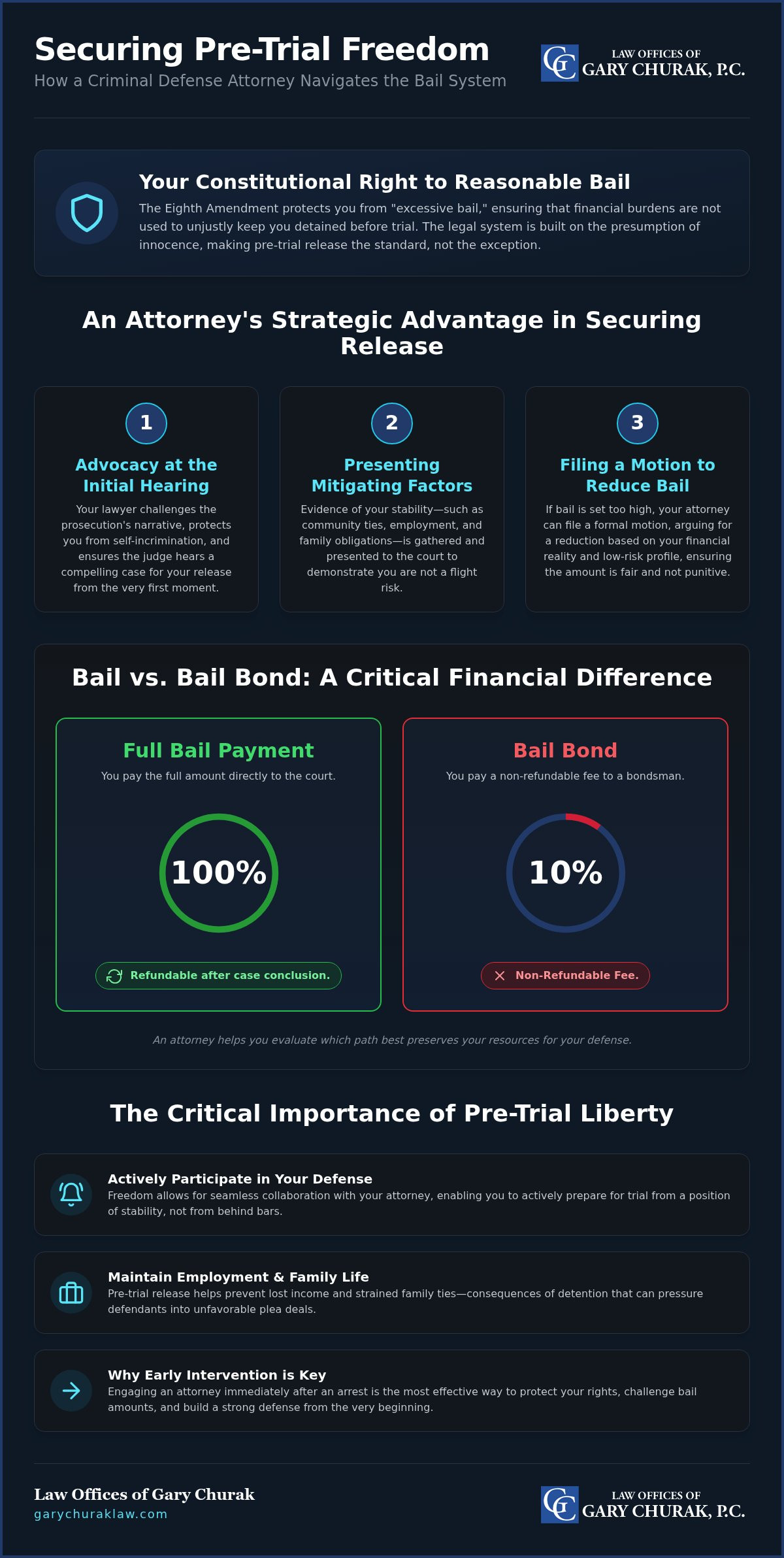
Bail serves as a critical bridge between an arrest and a trial. It is a set of conditions, often involving a financial deposit, intended to guarantee that a defendant will appear for all future court proceedings. This mechanism is a fundamental part of Bail in the United States. Under the Eighth Amendment of the Constitution, every individual is protected against "excessive bail." This national standard ensures that the court cannot impose a financial burden so extreme that it serves as a back-door method for indefinite detention. The primary goal of the legal system is to balance public safety with the bedrock principle of the presumption of innocence.
Pre-trial detention should be the exception, not the rule. When judges consider release, they must weigh the risk of flight against the rights of the accused. This is where understanding how a lawyer can help with bail becomes essential. An experienced advocate ensures the court views you as an individual with community ties and a stable background rather than just a case number on a docket.
Bail vs. Bail Bonds: Understanding the Critical Difference
Distinguishing between bail and a bail bond is vital for managing your finances during a crisis. Bail refers to the full amount of money set by the court. If you pay this amount in full, the court holds it as a security deposit and returns it once the case concludes, provided all appearances are met. In contrast, a bail bond involves a third-party guarantor. You typically pay a non-refundable fee, which is often 10% of the total bail amount, to a bondsman who then guarantees the full amount to the court. While bonds make release more accessible for high amounts, that fee is money you'll never recover. A strategic attorney helps you evaluate which path preserves your resources for the upcoming legal battle.
The Presumption of Innocence and Pre-Trial Liberty
The legal system prioritizes freedom while a case is pending because an accused person is legally innocent until proven guilty. Maintaining your liberty is not just a matter of comfort; it's a tactical necessity. Being out on release allows for seamless collaboration with a criminal defense attorney, facilitating frequent meetings and active participation in your defense strategy. Pre-trial detention often leads to lost employment and strained family ties, which can inadvertently pressure defendants into unfavorable plea deals. Determining how a lawyer can help with bail involves using these constitutional protections to argue for lower amounts or non-financial release conditions. Securing your release preserves your stability and provides the psychological strength needed to face the prosecution from a position of power.
How an Attorney Advocates During the Initial Bail Hearing
The initial bail hearing is the first critical crossroads in any criminal case. It's the moment when a judge determines whether you return home or remain in custody while your case proceeds. The stakes are high. Without legal representation, the court often relies solely on the prosecution’s summary of the charges, which is designed to make you appear as a risk. This is exactly how a lawyer can help with bail; they enter the courtroom prepared to disrupt that narrative before the judge makes a final ruling.
Having counsel present ensures that your constitutional rights are actively defended. Your attorney acts as a shield, preventing you from making statements that the prosecution could later use against you. Silence is your best defense during these proceedings. Judges value the presence of an experienced advocate because it signals that the defendant is taking the process seriously and has the professional support to comply with court orders. An attorney’s presence alone can shift the atmosphere of the hearing from one of routine processing to one of rigorous legal scrutiny.
Presenting Mitigating Factors to the Court
A judge’s primary concern is whether a defendant will return to court. To address this, your lawyer gathers evidence of stability that the prosecution typically ignores. We highlight long-term employment, deep community ties, and family obligations that make flight nearly impossible. If you have a minimal or non-existent criminal record, your attorney presents this as evidence of your reliability. By humanizing the defendant through concrete facts, a lawyer transforms a case file into a person with a life worth returning to. This level of detail often leads to a significant reduction in the bail amount or release on personal recognizance.
Refuting "Flight Risk" and "Danger to the Community" Claims
Prosecutors frequently use the labels of "flight risk" or "danger to the community" to justify excessive bail or total detention. An assertive lawyer refutes these characterizations by scrutinizing the actual evidence behind the claims. If the court remains concerned, your attorney can propose less restrictive monitoring methods such as GPS tracking, regular check-ins, or travel restrictions. Identifying these strategic arguments starts early, often during an initial criminal defense consultation. By offering the judge a pragmatic middle ground between high bail and release, your lawyer creates a clear path for you to go home. If you are facing these high stakes right now, consider requesting a personalized consultation to begin building your defense.
Strategic Legal Motions to Reduce Excessive Bail
The initial bail amount set by a judge is not always a final decision. If the court imposes a figure that is realistically unreachable, it often functions as a de facto detention order, which may violate the constitutional protections discussed earlier. This is a critical stage where understanding how a lawyer can help with bail becomes a game changer. A seasoned attorney does not simply accept an oppressive bail amount; they utilize specific legal motions to force the court to reconsider its decision based on your actual financial reality and background.
In many jurisdictions, an attorney can request a "de novo" hearing. This procedural move allows a different or higher court to review the bail decision from scratch, without being bound by the previous judge’s ruling. It provides a fresh opportunity to present your case to a new set of eyes, often leading to more favorable outcomes when the initial judge was overly cautious or influenced by aggressive prosecution tactics. Your lawyer’s role here is to demonstrate that the current bail is not just high, but legally oppressive and unnecessary to ensure your return to court.
Filing a Motion for Bail Reduction
A Motion to Reduce Bail is a formal request to adjust bail based on new evidence or financial hardship. To succeed, your attorney meticulously builds a case for why the current amount is excessive. This process involves gathering and presenting specific evidence to the court, including:
- Detailed financial records showing your inability to pay the set amount.
- Sworn testimony from family members regarding your community ties.
- Character references from employers or community leaders.
- Proof of medical needs or family obligations that require your presence at home.
By presenting this data, your lawyer provides the judge with a logical path to lower the financial barrier to your freedom.
The Writ of Habeas Corpus in Bail Disputes
When standard motions fail or procedural delays keep you behind bars indefinitely, a seasoned attorney may turn to a more powerful legal tool: the Writ of Habeas Corpus. This high-level legal maneuver is a direct challenge to the legality of a person’s detention. In the context of bail, it argues that the court is holding the defendant unlawfully because the bail amount is so high it is unconstitutional. While many lawyers rely only on standard motions, using a Writ can bypass standard procedural delays and force an immediate judicial review of the detention. This aggressive stance reflects the role of a fierce protector who refuses to let a client languish in jail due to an arbitrary or punitive bail setting. Understanding how a lawyer can help with bail through these advanced tactics is what separates a routine defense from a strategic, result-oriented advocacy.
Beyond the Courtroom: Navigating Bail Bonds and Conditions
A lawyer's involvement doesn't end once the judge sets a bail amount. While an attorney does not typically pay the bail for you, they serve as a vital navigator through the logistical maze that follows. Understanding how a lawyer can help with bail means recognizing their role in vetting the financial and behavioral obligations you are about to assume. They ensure that the terms of your release don't inadvertently set you up for failure before your trial even begins.
Legal counsel acts as a bridge between the court's requirements and your practical reality. Once bail is set, the focus shifts to meeting those requirements without compromising your rights or your financial future. Your attorney's job is to ensure that every document you sign and every condition you agree to is in your best interest. This protective stance is essential for maintaining your stability while your case is pending.
Coordinating with Reputable Bail Bondsmen
The bail bond industry can be complex, and families in crisis are often vulnerable to predatory practices. An experienced attorney provides a layer of protection by coordinating with reputable bondsmen who maintain professional standards. Your lawyer reviews the bonding paperwork to ensure it is legally sound and does not include clauses that could complicate your defense. For example, some bondsmen might require check-in schedules that conflict with your work or legal meetings. A lawyer negotiates these details, ensuring the bonding requirements align with your overall defense strategy rather than working against it.
Negotiating Personal Recognizance (PR) and Non-Monetary Release
The most favorable outcome for any defendant is "Release on Recognizance" (ROR) or a "Personal Recognizance" (PR) bond. This is essentially a signature bond where no upfront cash is required. Your lawyer argues for this by demonstrating your reliability and lack of flight risk. When cash bail is unavoidable, an attorney can still negotiate for non-monetary conditions that might lower the total financial burden. These conditions might include:
- Regular telephonic check-ins with pre-trial services.
- Maintaining current employment or educational status.
- Surrendering a passport rather than paying a higher cash amount.
- Agreement to participate in specific counseling or monitoring programs.
A lawyer balances these court-ordered conditions with your ability to maintain a productive life. If the conditions are too restrictive, such as 24-hour house arrest for a primary breadwinner, your advocate fights for a more pragmatic middle ground. This level of logistical scrutiny is a hallmark of a seasoned expert who understands how a lawyer can help with bail beyond just the initial hearing. If you need a fierce protector to navigate these complex requirements, contact the Law Offices of Gary Churak to discuss your options.
Why Early Legal Intervention is Critical for Your Defense
Securing your freedom is the first major victory in a criminal case, but it's only the beginning of a much larger battle. Understanding how a lawyer can help with bail is essential, but recognizing the value of their immediate intervention is what truly preserves your future. When you're out on bail, you gain the ability to meet with your legal team in a confidential, comfortable environment rather than through a plexiglass partition. These frequent and private consultations allow for a level of detail and strategy that's simply impossible to achieve while in custody.
The psychological advantage of fighting a case from home cannot be overstated. Detention creates a sense of desperation that often leads to rushed decisions or ill-advised plea deals. By returning to your family and your job, you approach your defense from a position of strength and clarity. This stability is the foundation of a resilient defense. Because the stakes are so high from the very first hour, choosing a criminal defense attorney immediately is the most vital decision you'll make.
Protecting Rights During Custodial Interrogation
The period between an arrest and a bail hearing is fraught with risk. Law enforcement officers often use this time to conduct custodial interrogations, hoping to secure self-incriminating statements before you've spoken to an advocate. Your lawyer monitors police conduct during the booking process to ensure no procedural shortcuts are taken. An attorney provides a protective barrier between the accused and law enforcement from the moment of arrest. This early presence ensures you don't inadvertently damage your case before how a lawyer can help with bail even becomes the primary focus.
From Release to Resolution: Building the Long-Term Defense
A successful pre-trial release provides the "breathing room" necessary for a thorough evidence review. Once you're home, your attorney can transition from the immediate crisis of the bail hearing to the complex discovery phase. We use this time to interview witnesses, scrutinize forensic data, and identify weaknesses in the prosecution's narrative. The momentum of a successful bail hearing often carries into plea negotiations; a judge’s decision to grant release signals that the defense has already successfully challenged the prosecution’s initial characterization of the defendant. This early win sets a professional, assertive tone for every court appearance that follows, leading you toward a more favorable resolution.
Reclaim Your Freedom and Protect Your Future
Navigating the bail system requires more than just financial resources; it demands a strategic legal architect who understands how to leverage your constitutional rights. We've explored how the Eighth Amendment guards against excessive bail and how specific motions, like the Writ of Habeas Corpus, can bypass procedural delays to restore your liberty. Release is not just a matter of comfort. It's a tactical necessity that allows you to build a resilient defense from the stability of your own home while maintaining your employment and family ties.
Understanding how a lawyer can help with bail is the first step toward shifting the momentum of your case in your favor. Gary Churak provides aggressive advocacy for pre-trial release, backed by over 40 years of criminal defense experience in high-stakes legal matters. You deserve a fierce protector who knows when to negotiate and when to take a forceful stance against oppressive bail settings. Don't let an unreachable financial figure dictate the course of your life. Schedule a Free Consultation with the Law Offices of Gary Churak today to secure the expert guidance you need. Your journey toward a resolution starts with the steady hand of a battle-tested advocate.
Frequently Asked Questions
How can a lawyer help with bail reduction if the amount is too high?
An attorney files a formal Motion to Reduce Bail to demonstrate that the set amount is unreachable and violates your constitutional protections. They present evidence of financial hardship, stable employment, and deep community ties to prove that a lower amount still ensures your return to court. By highlighting these mitigating factors, your lawyer provides the judge with a logical reason to adjust the figure to something manageable for your family.
What is the difference between bail and a bail bond in the legal process?
Bail is the full financial amount paid directly to the court as a security deposit, which is typically refundable after the case ends. A bail bond involves a third-party company that guarantees the full amount to the court in exchange for a non-refundable fee, usually 10% of the total bail. Understanding how a lawyer can help with bail involves analyzing which option best preserves your financial resources for your defense.
Can a lawyer get someone out of jail without paying any bail?
Yes, an attorney can argue for "Release on Recognizance" (ROR) or a "Personal Recognizance" bond, which allows for release based solely on a signature. This outcome is achieved by proving the defendant has no significant criminal history and strong ties to the community. Lawyers highlight these factors to reassure the judge that the defendant isn't a flight risk, eliminating the need for a cash deposit entirely.
What happens if I cannot afford the bail amount set by the judge?
If you cannot afford the bail, your lawyer can challenge the amount as "excessive" under the Eighth Amendment. They may file a motion for reduction or, in extreme cases, a Writ of Habeas Corpus to contest the legality of your detention. Without this intervention, you might remain in custody indefinitely. An advocate works to find a middle ground, such as non-monetary conditions or electronic monitoring, to secure your release.
How long does it typically take for a lawyer to get a bail hearing?
While timing varies by jurisdiction, an initial bail hearing often occurs within 24 to 48 hours of an arrest. A lawyer can often expedite this process by filing an emergency motion or coordinating directly with the court clerk. Their early presence ensures that your case is prioritized and that the hearing isn't delayed by missing paperwork or administrative errors. Prompt action is critical to preventing unnecessary time spent in a cell.
Does hiring a private lawyer speed up the pre-trial release process?
Hiring a private attorney often speeds up the process because they provide personalized, immediate attention to your specific case. Unlike public defenders who manage high caseloads, a private lawyer can dedicate time to gathering evidence of your stability and filing motions the moment they're needed. This focused advocacy ensures that the court hears your request for release as early as possible, often leading to a faster return home.
What are common conditions of pre-trial release that a lawyer can negotiate?
Lawyers negotiate various non-monetary conditions to convince a judge that release is safe. These may include regular check-ins with pre-trial services, travel restrictions, or the surrender of a passport. Other common conditions include maintaining current employment or participating in counseling programs. Your attorney ensures these rules are realistic and don't interfere with your ability to support your family or collaborate on your defense strategy.
Can an attorney help if a bail bond company denies my application?
If a bail bond company denies your application, an attorney can intervene by identifying more reputable bondsmen or negotiating better terms. They can also return to the court to argue that the denial proves the bail amount is unreachable and therefore unconstitutional. This may lead the judge to reconsider the amount or approve a personal recognizance bond, ensuring that a private company's decision doesn't result in your continued detention. Knowing how a lawyer can help with bail in these scenarios is vital.


