

The moment the handcuffs click shut, the state of Texas has already begun its case against you, but your arrest is merely the start of a fight, not the conclusion of your story. You're likely grappling with a paralyzing fear of losing your license or spending time behind bars. Understanding exactly what happens after a dwi arrest in texas is the only way to replace that anxiety with a focused, strategic defense. While the pressure is high, taking immediate action can prevent a single mistake from defining the rest of your life.
We understand that the legal process feels like a complex battle designed to keep you in the dark. This guide provides the clarity you need to navigate the 2026 legal landscape, from the urgent 15-day ALR hearing deadline to the complexities of a criminal trial. We'll outline the steps required to retain your driving privileges, avoid a permanent criminal record, and understand the full timeline of your case. With over 40 years of experience acting as a battle-tested guide, we're here to ensure you move forward with a clear plan and the protection you deserve.
Key Takeaways
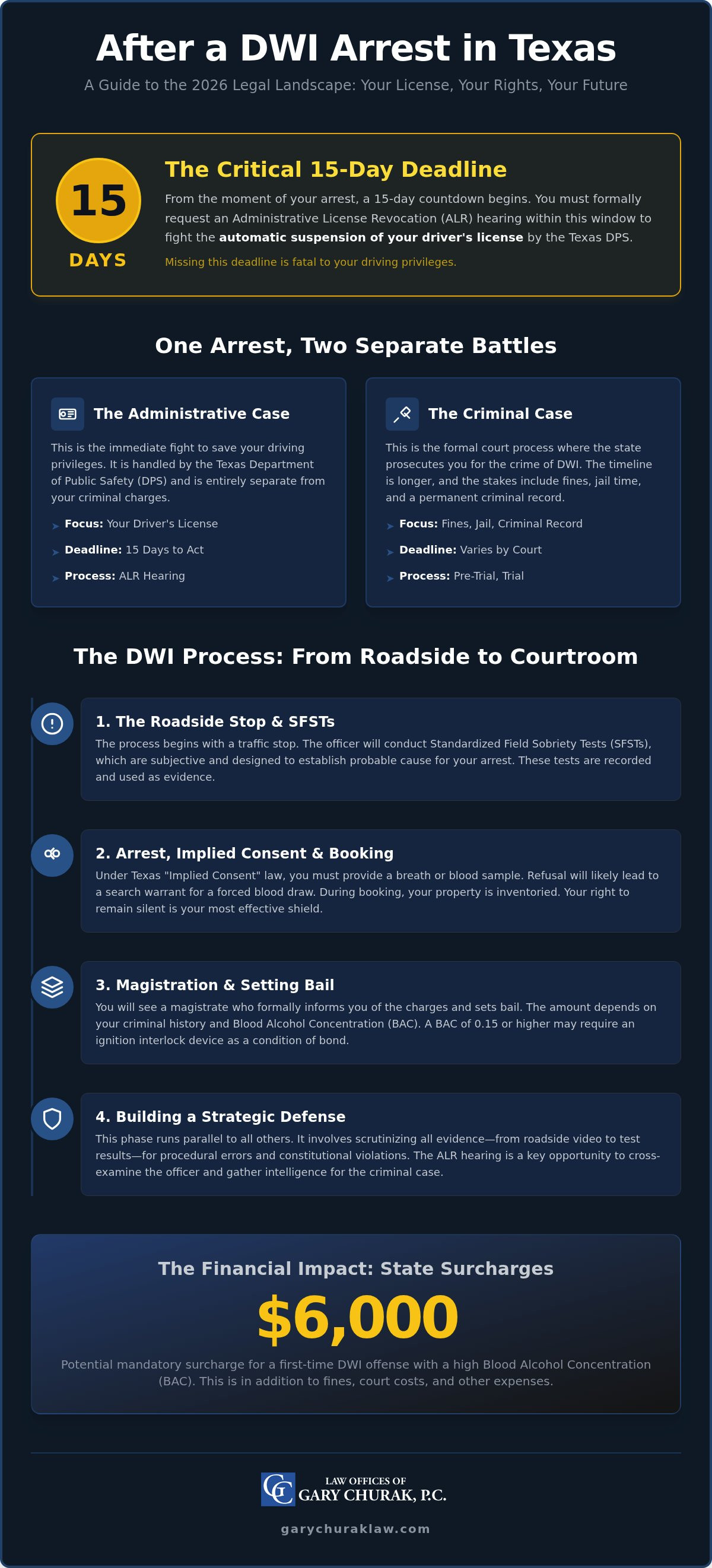
- Act immediately to request an Administrative License Revocation (ALR) hearing within 15 days to prevent the automatic suspension of your driving privileges.
- Understand the dual nature of what happens after a dwi arrest in texas by distinguishing between your administrative license case and your separate criminal court proceedings.
- Prepare for significant financial impacts, including mandatory state surcharges that can reach $6,000 for a first-time offense with a high blood alcohol concentration.
- Identify how to challenge the state's evidence by scrutinizing roadside sobriety tests and police video for procedural errors or constitutional violations.
- Navigate the complex pre-trial timeline with a strategic defense designed to protect your future and avoid a permanent criminal record.
The Immediate Aftermath: From Handcuffs to Jail Release
The roadside stop sets the tone for your entire case. Most people feel intense pressure to perform during Standardized Field Sobriety Tests (SFSTs), which include the Horizontal Gaze Nystagmus, the Walk and Turn, and the One-Leg Stand. These tests are highly subjective. Officers look for specific "clues" of impairment to establish probable cause for your arrest. Understanding what happens after a dwi arrest in texas requires recognizing that these initial moments are documented on camera and will be used as the primary evidence against you in court.
Texas operates under "implied consent" laws. By driving on public roads, you've already agreed to provide a breath or blood sample if arrested for intoxication. This is a foundational part of Texas alcohol laws. If you refuse, the state will likely seek a search warrant to take your blood forcibly. During the booking process, your personal property is inventoried, and you're fingerprinted and photographed. This initial 24-hour period is critical. Securing a criminal defense attorney early can streamline your release and ensure you don't inadvertently provide incriminating statements during the intake process.
Intoxication Testing and Your Rights
The handheld breathalyzer used at the scene is often just a screening tool. The evidentiary test happens later at the station or a hospital. In 2026, many jurisdictions operate under a permanent "No Refusal" policy, meaning judges are available around the clock to sign blood search warrants. While you must comply with a warrant, you have no obligation to answer questions about where you were or how much you drank. Silence is your most effective shield against self-incrimination while in custody.
Magistration and Setting Bail
Once booked, you'll see a magistrate. This official informs you of the formal DWI charges and sets your bail. The amount isn't arbitrary. The court considers your prior criminal history and your Blood Alcohol Concentration (BAC) levels. If your BAC was 0.15 or higher, the magistrate might require an ignition interlock device as a condition of bond. Getting out of jail quickly is the first priority. It allows you to meet the strict deadlines for your driver's license defense and begins the process of analyzing the state's evidence for flaws.
The 15-Day Rule: Protecting Your Texas Driver’s License
The state of Texas doesn't wait for your first court date to begin penalizing you. Most drivers don't realize that a DWI arrest triggers two completely separate legal battles that run on different tracks. While the criminal case moves through the court system, the administrative case regarding your license starts the second you're processed. If you fail to act within 15 days of your arrest, the Texas Department of Public Safety (DPS) will automatically suspend your license. This is often the most stressful part of what happens after a dwi arrest in texas because it directly threatens your livelihood, your family commitments, and your daily independence. Understanding what happens after a dwi arrest in texas in the 2026 legal landscape involves more than just court dates; it requires mastering the administrative clock.
Requesting the ALR Hearing
Preserving your right to drive requires precision and speed. You must follow these steps to halt the automatic suspension:
- Locate your DIC-25: This is the "Notice of Suspension" document the officer likely gave you. It serves as your temporary permit for 40 days.
- Submit the Request: You must send a formal written request for an Administrative License Revocation (ALR) hearing to the DPS within 15 calendar days. Missing this by a single day is fatal to your driving privileges.
- Subpoena the Officer: Your attorney should request the presence of the arresting officer at the hearing to ensure they are available for questioning.
Strategic Advantages of the ALR Hearing
The ALR hearing is far more than a bureaucratic hurdle; it is a powerful discovery tool. Under Texas Penal Code Chapter 49, the state must prove specific elements of intoxication. At the hearing, we cross-examine the officer under oath to lock in their testimony and identify flaws in their procedure. We use this time to obtain police reports and video evidence early. Even if the suspension is upheld, an Occupational Driver’s License (ODL) can keep you on the road for essential needs. If you're feeling overwhelmed, reaching out for a case evaluation can help you secure your rights before they expire.
Navigating the Texas Criminal Court Timeline
Once you've secured your release and addressed the immediate threat to your license, the focus shifts to the criminal judiciary. The court process is a methodical sequence of events designed to determine your guilt or innocence. It begins with the Arraignment, where you receive formal notice of the charges against you. We typically enter a plea of "Not Guilty" at this stage. This isn't just a formality; it's a strategic move that forces the state to prove every element of its case and triggers your right to see the evidence. Understanding what happens after a dwi arrest in texas means recognizing that the state's case must survive intense scrutiny to stand.
Following the arraignment, your case moves into Pre-Trial Announcement Settings. These aren't just dates on a calendar for scheduling. They are critical opportunities for your attorney to negotiate with the prosecution while building your defense. During this phase, we enter the Discovery Phase. We demand every piece of evidence the state intends to use, including dashcam footage, bodycam video, and forensic lab maintenance logs. A seasoned dwi defense attorney scrutinizes these materials to find the procedural errors that often lead to reduced charges or case dismissals.
Class A vs. Class B DWI Misdemeanors
Texas law categorizes first-time offenses based on your Blood Alcohol Concentration (BAC). A Class B misdemeanor applies when your BAC is below 0.15. This carries a fine of up to $2,000 and up to 180 days in jail. However, if your BAC is 0.15 or higher, the charge is enhanced to a Class A misdemeanor. This increases potential jail time to one year and triggers a $6,000 state fine. These enhancements significantly change the stakes, requiring a more aggressive approach to challenge the accuracy of the chemical testing and the state's narrative.
Motion to Suppress and Pre-Trial Hearings
The most powerful tool in your defense is often the Motion to Suppress. We use this to challenge the legality of the initial traffic stop under the Fourth Amendment. If the officer lacked reasonable suspicion to pull you over, any evidence gathered afterward is "fruit of the poisonous tree" and cannot be used against you. We also question the reliability of breathalyzer calibration and blood draw protocols. When a judge rules this evidence inadmissible, the state's case often collapses. This level of scrutiny is essential for anyone wondering what happens after a dwi arrest in texas and seeking a path toward a dismissal.
Texas DWI Penalties: Fines, Jail, and Surcharges
A conviction carries weight that lasts far beyond your final court appearance. While a judge may impose a fine of up to $2,000 for a first-time Class B misdemeanor, this is only the surface of the financial burden. Texas law mandates additional state fines, often called surcharges, which range from $3,000 to $6,000 upon conviction. These "super fines" are non-negotiable and apply even to first-time offenders. When people ask what happens after a dwi arrest in texas, they're often shocked to find the total cost can exceed $10,000 after factoring in court costs, surcharges, and monthly fees.
Judges frequently require an Ignition Interlock Device (IID) as a condition of bond or probation. If your BAC was 0.15 or higher, this requirement is almost certain. You're responsible for the installation and monthly monitoring costs of this device, which requires a clean breath sample to start your vehicle. Perhaps most importantly, a conviction creates a permanent criminal record. While some individuals research how to get a record expunged in texas, DWI convictions are notoriously difficult to remove. Most cases require a petition for nondisclosure rather than a full expungement, and even that is only available under specific, limited circumstances.
Collateral Consequences of a Conviction
The damage extends far into your personal and professional life. A DWI conviction can trigger a disciplinary review for professional licenses, putting nursing, legal, or commercial driving careers at risk. You'll also face a minimum of two years of SR-22 financial responsibility. This requirement labels you a high-risk driver, typically causing auto insurance premiums to skyrocket. International travel also becomes complicated; for instance, Canada often denies entry to individuals with a DWI record, viewing the offense as a serious crime that warrants exclusion.
Probation vs. Incarceration
Probation is a rigorous alternative to jail, but it isn't a "free pass." It involves strict oversight, monthly supervision fees, and mandatory alcohol education programs. For a first-time offender, the law requires a minimum of 72 hours in jail, though this is often credited through the time served during your initial arrest. If you're convicted of a second offense, you face a mandatory 30 days in jail as a condition of probation. Failure to comply with any term, such as missing a meeting or failing a drug test, allows the judge to revoke your probation and sentence you to the maximum jail time. If you want to avoid these life-altering outcomes, securing a defense evaluation is your most critical next step.
Strategic Defense: How Gary Churak Challenges the State
The state expects you to accept their version of the facts without question, but our approach is rooted in fierce skepticism. A strategic defense begins with a granular, frame-by-frame review of the police video. We analyze every second of your interaction with law enforcement to identify the minute procedural errors that often escape the notice of less experienced counsel. When you're trying to understand what happens after a dwi arrest in texas, it's vital to realize that the prosecution’s initial plea offer is rarely designed with your best interest in mind. Aggressive advocacy means refusing to settle for a conviction when the state's case is built on shaky evidence or constitutional violations. We build a narrative that focuses on protecting your freedom and reputation from the very start.
Challenging the Science of Intoxication
Breath and blood tests are often presented as absolute truths, yet they are subject to human and mechanical error. We utilize expert witnesses to expose the scientific flaws inherent in the state’s testing methods. Our analysis focuses on several key areas:
- Rising Blood Alcohol: We determine if your BAC was actually below the legal limit at the time of driving but rose during the lengthy interval before the test was administered.
- SFST Inaccuracies: We scrutinize the officer's training records and the video evidence to prove they failed to follow the strict federal protocols required for standardized field sobriety tests.
- Lab Contamination: We analyze maintenance logs and chain of custody documents to identify potential issues with blood sample storage or equipment calibration.
These technical challenges are essential components of what happens after a dwi arrest in texas, as they can turn an apparently strong prosecution case into one that is legally unsustainable.
The Power of Personalized Advocacy
A one-size-fits-all strategy is a recipe for failure in the complex Texas legal landscape. Every arrest involves a unique set of variables, from the specific reason for the traffic stop to the way a forensic sample was handled in the lab. With over 40 years of criminal defense experience, Gary Churak acts as a battle-tested guide who can predict prosecutorial tactics before they are even deployed. We possess the wisdom to know when a forceful stance is necessary and when a more strategic negotiation will yield the best result. During a free initial consultation, we perform a deep dive into the unique circumstances of your arrest to identify the specific flaws in the state's narrative. This personalized advocacy is how we ensure you aren't just another number in the system, but a person whose future is worth fighting for.
Take Control of Your Legal Future
A DWI arrest is a high-stakes event that demands immediate, calculated action. You now understand that what happens after a dwi arrest in texas is a dual-track process where missing a single 15-day deadline can cost you your license before your criminal case even begins. From the initial booking to the final resolution in court, the state uses every tool at its disposal to secure a conviction and impose thousands of dollars in surcharges. You don't have to face this complex system alone or unprepared.
Gary Churak offers over 40 years of battle-tested legal experience to serve as your fierce protector. We provide aggressive advocacy for high-stakes charges and a personalized, strategic defense for every client. The path forward requires a steady hand and a deep knowledge of Texas law to identify the procedural flaws that can lead to a dismissal or reduction of charges. Protect your future—schedule a free DWI case evaluation with Gary Churak today. You have the power to challenge the state's narrative and reclaim your life.
Frequently Asked Questions
How long does a DWI stay on your record in Texas?
A DWI conviction remains on your criminal record permanently in Texas unless you successfully petition for an expungement or an order of nondisclosure. While a full expungement is generally reserved for cases that were dismissed or resulted in an acquittal, first-time offenders who meet strict criteria won't see their records cleared automatically. This process is complex and often requires a waiting period of two to five years after completing probation and fulfilling all court requirements.
Can I refuse a breathalyzer test in Texas in 2026?
You have the right to refuse a breathalyzer test, but doing so triggers an automatic administrative license suspension under the state's implied consent laws. In 2026, many jurisdictions utilize "No Refusal" initiatives, where officers quickly obtain a search warrant for a blood draw if you decline the breath test. Refusal doesn't guarantee you'll avoid chemical evidence; it often leads to a more invasive blood test and a longer license suspension period.
What is the difference between a DUI and a DWI in Texas?
Texas law distinguishes these charges primarily by age and the level of intoxication. A DUI (Driving Under the Influence) is a specific charge reserved for minors under 21 who have any detectable amount of alcohol in their system. A DWI (Driving While Intoxicated) applies to any driver, regardless of age, who is impaired or has a blood alcohol concentration of 0.08 or higher. DWI carries significantly more severe penalties, including jail time and higher fines.
Will I lose my job if I am arrested for a DWI?
Employment consequences depend on your specific job contract and company policy. While an arrest isn't a conviction, many professional fields, such as healthcare, education, and transportation, have strict reporting requirements for any criminal charges. If your role requires a commercial driver's license or involves driving a company vehicle, your employer might terminate your position if your license is suspended. Understanding what happens after a dwi arrest in texas includes preparing for these potential career impacts.
What happens if this is my second DWI arrest in Texas?
A second DWI arrest is a Class A misdemeanor, which carries much harsher penalties than a first offense. You face up to one year in jail, a fine of up to $4,000, and a mandatory state surcharge of $4,500. Additionally, a second conviction requires a mandatory jail stay of at least 30 days as a condition of probation. Your driver's license may also be suspended for up to two years, making immediate legal advocacy critical.
How much does a DWI lawyer cost in Texas?
The cost of a DWI defense varies significantly based on the complexity of your case and the attorney's experience. Factors such as whether the case goes to trial, the need for expert witnesses to challenge blood science, and the specific court jurisdiction all influence the total investment. Most seasoned attorneys provide a clear fee structure during an initial evaluation. Investing in a strategic defense is often measured against the long-term costs of a permanent criminal record.
Can a DWI charge be reduced to 'Obstruction of a Highway'?
It's possible to negotiate a reduction to an "Obstruction of a Highway" charge under specific circumstances. This is often a favorable outcome because it's a non-alcohol-related offense that may allow for eventual record sealing. Prosecutors typically only consider this reduction if your defense attorney identifies significant flaws in the state's evidence or if your BAC was relatively low. This result avoids the mandatory state surcharges and the social stigma associated with a DWI conviction.
What is an Ignition Interlock Device and will I need one?
An Ignition Interlock Device (IID) is a vehicle-mounted breathalyzer that prevents the engine from starting if alcohol is detected. In 2026, judges frequently require an IID as a condition of bond if your BAC was 0.15 or higher or if you're a repeat offender. Knowing what happens after a dwi arrest in texas helps you prepare for the installation costs and monthly monitoring fees associated with this device, which are mandatory for maintaining driving privileges.


