

In the federal justice system, the moment you realize you're under investigation is the most critical window you'll ever have to save your future. It's terrifying to face the unlimited resources of agencies like the FBI, DEA, or IRS, especially when mandatory minimum sentences loom over every decision. You likely feel the weight of a system that seems designed to secure convictions rather than find the truth. It's a high-stakes environment where a single misstep can lead to decades of incarceration, leaving you feeling isolated and overwhelmed by complex court rules.
Effective federal crimes defense isn't just about reacting to an indictment; it's about proactive intervention and seasoned advocacy. This guide helps you navigate these complexities to protect your rights and your future. We'll explore how the November 1, 2026, Sentencing Guidelines amendments, such as the new credits for post-offense rehabilitation and adjusted economic loss thresholds, create new opportunities for leniency. From challenging aggressive federal investigations to strategically navigating the sentencing table, we outline a clear path toward dismissing or reducing charges and avoiding the harshest penalties the system can impose.
Key Takeaways
- Recognize the critical distinction between state and federal prosecutions and how the vast resources of agencies like the FBI and DEA impact your case.
- Navigate the complexities of the Federal Sentencing Table and mandatory minimums that often strip judges of their discretion during sentencing.
- Act decisively during the pre-indictment phase to address target letters and grand jury proceedings before a formal indictment occurs.
- Implement aggressive federal crimes defense strategies specifically tailored to combat high-stakes allegations involving drug trafficking or white-collar fraud.
- Benefit from four decades of seasoned legal wisdom to secure a defense that prioritizes the dismissal or reduction of charges through meticulous case analysis.
The Gravity of Federal Criminal Prosecution vs. State Charges
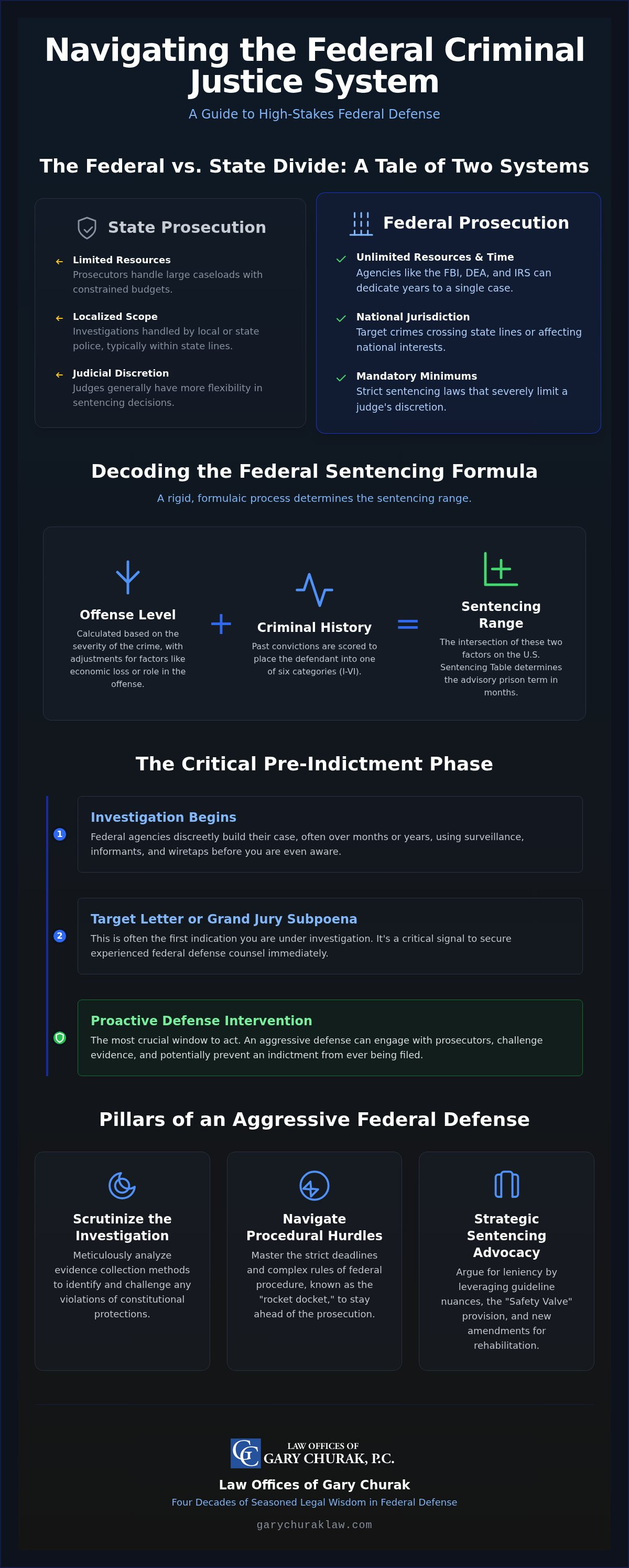
Facing a federal indictment isn't just a legal challenge; it's a confrontation with the full might of the United States government. A Federal crime in the United States involves offenses that violate federal statutes or occur on federal property, such as national parks or military bases. Unlike state cases, which often deal with localized crimes, federal prosecutions target interests that affect the entire nation or involve activities that cross state lines. This shift in jurisdiction changes everything about how a case is investigated, prosecuted, and eventually resolved.
Federal prosecutors, known as Assistant United States Attorneys (AUSAs), operate with a level of precision that state prosecutors rarely match. They typically manage significantly smaller caseloads, allowing them to dedicate months or even years to a single investigation. This luxury of time, combined with nearly unlimited funding and the support of the FBI, DEA, and Homeland Security, contributes to conviction rates that are substantially higher than those found in state systems. When the government decides to bring charges, they've usually already built a formidable case backed by exhaustive evidence.
The Role of Federal Investigative Agencies
Federal probes are rarely impulsive. Agencies like the Secret Service and IRS Criminal Investigation utilize sophisticated surveillance, wiretaps, and deep networks of informants to construct multi-year cases before an arrest is ever made. Federal jurisdiction often hinges on matters involving interstate commerce or government interests, giving these agencies broad reach across state lines. Because of this, effective federal crimes defense must begin with an understanding that the evidence against you was likely gathered with extreme scrutiny. Gary Churak leverages over 40 years of experience to scrutinize these investigative methods, identifying where the government may have overstepped its bounds or violated your constitutional protections.
Why Federal Procedure Requires a Specialized Approach
The federal system operates under the strict Federal Rules of Criminal Procedure, which demand precise adherence to deadlines and filing requirements. Many federal districts are known as "rocket dockets" because they move cases toward trial or resolution with a speed that can catch unprepared defendants off guard. This rapid pace contrasts sharply with the often slower state court proceedings. Discovery in these cases is equally complex; while the "Brady" rule requires prosecutors to hand over exculpatory evidence, the sheer volume of data in a federal case requires a steady hand to analyze. A strategic federal crimes defense requires navigating these rigid procedural hurdles while anticipating the government's next move in a high-pressure environment.
Navigating the Federal Sentencing Guidelines and Mandatory Minimums
Federal sentencing isn't a matter of judicial intuition; it's a rigid, formulaic process that demands extreme precision. The United States government utilizes a complex grid system known as the Sentencing Table to determine the fate of those convicted. This system calculates a range based on the severity of the offense and the defendant's past, leaving little room for error. Understanding the nuances of the Federal Sentencing Guidelines is the cornerstone of any effective federal crimes defense. Without a lawyer who can navigate these advisory rules, you risk facing the maximum penalties allowed by law.
Mandatory minimums present an even more formidable challenge. These statutory floors strip federal judges of their discretion, forcing them to impose specific prison terms regardless of mitigating circumstances. In many drug trafficking cases, for instance, the quantity of the substance triggers a five or ten year minimum. However, the "Safety Valve" provision offers a narrow window for eligible non-violent drug offenders to bypass these harsh minimums. Another critical factor is "Relevant Conduct," which allows the court to increase your sentence based on uncharged acts or conduct related to the offense. This means you could be punished for allegations that were never even proven to a jury.
Calculating the Offense Level and Criminal History
The sentencing range is built on two primary axes: the offense level and the criminal history category. Every federal crime begins with a base offense level, which is then modified by specific adjustments, such as your role in the offense or whether you accepted responsibility. Your prior record is converted into a criminal history category ranging from I to VI. It's a stark reality that federal parole was abolished in 1987, meaning life sentences in the federal system offer no possibility of early release. Every month added to the sentencing range is time you will serve in full.
Strategic Advocacy for Sentencing Variances
While the guidelines are a starting point, they aren't the final word. A skilled advocate uses the "3553(a) factors" to argue for a variance, which is a sentence below the calculated guideline range. These factors include the nature of the offense, the defendant's personal history, and the need for the sentence to reflect the seriousness of the crime. Much of this battle happens within the Pre-Sentence Report (PSR). Federal probation officers prepare this document, and it serves as the judge's primary resource. Challenging inaccuracies in the PSR is a vital component of federal crimes defense, as even a minor error can lead to years of additional prison time. Securing a personalized strategy during this high-stakes phase is essential for protecting your future.
The Critical Pre-Indictment Phase: Proactive Federal Defense
Winning a case often happens before a judge ever sees it. If you've received a "Target Letter," the government has already identified you as a primary subject of an investigation. This letter isn't a mere suggestion; it's a formal signal that an indictment is likely unless immediate action is taken. Proactive federal crimes defense during this window can lead to "declination," where the government decides not to file charges at all. It's the most effective way to protect your reputation and freedom before the public record of an arrest exists.
The federal criminal process officially begins with an indictment, but the investigation phase provides the only opportunity for pre-indictment negotiations. During this time, a seasoned attorney can present mitigating evidence or legal arguments that may convince a prosecutor to abandon the case or reduce the severity of the planned charges. This might involve demonstrating that you lacked the intent required for a specific crime or showing that the government's evidence was obtained through illegal means. Intervening at this stage allows you to shape the narrative before the prosecution's theory becomes set in stone.
Responding to Federal Target Letters
The Federal Grand Jury is a secretive body that decides whether there's probable cause to charge you. While your attorney cannot enter the grand jury room to cross-examine witnesses, they can wait outside to consult with you after every question. Invoking your Fifth Amendment right against self-incrimination is a standard and often necessary strategy in this high-pressure environment. Prosecutors often use the grand jury to lock in witness testimony or pressure targets into making mistakes. Understanding these rules is vital when preparing for a criminal defense consultation. A strong federal crimes defense ensures you don't face this secretive process without a battle-tested guide who knows how to counter the government's narrative.
Proven Defense Strategies for Complex Federal Allegations
Federal prosecutors rely on a mountain of data, but data is only as good as its interpretation. In white collar cases involving wire fraud, mail fraud, or money laundering, the "Lack of Intent" defense remains a powerful tool. The government must prove beyond a reasonable doubt that you intended to defraud or knowingly engaged in illegal financial transactions. Often, what the government views as a criminal conspiracy is actually a legitimate business failure or a complex misunderstanding of regulatory requirements. By dismantling the prosecution's narrative of intent, a skilled federal crimes defense can turn a high-stakes indictment into a dismissal.
Forensic accountants and private investigators play a pivotal role in dismantling the government's narrative. While federal agents have vast resources, they aren't infallible. They make assumptions, miss context, and occasionally overlook exculpatory evidence. We utilize independent experts to audit financial records and re-examine digital footprints to provide a counter-narrative that the FBI or IRS may have ignored. This methodical scrutiny ensures that every piece of evidence the government presents is challenged for accuracy and relevance.
Suppressing Evidence in Federal Drug Cases
Constitutional protections don't vanish just because a case moves to federal court. In cases involving drug trafficking, Fourth Amendment challenges are often the most effective way to secure a favorable outcome. We scrutinize the validity of federal search warrants and the execution of "no-knock" entries to identify procedural errors. If agents exceeded the scope of a warrant or lacked probable cause, the "Exclusionary Rule" can be invoked to suppress the seized evidence. Successfully suppressing a large quantity of narcotics often leaves the government with no case to prosecute. For more on these tactics, see our guide on federal drug trafficking defense.
Defending Against RICO and Conspiracy Charges
The government frequently uses conspiracy charges to link individuals to crimes they didn't personally commit. Under the "Pinkerton Rule," you can be held vicariously liable for the foreseeable acts of co-conspirators, even if you weren't present. A strategic defense involves proving a lack of an actual agreement or demonstrating a timely "withdrawal" from the conspiracy. We focus on showing that your involvement was incidental rather than central to the alleged criminal enterprise. This limits your exposure and prevents the government from punishing you for the actions of others. If you are facing these complex charges, you need a battle-tested federal advocate to protect your rights.
Choosing Aggressive Federal Advocacy with Gary Churak
When you face the Department of Justice, you aren't just fighting a legal case; you're confronting a machine with nearly infinite resources. The federal government rarely brings charges unless they've spent months or years building a foundation for conviction. In this high-stakes environment, effective federal crimes defense requires more than just legal knowledge. It demands a battle-tested advocate who understands the nuances of the federal system and possesses the resilience to stand firm against aggressive prosecution. Gary Churak provides a level of personalized attention that is impossible for a large "mill" firm to replicate, ensuring your case is never treated like a number on a spreadsheet.
Aggressive advocacy begins with a commitment to thorough case analysis and exhaustive pre-trial preparation. We don't wait for the government to dictate the pace of the proceedings. Instead, we scrutinize every piece of evidence and every investigative tactic used by federal agents to identify weaknesses in their narrative. This proactive stance is essential because federal prosecutors often have smaller caseloads and more time to focus on securing a victory. Countering that focus requires a defense that is equally methodical and unwavering in its commitment to protecting your constitutional rights.
The Advantage of Decades of Federal Experience
With over 40 years of legal practice, Gary Churak possesses the wisdom gained from four decades of high-stakes litigation. This experience provides the clarity to know when a forceful trial strategy is required and when a quiet, strategic negotiation will yield a more favorable result. Knowing what to look for in a criminal defense attorney is vital, but nothing replaces the insight gained from thousands of hours spent in federal courtrooms. Gary Churak personally handles the strategic direction of every federal case, ensuring that every decision is backed by forty years of professional judgment rather than being handed off to an inexperienced associate.
Securing Your Future with a Strategic Defense
A federal indictment threatens more than just your freedom; it puts your reputation, your family, and your livelihood at risk. Our primary goal is to protect your future by building a federal crimes defense that is as resilient as it is strategic. Whether we're challenging illegal search and seizure or navigating the complex 2026 sentencing guideline updates, our focus remains on achieving a dismissal or a significant reduction of charges. Don't wait for the government to build an insurmountable case while you remain in a state of uncertainty. Take immediate action to protect your rights during an investigation. Schedule your free federal defense consultation with Gary Churak today to begin crafting a defense designed to protect your freedom.
Securing Your Future Against Federal Prosecution
Facing the full weight of the Department of Justice is a life-altering experience that demands immediate, decisive action. We've explored how the federal system differs from state courts, particularly with the 2026 sentencing amendments and the rigid nature of mandatory minimums. You've learned that the most effective time to challenge the government's narrative is during the pre-indictment phase, before formal charges are ever filed. A successful federal crimes defense relies on meticulous case analysis and the courage to challenge every investigative error made by federal agencies.
Gary Churak brings over 40 years of criminal defense experience to your corner, offering the aggressive advocacy and personalized strategy required to navigate these high-stakes waters. You don't have to face this complex system alone. By securing a seasoned protector who understands when to negotiate and when to fight, you take the first step toward reclaiming your life and protecting your legacy. Contact the Law Offices of Gary Churak for a Strategic Federal Defense Consultation and begin building your shield today. Your future is worth the fight, and help is available to guide you through this storm.
Frequently Asked Questions
What is the difference between a state crime and a federal crime?
Federal crimes involve violations of U.S. federal statutes or offenses committed on federal property, such as national parks or military bases. State crimes involve violations of laws passed by individual state legislatures. Federal cases are investigated by national agencies like the FBI or DEA and prosecuted by Assistant United States Attorneys. These federal agencies possess significantly more resources than local police, often leading to more exhaustive investigations and higher conviction rates.
Do federal crimes have mandatory minimum sentences?
Yes, many federal offenses carry mandatory minimum sentences that strip judges of their discretion. These statutory floors are common in drug trafficking and firearm cases. While the 2026 amendments to the sentencing guidelines provide new avenues for relief, such as credits for post-offense rehabilitation, mandatory minimums remain a primary concern for any federal crimes defense strategy. Judges must impose these terms unless a specific exception, like the "safety valve" for non-violent drug offenses, applies.
Can a federal indictment be dismissed before trial?
A federal indictment can be dismissed before trial, though it requires a rigorous and strategic legal process. Success often hinges on proving constitutional violations, such as illegal searches or Fifth Amendment breaches. Defense attorneys also file motions to dismiss based on a lack of evidence or prosecutorial misconduct. Proactive intervention during the pre-indictment phase is the most effective way to prevent charges from ever reaching the trial stage or becoming part of a public record.
What should I do if the FBI wants to talk to me?
You should politely decline to answer any questions and contact an attorney immediately. Federal agents are trained to extract statements that can be used against you, even if you're innocent. Anything you say can be interpreted as a false statement to a federal officer, which is a separate felony charge under 18 U.S.C. § 1001. Silence is your most powerful tool until you have legal representation to manage all communication with the Department of Justice.
How long does a federal criminal case typically take?
Federal criminal cases vary in length, but many move faster than state cases due to "rocket dockets" in certain jurisdictions. A standard case might last anywhere from six months to two years depending on the complexity of the evidence and the number of defendants involved. Cases involving extensive wiretap data or complex financial audits usually take longer. Your defense team uses this time to conduct independent investigations and challenge every piece of the government's discovery.
What is a "target letter" from the Department of Justice?
A target letter is a formal notification from the Department of Justice stating that you are the subject of a grand jury investigation. Receiving this letter means the government has substantial evidence linking you to a crime and intends to seek an indictment. It's a critical signal for immediate legal intervention. An experienced lawyer often uses this pre-indictment window to negotiate with prosecutors and potentially prevent formal charges from being filed against you in federal court.
Are federal sentencing guidelines mandatory or advisory?
Federal sentencing guidelines have been advisory since the 2005 Supreme Court ruling in United States v. Booker. However, judges are still legally required to calculate the guidelines accurately and consider them when imposing a sentence. As of the November 1, 2026, amendments, new factors like post-offense rehabilitation and adjusted economic loss tables play a significant role. A judge can "vary" from the guidelines based on specific 3553(a) factors presented during your federal crimes defense.
How does a federal conspiracy charge work?
A federal conspiracy charge requires the government to prove that two or more people agreed to commit a crime and that at least one member took an "overt act" toward that goal. You don't have to successfully complete the crime to be convicted. Under the Pinkerton Rule, you can be held liable for all foreseeable crimes committed by your co-conspirators. This makes conspiracy charges one of the most powerful and dangerous tools in the federal prosecutor's arsenal.


