

A plea deal is not an admission of defeat; it's a calculated tactical maneuver designed to seize control of a high-stakes legal outcome. When you're facing the weight of a Texas DWI arrest, the uncertainty can be paralyzing. You're likely worried about potential jail time, the stigma of a permanent record, and the complex web of state laws that seem designed to work against you. These fears are valid, but they don't have to define your future. By focusing on negotiating a plea deal for DWI in Texas, you move from a position of vulnerability to one of strategic advocacy.
This guide provides the clarity you need to move forward with confidence. You'll discover how strategic negotiations can lead to reduced charges, such as obstruction of a highway, or help you qualify for deferred adjudication under current 2026 statutes. We'll examine the critical role of thorough case analysis, the impact of blood alcohol concentration levels, and the specific steps required to avoid incarceration. From mandatory ignition interlock requirements to the repeal of driver responsibility surcharges, this 2026 strategic guide ensures you're prepared to secure the most favorable resolution possible.
Key Takeaways
- Understand that prosecutors often prioritize efficiency, creating a strategic opening for your defense to negotiate terms that favor your future.
- Learn how to leverage technicalities, such as breathalyzer calibration and blood draw procedures, to build a position of strength when negotiating a plea deal for DWI in Texas.
- Distinguish between charge reductions and sentence reductions to prioritize avoiding the permanent stigma of a criminal conviction on your record.
- Evaluate the "trial penalty" and the emotional toll of a courtroom battle to determine if a negotiated resolution provides the certainty you need.
- Discover why a seasoned attorney’s established reputation with the prosecution is essential for aligning a legal strategy with your personal and professional goals.
Understanding the Plea Bargain Process in Texas DWI Cases
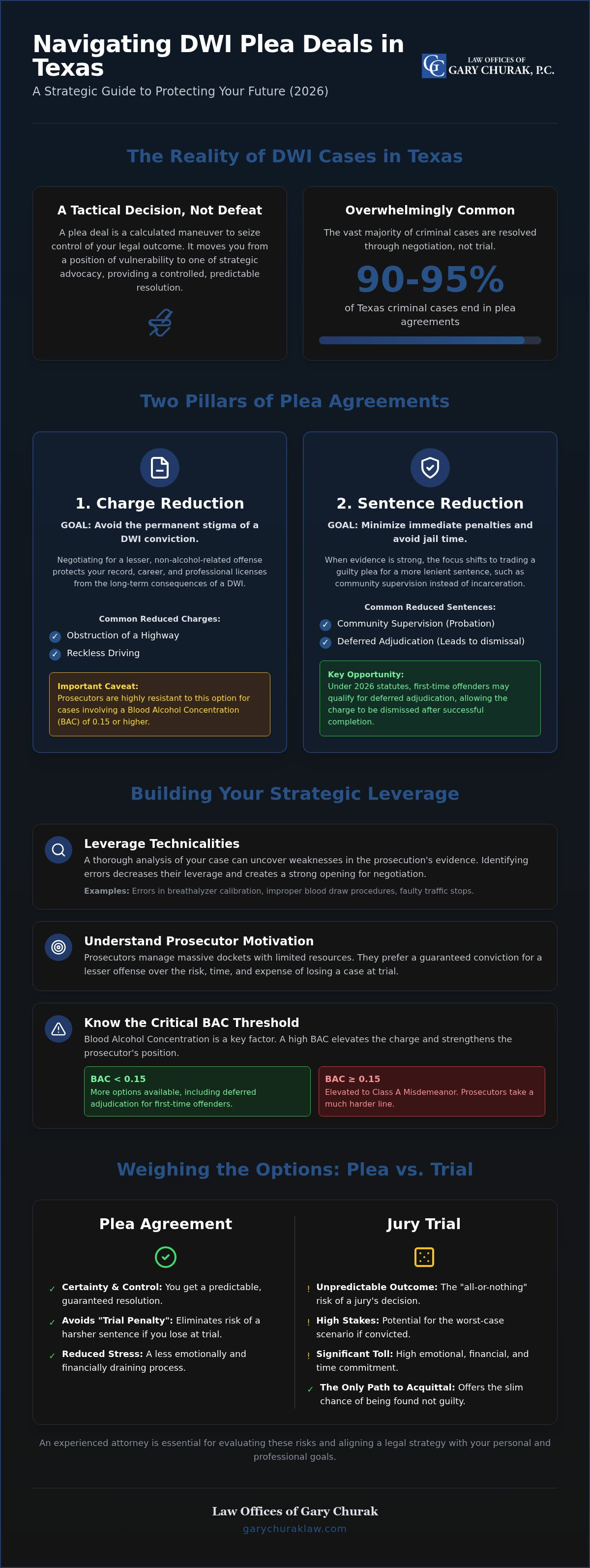
A plea bargain is a contract between you and the State of Texas. It serves as a negotiated settlement where you agree to specific terms in exchange for reduced penalties or lower charges. Statistics from 2026 indicate that approximately 90% to 95% of criminal cases in the state resolve through these agreements. This isn't a sign of weakness. It's a strategic choice. When you're negotiating a plea deal for DWI in Texas, you are actively removing the "all-or-nothing" risk inherent in a jury trial. A trial is unpredictable. A plea deal provides a controlled, predictable resolution to a high-stress situation.
The prosecutor's primary goals are efficiency and maintaining high conviction rates. They aren't looking to take every single case to a full jury trial. By reaching an agreement, the State ensures a conviction is recorded while avoiding the time and expense of a protracted courtroom battle. For you, this means trading the slim chance of an acquittal for the guaranteed avoidance of the worst-case scenario. It's about damage control and protecting your long-term interests through a calculated plea bargain process.
The Legal Framework of DWI Negotiations
The Texas Code of Criminal Procedure provides the rules that govern how these agreements are structured. While your attorney and the prosecutor might reach a deal, the judge always has the final say. A judge must approve the agreement before it becomes official. Your eligibility for specific deals, such as deferred adjudication, often depends on your prior criminal history. In 2026, first-time offenders with a blood alcohol concentration below 0.15 have access to options that repeat offenders do not. Your past determines your starting position at the negotiating table.
Why Prosecutors Agree to Negotiate
Prosecutors manage massive court dockets with limited resources. They simply don't have the capacity to take every DWI arrest to trial. If a defense attorney identifies evidentiary weaknesses, such as errors in breathalyzer calibration or blood draw procedures, the prosecutor's leverage decreases. They would rather secure a conviction for a lesser offense, like obstruction of a highway, than risk losing the case entirely in front of a jury. This reality creates the space needed for a seasoned advocate to push for a deal that protects your record and your freedom.
The Two Pillars of Plea Agreements: Charge vs. Sentence Reductions
Effective defense strategies focus on two distinct paths: changing what you're charged with or changing the punishment you receive. While both approaches offer relief, they serve different long-term purposes. A 'lesser included offense' is a tactical tool for avoiding mandatory minimums by pleading to a crime that shares elements with the original charge but carries far less weight. For many, the ultimate goal is avoiding the permanent stigma of a 'Driving While Intoxicated' conviction, which can haunt background checks for decades.
The stakes extend beyond courtrooms and into your daily life. Convictions for Texas alcohol-related offenses trigger automatic license suspensions and can cause insurance premiums to skyrocket. Professional licenses for nurses, pilots, or commercial drivers are often at risk. By prioritizing a charge reduction, you protect your professional standing. If you're unsure which path fits your specific needs, speaking with a criminal defense attorney can help clarify your options.
Charge Reduction: Negotiating for Lesser Offenses
Negotiating a plea deal for DWI in Texas often involves seeking a reduction to 'Obstruction of a Highway' or 'Reckless Driving.' These are non-alcohol-related offenses. They don't carry the same social or professional weight as a DWI. However, prosecutors in 2026 remain resistant to these deals in cases involving a blood alcohol concentration (BAC) of 0.15 or higher. Since a high BAC elevates the charge to a Class A misdemeanor, the State often takes a harder line to ensure the record reflects the severity of the incident.
Sentence Reduction: Minimizing the Penalties
When the evidence is strong, the strategy shifts to sentence reduction. This involves trading a guilty plea for community supervision, commonly known as probation, instead of incarceration. Under current 2026 statutes, first-time offenders may qualify for deferred adjudication. This allows the charge to be dismissed upon successful completion of probation, though an ignition interlock device (IID) is now a standard, non-negotiable requirement for most probation agreements. Negotiating a plea deal for DWI in Texas this way ensures you stay out of jail and provides a clear, predictable path to resolution.
Building Strategic Leverage for a Favorable Outcome
Effective negotiations aren't built on requests for mercy; they're built on the cold reality of evidentiary gaps. When you're negotiating a plea deal for DWI in Texas, your strongest position comes from a thorough, aggressive analysis of every detail in the police report. If the initial traffic stop lacked reasonable suspicion or the arrest lacked probable cause, you have a constitutional violation that can dismantle the State's case. We don't just look for errors; we look for leverage that forces the prosecution to rethink their strategy.
Prosecutors weigh several factors when deciding how much ground to give during a meeting. According to the Texas District & County Attorneys Association, office policies and the strength of the evidence are central to their decision-making process. By exposing flaws in their case early, you force them to reconsider the risk of taking the matter to a jury. This proactive stance transforms a standard plea discussion into a strategic defense maneuver.
Scrutinizing the State's Evidence
We begin by dissecting the technical details of the arrest. Breathalyzer machines require precise calibration and rigorous maintenance records. If these are missing or outdated, the results are vulnerable to challenge. Blood draw procedures must follow strict chain-of-custody protocols, and any deviation creates an opening to question the integrity of the sample. Dashcam and bodycam footage often tell a different story than the written police report. We look for inconsistencies in officer testimony, such as claims of slurred speech that aren't audible on the recording. Field Sobriety Tests (FSTs) are notoriously unreliable when performed on uneven ground or by individuals with physical injuries. A skilled dwi defense attorney uses these environmental factors to cast doubt on the officer's observations.
Creating 'Reasonable Doubt' Pre-Trial
Filing a Motion to Suppress is a powerful tactical move. If a judge agrees that evidence was obtained illegally, that evidence is excluded from the trial. This often leaves the prosecutor with a case too weak to sustain a conviction. A prosecutor's fear of losing at trial is the defendant's greatest asset. When the State realizes their conviction rate is in jeopardy, they become much more willing to offer a favorable deal to avoid an embarrassing loss in court.
Beyond technicalities, we use mitigating factors to humanize you. A clean criminal record, a stable professional history, and a proactive approach toward alcohol education can influence a prosecutor's perspective. These elements show that you're a responsible citizen rather than a threat to public safety. This comprehensive preparation ensures that when we sit down to negotiate, we're doing so from a position of strength.
Evaluating the Risks: Trial vs. Plea Agreement
Choosing between a jury trial and a negotiated settlement is the most critical decision you'll face. It requires a clear-eyed assessment of the State's evidence and your own tolerance for risk. While some cases demand a fight for a full dismissal, others benefit from the predictability of a plea. Negotiating a plea deal for DWI in Texas allows you to lock in a known outcome rather than leaving your fate to six or twelve strangers who may bring personal biases into the jury room. You're trading the slim possibility of an acquittal for the guaranteed avoidance of the worst penalties.
The 'Trial Penalty' is a harsh reality in Texas courtrooms. While you have a constitutional right to a trial, judges often impose stricter sentences after a jury conviction than what was offered in a plea deal. This isn't a formal rule, but it's a common observation among seasoned practitioners. A judge may view a plea as an acceptance of responsibility, whereas a trial loss might result in the maximum possible jail time and fines. Balancing these risks requires a battle-tested guide who knows when the State's case is too weak to survive a courtroom challenge.
The Advantages of Accepting a Strategic Deal
A well-negotiated deal provides immediate relief from the crushing weight of a pending criminal charge. By accepting a strategic offer, you can:
- Guarantee the avoidance of jail time through community supervision.
- Resolve the matter in months rather than years, reducing emotional strain.
- Secure eligibility for a non-disclosure agreement in the future, effectively sealing your record from public view.
- Eliminate the high cost of hiring expert toxicologists and accident reconstructionists.
Negotiating a plea deal for DWI in Texas is often the fastest way to regain your driver's license and return to your normal life without the threat of incarceration hanging over your head.
The Risks of Going to Trial
Trials are expensive and emotionally draining. Beyond attorney fees, you must account for the cost of expert witnesses to challenge blood results or breathalyzer data. Juries in Texas can be unpredictable. In 2024, over 1,000 people died in alcohol-related crashes in the state, a statistic that many potential jurors carry with them. This collective trauma often makes it difficult for a jury to remain truly impartial in a DWI case. If you're struggling with this decision, choosing a criminal defense attorney with extensive trial experience is vital. They can provide the objective analysis needed to determine if the State's evidence is truly beatable. If the risks of a trial outweigh the potential rewards, request a consultation to explore your negotiation options.
The Vital Role of Experienced Legal Advocacy in Negotiations
A prosecutor's willingness to offer a favorable deal often depends on who is sitting across the table. When you're negotiating a plea deal for DWI in Texas, your attorney's reputation with the District Attorney's office acts as silent leverage. Prosecutors know which lawyers are prepared to take a case to a jury and which ones are merely looking for a quick exit. An advocate with 40 years of experience brings a level of professional weight that forces the State to take your defense seriously. This isn't just about legal knowledge; it's about the pragmatic wisdom of knowing when to push and when to secure a strategic agreement.
Personalized advocacy ensures that your legal strategy aligns with your specific life goals. We don't just look at the immediate charges. We look at how a plea might impact your ability to seek an expungement or a non-disclosure agreement in the future. An aggressive stance prevents you from being steamrolled by a system that prioritizes high conviction rates over individual outcomes. By scrutinizing the State's evidence from the very beginning, we ensure that any deal you accept is the result of strength, not desperation.
Navigating the Administrative Side (ALR)
The criminal case is only one half of the battle. You also face the Administrative License Revocation (ALR) process, which handles the suspension of your driving privileges. Strategic plea negotiations can sometimes influence the outcome of your ALR hearing, or at least provide valuable testimony that can be used later in the criminal case. Coordinating these two separate legal tracks is essential for protecting your ability to get to work and support your family. Understanding this dual-track system is a major part of preparing for a criminal defense consultation.
Securing Your Future Through Strategic Planning
We focus on the long-term consequences that a standard plea might overlook. A poorly structured deal can permanently strip you of your firearm rights, limit your ability to travel internationally, or trigger the loss of a professional license. We advocate for resolutions that minimize these collateral damages. Whether it's negotiating for deferred adjudication or a reduction to a non-DWI offense, our goal is to provide a steady hand during these high-stakes moments. You deserve a resolution that provides certainty and protects your future. Contact the Law Offices of Gary Churak for a free case analysis to begin building your strategic defense.
Secure Your Future with Strategic Advocacy
A Texas DWI arrest is a high-stakes event, but it doesn't have to result in a permanent criminal conviction. By understanding the distinction between charge and sentence reductions, you can prioritize the long-term protection of your professional record. Negotiating a plea deal for DWI in Texas is a methodical process that relies on identifying evidentiary weaknesses and building leverage before ever setting foot in a courtroom. Whether you're seeking deferred adjudication or a reduction to a non-alcohol-related offense, your defense must be rooted in thorough case analysis and resilience.
You don't have to navigate this complex legal landscape alone. Gary Churak provides over 40 years of criminal defense experience and an aggressive advocacy stance to ensure you aren't steamrolled by the system. Every case receives personalized strategic planning designed to secure a predictable, favorable resolution. Take the first step toward reclaiming your life and your peace of mind. Schedule your free consultation with Gary Churak today to discuss your options and protect your future. You have a path forward; let's find it together.
Frequently Asked Questions
What is the average plea deal for a first-time DWI in Texas?
Most first-time offenders are offered probation, also known as community supervision, which includes fines and mandatory alcohol education classes. In 2026, these deals almost always require the installation of an ignition interlock device as a condition of the agreement. For those with a blood alcohol concentration below 0.15, deferred adjudication is often the standard offer. This provides a path toward an eventual dismissal, helping you protect your future and your record.
Can a DWI charge be reduced to a non-alcohol related offense?
Yes, reducing a charge to "Obstruction of a Highway" or "Reckless Driving" is a primary goal when negotiating a plea deal for DWI in Texas. These reductions are tactical maneuvers used to avoid the long-term stigma and insurance hikes associated with a DWI conviction. Prosecutors may agree to this if the defense identifies evidentiary weaknesses, such as issues with breathalyzer calibration or the legality of the initial traffic stop.
Do I have to plead guilty to get a plea bargain?
Most plea bargains require a plea of "guilty" or "no contest," also known as nolo contendere. From a legal standpoint, both results lead to a conviction or a period of deferred adjudication. Pleading no contest means you aren't admitting guilt but are accepting the punishment to resolve the case predictably. This choice is often part of a strategic defense plan to minimize risk while avoiding the uncertainty of a full jury trial.
What happens if I reject the prosecutor's plea offer?
If you reject an offer, your case typically proceeds toward a trial. The prosecutor may provide a counter-offer, or they might take a harder line, potentially seeking maximum penalties if you lose in court. This is often referred to as the "trial penalty." You must weigh the strength of the State's evidence against the benefits of the deal. A seasoned attorney will help you assess if the risk of a trial is truly justified.
How long does the plea negotiation process usually take?
The timeline varies depending on the court's docket and the complexity of the evidence. Generally, negotiating a plea deal for DWI in Texas begins after the initial discovery phase, where your attorney reviews police reports and video footage. This process can take several months. Rushing a deal is rarely beneficial. A methodical approach ensures every technicality is scrutinized, allowing for a stronger bargaining position that aligns with your professional and personal goals.
Can a plea deal help me keep my driver's license?
A plea deal can influence the status of your driving privileges, but the Administrative License Revocation process is technically separate from the criminal case. However, negotiating a reduction to a non-alcohol offense can prevent the automatic suspensions triggered by a DWI conviction. Coordinating these two legal tracks is vital for maintaining your mobility and ensuring you can continue meeting your daily obligations, such as commuting to work, without unnecessary interruption.
Is deferred adjudication an option for DWI in Texas in 2026?
Yes, deferred adjudication remains a critical option for many first-time offenders in 2026. This allows you to serve a period of probation without a formal conviction being entered on your record. If you successfully complete the terms, the judge dismisses the charge. Eligibility usually requires a blood alcohol concentration below 0.15 and no previous DWI convictions. It's a powerful tool for anyone focused on protecting their long-term employment prospects and civil rights.
Will a plea deal still show up on my criminal background check?
A plea deal will appear on your record, but the specific way it's listed matters significantly. A conviction is permanent and visible to everyone. However, if your deal involves deferred adjudication or a reduction to a lesser charge, you may eventually qualify for a non-disclosure agreement. This effectively hides the record from public view, including most private employers and background check agencies, providing you with a much-needed clean slate for your future.


