

A single gram of a THC concentrate in your pocket is no longer a minor legal hurdle; in 2026, it's a state jail felony that can derail your career and your freedom. The landscape of Texas drug possession laws has shifted dramatically, especially with the recent classification of manufactured Delta-8 as a controlled substance. You likely feel the weight of a system designed to prosecute first and ask questions later. It's natural to feel overwhelmed by the complexity of Penalty Groups and the looming threat of a permanent criminal record that impacts your future employment.
We understand that an arrest feels like a dead end, but it's actually the beginning of a legal process where rigorous evidentiary scrutiny can change the narrative. This guide provides a comprehensive breakdown of the Texas Controlled Substances Act, detailing how specific weights and classifications dictate your sentencing. You'll learn the critical differences between state and federal implications and discover the aggressive defense strategies used to secure dismissals or paths to expungement. We'll move from the anxiety of the unknown to a methodical, strategic plan for your defense.
Key Takeaways
- Understand the logic behind Texas Penalty Groups to identify how specific substances and weights dictate the severity of potential sentencing.
- Distinguish between actual and constructive possession to challenge the state's claim that you had care, custody, or control over a substance.
- Learn how the Michael Morton Act empowers your defense by granting access to lab reports, dashcam footage, and officer notes.
- Navigate the complexities of Texas drug possession laws with a strategic focus on evidentiary scrutiny and procedural errors.
- Identify the necessary steps to pursue a reduction of charges or a permanent record seal through aggressive, battle-tested legal advocacy.
Understanding the Texas Controlled Substances Act and Penalty Groups
The Texas Controlled Substances Act serves as the rigid framework for all drug-related prosecutions. It mirrors the structure of the federal Controlled Substances Act by categorizing drugs into "Penalty Groups." These groups aren't arbitrary; they reflect the state's assessment of a drug's danger and its potential for addiction. In 2026, legislative updates have specifically refined how the state handles synthetic substances, closing loopholes that previously allowed "designer drugs" to evade classification. Understanding these groups is vital because the substance's category dictates the baseline severity of your charges under Texas drug possession laws.
The logic behind these classifications is simple: the higher the potential for abuse and the lower the recognized medical utility, the harsher the penalty. This categorization is the single most important factor in your case. It determines whether you face a misdemeanor or a life sentence before the weight of the drug is even considered. A seasoned defense requires a deep understanding of these shifting statutory definitions to challenge the prosecution's narrative from the start.
Penalty Group 1 and 1-A: The Highest Stakes
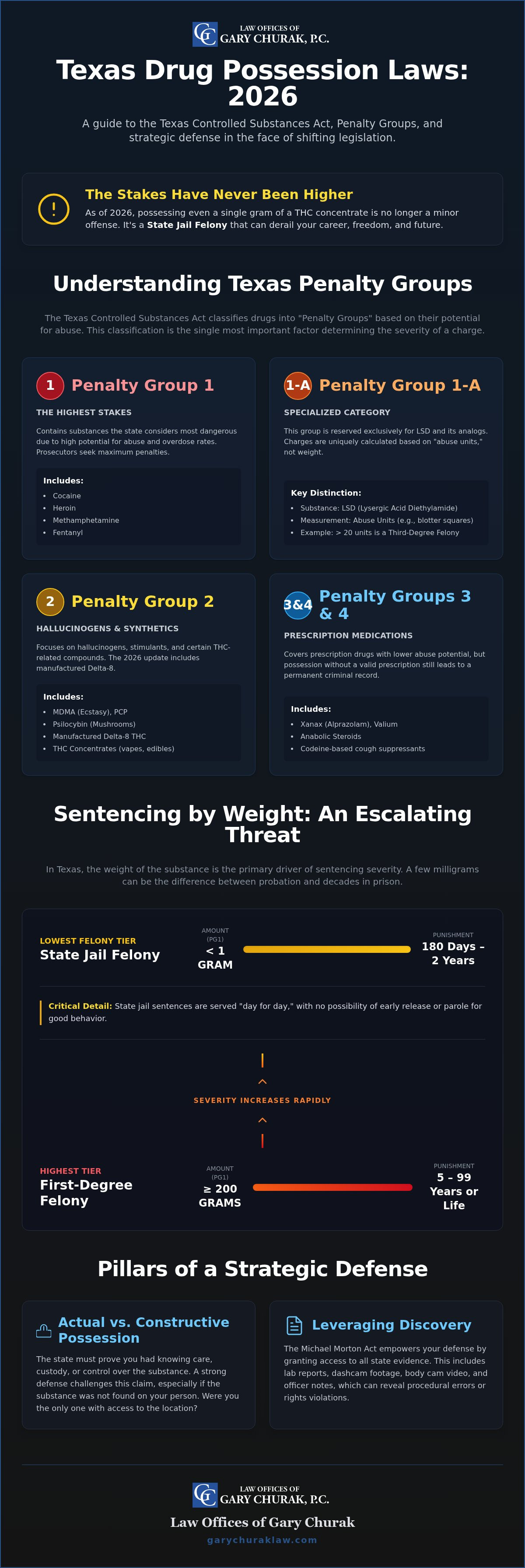
Penalty Group 1 (PG 1) contains substances the state views as the most dangerous. This group includes cocaine, heroin, methamphetamine, and fentanyl. Because of the high overdose rates associated with these drugs, prosecutors often seek the maximum possible penalties. Even possessing less than one gram of a PG 1 substance is a state jail felony, carrying a mandatory minimum of 180 days in jail.
Penalty Group 1-A is a specialized category reserved exclusively for LSD. Unlike other drugs measured by weight, the state calculates PG 1-A charges based on "abuse units," such as individual blotter squares or stamps. If you're found with more than 20 units, you're immediately facing a third-degree felony. The precision of these measurements means there's little room for error in your defense strategy.
Penalty Groups 2, 3, and 4: From Hallucinogens to Prescription Fraud
Penalty Group 2 focuses on hallucinogens and stimulants like MDMA (Ecstasy), PCP, and psilocybin. As of 2026, this group also includes manufactured Delta-8 THC, following the Texas Supreme Court's decision to uphold its classification as a controlled substance. Possession of these substances in any amount, including vape cartridges containing THC concentrates, is typically a felony under Texas drug possession laws.
Penalty Groups 3 and 4 generally cover prescription medications and chemical compounds with lower abuse potential.
- Penalty Group 3: Includes "street" favorites like Xanax (Alprazolam), Valium, and anabolic steroids. Possession without a valid prescription often results in Class A or B misdemeanors for small amounts.
- Penalty Group 3: Also includes compounds containing limited quantities of narcotics, such as prescription-strength cough suppressants with codeine.
While these groups carry lighter penalties than PG 1, a conviction still results in a permanent criminal record. Challenging the state's chemical analysis is often the first step in a successful defense.
Sentencing and Punishment Ranges for Drug Possession in 2026
Prosecutors in Texas weigh the evidence literally. Under the Texas Health and Safety Code Chapter 481, the weight of the substance seized is the primary driver of your potential sentence. Sentencing ranges escalate rapidly from state jail felonies to first-degree felonies that carry life imprisonment. A few milligrams often represent the difference between a chance at probation and a mandatory decade behind bars. Texas drug possession laws are designed to be punitive, and the state rarely offers leniency without a strategic defense intervention.
State jail felonies represent a dangerous bridge in the Texas legal system. These offenses apply to the smallest measurable amounts of Penalty Group 1 substances, such as less than one gram of cocaine or methamphetamine. While technically the lowest level of felony, a conviction carries 180 days to two years in a state jail facility. Unlike prison sentences, state jail time is served "day for day," meaning there's no opportunity for early release through good behavior or parole. Beyond the immediate incarceration, a felony conviction strips you of civil liberties, including your right to possess a firearm and your ability to hold many professional licenses.
Weight Thresholds and Felony Classifications
The severity of your charge depends on specific weight tiers. For Penalty Group 1 substances, the tiers are strictly enforced:
- Less than 1 gram: State Jail Felony (180 days to 2 years).
- 1 to 4 grams: Third-Degree Felony (2 to 10 years).
- 4 to 200 grams: Second-Degree Felony (2 to 20 years).
- 200 to 400 grams: First-Degree Felony (5 to 99 years or life).
- Over 400 grams: Enhanced First-Degree Felony (10 to 99 years or life and fines up to $100,000).
Enhancement factors further complicate these ranges. If an arrest occurs within 1,000 feet of a school or playground, the state can "bump" the charge up by one degree. Prior convictions also trigger habitual offender statutes, which can significantly increase mandatory minimums. If you are facing these high stakes, securing a seasoned criminal defense attorney is the most critical decision you'll make.
Marijuana Possession: A Separate Legal Category
Texas treats leaf marijuana differently than other controlled substances, but the penalties remain severe for larger quantities. Possession of under two ounces is a Class B misdemeanor, while amounts over four ounces trigger felony charges. However, a common trap involves THC concentrates, such as vape cartridges or wax. These are classified under Penalty Group 2, not the marijuana statute. This means possessing even a single vape pen is a state jail felony, regardless of how "legal" it may seem in neighboring states. For cases involving massive quantities that cross state lines, you may require a federal drug trafficking defense to navigate the intersection of state and national enforcement.
Actual vs. Constructive Possession: The Legal Battleground
In many arrests, the state's case hinges on a single, complex word: possession. Under the Texas Controlled Substances Act, possession is legally defined as having "actual care, custody, control, or management" of a substance. While "actual possession" occurs when drugs are found on your person, "constructive possession" is far more common and legally precarious. This occurs when the state alleges you had control over a substance found in a shared space, like a vehicle or a residence. Prosecutors often rely on your proximity to the drugs to imply guilt, but Texas drug possession laws require more than just being near an illegal substance.
The state must prove a nexus between you and the drugs through the "Affirmative Links" test. This test examines factors such as whether the drugs were in plain view, if you owned the premises, or if you made incriminating statements. We scrutinize these links to break the state's chain of evidence. If the drugs were hidden in a passenger's bag or tucked deep inside a shared glove box, proximity alone cannot sustain a conviction. Our goal is to demonstrate that you lacked the required "control or management" to meet the legal threshold for possession. We look for the gaps where the prosecution's assumptions fail to meet the standard of proof.
Challenging the Link to the Substance
Cases involving multiple occupants in a vehicle are frequent battlegrounds. If drugs are found under a seat, the police often arrest everyone in the car. We fight these charges by proving a lack of knowledge. If you didn't know the substance was present, you couldn't have intentionally possessed it. We also demand scientific scrutiny of the evidence. Analyzing DNA and fingerprint evidence on the packaging can often prove that someone else handled the substance, providing the reasonable doubt necessary for a dismissal. It's about forcing the state to prove its case with facts, not just suspicion.
Fourth Amendment Violations and Suppressing Evidence
The most powerful tool in a defense arsenal is the suppression of evidence through the Fourth Amendment. If the police conducted an illegal search or seizure, the evidence they found may be inadmissible. We challenge the "probable cause" used for the initial traffic stop or the validity of a search warrant. Under the "Fruit of the Poisonous Tree" doctrine, if the initial stop was illegal, everything that followed, including the discovery of drugs, is tainted. By successfully arguing a motion to suppress, we can often force the prosecution to drop the charges entirely before the case ever reaches a jury. This strategic approach protects your rights and can stop a high-stakes prosecution in its tracks.
Strategic Defense: Leveraging the Michael Morton Act and Discovery
The Michael Morton Act revolutionized how we defend clients against Texas drug possession laws. This statute mandates that prosecutors open their files and share almost all evidence with the defense, including exculpatory evidence that might prove your innocence. We don't wait for the state to volunteer this information; we aggressively demand every lab report, every second of dashcam footage, and every handwritten officer note. This discovery process often reveals the procedural cracks in a prosecution's case that surface-level reviews miss.
Independent lab testing is a critical component of a strategic defense. State labs handle thousands of samples every month, and errors in measurement or chemical analysis are more common than the public realizes. We often verify the purity and the exact weight of the alleged substance through independent experts. As weight thresholds dictate the severity of your felony charge, even a fraction of a gram can be the difference between prison and probation. If the state's measurements are inaccurate, the entire foundation of their charge becomes vulnerable to a motion to dismiss.
The Role of Thorough Case Analysis
Understanding how a criminal defense attorney protects your future begins with a line-by-line scrutiny of the police report. Officers frequently rely on subjective claims like the "smell of marijuana" or "plain view" to justify a search without a warrant. We compare these claims against body camera footage and physical evidence to find inconsistencies. If an officer's testimony doesn't match the digital record, we file pre-trial motions to expose those procedural errors. Applying high-register scrutiny to state-level drug trials ensures that your rights remain protected against unreliable police work.
Alternative Sentencing and Pre-Trial Diversion
A successful outcome doesn't always require a trial; sometimes the most strategic path involves the negotiating table. Many first-time offenders are eligible for drug courts or rehabilitation-focused programs that prioritize treatment over incarceration. These pre-trial diversion programs offer a path to a "Clean Slate" by allowing for the dismissal of charges upon successful completion. This is often the first step in learning how to get a record expunged in Texas. Negotiating for deferred adjudication can also prevent a permanent conviction from ruining your professional future. If you are facing high-stakes charges, you should consult with a battle-tested advocate to explore every available defense strategy.
Choosing an Assertive Advocate for Your Drug Defense
Facing a felony charge under 2026 Texas drug possession laws is a life-altering event. The state has invested significant resources into aggressive prosecution; you must invest in a defense that is equally rigorous. Gary Churak brings over four decades of legal experience to your side. This depth of knowledge isn't just about time spent in a courtroom. It's about having the quiet strength to anticipate the prosecution's next move before they make it. We act as a fierce protector, ensuring that a single mistake doesn't define the rest of your life.
A battle-tested guide understands that the nuances of state law often collide with federal implications. Whether your case involves a small amount of a Penalty Group substance or high-stakes federal allegations, you need a strategist who knows when to negotiate and when to take a forceful stance. During your personalized consultation, we move past the surface-level facts. We conduct a deep analysis of the evidence to identify the procedural errors that lead to dismissals or reduced charges. Our commitment is to your results and your resilience.
Personalized Strategy vs. 'Mill' Law Firms
Many high-volume "mill" law firms prioritize case turnover over individual results. In these environments, your future is often handed off to a junior associate with limited experience. We believe a felony charge carries too much emotional gravity for a volume-based approach. You deserve direct communication with your lead counsel. We provide a protective stance that alleviates your anxiety by projecting strength and preparedness. Every case receives the scrutiny required to protect your professional licensing and your long-term civil liberties. We don't just manage cases; we advocate for individuals.
Taking the First Step Toward Your Defense
The hours following a drug arrest are critical. You shouldn't provide statements to law enforcement without an attorney present. Silence is your most effective tool for preventing self-incrimination. Before our first meeting, gather any documentation related to your arrest, including search warrants or property receipts. Preparing for your defense starts with a commitment to aggressive advocacy. We provide a steady hand to lead you from a state of uncertainty toward a clear understanding of the next steps.
We are unwavering in the face of opposition. We understand the stakes are high, and we offer a grounded, methodical approach to navigate the complexities of the legal system. Don't leave your future to chance or a firm that views you as a number. Schedule your strategic defense consultation today to secure a path toward protection and results.
Protecting Your Future Against State and Federal Prosecution
A drug arrest in Texas is a high-stakes challenge, but it doesn't have to be the end of your story. Navigating the rigid structure of Texas drug possession laws requires a methodical approach to evidentiary scrutiny. You've seen how the state uses Penalty Groups and constructive possession to build its narrative; however, by leveraging the Michael Morton Act and challenging illegal searches, a seasoned advocate can dismantle that narrative piece by piece. Whether you're facing state jail felony charges for concentrates or high-stakes federal litigation, your defense hinges on thorough case analysis and unwavering advocacy.
Gary Churak offers over 40 years of criminal defense experience as an aggressive advocate for both state and federal charges. We provide a steady hand to help you reclaim your life and protect your professional future. Take the first step toward a strategic resolution with a free initial case analysis. You don't have to face this alone; we're here to provide the strength and preparedness your case demands. Secure your future with an assertive drug crimes defense. Your journey toward a clean slate begins with a single, decisive action today.
Frequently Asked Questions
What is the difference between actual and constructive possession in Texas?
Actual possession means the substance was physically on your person, such as in your pocket or hand. Constructive possession is more complex; it involves drugs found in a space you control, like a vehicle or home. To win a case under Texas drug possession laws, the state must prove you had intentional care, custody, and management of the substance. Simply being near the drugs is not enough for a conviction if we break the affirmative links.
Is possession of CBD or low-THC oil legal in Texas in 2026?
Naturally occurring CBD with less than 0.3% THC remains legal, but the landscape for other hemp products has changed. As of July 31, 2026, manufactured Delta-8 THC is classified as a controlled substance in Texas. Possessing these manufactured products can now lead to felony charges. Low-THC oil is only legal for individuals registered in the Compassionate Use Program. Always verify the chemical composition of products before traveling with them, as enforcement priorities have shifted significantly.
What are the penalties for possessing less than one gram of a controlled substance?
Possessing even a trace amount of a Penalty Group 1 substance, such as cocaine or fentanyl, is a state jail felony. This charge carries a sentencing range of 180 days to two years in a state jail facility. Fines can reach up to $10,000. Because these sentences are served day for day without the possibility of early parole, these small amounts carry heavy consequences that require an aggressive defense strategy to mitigate the long term impact on your future.
How does the Michael Morton Act help my drug defense case?
The Michael Morton Act is a powerful discovery tool that forces the prosecution to share their entire file with your defense team. This includes police reports, witness statements, and lab results. By accessing this evidence early, we can identify inconsistencies in officer testimony or errors in chemical testing. It ensures transparency and allows us to uncover exculpatory evidence that the state might otherwise have overlooked or withheld during the high stakes legal process.
Can a drug possession charge be expunged from my record in Texas?
Expungement is possible if your case resulted in an acquittal or a formal dismissal. If you successfully completed a pre-trial diversion program, you may also be eligible to have the records destroyed. For those who received deferred adjudication, an Order of Nondisclosure may be the better path; it seals the record from the general public and most employers. Securing a clean slate is a primary goal in our strategic defense planning for every client we represent.
What is a 'Drug-Free Zone' and how does it affect my sentencing?
A Drug-Free Zone is a designated area within 1,000 feet of a school, playground, or youth center. If an arrest occurs in these zones, the state can enhance the punishment by one full degree. For example, a third-degree felony can be prosecuted as a second-degree felony. This enhancement significantly increases both the minimum and maximum prison time you face, making it vital to challenge the exact location and measurement of the alleged offense during discovery.
Does a 'Motion to Suppress' actually work in drug cases?
A Motion to Suppress is one of the most effective tools for dismissing Texas drug possession laws violations. If we prove the police conducted an illegal search or lacked probable cause for a stop, the judge can rule the evidence inadmissible. Without the physical drugs as evidence, the prosecution's case typically collapses. This strategy relies on the "Fruit of the Poisonous Tree" doctrine, which protects your Fourth Amendment rights against unlawful and overreaching government intrusion.
What should I do if the police searched my car without a warrant?
You should remain calm and clearly state that you do not consent to the search, but do not physically interfere with the officers. Document the interaction as soon as possible and contact a defense attorney. While police sometimes claim "probable cause" or "plain smell" to bypass a warrant, these claims are often vulnerable to legal challenges. We scrutinize dashcam footage and officer reports to determine if the warrantless search was truly justified under the law.


