

What if the flashing lights in your rearview mirror didn't have to mean the end of your career or your freedom? Many drivers assume a breathalyzer result is an automatic conviction, but a first-time arrest is a strategic battle rather than a foregone conclusion. You're likely feeling the heavy weight of anxiety over first time dwi in texas penalties, which now include state fines up to $6,000 for high BAC levels and the very real threat of immediate incarceration. It's a high-stakes situation where a single mistake in the days following your arrest can have lasting consequences on your ability to work and move freely.
You deserve a defense that acts as a fierce protector of your rights and your future. This guide provides the clarity you need to navigate the 2026 legal landscape with professional confidence. We'll break down the specific jail time risks for Class A and B misdemeanors, explain the critical 15-day window to save your driver's license through an ALR hearing, and outline the aggressive defense strategies used to pursue a dismissal or reduction of charges. From scrutinizing police procedures to challenging blood evidence, we'll show you exactly how a seasoned expert builds a path toward a resolution that keeps you on the road and out of a cell.
Key Takeaways
- Understand the full scope of first time dwi in texas penalties, including the potential for mandatory jail time and one-time state fines reaching $6,000.
- Secure your driving privileges by requesting an Administrative License Revocation (ALR) hearing within the critical 15-day window after your arrest.
- Identify the collateral consequences a conviction has on professional licenses for teachers, nurses, and commercial drivers.
- Learn how a strategic defense challenges the legality of the initial traffic stop and the accuracy of forensic evidence to seek a dismissal.
- Recognize the importance of early legal intervention to identify weaknesses in the prosecution's case before your first court appearance.
Understanding First-Time DWI Charges in Texas
A first-time arrest for Driving While Intoxicated (DWI) often begins with a sense of disbelief. In Texas, the law is uncompromising, defining intoxication in two distinct ways under the Texas Penal Code. You are legally intoxicated if you don't have the normal use of your mental or physical faculties due to alcohol or drugs, or if your blood alcohol concentration (BAC) reaches 0.08 or higher. This dual definition gives the state multiple paths to a conviction. Understanding the foundation of Texas alcohol laws is the first step in mounting a defense that protects your future from the harshest first time dwi in texas penalties.
The Legal Definition of Intoxication
Prosecutors often rely on the "per se" definition, which means the mere fact that your BAC was 0.08% or higher is enough to prove intoxication. However, the state doesn't always need a chemical test to win a conviction. They can argue you lost your "normal faculties" based on officer testimony, driving behavior, or performance on Standardized Field Sobriety Tests (SFSTs). These tests, including the Horizontal Gaze Nystagmus (HGN) and the Walk-and-Turn, are notoriously difficult. Officers use your performance to build a narrative of impairment, even if your actual BAC was below the legal limit at the time of driving.
Class B vs. Class A Misdemeanors
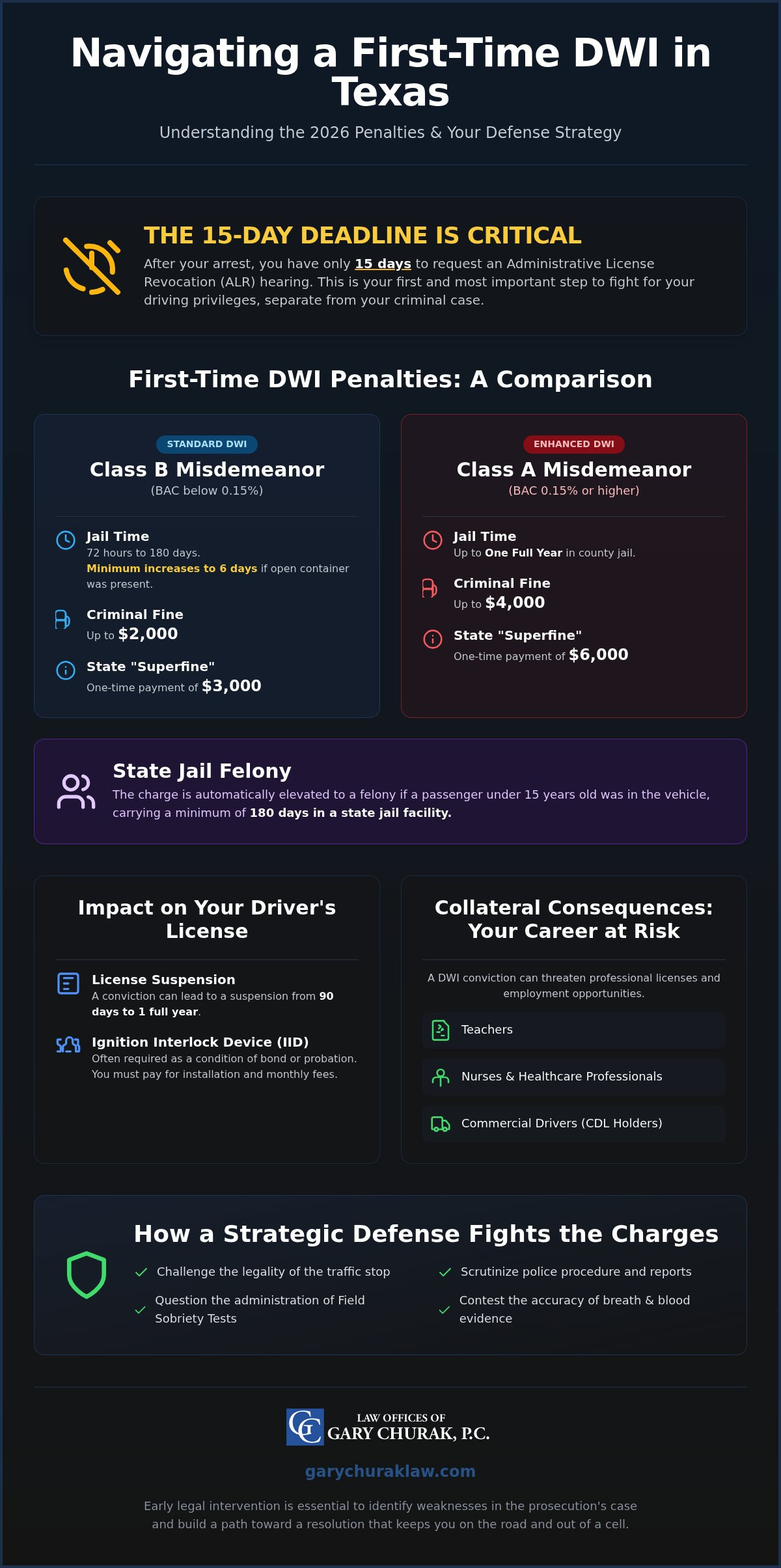
Most people assume every first offense is treated the same, but the severity of the charge depends heavily on the evidence collected. A standard first-time DWI is a Class B misdemeanor. This typically applies when your BAC is below 0.15% or when the state relies solely on the "loss of faculties" argument. If convicted, the first time dwi in texas penalties include a mandatory minimum of 72 hours in jail and court-ordered fines reaching $2,000. This classification is the baseline for most first offenders, but it's not the only possibility.
Enhanced charges apply if your BAC is 0.15% or higher. As of January 1, 2026, this is classified as a Class A misdemeanor, which doubles the potential fine to $4,000 and extends possible jail time to one full year. You also face a one-time state fine of $6,000 under the Texas Transportation Code. Additionally, if a child under the age of 15 was in the vehicle, the charge is automatically elevated to a state jail felony. This is a serious felony offense that carries a minimum of 180 days in a state jail facility. Identifying these distinctions early allows for a more targeted defense strategy.
2026 Statutory Penalties: Fines, Jail, and Suspensions
Facing a judge for the first time is a sobering experience, especially when the prosecution is pushing for the maximum first time dwi in texas penalties. While many believe a first offense results in a simple warning or probation, Texas law mandates specific minimums that can disrupt your life immediately. These penalties are designed to be punitive, impacting both your personal liberty and your financial stability long after the court date concludes.
Incarceration and Financial Fines
Incarceration is a standard component of Texas DWI sentencing. For a Class B misdemeanor, you face between 72 hours and 180 days in a county jail. If an open container was found in your vehicle at the time of the arrest, the mandatory minimum jail stay increases to six days. Financial obligations extend far beyond the initial court-ordered fine of up to $2,000. The state now imposes a one-time "superfine" of $3,000 for standard convictions, which doubles to $6,000 if your BAC exceeded the 0.15 threshold. If your blood alcohol concentration was 0.15% or higher, you face a maximum criminal fine of $4,000.
Driver's License and Ignition Interlock
Your ability to commute to work or care for your family is often the first thing at risk. A conviction typically triggers a driver's license suspension ranging from 90 days to one full year. The Administrative License Revocation (ALR) Program operates independently of your criminal case, meaning you can lose your driving privileges even if you aren't ultimately convicted. To regain your license, you'll be required to pay a reinstatement fee and maintain an SR-22 insurance filing, which significantly increases your monthly premiums.
Judges frequently mandate the installation of an Ignition Interlock Device (IID) as a condition of bond or probation. This device requires a clean breath sample before the engine starts and includes monthly calibration fees that you must pay out of pocket. Beyond these technical requirements, you'll likely face 24 to 100 hours of community service and mandatory attendance at a DWI education program. Because these consequences are so rigid, it's vital to consult with a seasoned professional who can identify procedural errors that might lead to a reduction in these mandates.
The ALR Hearing: Your 15-Day Window to Save Your License
The moment you're arrested, two separate legal clocks start ticking. While your criminal case focuses on guilt or innocence, the Administrative License Revocation (ALR) process deals exclusively with your right to drive. You have exactly 15 days from the date of your arrest to request a hearing. If you fail to act within this narrow window, the Department of Public Safety (DPS) will automatically suspend your license 40 days after the arrest. Navigating the administrative side of first time dwi in texas penalties requires immediate attention to detail; missing this deadline means forfeiting your right to challenge the suspension entirely.
The Administrative License Revocation Process
The ALR hearing is a civil proceeding where an administrative law judge determines if the officer had reasonable suspicion to stop you and probable cause to arrest you. It serves as a powerful discovery tool for your defense. By requesting this hearing, your attorney can subpoena the arresting officer and cross-examine them under oath before the criminal trial begins. This often reveals inconsistencies in their testimony or flaws in how the field sobriety tests were administered. Successfully defending the ALR can prevent a suspension entirely, but even a loss provides a vital "preview" of the state's evidence. This official document on Texas DWI Penalties outlines how these administrative actions integrate with the broader legal consequences you face.
Securing an Occupational Driver's License (ODL)
If the judge sustains the suspension, you aren't necessarily stranded. You may be eligible for an Occupational Driver's License (ODL), which allows you to drive for essential needs such as work, school, or essential household duties. To secure an ODL, you must petition a court and demonstrate a legitimate "essential need." The court will often place restrictions on your driving times and locations, and you'll be required to maintain an SR-22 insurance policy and potentially install an ignition interlock device. While an ODL keeps you on the road, it's a temporary solution compared to a successful ALR defense. Proactive legal action within that first 15-day window is the only way to avoid these additional hurdles and the escalating first time dwi in texas penalties that follow a conviction. Securing professional advocacy early ensures you don't navigate these complex filings alone.
Collateral Consequences: The Hidden Costs of a DWI
Statutory first time dwi in texas penalties like jail time and fines are only the beginning of the fallout. The collateral consequences of a conviction often inflict more damage over time, as a DWI becomes a permanent entry on your criminal record. This mark follows you into every job interview, housing application, and professional review. While the court case might end in a few months, the social and economic impact can last for decades, affecting your ability to provide for your family and maintain your professional standing.
For professionals in regulated industries, the stakes are exceptionally high. Nurses, teachers, and pilots often face mandatory reporting requirements to their respective state boards. An arrest can trigger a disciplinary investigation, potentially leading to the suspension or loss of a professional license. Commercial Driver’s License (CDL) holders face even harsher immediate impacts. Under federal and state regulations, a first-time DWI conviction results in an automatic one-year disqualification of commercial driving privileges, which typically results in immediate termination for those in the transportation industry.
Employment and Career Obstacles
Many employers view a DWI conviction as a significant liability, particularly if the role involves operating a company vehicle or traveling for business. If a position requires you to be covered under a corporate insurance policy, a conviction often makes you uninsurable, leading to a job loss or a rescinded offer. Background checks for new positions will highlight the offense, forcing you to disclose sensitive details to hiring managers. For individuals in the defense or technology sectors, a DWI can jeopardize security clearances, as it raises concerns about judgment and personal reliability during high-pressure situations.
Travel and Housing Impacts
International travel becomes significantly more complicated with a criminal record. Canada, for instance, has strict entry requirements and often denies entry to individuals with a DWI conviction, treating it as a serious criminal offense. Domestic life is also impacted, as many landlords use criminal background checks to screen potential tenants. A conviction can lead to a rejected rental application, limiting your housing options to less desirable areas.
In Texas, a DWI conviction remains on your record indefinitely unless you take specific legal steps to seal it. Understanding how to get a record expunged in Texas is vital for anyone seeking a clean slate and a return to normalcy. Because these hidden costs far exceed the initial court fines, you must mount an aggressive defense from the very beginning. Request a case analysis from a seasoned advocate to start protecting your future and your reputation today.
Strategic Defense: How an Attorney Challenges the State
A first-time arrest feels final, but it's actually the beginning of a complex evidentiary review. The prosecution relies on the assumption that you won't fight back or question the validity of their evidence. However, the first time dwi in texas penalties can often be mitigated or avoided entirely by exposing procedural flaws. It starts with a comprehensive criminal defense consultation to dissect every moment of the police encounter, from the initial observation to the final chemical test.
Every stop requires reasonable suspicion. If the officer lacked a valid, articulable reason to pull you over, all subsequent evidence may be suppressed. We also scrutinize the administration of Standardized Field Sobriety Tests. These aren't just simple tests of balance; they are highly specific evaluations that must be administered according to strict NHTSA standards. Any deviation by the officer—whether in the instructions given or the environment where the test occurred—can render the results unreliable and inadmissible in a court of law.
Evidence Review and Scrutiny
Modern defense depends on a granular review of digital and forensic evidence. Dashcam and bodycam footage often tell a different story than the officer's written report, revealing nuances in your speech and physical movements that contradict a narrative of impairment. When choosing a criminal defense attorney, you need someone who understands the technical maintenance of breathalyzers and blood-draw protocols. These machines require regular calibration and specific environmental conditions to produce accurate results. If the maintenance logs show gaps or the blood vials were improperly stored, the "science" behind your charge begins to crumble. Choosing a criminal defense attorney with technical expertise is often the difference between accepting a plea and winning a dismissal.
Negotiation and Courtroom Advocacy
Not every case goes to trial, but every case must be prepared as if it will. Through pretrial motions, we move to suppress evidence obtained through illegal searches or faulty equipment. This leverage often leads to favorable negotiations, such as reducing a DWI to "Obstruction of a Highway," a charge that carries far fewer long-term consequences and may allow for future non-disclosure. This level of aggressive advocacy is essential to protect your record from the harshest first time dwi in texas penalties. When choosing a criminal defense attorney, look for a track record of standing firm against the prosecution's pressure to settle for an unfavorable outcome. Your future depends on a defense that is both strategic and unwavering.
Take Control of Your Legal Future
You don't have to face the weight of the Texas legal system alone. While the first time dwi in texas penalties are designed to be intimidating, they aren't an absolute sentence. By acting within the critical 15-day ALR window and challenging the state's forensic evidence, you can fight to keep your license and your freedom. Gary Churak brings over 40 years of battle-tested experience to your corner, offering the aggressive advocacy required to navigate these high stakes. Don't let a single mistake define your future or your career.
Take the first step toward a strategic defense by understanding your options and identifying the weaknesses in the prosecution's case. Contact the Law Offices of Gary Churak today for a free consultation and put a seasoned protector on your side. You have a path forward; with the right guidance, you can move toward a resolution that preserves your record and your peace of mind.
Frequently Asked Questions
Can a first-time DWI in Texas be dismissed?
Yes, a first-time DWI can be dismissed if your attorney identifies critical flaws in the state's evidence. Common grounds for dismissal include an illegal traffic stop lacking reasonable suspicion or procedural errors during the administration of field sobriety tests. Challenging the maintenance records of breathalyzer equipment or the chain of custody for blood samples can also lead to a dismissal. Proactive legal scrutiny often forces the prosecution to acknowledge that they cannot meet their burden of proof.
How much does a first-time DWI cost in total?
The total financial impact varies based on the circumstances of your arrest. You'll face court-ordered fines between $2,000 and $4,000, along with a mandatory state fine reaching $6,000 for high BAC results. Additional costs include ignition interlock fees, SR-22 insurance filings, and substantial increases in annual premiums. While the financial weight of first time dwi in texas penalties is heavy, a strategic defense can often minimize these administrative and statutory fees through aggressive negotiation.
Will I go to jail for my first DWI arrest?
Most first-time offenders face a mandatory minimum of 72 hours in jail, but this can increase to six days if an open container was present. While the law allows for a maximum of 180 days for a Class B misdemeanor or one year for a Class A misdemeanor, many people serve their time through community supervision or probation. An aggressive defense focuses on avoiding incarceration entirely by pursuing a dismissal or alternative sentencing that keeps you out of a cell.
How long does a DWI stay on your record in Texas?
A DWI conviction remains on your Texas criminal record permanently unless you successfully petition for an order of non-disclosure or an expungement. Texas law allows some first-time offenders to seal their records from public view if they meet specific criteria, such as completing probation and installing an ignition interlock. Because this conviction can impact employment and housing indefinitely, it's vital to mount a defense that prevents a final judgment from ever appearing on your background check.
What happens if I refused the breathalyzer test?
Refusing a breathalyzer test triggers an automatic 180-day driver's license suspension under the Texas implied consent law. While refusal prevents the state from having immediate chemical evidence of your BAC, the prosecution will often argue that your refusal indicates a consciousness of guilt. You still have the right to challenge this suspension at an ALR hearing within 15 days. Even without a breath test, the state may still seek a warrant to draw your blood forcibly.
Can I drive while my DWI case is pending?
You can generally continue to drive while your case is pending, provided you requested an ALR hearing within the 15-day deadline. If you missed this window or lost the hearing, your license will be suspended. In these situations, you may petition the court for an Occupational Driver's License to maintain your commute. This essential-need license ensures you don't lose your livelihood while fighting the first time dwi in texas penalties in criminal court.
What is the difference between DUI and DWI in Texas?
In Texas, the difference between DUI and DWI is primarily based on the age of the driver. DUI (Driving Under the Influence) applies specifically to minors under 21 who have any detectable amount of alcohol in their system. DWI (Driving While Intoxicated) is a more serious charge that applies to adults or minors with a BAC of 0.08% or higher. While a DUI is a Class C misdemeanor, a DWI carries much harsher penalties, including potential jail time.
Is a first-time DWI considered a felony in Texas?
A first-time DWI is typically classified as a Class B or Class A misdemeanor rather than a felony. It only becomes a state jail felony if you were driving with a child passenger under the age of 15 at the time of the arrest. Other factors that can elevate a first offense to a felony include causing serious bodily injury or death. Without these aggravating factors, your case will remain in the misdemeanor court system, though the consequences are still severe.


