

Did you know that recent studies show individuals representing themselves in criminal court are convicted 94 percent of the time? It's a staggering figure that highlights the severe risks of representing yourself in a criminal case. You might feel that the legal system is stacked against you, or perhaps you're anxious that high legal fees will cause more harm than the charges themselves. It's understandable to want to take the reins when your future feels uncertain. However, entering a courtroom without a battle-tested guide isn't just a financial decision; it's a strategic move that often results in the harshest possible outcomes.
This article will help you discover why "pro se" representation is so dangerous and how a seasoned attorney protects your constitutional rights. We'll examine the 2026 legal landscape, including updated federal sentencing guidelines and new procedural rules, to help you evaluate the true cost of your defense. By the end, you'll have the clarity needed to avoid a permanent criminal record and navigate the system with the confidence of a professional at your side.
Key Takeaways
- Understand how complex procedural rules, such as the Rules of Evidence, can lead to your most vital testimony being excluded from the record.
- Learn why prosecutors rarely offer favorable plea deals to unrepresented defendants and how a professional negotiator levels the playing field.
- Evaluate the specific risks of representing yourself in a criminal case, including the inability to conduct a thorough investigation or properly subpoena key witnesses.
- Discover how strategic case analysis by a seasoned advocate identifies weaknesses in the prosecution’s evidence that most individuals overlook.
- Identify the long-term consequences of a "pro se" conviction and how a protective legal strategy helps you avoid a permanent criminal record.
The Illusion of 'Pro Se' Representation: Why Going It Alone is a Gamble
The Sixth Amendment of the U.S. Constitution guarantees your right to legal counsel, but it also allows you to waive that right. Choosing Pro se legal representation means you're stepping into the legal arena entirely alone. While the law grants you this freedom, it doesn't provide a safety net. Many people attempt this because they fear high legal fees or believe their case is straightforward. In reality, the legal system is a complex machine that doesn't pause to help those who don't know how to operate it.
One of the most dangerous risks of representing yourself in a criminal case is the "emotional trap." When your freedom is on the line, staying objective is nearly impossible. You're likely to focus on what feels morally right rather than what is legally effective. This proximity clouds your judgment, making it difficult to spot weaknesses in the prosecution's narrative or to know when to stay silent. A seasoned advocate provides the necessary distance to make cold, calculated decisions that protect your future.
It's also a common misconception that the judge will guide you through the process. They won't. A judge's duty is to remain neutral. They cannot act as your advisor, explain the law to you, or help you present your case. If you miss a deadline or fail to object to improper evidence, the judge will not step in to save you. You're expected to know the rules as well as any attorney with 40 years of experience. The prosecution has a massive head start, often building their case for months before you even see the inside of a courtroom.
The Objective Reality of the Courtroom
In a criminal trial, there is a sharp divide between personal truth and legal facts. You might know you're innocent, but without knowing how to admit evidence properly, that "truth" never reaches the jury. Pro se defendants often engage in self-incrimination by talking too much. They believe that "explaining their side" will clear things up. Instead, they often hand the prosecutor the missing pieces of the puzzle. Fairness in a courtroom is a legal standard, not a moral one; it's about following the rules, not about who is the better person.
The Prosecutor’s Advantage
The prosecution has resources you simply cannot match. While you are researching basic terminology, the prosecutor is already leveraging a network of investigators and experts. They try hundreds of cases every year and understand the nuances of the bench. Understanding the risks of representing yourself in a criminal case means acknowledging the profound procedural disparity at play. Procedural disparity refers to the inherent disadvantage an unrepresented individual faces when going up against the vast resources and specialized training of the state. The prosecution isn't just your opponent; they are a professional entity designed to secure convictions, and they won't go easy on you just because you're alone.
Procedural Minefields and the Complexity of Legal Rules
Courtrooms operate on rigid protocols that leave no room for amateur error. If you don't know the Rules of Evidence, your most compelling proof could be silenced before the jury hears a single word. This is one of the primary risks of representing yourself. Missing a filing deadline or failing to meet specific jurisdictional requirements can end your defense before it even starts. The law doesn't care about your intentions; it cares about your compliance.
Admitting and Challenging Evidence
Hearsay is more than just a common phrase for rumors. It's a complex web of rules with dozens of exceptions that non-lawyers often miss entirely. If you can't identify which specific exception applies to your evidence, your key witness might be barred from testifying. Similarly, challenging the chain of custody for physical evidence, such as drug samples or digital records, requires technical knowledge of law enforcement protocols. Understanding how a criminal defense attorney protects your future often comes down to their ability to suppress evidence that was handled improperly by the state.
Television portrays cross-examination as a series of dramatic, emotional outbursts. In a real 2026 courtroom, it's a precise, strategic exercise in control. You must ask leading questions that limit a witness’s ability to wander or provide narrative answers. If you lose control of a witness, they can damage your case beyond repair in seconds. Jury selection is equally scientific. You aren't just looking for friendly faces; you're using strikes to remove individuals whose underlying biases could lead to an inevitable conviction.
Trial Mechanics You Cannot Ignore
Opening statements and closing arguments have strict legal boundaries that differ significantly. You cannot argue the law or the credibility of witnesses during an opening, and you cannot introduce new evidence during a closing. If you overstep these bounds, the prosecutor will object, and the judge will reprimand you in front of the jury, instantly damaging your credibility. Making timely objections is also critical for preserving your right to appeal. If you fail to object to an error during the trial, you've likely waived your right to complain about it in a higher court later.
Leveraging the standard of "Beyond a Reasonable Doubt" requires more than just repeating the phrase to the jury. It involves dissecting the prosecution’s case piece by piece to demonstrate exactly where the logic fails. Because the risks of representing yourself in a criminal case are so high, having a battle-tested defense lawyer ensures these procedural minefields don't become the reason you lose your freedom.
The Hidden Cost of Inexperience in Plea Negotiations
Approximately 90 percent of criminal cases never reach a jury. Instead, they are resolved through plea negotiations. This statistic reveals that the most critical part of your defense happens in a conference room, not a courtroom. If you choose to go it alone, you face what many call the "pro se penalty." Prosecutors are professional negotiators who understand the precise value of a case. When they see a defendant without an attorney, they know they aren't facing a credible trial threat. Consequently, they are far less likely to offer their most favorable terms. You might think you've secured a fair deal, but without a professional benchmark, you have no way of knowing if a significantly better outcome was possible. To learn more about securing expert representation, visit MZ-Law.
Leverage is the currency of plea bargaining. A battle-tested attorney creates this currency by filing pretrial motions to suppress evidence or by identifying procedural errors in the state's case. These strategic moves force the prosecutor to reconsider the strength of their position. If you don't know how to challenge the legality of a search or the validity of a witness statement, you have zero leverage. You're simply asking for mercy. In a high-stakes legal environment, mercy is rarely a substitute for a calculated defense strategy.
The risks of representing yourself in a criminal case extend far beyond the immediate sentence. Many defendants accept a plea because it avoids jail time, entirely unaware of the collateral consequences. A conviction or even certain types of "guilty" pleas can lead to losing your professional license, being evicted from housing, or forfeiting your right to own a firearm. An advocate with over 40 years of experience looks beyond the courtroom to ensure the final agreement doesn't destroy your long-term stability.
Protecting Your Long-Term Record
Protecting your record requires a deep understanding of alternatives like deferred adjudication or pretrial diversion programs. These options can keep a conviction off your permanent record if they are negotiated and executed correctly. Once a case is resolved, you must also understand how to get a record expunged to truly clear your name. Securing finality in a plea agreement means ensuring that once you've completed your requirements, the shadow of the case doesn't follow you for the rest of your life. Mitigation isn't just about telling a sad story; it's about presenting your life in a way that legally justifies a lighter touch from the state.
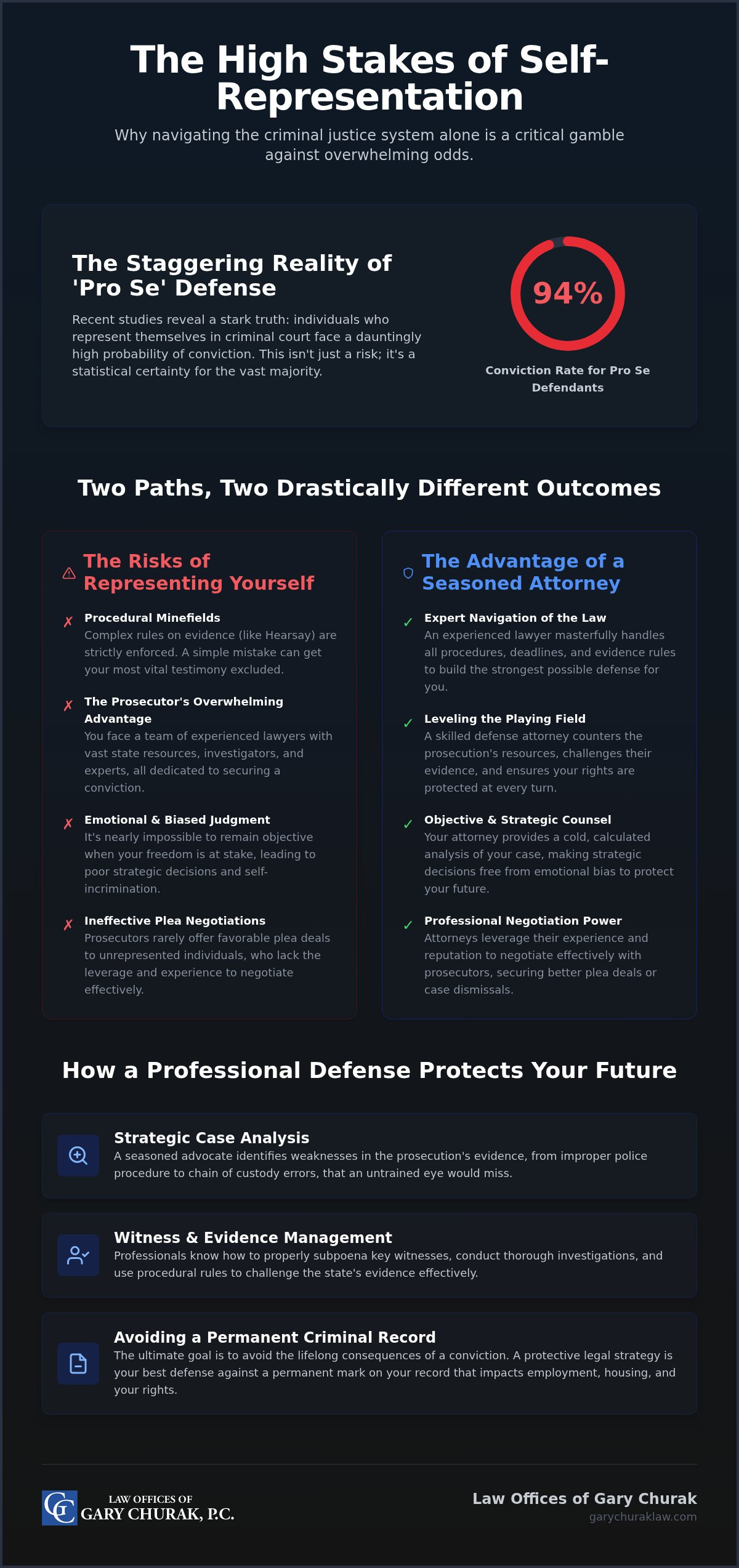
Checklist: 10 Critical Risks of Representing Yourself
The legal system doesn't offer a learning curve. You're either prepared or you're penalized. When you evaluate the risks of representing yourself in a criminal case, you must look beyond the immediate courtroom drama. Recent data indicates that pro se defendants face a conviction rate of approximately 94 percent. This isn't because they're all guilty; it's because the system is built for professionals. Attempting to navigate these waters alone means you're not just risking a fine. You're risking your entire future on a gamble where the house always has the advantage.
The Essential Risk Assessment
To understand the gravity of your situation, consider these ten specific hazards that unrepresented individuals face every day:
- Procedural Errors: Missing a single filing deadline can result in the immediate forfeiture of your defense.
- Evidence Suppression Failures: Without deep technical knowledge, you won't know how to suppress evidence obtained through illegal means.
- Constitutional Blind Spots: Most non-lawyers fail to recognize when their Fourth or Fifth Amendment rights have been violated during an arrest.
- Sentencing Disparities: Pro se defendants often receive harsher sentences because they don't know how to argue for mitigating factors.
- Lack of Mitigation: You likely don't know how to present your background in a way that moves a judge toward leniency.
- Investigation Failures: You lack the authority and resources to properly subpoena witnesses or secure forensic experts.
- Irreversible Trial Records: Mistakes made during trial are etched into the record, often making an appeal impossible.
- Psychological Burnout: The stress of facing jail time clouds your judgment, leading to impulsive, poor decisions.
- Career Destruction: A felony conviction on your record can permanently bar you from dozens of professional industries.
- Loss of Civil Liberties: Beyond jail, you risk losing your right to vote, own a firearm, or even travel freely.
Can You Afford the Alternative?
Many people choose self-representation to avoid legal fees, but this is often a false economy. You must compare the "cost" of an attorney to the lifetime "cost" of a criminal conviction. A permanent record affects your lifetime earning potential, your ability to secure housing, and your reputation in the community. When you look at the 2026 updates to federal sentencing guidelines, the margin for error has become even slimmer. Fines have adjusted for inflation, and sentencing calculations have been simplified to make convictions swifter.
Professional advocacy isn't an expense; it's an investment in your freedom. By choosing a criminal defense attorney who understands the nuances of the law, you're buying back your future. You need someone who can identify the threads the prosecution hopes you'll miss. Don't wait until you're standing in front of a judge to realize you're outmatched. Start protecting your rights today by securing a battle-tested guide who knows how to win.
Why Professional Advocacy is Your Best Defense
Standing alone in a courtroom is a heavy burden that few are truly prepared to carry. Wisdom isn't found in a textbook; it's forged through four decades of navigating complex federal and state courtrooms where every decision carries the weight of a client's future. When you face the risks of representing yourself in a criminal case, you aren't just fighting a legal charge. You're fighting an institutional machine that has spent decades refining its ability to secure convictions. A battle-tested attorney serves as more than just a legal advisor; they act as a fierce protector who stands between you and the full power of the state.
The primary advantage of professional representation is the ability to see the battlefield from a strategic distance. An attorney acts as a shield, handling every communication with investigators, prosecutors, and the court. This protection ensures that you don't inadvertently provide the state with the evidence they need to seal your fate. By taking the lead, your advocate preserves your dignity and your silence, allowing you to focus on your life while they focus on the law.
The Power of a Strategic Defense
A thorough case analysis often reveals the threads the prosecution hopes you'll miss. This involves scrutinizing every police report, witness statement, and piece of forensic evidence for procedural flaws or constitutional violations. Aggressive advocacy means more than just showing up to court; it involves a methodical deconstruction of the state's narrative. Whether you're facing drug charges or federal crimes, the trajectory of your case changes the moment a professional identifies a single illegal search or an unreliable witness. Understanding how to leverage these weaknesses is the difference between a dismissed charge and a life-altering conviction. You can begin this process by preparing for a criminal defense consultation to ensure your side of the story is heard with precision.
Securing Your Freedom
Your most important move today is transitioning from a state of uncertainty to a state of preparedness. The legal system moves quickly, and the prosecution is already building its case against you. Protecting your rights and your reputation requires a commitment to excellence and a refusal to settle for "good enough." Gary Churak provides the steady hand and strategic wisdom needed to navigate these high-stakes situations, backed by 40+ years of legal experience. We offer free initial consultations to help you understand the reality of your situation without immediate financial pressure. Don't gamble with your life or your liberty. Contact a seasoned criminal defense expert today and secure the advocate you deserve.
Take Decisive Action to Protect Your Future
You now understand that the risks of representing yourself in a criminal case extend far beyond a simple fine or a few days in court. From navigating the 94 percent conviction rate to mastering complex evidence rules, the burden of self-representation is often too heavy to carry alone. Every decision you make right now creates a ripple effect that impacts your career, your family, and your long-term freedom. You don't have to face this institutional machine without a battle-tested guide by your side.
Gary Churak provides over 40 years of aggressive criminal defense experience and a commitment to comprehensive case analysis. We offer personalized advocacy designed to find the specific legal threads the prosecution hopes you'll miss. Don't leave your reputation to chance when you can have a professional protector standing in your corner. Schedule your free strategic defense consultation today. Your future is worth protecting, and the right legal strategy starts with taking this first step with confidence.
Frequently Asked Questions
Is it ever a good idea to represent yourself in a criminal case?
Self-representation is almost never advisable, even for charges that seem minor. The long term consequences of a criminal conviction can include the loss of your professional license, restricted travel, and permanent damage to your reputation. A seasoned advocate identifies procedural opportunities for dismissal or reduction that an untrained individual will likely miss. Professional defense is an investment in your future stability and constitutional protection.
What is the most common mistake 'pro se' defendants make?
Failing to master the Rules of Evidence is the most frequent pitfall for those going it alone. Many defendants attempt to introduce hearsay or unauthenticated documents that the court is legally required to reject. This often leads to the defendant inadvertently providing incriminating testimony while trying to explain their side of the story. This lack of technical knowledge is one of the primary risks of representing yourself in a criminal case.
Can a judge help me if I don't have a lawyer?
No, the judge must remain a neutral arbiter and is strictly prohibited from providing legal advice or strategic guidance. While a judge might explain basic courtroom mechanics, they will not tell you when to object or how to cross-examine a witness effectively. You are held to the exact same standard as a licensed attorney with decades of experience, regardless of your lack of formal legal training.
What happens if I start representing myself but realize I need a lawyer later?
You have the right to hire an attorney at any stage, but damage done during the early phases of a case is often irreversible. If you have already missed deadlines for filing motions to suppress evidence or made recorded statements to the prosecution, a lawyer’s ability to help you is severely limited. It is far more effective to have a protector involved from the initial arraignment to prevent these critical errors.
Will the prosecutor take me seriously if I don't have an attorney?
Prosecutors generally view unrepresented defendants as a guaranteed path to a conviction. Without an attorney, you do not represent a credible threat of a successful trial, which effectively eliminates your leverage during plea negotiations. Understanding the risks of representing yourself in a criminal case means acknowledging that you lack the professional standing to force a prosecutor to offer their most favorable terms or consider alternative sentencing.
How much more likely is a conviction when representing yourself?
Data consistently shows that individuals without professional representation face significantly higher conviction rates than those with seasoned counsel. Beyond the verdict itself, pro se defendants often receive harsher sentences because they don't know how to present mitigating factors effectively. An experienced attorney argues for options like deferred adjudication or pretrial diversion that can keep a conviction off your permanent record, options a non-lawyer rarely knows how to secure.
Can I appeal a conviction if I represented myself and made a mistake?
You can file an appeal, but you generally cannot claim "ineffective assistance of counsel" if you chose to represent yourself. Furthermore, if you failed to make a timely, legal objection during your trial, that error is usually considered waived. This means a higher court will refuse to review the mistake. Your errors become permanent parts of the trial record that even the best appellate lawyer may not be able to fix.
What should I ask during a free legal consultation?
Focus on the attorney's specific experience with your type of charge and their initial assessment of the state's evidence. Ask about potential collateral consequences for your career and what strategic motions they would prioritize to create leverage. A free consultation is the best time to evaluate their depth of knowledge and ensure they possess the aggressive, battle-tested approach required to protect your rights and your freedom.


