

Most motorists assume flashing emergency lights simply mean an expensive civil fine, but a citation for reckless driving is not just an ordinary traffic ticket. It is an allegation of criminal conduct centered on conscious intent rather than simple negligence. If you feel blindsided by the sudden prospect of license suspension, soaring insurance premiums, or a permanent criminal record that threatens your livelihood, your anxiety is completely justified. Facing prosecutors who claim you operated a vehicle with willful or wanton disregard for safety is a high-stakes challenge that demands an assertive response.
You don't have to face this situation without a battle-tested strategy. This guide clarifies the legal standards that separate minor traffic infractions from criminal charges, showing you precisely what evidence prosecutors must establish to secure a conviction. You will also discover viable defense angles to challenge uncalibrated radar readings, contest officer observations, and build a methodical roadmap toward securing charge reductions or outright dismissals.
Key Takeaways
- Understand the vital threshold of willful and wanton disregard that separates criminal prosecution from ordinary driver error.
- Learn why a reckless driving charge triggers severe misdemeanor penalties, including driver license suspension and potential jail time, rather than routine traffic fines.
- Distinguish minor moving infractions from criminal offenses to recognize how the state attempts to establish driver intent.
- Discover tactical defense methods used to challenge speed detection devices, contest law enforcement testimony, and identify improper stops.
- Explore how assertive pre-trial litigation and evidentiary motions can help dismantle the prosecution's case to safeguard your future.
What Is Reckless Driving? Legal Definition and the Standard of Disregard
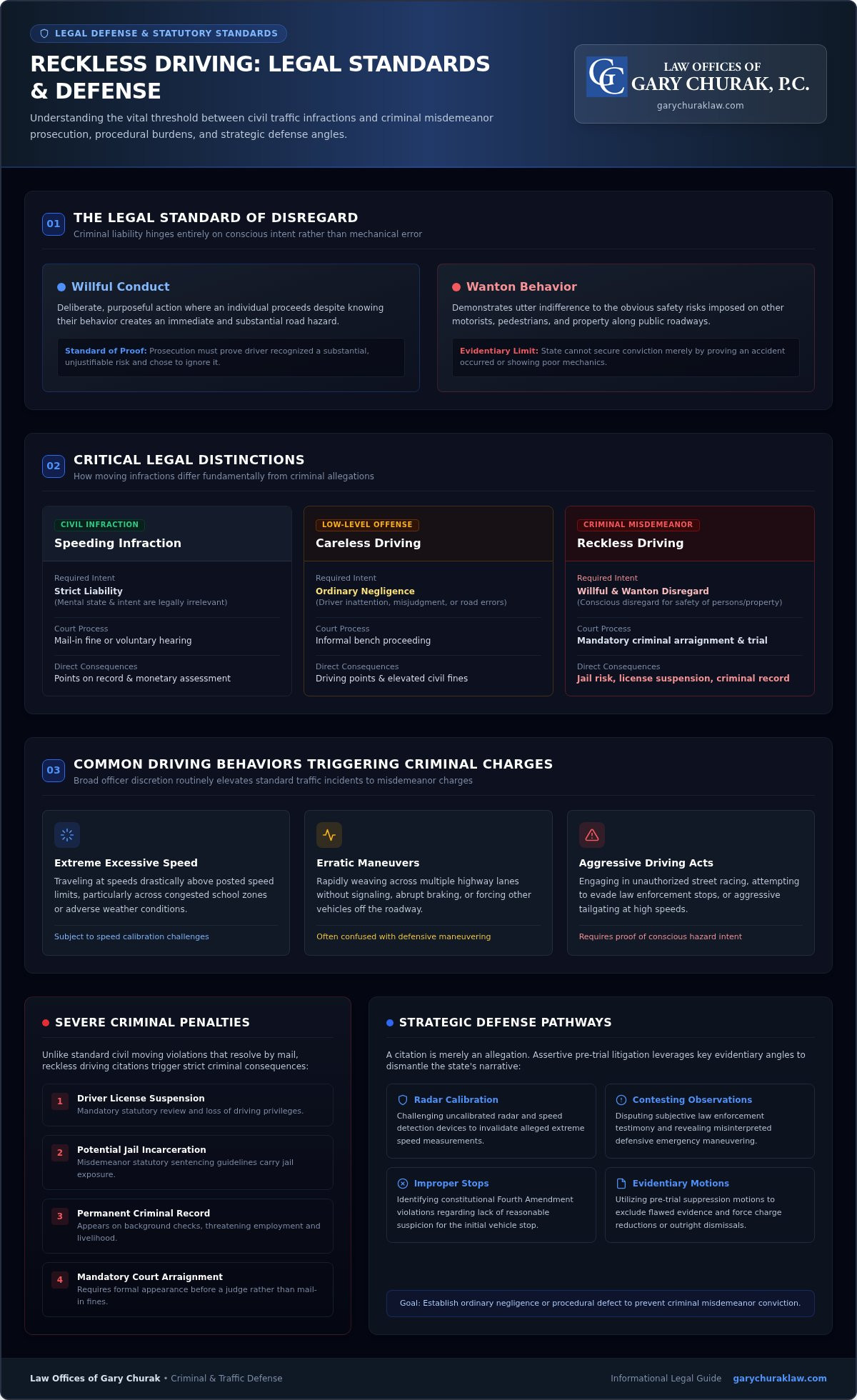
Legally defined, reckless driving is the operation of a motor vehicle with a willful or wanton disregard for the safety of persons or property. It is not an ordinary civil moving violation. Unlike standard traffic infractions, this charge targets the driver's mental state rather than a simple error in judgment. The law draws a clear line between accidental miscalculations and conscious hazards.
Every valid prosecution hinges on the driver's state of mind. An honest mistake, such as failing to notice a reduced speed sign or momentarily drifting within a lane, represents negligence rather than a crime. Reckless driving requires conscious risk awareness. The prosecution must prove you recognized a substantial, unjustifiable risk and chose to ignore it anyway. Under the established legal standard of disregard, the state cannot secure a criminal conviction merely by showing that a collision occurred or that an officer observed poor driving mechanics. Establishing this distinction forms the foundational pillar of an assertive defense strategy.
The Legal Meaning of Willful and Wanton Conduct
Willful conduct denotes deliberate, purposeful action where an individual proceeds despite knowing their behavior creates an immediate road hazard. Wanton behavior takes this further, demonstrating utter indifference to the obvious safety risks imposed on other motorists, pedestrians, and property. Prosecutors face the burden of proving this specific mindset beyond a reasonable doubt. They must establish criminal intent, not merely mechanical failure or bad weather conditions.
Common Driving Behaviors That Trigger Criminal Citations
Law enforcement officers frequently exercise broad discretion when issuing these citations, converting what should be minor tickets into serious misdemeanor cases. Behaviors that routinely trigger these criminal charges include:
- Extreme excessive speed: Traveling at speeds drastically above the posted limit, particularly across congested school zones or adverse weather conditions.
- Erratic maneuvers: Rapidly weaving across multiple highway lanes without signaling, braking abruptly, or forcing other motorists off the roadway.
- Aggressive driving acts: Engaging in unauthorized street racing, attempting to evade law enforcement stops, or tailgating vehicles aggressively at high speeds.
A citation is merely an allegation. An aggressive case analysis can reveal that an officer misinterpreted defensive maneuvering or relied on flawed observations, providing the leverage needed to challenge the state's narrative.
Reckless Driving vs. Careless Driving and Speeding: Critical Legal Distinctions
Motorists often conflate speeding, careless driving, and reckless driving, yet the legal boundaries between them dictate whether you resolve a minor ticket by mail or appear before a judge on criminal charges. Ordinary speeding remains a civil infraction. Criminal driving citations, by contrast, demand mandatory court appearances, risk driver license suspension, and threaten your personal record.
| Legal Factor | Speeding Infraction | Careless Driving | Reckless Charge |
|---|---|---|---|
| Required Intent | Strict liability; intent is irrelevant | Ordinary negligence or inattention | Willful and wanton disregard for safety |
| Classification | Civil moving violation | Civil infraction or low-level offense | Criminal misdemeanor |
| Court Process | Mail-in fine or voluntary hearing | Informal bench proceeding | Mandatory criminal arraignment and trial |
| Consequences | Points and monetary assessment | Points and elevated civil fines | Jail risk, suspension, criminal record |
Ordinary Negligence vs. Conscious Disregard
Ordinary negligence involves failing to exercise the standard of caution that a reasonable person would maintain under similar conditions. Accidental hydroplaning across a slick road, misjudging a stopping distance, or momentarily looking away from a lane marker reflects careless error rather than criminal behavior. The driver didn't intend to create danger. A criminal allegation requires prosecutors to prove conscious disregard, meaning the motorist understood the severe risks of their conduct and deliberately proceeded anyway. Defense counsel routinely analyzes officer statements to show that observed driving was merely negligent, giving the defense leverage to pursue charge reductions. Reviewing the formal legal definition of reckless driving demonstrates just how strictly the state must prove mental intent.
When Excessive Speed Crosses into Criminal Recklessness
Speeding shifts into criminal territory when velocity exceeds specific statutory boundaries or directly endangers others. Several states classify driving 20 to 30 miles per hour over the posted limit, or exceeding absolute thresholds like 85 or 100 miles per hour, as an automatic criminal misdemeanor. Surrounding circumstances such as heavy fog, active school zones, or dense pedestrian crosswalks quickly elevate civil speeding tickets into serious criminal cases.
Identifying the precise classification of your citation shapes every pre-trial strategy. Partnering with a dedicated criminal defense attorney allows you to challenge flawed speed measurement devices and contest officer testimony. If you face criminal charges on the road, retaining experienced advocacy from The Law Offices of Gary Churak provides the assertive representation necessary to safeguard your record and driving privileges.
Penalties and Hidden Consequences of a Reckless Driving Conviction
Pleading guilty to reckless driving does not just close a court file; it triggers a cascade of statutory penalties and long-term disruptions. Many drivers mistakenly treat this charge as an expensive fine, only to discover too late that they have accepted a permanent criminal conviction. Misdemeanor records follow you indefinitely, influencing your freedom, finances, and future career path.
The immediate administrative impact begins with your driver's license. State motor vehicle departments routinely assess substantial demerit points against your record following a conviction, which often initiates an automatic suspension period. Losing your driving privileges directly impairs your ability to commute, care for family, and maintain employment. If a suspension ultimately leads to mandatory re-examination before reinstatement, motorists can discover Book Your Road Test for help navigating practical exam bookings.
Direct Judicial Penalties: Jail Time, Fines, and Probation
Judges impose severe criminal penalties based on statutory frameworks and past driving history. Depending on the jurisdiction, a first-offense conviction can result in statutory jail sentences ranging from 60 days up to a full year. Courts frequently impose steep statutory fines, mandatory community service, and supervised probation requiring regular administrative check-ins. If your driving record already contains prior moving infractions, prosecutors vigorously pursue harsher incarceration terms and restrictive probationary conditions.
Long-Term Collateral Consequences on Career and Daily Life
Beyond the courtroom, secondary consequences frequently outweigh the initial judicial sentence. Insurance carriers routinely categorize convicted drivers as high-risk policyholders, leading to immediate premium surges or outright coverage cancellations that persist for three to five years. For commercial motorists, a conviction delivers an even heavier blow. A reckless driving conviction can trigger mandatory commercial driver license disqualification, effectively terminating a transportation career overnight.
A criminal record creates enduring obstacles across modern professional life:
- Background check disqualifications: Misdemeanor convictions show up on corporate background screenings, complicating job applications and promotional opportunities.
- Security clearance hurdles: Demonstrated criminal conduct can stall federal clearances and sensitive government employment reviews.
- Professional licensing scrutiny: Regulatory boards for healthcare, law, finance, and contracting closely review criminal convictions during licensing renewals.
Accepting a conviction without a fight leaves these damaging penalties unchallenged. Thorough defense preparation examines every flaw in the prosecution's evidence, providing the leverage necessary to seek reduced offenses or full dismissals that preserve your record.
Strategic Defense Approaches to Defeat Reckless Driving Charges
Beating a reckless driving charge requires dismantling the state's narrative piece by piece. Prosecutors rely heavily on subjective police accounts and fallible detection hardware. By conducting a methodical case review, an assertive defense can expose reasonable doubt, suppress compromised evidence, and eliminate the claim of intentional disregard.
Challenging Speed Measurement and Law Enforcement Observations
Speed detection equipment is far from infallible. Officers must strictly adhere to operating protocols, maintain detailed maintenance logs, and conduct routine tuning fork calibrations before and after their shifts. Subpoenaing these technical records often reveals lapsed certifications or improper device handling, rendering radar or LiDAR readings inadmissible in court.
Visual estimations are equally vulnerable under targeted cross-examination:
- Sightline obstructions: Heavy traffic, curved terrain, adverse weather, or distance can distort an officer's visual tracking.
- Video evidence reconciliation: Dashcam, body-worn camera, and nearby surveillance footage frequently contradict subjective claims in police reports.
- Improper stop procedures: Traffic stops initiated without reasonable articulable suspicion create grounds for formal constitutional suppression motions.
Arguing Lack of Intent and Emergency Circumstances
Establishing reasonable doubt regarding the driver's mental state directly defeats the charge. A motorist who swerves abruptly to avoid unexpected road hazards, blown tires, or wildlife acted out of necessity, not criminal recklessness. Similarly, documented mechanical breakdowns, such as sudden throttle malfunctions or power steering loss, demonstrate an absence of willful conduct. Proving that your actions were reasonable attempts to prevent a crash directly refutes the accusation of wanton disregard.
Negotiating Charge Reductions and Alternative Dispositions
Assertive pre-trial litigation often shifts prosecutorial leverage in your favor. When defense counsel exposes evidentiary weaknesses, prosecutors frequently agree to amend misdemeanor charges to non-criminal infractions like defective equipment or basic civil speeding. Completing proactive measures, such as an approved defensive driving curriculum, further supports these negotiated resolutions.
Effective defense outcomes depend on early preparation. Understanding how to organize your evidence is essential, which is why preparing for a criminal defense consultation with all relevant citations, maintenance logs, and witness statements sets the foundation for success. If you are ready to challenge the allegations against you, request a strategic case review to start building a tailored defense that protects your driving privileges and your future.
Why Retaining Experienced Legal Representation Protects Your Driving Future
A citation for reckless driving cannot be resolved by simply mailing a payment. Treating this criminal charge like a minor parking ticket creates devastating legal exposure. The proceedings unfold in criminal courtrooms where prosecutors demand formal convictions, making assertive litigation essential to protect your personal liberties, driving privileges, and future career opportunities.
Navigating the justice system requires decisive intervention. Seasoned advocates manage every stage of the process, from initial arraignments to contentious pre-trial conferences, using procedural rules to challenge the state's case long before a trial begins.
The Perils of Self-Representation in Criminal Traffic Court
Entering a courtroom without counsel places you at a major disadvantage against experienced prosecutors. Unrepresented defendants routinely make avoidable procedural mistakes that permanently damage their defense:
- Irrevocable criminal convictions: Paying a fine or pleading guilty enters a permanent misdemeanor on your record that standard expungement processes may not easily erase.
- Waived suppression motions: Motorists unfamiliar with evidentiary rules fail to contest unlawful vehicle stops, forfeiting opportunities to suppress key evidence.
- Unequal bargaining leverage: Prosecutors recognize when defendants lack trial readiness, offering rigid plea deals rather than negotiating meaningful charge reductions.
Decisive Advocacy: How the Law Offices of Gary Churak Defends You
Protecting your driving privileges requires strategic, proactive representation. Knowing what to look for in a criminal defense attorney ensures you secure an advocate who examines every detail of the arresting officer's conduct. High-speed allegations often intersect with related allegations, and working with a battle-tested dwi defense attorney ensures your legal team possesses deep experience in dismantling subjective officer testimony, roadside observations, and technical equipment readings.
Backed by over 40 years of courtroom litigation and criminal defense experience, The Law Offices of Gary Churak delivers assertive representation focused on charge dismissals, reductions, and complete record protection. A meticulous evaluation of your case can expose procedural flaws and uncalibrated radar measurements before trial. Don't leave your driving record and personal liberty to chance. Contact the firm today to schedule a strategic case evaluation and take control of your defense.
Protecting Your Future Against Criminal Traffic Allegations
A citation for reckless driving demands decisive, strategic pushback rather than passive acceptance. The state bears the heavy burden of proving conscious, willful disregard rather than a simple lapse in driver attention. From uncovering calibration gaps in radar hardware to challenging subjective officer observations, procedural challenges can quickly dismantle the prosecution's case before trial.
You don't have to navigate these high-stakes criminal proceedings alone. Backed by over 40 years of courtroom litigation and criminal defense experience, our firm provides aggressive representation focused on charge dismissals and reductions. Through meticulous case analysis that pinpoints evidentiary flaws in traffic stops, we work tenaciously to protect your driving privileges, your career, and your clean record. Protect your driving record and future by scheduling a confidential case evaluation with our seasoned defense team today. With a prepared advocate in your corner, you can face the courtroom with confidence and safeguard your future.
Frequently Asked Questions
Is reckless driving classified as a misdemeanor or a felony offense?
Reckless driving is predominantly classified as a criminal misdemeanor across most jurisdictions. However, prosecutors can elevate the charge to a felony if the driving behavior causes serious bodily injury, extensive property destruction, or death. In severe crash scenarios, the incident often spurs parallel civil claims where victims seek representation from a Personal Injury Attorney in Fort Lauderdale to hold reckless drivers accountable. A standard misdemeanor charge still carries potential jail terms, significant fines, and a criminal record. Treating any classification lightly jeopardizes your personal liberty and driving privileges.
Can a reckless driving charge be reduced to a regular speeding ticket?
Yes, prosecutors frequently agree to reduce reckless driving charges to simple civil speeding or non-moving equipment violations during pre-trial negotiations. Securing this reduction requires exposing flaws in the state's case, such as improper radar calibration or unreliable officer observations. Demonstrating an absence of wanton disregard gives defense counsel the leverage necessary to convert a criminal charge into an ordinary civil fine with no jail exposure.
Will a reckless driving citation cause an immediate suspension of my license?
An immediate suspension doesn't typically occur at the roadside upon receiving a citation unless you are simultaneously arrested for an offense like DUI. Instead, license suspension usually follows a formal court conviction or the accumulation of excessive demerit points assessed by your state motor vehicle agency. A proactive defense seeks to prevent the underlying conviction, stopping any license suspension before administrative sanctions take effect.
How does reckless driving differ legally from aggressive or careless driving?
The primary legal distinction lies in the driver's mental intent and criminal exposure. Careless driving involves ordinary negligence or momentary driver inattention, remaining a civil infraction in most states. Aggressive driving covers a pattern of specific traffic offenses committed in quick succession. Criminal traffic charges require proof that you knowingly acted with conscious, wanton disregard for safety, elevating the violation to a crime.
What happens if I simply pay the fine on my reckless driving citation?
Paying the fine on a criminal citation functions as an immediate guilty plea. You can't simply pay it like a routine civil ticket without entering an irrevocable misdemeanor conviction on your permanent record. This action triggers administrative point penalties, substantial insurance rate increases, and a criminal history that appears on future employment background checks. Consulting counsel before paying preserves your defense options.
Do I need to appear in criminal court personally for a reckless driving charge?
Most jurisdictions mandate a personal court appearance because the allegation is a criminal misdemeanor rather than a civil infraction. Failing to appear can prompt the judge to issue an immediate bench warrant for your arrest. In many cases, retaining private defense counsel allows an attorney to appear on your behalf for routine pre-trial conferences, sparing you time away from your job and family obligations.
How long will a reckless driving misdemeanor conviction stay on my record?
A misdemeanor conviction remains on your criminal record permanently unless you successfully pursue formal expungement or record sealing. Driving points typically drop off your motor vehicle record after several years, but the criminal entry doesn't expire on its own. It remains visible during routine background screenings indefinitely. Taking aggressive action to defeat or reduce the initial charge prevents this permanent mark entirely.


