

What if the search warrant that authorized law enforcement to invade your privacy was built on a foundation of legal guesswork rather than solid facts? Many people mistakenly assume a judge's signature makes a warrant infallible, but the reality is that the underlying evidence is often highly subjective. To protect your future, you must first understand exactly what is probable cause for a search warrant and recognize where investigators frequently overstep their bounds.
Watching officers sift through your private belongings is an inherently violating experience, and it's completely natural to feel overwhelmed by anxiety about upcoming charges. The complex constitutional terminology used in affidavit documents only adds to the confusion. This strategic guide will clarify the precise legal threshold required for a search warrant and demonstrate how an aggressive defense can challenge and suppress evidence obtained through constitutional violations. We will examine the critical vulnerabilities in law enforcement affidavits and outline the exact steps required to fight back in court.
Key Takeaways
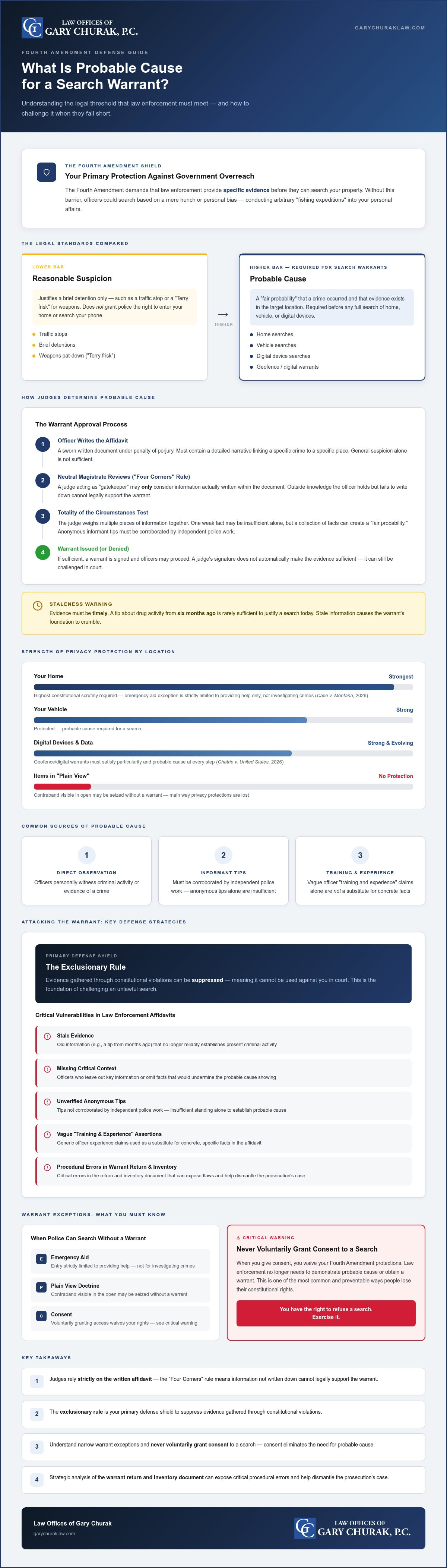
- Understand exactly what is probable cause for a search warrant and how judges rely strictly on the written affidavit to authorize law enforcement actions.
- Discover how the exclusionary rule acts as a primary defense shield to suppress evidence gathered through constitutional violations.
- Learn to identify the narrow exceptions police use to bypass warrants, including why you should never voluntarily grant consent to a search.
- Uncover how a strategic case analysis of the return and inventory document can expose critical procedural errors and help dismantle the prosecution's case.
Defining Probable Cause and Your Fourth Amendment Rights
The Fourth Amendment isn't just a dusty legal concept; it's your primary shield against government overreach. It demands that law enforcement provide specific evidence before they can disrupt your life. Understanding what is probable cause for a search warrant is the first step in determining if your rights were trampled during a police investigation. This standard exists specifically to prevent the government from conducting arbitrary "fishing expeditions" into your personal affairs. Without this barrier, officers could search your home based on a mere hunch or personal bias.
Identifying what is probable cause for a search warrant allows your attorney to scrutinize the state's actions. It's vital to distinguish between "reasonable suspicion" and the higher standard of probable cause. Reasonable suspicion is a lower bar that justifies a brief detention, such as a traffic stop or a "Terry frisk" for weapons. It doesn't give police the right to enter your home or dig through your phone. If an officer conducts a full search based only on suspicion, they've violated your rights. We look for these distinctions to build a strategy that protects you from unlawful government intrusion.
The Constitutional Threshold for a Search
Probable cause acts as the necessary legal bridge between a simple suspicion and a full scale search. In the current 2026 legal landscape, this threshold remains a vital protection. For example, the Supreme Court's June 2026 ruling in Chatrie v. United States reinforced that digital searches, like geofence warrants, must still satisfy particularity and probable cause at every step. For a warrant to be valid, a "neutral and detached magistrate" must review the police request. This judge acts as a gatekeeper. They ensure that officers have more than just a guess. The prosecution must show a "fair probability" that a crime occurred and that evidence exists in the target location.
What Constitutes a 'Reasonable' Expectation of Privacy?
Your "privacy interest" is strongest inside your home. It also covers your vehicle and digital devices. In 2026, the Supreme Court clarified in Case v. Montana that while police can enter for emergency aid without probable cause, that entry is strictly limited to providing help, not investigating crimes. The location of the search often dictates how much scrutiny a warrant needs. The "plain view" doctrine is the main way these protections are lost. If an officer sees contraband in the open, they can seize it without a warrant. Outside of these specific scenarios, law enforcement must adhere to the Probable Cause standard to justify their actions.
The Evidentiary Standard: How Judges Determine Probable Cause
The process begins with the affidavit. This is the written document where an officer must swear to specific facts under penalty of perjury. When a judge asks what is probable cause for a search warrant, they aren't looking for a general suspicion; they require a detailed narrative that links a specific crime to a specific place. This requirement is rooted in the Fourth Amendment, which protects you from intrusive searches without a factual basis. Police don't just get a warrant by asking; they must prove their case on paper first.
Strict adherence to the "Four Corners" rule is mandatory. This means a judge can usually only consider the information actually written on the paper. If the officer knows more but fails to write it down, that outside knowledge cannot legally support the warrant. We scrutinize these documents to ensure the police didn't leave out critical context or include "stale" information. In 2026, evidence must be timely. For instance, a tip about drug activity from six months ago is rarely enough to justify a search today. If the information is too old, the warrant's foundation crumbles.
The Totality of the Circumstances Test
When analyzing what is probable cause for a search warrant, judges use a "totality of the circumstances" approach. They weigh multiple pieces of information together rather than looking at them in isolation. While one single fact might seem weak, a collection of facts can create a "fair probability" of criminal activity. However, a judge's signature doesn't automatically make the evidence sufficient. Vague claims about an officer's "training and experience" aren't a substitute for concrete facts. If the affidavit relies on an anonymous informant, the court must vet their reliability. The tip must be corroborated by independent police work to hold weight.
Common Sources of Probable Cause
Probable cause typically stems from three main areas:
- Direct Observation: Officers seeing illegal acts or contraband firsthand during their duties.
- Physical Evidence: Items recovered during a lawful stop, surveillance footage, or digital breadcrumbs left behind.
- Hearsay: Information provided by witnesses or confidential sources, provided it meets strict reliability standards.
Analyzing these sources requires a battle-tested eye to spot where the logic fails. If you're facing charges, you should have an experienced attorney review the specific warrant documents to identify these weaknesses before your case proceeds.
Attacking the Warrant: Can Probable Cause Be Challenged?
A judge's signature on a search warrant is not the final word. If law enforcement secured that warrant through flawed, misleading, or insufficient data, you have the legal right to challenge it. Understanding what is probable cause for a search warrant gives you the baseline knowledge needed to spot where the state's argument falls apart. Your primary weapon in this fight is the exclusionary rule, which prevents prosecutors from using illegally obtained evidence against you at trial. You must act quickly to preserve these rights, as procedural deadlines for challenging warrants are strict.
When we expose a flawed warrant, the "fruit of the poisonous tree" doctrine comes into play. This legal rule dictates that if the initial search warrant was invalid, any secondary evidence discovered because of that search is also tainted. For example, if an unlawful search of a home reveals a key to a storage locker, the evidence found inside that locker can also be suppressed. This single vulnerability can cause an entire prosecution to collapse, especially in complex federal or drug crimes cases where the physical evidence is the cornerstone of the state's case.
Filing a Motion to Suppress Evidence
To challenge the evidence, your defense attorney must file a formal motion to suppress. This procedural step requests a court hearing where a judge reviews whether the police truly established a sufficient level of probable cause in their original affidavit. If the judge agrees that the warrant was defective, the primary evidence is thrown out. When the prosecution loses its main evidence, they often have no choice but to reduce or entirely dismiss the charges. To understand how these motions fit into a broader defense plan, you can learn more about how a criminal defense attorney protects your future and your freedom through aggressive case analysis.
Common Flaws in Search Warrant Affidavits
Defenses frequently uncover critical errors when dismantling an officer's sworn statement. We look specifically for these three major flaws:
- Misleading Statements: Officers showing a reckless disregard for the truth by fabricating details or omitting facts that would damage their case. If this occurs, we request a Franks Hearing to challenge the officer's integrity directly.
- Lack of a Nexus: A failure to connect the alleged criminal behavior to the specific location. For example, suspecting someone of a crime does not automatically give police a legal reason to search their cousin's house.
- Overbroad Warrants: Warrants that authorize a general sweep for "any evidence of illegal activity" instead of naming specific items, violating the constitutional requirement for particularity.
Search Warrant Exceptions: When Probable Cause Isn't Enough (or Needed)
While the general rule requires a warrant, the justice system allows several narrow exceptions that let law enforcement bypass your constitutional protections. Understanding what is probable cause for a search warrant is vital, but you must also recognize the scenarios where police don't need a judge's signature at all. These exceptions are often the most abused areas of criminal procedure. Knowing when an officer is legally permitted to search without a warrant can prevent you from inadvertently helping the prosecution build a case against you.
Beyond consent and emergencies, two other common exceptions exist. A "search incident to a lawful arrest" allows officers to search your person and the immediate area for weapons or evidence once you're in custody. Additionally, the "automobile exception" gives police more leeway. Because vehicles are mobile and have a lower expectation of privacy than a home, officers can often search a car if they have probable cause to believe it contains contraband, even without a warrant in hand.
The Danger of Consenting to a Search
Police often ask for consent when they know they lack the necessary evidence to satisfy the standard of what is probable cause for a search warrant. You should never waive your rights. If an officer asks to "take a quick look" around your property, they're looking for a shortcut. You have the right to remain silent and to refuse a search. Be polite but firm by saying, "I do not consent to any searches." Many people believe that having "nothing to hide" makes consent harmless, but this is a dangerous misconception. A search can lead to the discovery of items you didn't know were there or evidence that can be taken out of context to support a charge.
Emergency Situations and Public Safety
Exigent circumstances allow police to act without a warrant when there is an immediate threat to public safety or the risk that evidence will be destroyed. This includes "hot pursuit" of a fleeing suspect. The Supreme Court's January 14, 2026, ruling in Case v. Montana further clarified the "emergency aid exception." The Court held that officers may enter a home without a warrant if they have an "objectively reasonable basis" for believing someone inside needs help. This specific standard doesn't require probable cause in the traditional criminal sense. However, a seasoned defense lawyer will always scrutinize these "emergencies" to ensure police didn't manufacture the crisis just to gain entry. If you've been subjected to a warrantless search, you should contact an experienced criminal defense attorney immediately to review the legality of the officer's actions.
Strategic Defense: How an Attorney Analyzes Search Warrant Validity
Dismantling a government investigation requires a methodical examination of the state's evidence. An experienced defense lawyer doesn't take the prosecution's claims at face value. Instead, they perform a comprehensive case analysis to identify procedural errors and constitutional overreach. One of the first documents we review is the "Return and Inventory." This sheet lists exactly what items the police seized during their search. By comparing this list against the original warrant, we can determine if officers exceeded their legal authority by taking items that weren't authorized by the judge.
The stakes increase significantly when dealing with federal investigations. Federal agencies often use complex digital surveillance and delayed-notice warrants, making the legal battleground much more technical. If you are facing high-stakes warrant issues from agencies like the FBI or DEA, securing specialized representation is non-negotiable. You can read more about building a defense against these powerful agencies by reviewing our guide on federal drug trafficking defense.
Protecting Your Future Through Aggressive Advocacy
A "cookie-cutter" defense strategy fails when your constitutional rights are on the line. Every affidavit contains a unique set of allegations, and exposing weaknesses requires a deep understanding of what is probable cause for a search warrant. A battle-tested guide knows how to leverage these weaknesses to craft persuasive pre-trial motions. Our role is to act as a fierce protector, ensuring that the prosecution is held to the highest possible standard of proof and that any tainted evidence is completely barred from the courtroom.
Your Path Forward After a Search
Navigating the aftermath of a police search is incredibly stressful, but taking immediate, organized action can change the trajectory of your case. To help your legal team build the strongest possible defense, you should follow these specific steps:
- Document the Event: Write down a detailed timeline of the search while the memory is fresh, noting what the officers said and did.
- Preserve the Paperwork: Keep copies of the warrant and the inventory receipt provided by the officers.
- Prepare for Guidance: Learn what to expect during your initial legal meeting by reviewing our resource on preparing for a criminal defense consultation.
A personalized consultation allows an attorney to examine the specific language of your warrant and find the path forward. Protecting your freedom starts with scrutinizing the government's actions right away.
Take Decisive Action to Protect Your Constitutional Rights
A search warrant isn't an absolute authority; it's a legal claim that must withstand intense scrutiny. We've examined how the Fourth Amendment serves as your primary shield and why the "totality of the circumstances" test often leaves room for significant defense challenges. Understanding what is probable cause for a search warrant allows you to recognize when law enforcement has relied on stale information or misleading affidavits to invade your privacy. By filing a motion to suppress, you can potentially dismantle the prosecution's case before it even reaches trial.
Gary Churak provides fierce protection for clients in both state and federal courts, backed by over 40 years of aggressive criminal defense experience. He utilizes thorough case analysis to identify every constitutional violation, ensuring the government is held to its highest legal burden. Don't let a feeling of violation turn into a sense of defeat. Schedule a personalized consultation with the Law Offices of Gary Churak to protect your rights. You deserve a battle-tested guide who will fight for your freedom and future with unwavering commitment.
Frequently Asked Questions
What is the difference between probable cause and reasonable suspicion?
Probable cause is a higher evidentiary standard than reasonable suspicion. While reasonable suspicion allows for a brief "Terry stop" or frisk based on specific facts, probable cause requires a "fair probability" that a crime occurred. This higher bar is essential when determining what is probable cause for a search warrant. An officer's hunch isn't enough; they need factual evidence that links a specific person or place to criminal activity.
Can a search warrant be issued based on an anonymous tip?
A search warrant can be issued based on an anonymous tip, but only if the police can independently corroborate the information. The court uses a "totality of the circumstances" test to evaluate the tipster's reliability and the basis of their knowledge. If the tip is vague or lacks detail, it rarely meets the standard of what is probable cause for a search warrant. Judges require specific, verifiable facts before authorizing an invasion of privacy.
What happens if a search warrant has a mistake, like the wrong address?
A clerical error like a wrong address can potentially invalidate a warrant, but it depends on the severity of the mistake. The Fourth Amendment requires that a warrant "particularly describe" the place to be searched. If the error is so significant that officers could search the wrong house, a defense attorney can file a motion to suppress. However, courts sometimes overlook minor typos if the description otherwise makes the target location clear.
Do police have to show you the search warrant before they start searching?
Generally, officers must show you a copy of the search warrant, but they don't always have to do it before they begin the search. In many jurisdictions, they can start the process and provide the paperwork shortly after. If they have a "no-knock" warrant or believe evidence is being destroyed, they may enter immediately. You should always ask to see the warrant and the specific areas it authorizes them to search.
Can my roommate or spouse give consent to search my private room?
A roommate or spouse can give consent to search common areas, but they generally cannot authorize a search of your private room or locked containers. If you have a reasonable expectation of privacy in a specific space that only you use, third-party consent is legally insufficient. Police often try to use this tactic when they lack a warrant. An experienced attorney will scrutinize these "consent" searches to see if your individual rights were violated.
What should I do if the police show up at my door with a search warrant?
If police arrive with a warrant, remain calm and don't physically resist, as this can lead to additional charges. Ask to see the warrant and read it carefully to understand the scope of the search. You should state clearly that you do not consent to the search, which preserves your right to challenge it later. Contact a defense attorney immediately and avoid answering questions without legal representation present.
Can evidence be used against me if the warrant was later found to be invalid?
Evidence obtained through an invalid warrant is often excluded under the "exclusionary rule." However, the Supreme Court has created a "good-faith exception." This allows evidence to be used if the officers reasonably believed the warrant was valid at the time. A strategic defense involves proving that the officers knew the warrant was flawed or that the issuing judge was misled. This is a complex legal battleground that requires aggressive advocacy.
How long does a search warrant remain valid before it expires?
Search warrants don't remain valid indefinitely and typically expire within a few days to two weeks. Federal Rule of Criminal Procedure 41, for example, generally requires that a warrant be executed within 14 days. If the police wait too long, the information becomes "stale," and the warrant loses its legal force. Executing an expired warrant is a direct violation of your rights and provides a strong basis for suppressing any seized evidence.


