

The physical discovery of contraband does not establish legal guilt. When law enforcement recovers controlled substances, prosecutors want you to believe your conviction is an absolute certainty. In reality, establishing an assertive legal defense for drug possession begins by challenging that premise on constitutional grounds, because police procedural errors or unlawful searches can dismantle the state's case before trial ever starts.
Facing criminal allegations triggers immediate personal dread. You're likely wrestling with the paralyzing fear of jail time, a permanent record, and the sudden threat of career destruction. It's easy to feel overwhelmed by dense legal terminology and rigid court hearings, especially when you're uncertain whether an officer's stop or vehicle search violated your basic rights.
You don't have to face the justice system without a clear, protective strategy. This guide breaks down actionable legal defenses to get charges reduced or dismissed, clarifies your Fourth Amendment protections against unlawful searches, and highlights crucial diversion programs that keep you out of custody.
Key Takeaways
- Understand the prosecution's strict burden of proof and how controlled substance schedules influence misdemeanor versus felony charge classifications.
- Discover how Fourth Amendment violations, unlawful stops, and improper warrants form the cornerstone of an aggressive legal defense for drug possession.
- Learn the legal distinction between actual and constructive possession to effectively challenge allegations involving shared residences or vehicles.
- Explore viable diversion programs and specialized drug treatment courts designed to dismiss charges and protect you from incarceration.
- Identify the immediate steps required to shield your rights, avoid fatal investigative errors, and retain experienced defense representation.
Understanding Drug Possession Charges: Classification, Burden of Proof, and Penalties
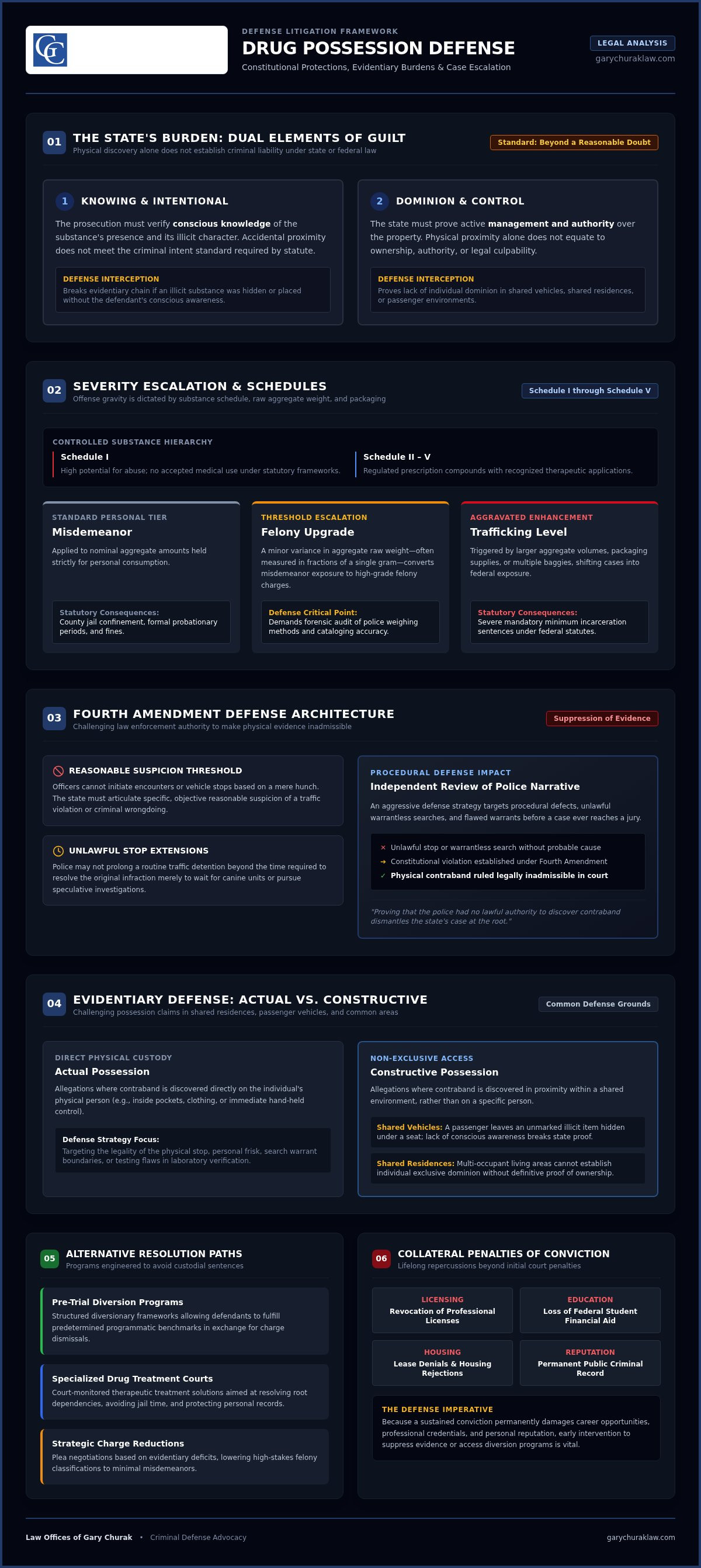
Facing criminal allegations under state or federal statutes begins with understanding the precise elements the state must prove. In any prosecution for possession of a controlled substance, the government shoulders a strict burden of proof. Prosecutors cannot secure a conviction merely by demonstrating that contraband was discovered near your person. Instead, they must establish beyond a reasonable doubt that you exercised dominion and control over the illicit item, and that you did so knowingly.
A strategic legal defense for drug possession targets this dual requirement. Physical proximity alone doesn't equate to ownership or culpability under criminal statutes. Beyond immediate statutory penalties like statutory fines or incarceration, a sustained conviction brings permanent collateral fallout: revocation of professional licenses, loss of federal student aid, housing rejections, and lasting damage to your personal reputation.
The Legal Elements of Knowing and Intentional Possession
Accidental proximity does not meet the standard for legal guilt. To secure a valid conviction, the state must prove that you possessed conscious knowledge of the item's presence and were aware of its illicit nature. If a passenger leaves an unmarked illicit substance hidden beneath your passenger seat, you do not possess the criminal intent required by law. Establishing lack of knowledge serves as a foundational defense against state overreach, effectively breaking the evidentiary chain that prosecutors rely upon.
Controlled Substance Schedules and Weight Thresholds
Drug offenses are categorized under federal and state frameworks spanning Schedule I through Schedule V. Schedule I covers narcotics deemed to carry high abuse potential and no accepted medical use, while lower schedules involve regulated prescription compounds with recognized therapeutic value. The legal severity escalates rapidly based on aggregate measurements:
- Misdemeanor Classifications: Typically applied to nominal amounts held strictly for personal use, carrying potential county jail terms and probationary conditions.
- Felony Upgrades: A minor variation in raw weight, often measured in fractions of a gram, can instantly convert a simple misdemeanor into a high-grade felony offense.
- Trafficking Enhancements: When investigators recover larger volumes, packaging materials, or multiple baggies, standard charges give way to complex federal drug trafficking defense situations that carry mandatory minimum sentences.
Building an effective legal defense for drug possession demands an aggressive audit of how law enforcement weighed, cataloged, and characterized the seized property.
Constitutional Defense Strategies: Challenging Unlawful Searches and Seizures
The Fourth Amendment serves as your most formidable shield against state overreach. When law enforcement officers violate constitutional boundaries during an investigation, the physical items they seize can become entirely inadmissible in court. Building an aggressive legal defense for drug possession often hinges not on contesting what was found, but on proving that the police had no lawful authority to discover it in the first place.
An experienced criminal defense attorney conducts an independent review of the police narrative, pinpointing procedural defects that can dismantle the prosecution's foundation before a case ever reaches a jury.
Challenging Reasonable Suspicion and Probable Cause
Every warrantless encounter requires precise constitutional justification. Officers cannot initiate a traffic stop on a mere hunch; they must point to specific, articulable reasonable suspicion of a traffic violation or criminal conduct. Similarly, prolonged detention without cause violates established constitutional limits:
- Unlawful Stop Extensions: Police cannot prolong a routine traffic stop beyond the time needed to address the initial infraction just to wait for a canine unit or fish for evidence.
- Exceeded Search Scope: Searching closed compartments, glove boxes, or locked luggage without voluntary consent or verified probable cause renders that search illegal.
- Bodycam Audits: Scrutinizing cruiser dashcam and bodycam video often exposes contradictions between an officer's written incident report and actual roadside events.
The Exclusionary Rule and Motions to Suppress Evidence
Under the Exclusionary Rule, evidence obtained through unconstitutional police actions must be suppressed. This legal principle encompasses the fruit of the poisonous tree doctrine: if the initial stop or search was unlawful, every piece of evidence discovered as a direct result must be thrown out. For example, if an officer searches a vehicle trunk without probable cause, any recovered narcotics are legally tainted.
Enforcing these rights requires tactical pre-trial litigation. Defense counsel drafts and files a comprehensive motion to suppress, forcing a formal evidentiary hearing where the arresting officers are subjected to cross-examination under oath. When the presiding judge grants the motion and excludes the seized contraband, the state's case collapses. Without physical evidence to present, prosecutors are frequently left with no choice but to dismiss the charges entirely.
If you suspect law enforcement violated your constitutional protections during a search, seeking an early case evaluation through legal representation can help expose those flaws and safeguard your record.
Evidentiary Defenses: Actual vs. Constructive Possession and Laboratory Flaws
Prosecutors must prove guilt with verifiable facts, not broad assumptions. While constitutional motions contest how officers obtained contraband, evidentiary defenses attack whether the state can legally link you to the substance or even prove what it is. A strategic legal defense for drug possession rigorously separates concrete proof from prosecutorial speculation, challenging the government's narrative at every evidentiary turn.
The legal distinction between having an item directly in your custody versus occupying an area where contraband is discovered represents one of the most powerful battlegrounds in criminal defense.
Dismantling Claims of Constructive Possession
Actual possession occurs when an individual carries an illicit substance directly on their person, such as in a pocket or waistband. Constructive possession is far more legally vulnerable. To convict on constructive grounds, prosecutors must prove that you knew the contraband was present and had both the power and intention to exercise dominion over it.
- Shared Vehicles: When police discover narcotics in a glove box, center console, or under a floor mat of a multi-passenger car, presence alone does not establish ownership.
- Communal Residences: In apartments with roommates or frequent guests, contraband found in shared living rooms or kitchens cannot be attributed to a single resident without direct physical links.
- Lack of Affirmatives Links: Without fingerprints, DNA, incriminating admissions, or personal effects stored directly alongside the items, mere proximity fails as a matter of law.
Forensic Lab Challenges and Chain of Custody Vulnerabilities
Roadside presumptive chemical kits are notoriously unreliable. These cheap colorimetric field tests routinely produce false positives when reacting with legal over-the-counter medications, household cleaners, or food items. State laws require formal crime laboratory verification via gas chromatography-mass spectrometry (GC-MS) before a prosecutor can sustain a conviction.
Forensic testing protocols demand absolute procedural precision. Any documented gap in the chain of custody breaks the legal foundation of the prosecution's case:
- Missing or inaccurate time stamps on evidence locker intake logs.
- Improper packaging that exposes samples to cross-contamination or degradation.
- Failure to calibrate laboratory instruments according to scientific standards.
Executing an assertive legal defense for drug possession involves demanding every maintenance record, calibration log, and forensic bench note. When the defense exposes mishandled samples or ambiguous chemical results, the court cannot permit compromised evidence into the record.
Alternative Resolutions: Pre-Trial Diversion, Drug Courts, and Charge Reductions
A complete courtroom trial isn't the only path to protecting your freedom. When constitutional suppression isn't an option, an effective legal defense for drug possession shifts focus toward alternative resolutions. State and federal systems increasingly recognize that substance use disorders require treatment rather than incarceration. Securing an alternative resolution shields you from a permanent criminal record, allowing you to walk away without a conviction.
Strategic defense advocacy focuses on pre-trial intervention before prosecutors formalize grand jury indictments or advance cases toward trial calendars.
Navigating Pre-Trial Diversion and Intervention Programs
Pre-trial diversion programs offer eligible defendants an opportunity to earn a complete dismissal of their pending charges. These contracts pause formal prosecution while you complete court-supervised conditions over six to twelve months. Typical requirements include:
- Substance abuse education or clinical treatment programs.
- Randomized urinalysis screenings to verify compliance.
- Community service hours with verified non-profit organizations.
- Payment of nominal administrative program oversight fees.
Eligibility generally requires a clean criminal background and an absence of violent history. Once you satisfy every program requirement, the state dismisses the possession charge with prejudice, ensuring it cannot be refiled.
Deferred Adjudication and Protecting Your Criminal Record
When formal diversion is unavailable, deferred adjudication provides an essential secondary shield. Under this arrangement, you enter a plea, but the judge defers making a formal finding of guilt. Instead, the court places you on community supervision. If you complete the supervisory term without violations, the court discharges the case without an adjudicated conviction.
Avoiding a final conviction preserves your eligibility for subsequent record sealing and expungements. A straightforward plea of guilty creates a permanent disqualifier for professional licenses, commercial housing, and educational loans. By contrast, a carefully structured deferred disposition or specialty drug court resolution prioritizes rehabilitation while insulating your professional credentials from career destruction.
Every case requires a tailored defense strategy. To evaluate your qualification for diversionary alternatives, request a strategic case review with an advocate who knows how to hold prosecutors accountable.
Selecting Experienced Defense Counsel and Taking Immediate Protective Action
The earliest decisions you make after an arrest directly influence the outcome of your case. Law enforcement investigators rely on confusion and anxiety to extract incriminating statements, often before you realize you're relinquishing fundamental constitutional safeguards. Understanding what to look for in a criminal defense attorney gives you the ability to counter aggressive prosecution tactics with seasoned, fearless advocacy.
A battle-tested advocate will intervene before initial appearances to challenge charging instruments, seek immediate reduction of bail conditions, and initiate preservation requests for perishable evidence.
Critical Inquiries to Make When Evaluating Legal Representation
Not all legal practitioners possess trial experience. When building a formidable legal defense for drug possession, vet prospective counsel by asking pointed, direct questions:
- Courtroom Advocacy: Does the attorney offer decades of dedicated courtroom trial advocacy, or do they primarily process volume plea deals? Gary Churak brings over 40 years of courtroom advocacy across state and federal venues.
- Constitutional Motion Record: Inquire directly about their track record filing complex motions to suppress evidence, conduct Fourth Amendment hearings, and challenge unlawful search warrants.
- Independent Investigation: Assess whether the firm reviews raw CAD logs, dispatch recordings, and calibration reports rather than accepting the police report as fact.
Essential Immediate Steps Following a Drug Possession Arrest
Your actions in the initial 24 to 48 hours create the foundation of your defense. First, invoke your Fifth Amendment rights immediately. State clearly: "I am asserting my right to remain silent and I request an attorney." Never attempt to explain your circumstances or negotiate with arresting officers roadside or in interrogation rooms.
Next, gather every piece of paper provided during processing. When preparing for a criminal defense consultation, bring your property seizure receipts, citation sheets, and bond documents. Write down everything you remember about officer badge numbers, patrol vehicle markings, and the precise timeline of events while the details remain fresh.
Finally, engage counsel immediately. Many municipalities and commercial establishments purge dashcam, bodycam, and private security video after 14 to 30 days. Rapid intervention ensures formal preservation letters are served on law enforcement agencies before crucial exonerating footage is permanently destroyed. The Law Offices of Gary Churak delivers decisive, aggressive criminal defense, scrutinizing police conduct to protect your liberty from the very start.
Protect Your Freedom With Decisive Legal Action
An arrest for controlled substances doesn't determine the rest of your life. From invalidating unconstitutional police stops under the Fourth Amendment to exposing constructive possession assumptions and faulty chemical testing, a strategic legal defense for drug possession systematically dismantles the government's narrative. Proactive intervention opens critical pathways to diversion programs, protecting your clean record and shielding your career.
You don't have to navigate these high-stakes proceedings alone. With over 40 years of assertive criminal defense trial and courtroom experience, the Law Offices of Gary Churak delivers comprehensive case analysis targeting constitutional violations and evidentiary flaws. Decisive advocacy can turn the tide in your favor. Request a confidential case consultation with the Law Offices of Gary Churak to secure aggressive representation focused on seeking charge dismissals and protecting your future.
Frequently Asked Questions
Can drug possession charges be dismissed if police conducted an illegal search?
Yes. If law enforcement conducted a stop, search, or seizure that violated your Fourth Amendment protections, your attorney can file a formal motion to suppress the evidence. Under the Exclusionary Rule, unconstitutionally seized contraband is rendered inadmissible in court. Without physical evidence to present to a jury, prosecutors are usually forced to dismiss the charges entirely before trial.
What is the legal difference between actual possession and constructive possession?
Actual possession means the contraband was discovered physically on your person, such as in your pocket or clothing. Constructive possession applies when drugs are discovered in an area you control, like a vehicle or living room. In constructive cases, prosecutors must prove you knew the substance was present and intended to exercise dominion over it, creating a vital angle for your legal defense for drug possession.
What happens if someone else leaves controlled substances in my vehicle?
You aren't legally culpable simply because another person left contraband inside your vehicle. Criminal possession requires conscious knowledge and intentional control over the illicit items. If an occupant or acquaintance hid substances without your awareness, your defense team can present vehicle ownership records, passenger statements, and forensic testing showing an absence of your fingerprints to establish your innocence.
Are roadside field drug test kits legally admissible as conclusive evidence in court?
No, roadside presumptive field tests aren't admissible as conclusive proof of guilt during a trial. These screening pouches produce frequent false-positive reactions when exposed to common prescription medications, cleaning agents, or food residue. Convictions require confirmatory laboratory analysis using gas chromatography-mass spectrometry conducted by a certified forensic scientist adhering to strict evidentiary protocols.
How does a first-offense drug possession charge differ from repeat offenses?
First offenses often qualify for diversionary alternatives, while repeat offenses carry elevated penalties and strict statutory minimums. A first-time arrest frequently opens doors to pre-trial intervention programs, deferred adjudication, or specialty drug courts that dismiss charges upon completion. Repeat allegations eliminate these alternative paths, expose you to mandatory custodial sentences, and trigger heightened felony classifications.
Will enrolling in a drug diversion program prevent a permanent criminal record?
Yes, completing a qualified diversion program shields you from an adjudicated conviction on your permanent record. Diversion agreements suspend formal criminal proceedings while you complete court-ordered terms, including community service, random screenings, or treatment courses. Once you fulfill every requirement, the court or prosecutor dismisses the charge, allowing you to preserve eligibility for subsequent record sealing or statutory expungement.
Why should I retain a private defense lawyer instead of using a public defender?
Private counsel brings focused resources, manageable caseloads, and deep courtroom advocacy that overburdened public defenders cannot always provide. Public defenders face demanding dockets and limited time for exhaustive pre-trial investigation. Retaining private counsel ensures rapid preservation of perishable dashcam evidence, independent forensic laboratory review, and an aggressive legal defense for drug possession tailored directly to protecting your future.


