

Could a DUI put your job at risk before your case is decided? If you’re asking, “will I lose my job for a DUI,” there’s no single answer for every worker. The concern is understandable when your income, professional standing, or ability to drive for work may be at stake. But an arrest alone doesn’t tell you what your employer can do or whether you have to disclose it.
The impact often depends on your job duties, workplace policies, employment agreements, professional licensing rules, and whether the case is pending or has resulted in a conviction. Before responding to your employer, review the documents that govern your role and keep a record of communications. Don’t assume a rule that applies to one state or profession applies everywhere.
This article explains which factors may put your job at risk, what to check before discussing a DUI at work, and when legal advice may help. A DUI defense attorney can assess the charge and potential case consequences. Questions about workplace rights may call for employment counsel.
Key Takeaways
- “Will I lose my job for a DUI” has no automatic yes-or-no answer. An arrest, charge, plea, and conviction are different stages that can have different employment effects.
- A criminal-record check and a driving-record check can reveal different information. Identify which type of screening applies to your role.
- Driving-essential duties and professional license requirements can increase scrutiny, but neither alone determines whether an employer will take action.
- Before responding to an employer or screening company, preserve relevant records, check for deadlines, and avoid rushed admissions or inaccurate statements.
- DUI defense counsel can assess the criminal case and its possible consequences. Workplace-rights questions may require separate employment counsel.
Will I lose my job for a DUI? The answer depends on more than the charge
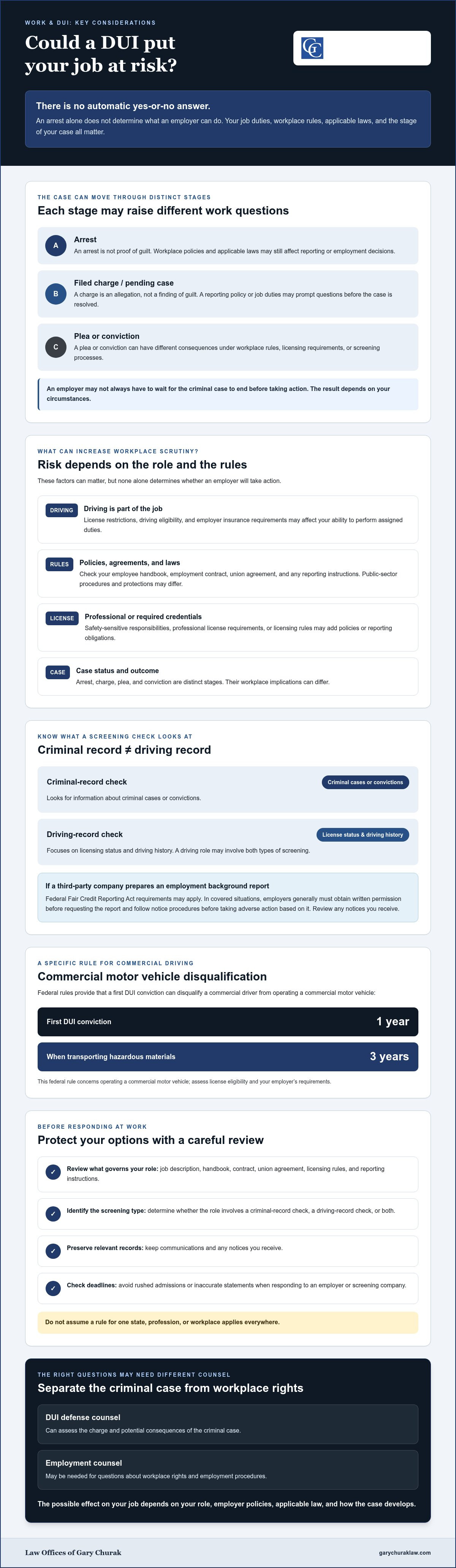
Job loss is possible, but a DUI doesn’t automatically end every job. If you’re asking, “will I lose my job for a DUI,” consider what your work requires, what your employer’s policies or agreements say, which laws apply, and how the case develops. An arrest, a filed charge, a plea, and a conviction are distinct stages. Each may prompt different questions, but none determines the outcome for every employee.
A charge is an allegation, not a finding of guilt. A plea may resolve a case without a trial, while a conviction follows a guilty plea or a finding of guilt. Those distinctions matter, but they don’t mean an employer must always wait for the criminal case to end before taking action. Workplace procedures may address arrests, charges, driving privileges, or conduct affecting job duties. For general background on the offense and its legal consequences, see Driving under the influence (DUI).
Does an arrest alone mean my employer can fire me?
Not necessarily. There’s no universal rule requiring every employer to respond the same way. An arrest isn’t proof of guilt, but workplace policies and applicable laws may affect whether you must report it or whether it can factor into an employment decision. Public-sector jobs, union agreements, and individual employment contracts may provide procedures or protections that differ from those in other workplaces. Review the rules that govern your position before assuming your employer must wait for a court outcome.
Why the type of work can change the risk
A DUI may have a more direct effect on someone whose job requires driving than on an employee who works entirely at a desk. A suspended license, driving restrictions, or employer insurance requirements may affect whether you can perform assigned duties; commercial fleet and motor policies, such as those arranged by independent brokers like Britton Insurance, often establish specific guidelines regarding driver records. Safety-sensitive responsibilities or a professional license can also bring additional policies or reporting rules into play. These are risk factors, not automatic grounds for termination.
For example, a delivery employee may need to determine whether they can still legally drive and meet the employer’s requirements. A worker who doesn’t drive for work may face different questions, though company policy and applicable law can still matter. Check your job description, contract, employee handbook, licensing rules, and any relevant reporting instructions. Requirements vary by jurisdiction and circumstance, so this overview can’t predict what will happen in your case or replace advice tailored to your situation.
How a DUI arrest, charge, or conviction can affect your employment
A DUI can affect work in different ways as a case progresses. A pending charge may prompt questions under an employer’s reporting policy, while a conviction may affect driving eligibility, a required credential, or a background-screening result. The employment impact depends on your role, employer policy, jurisdiction, and case status. The same charge can raise different workplace issues for employees in different positions.
Screening checks can serve different purposes. A criminal-record check looks for information about criminal cases or convictions. A driving-record check focuses on licensing status and driving history. An employer hiring for a driving role may review both, while another position may involve different screening. If a third-party company prepares an employment background report, federal Fair Credit Reporting Act requirements may apply. In covered situations, employers generally must obtain written permission before requesting the report and follow notice procedures before taking adverse action based on it. Review any notices you receive and verify which requirements apply to your circumstances.
- Pending case: A charge may raise workplace questions before the case is resolved, especially if a policy requires disclosure.
- Case outcome: A plea or conviction may have different consequences under workplace rules, licensing requirements, or screening processes.
- Driving privileges: License restrictions can affect your ability to perform driving duties, separately from any employer decision.
When driving is an essential part of your job
Commercial drivers and other employees required to drive for work should assess both license eligibility and employer requirements. Federal rules provide that a first DUI conviction can disqualify a commercial driver from operating a commercial motor vehicle for one year, or three years when transporting hazardous materials. A second major violation can lead to a lifetime disqualification. These rules may apply even if the DUI occurred in a personal vehicle. Confirm how they apply to your license and circumstances. License restrictions and an employer’s insurance or job requirements are separate issues to assess.
When a professional credential or workplace policy may apply
Review your signed employment documents, handbook, licensing rules, and any language requiring disclosure of an arrest, charge, or conviction. Reporting duties vary by employer, occupation, and jurisdiction. A charge doesn’t automatically trigger the same licensing result in every profession, so verify the rules for your credential before deciding what to report or when. A DUI defense attorney can assess the criminal case and its potential consequences. Employment-specific questions may call for employment counsel. To learn more about the criminal matter, see the firm’s DUI defense services.
Which factors create the greatest risk of losing a job for DUI?
The answer to “will I lose my job for a DUI” depends less on the charge’s label than on how it intersects with your duties and workplace rules. A DUI case and an employer’s response are separate processes. Defense counsel can address the criminal case, while an employer may also assess staffing, safety, insurance, and policy concerns. No attorney can guarantee that an employer will retain an employee.
Use this comparison to identify questions to investigate, not to predict a guaranteed result. A DUI’s legal meaning and consequences vary, as Cornell Law School explains in its overview of the legal definition of DUI.
| Factor | Why it may matter | What to check |
|---|---|---|
| Driving is essential | A license restriction or driving-record standard may interfere directly with core job duties. | Whether driving is central to the role, and what license or employer-approved record is required. |
| Driving is occasional | Limited driving may still matter if it’s an assigned task, but its effect may differ from a position built around driving. | How often you drive, whether it’s required, and whether other duties are available. An employer may not be required to reassign you. |
| License or credential required | A suspended or restricted license, or a licensing-board rule, could affect eligibility to perform certain work. | Requirements for your specific role and credential, including any reporting language. |
| Employer policy applies | A written rule or contract may address arrests, charges, convictions, or changes to driving status. | The current policy, your signed agreement, and how the rule applies to your position and case stage. |
Assess your role and the employer’s rules
Start with the facts. Is driving a core duty, an occasional task, or unrelated to your position? Does your job require a valid license, a commercial driver license, or an employer-approved driving record? Then read the exact policy language. An employer asking about convictions may be asking a different question from one asking about pending charges or license changes. Don’t assume a policy applies the same way to every role.
Also identify your workplace setting. Public employers, private employers, and union-covered positions may follow different procedures, and local law can affect what an employer may ask or do. Compare the written rule with your employment agreement and the facts of your case. A policy review can help identify issues to raise, but it can’t determine the employer’s final decision.
These factors may increase scrutiny, but they don’t make the outcome certain. Keep the criminal defense process distinct from the workplace assessment. Before making assumptions about reassignment, disclosure, or job security, seek advice tailored to the jurisdiction and rules that govern your employment.
What should you do now to protect your options at work?
Pause before responding, then work through the facts in order. A court deadline and a workplace disclosure deadline may both require prompt attention, but they’re separate obligations. Don’t assume that responding to one satisfies the other. If you’re wondering, “will I lose my job for a DUI,” carefully reviewing your documents and the rules for your role can help you respond accurately instead of making rushed assumptions.
Documents and policies to review before responding
Gather the records that govern your job and any request you’ve received. Keep copies in a secure place, and note dates, deadlines, and who contacted you. Read the specific wording before you answer.
- Employment documents: Employee handbook, offer letter, employment contract, and any union agreement.
- Role requirements: Policies about driving, license status, background screening, and reporting arrests, charges, or convictions.
- Professional rules: Licensing requirements or reporting instructions that apply to your occupation and jurisdiction.
- Communications: Emails, letters, screening notices, and notes of conversations with dates and names.
Don’t make an admission in a rush, speculate about what happened, or give your employer or a screening company information you know is inaccurate. If a question is unclear, seek advice before answering. Avoid sharing case details broadly. Ask counsel what information is appropriate to provide and to whom.
Who to contact and what to ask
If appropriate, ask HR or your supervisor for the written policy that applies to your situation. Keep the request focused, and don’t assume a conversation with an employer is confidential. Ask what the policy requires, what deadline applies, and whether the request concerns an arrest, charge, conviction, or driving-record change.
For workplace rights and disclosure questions, consider speaking with employment counsel familiar with the relevant jurisdiction. A DUI defense attorney can assess the criminal charge, evidence, procedural options, and possible case consequences. Organizing your records and questions can make that discussion more focused. See this guide to preparing for a criminal defense consultation.
If you need to understand the criminal case itself, consider requesting a DUI defense case review. A defense consultation can clarify the case and possible legal consequences, but it can’t guarantee that an employer will retain you.
How DUI defense counsel can help you make informed next steps
A DUI defense attorney can help you understand the criminal case as you assess its possible effect on work. If you’re asking, “will I lose my job for a DUI,” counsel can’t guarantee your employer’s decision. A careful case review can clarify what’s pending, what options may be available, and what legal consequences to consider before you decide what to do next.
What to expect from a DUI defense case review
A review may cover the allegations, available evidence, upcoming deadlines, and possible procedural or case-resolution options. Based on the facts and applicable law, an attorney can explain how different paths may affect the criminal matter. The Law Offices of Gary Churak provides DUI/DWI defense and case analysis. Attorney Gary Churak has more than four decades of experience. Ask about current consultation terms and what a meeting covers.
For additional context, read about strategic DUI and DWI defense and how a criminal defense attorney protects your future. Defense counsel can help you make informed decisions about the criminal case, but that work doesn’t determine whether an employer will keep you or resolve employment-law questions.
Employment counsel may be appropriate for questions about disclosure duties, workplace policies, contracts, or your rights under local law. Bring relevant policies or employer communications to that discussion. Ask what response is required, which deadline applies, and whether the answer depends on an arrest, pending charge, conviction, or change in driving status.
When a record-related question may arise later
After a case ends, you may wonder whether the record can be cleared or restricted. Available options depend on jurisdiction, case outcome, and eligibility. A dismissal, sealing, or expungement isn’t automatic and may not be immediately available. Check the rules that apply to your specific case before relying on a record-related option for employment screening or disclosure purposes.
If a DUI charge is affecting your decisions, discuss the case with DUI defense counsel and prepare a separate list of workplace questions for an employment adviser. A focused review can help you understand the criminal process and identify the right next questions, without promising a particular job outcome.
Take the next step with a clearer plan
If you’re asking, “will I lose my job for a DUI,” the answer depends on your duties, workplace rules, applicable law, and how the case develops. A DUI doesn’t automatically end every job, but driving requirements, professional credentials, and disclosure policies can affect the risk. Before responding to an employer, review the documents that govern your role, preserve communications, and identify any deadlines.
Keep the legal questions distinct. DUI defense counsel can review the charge, evidence, and possible case paths. Employment counsel may be needed to assess workplace rights or disclosure obligations. The Law Offices of Gary Churak handles DUI/DWI defense and case analysis. Attorney Gary Churak has more than four decades of experience, and a case review can help you make informed decisions about the criminal matter without guaranteeing a particular job outcome.
If you want to discuss the charge and understand possible next steps, request a case review with the Law Offices of Gary Churak. A focused review can help you approach the criminal case with greater clarity.
Frequently Asked Questions
Can I be fired for a DUI arrest if I have not been convicted?
Possibly, but an arrest isn’t a conviction, and an employer’s response depends on applicable law, workplace rules, and your job. Some employers may act before a case is resolved, while public-sector, union, or contract-covered employees may have different procedures or protections. Check whether the policy addresses arrests or only convictions. If you’re asking, “will I lose my job for a DUI,” the arrest alone can’t predict the answer.
Can my employer find out about a DUI charge?
Yes, an employer may learn about a charge through a background screening or another source, but what appears depends on the records searched, the type of check, and applicable law. A criminal-record check and a driving-record check serve different purposes. An employer may use one or both, depending on the position. If a third-party screening company is involved, review its notices and check what rights apply to you.
Do I have to tell my employer about a DUI?
There isn’t one reporting rule for every employee. A duty to disclose may come from your employment agreement, workplace policy, professional licensing rules, or laws that apply to your occupation and jurisdiction. Read the exact language to see whether it covers an arrest, pending charge, conviction, or license change. Don’t assume that a court requirement to respond to a case also answers whether you must notify your employer.
Can I lose my job for a DUI if driving is part of my work?
Yes, a DUI may put a driving-related job at greater risk if it affects your license, commercial driving eligibility, or ability to meet employer requirements. Federal rules generally disqualify a commercial driver for one year after a first DUI conviction, or three years when transporting hazardous materials. A second major violation can result in a lifetime disqualification. Whether you will lose your job for a DUI still depends on your role, circumstances, and applicable rules.
Will a DUI conviction show up on an employment background check?
It may, depending on the records searched, the screening provider, the case outcome, and laws governing the check. Employers may also review driving records separately, particularly for jobs involving vehicle operation. Don’t assume a criminal-record search and motor vehicle record search reveal the same information. If a report appears inaccurate, review the screening notice and follow the instructions for raising a dispute or seeking guidance on your rights.
Can a DUI affect my professional license or certification?
It can, but the effect depends on the profession, licensing board, jurisdiction, and whether the matter is an arrest, charge, or conviction. Some boards have reporting deadlines or review conduct outside work, while others apply different standards. Read the rules for your specific credential and contact the board or a qualified adviser if the requirements are unclear. A pending charge doesn’t produce the same licensing result in every profession.
Should I tell my employer about a pending DUI case?
First, check your handbook, contract, licensing rules, and any written request for disclosure. If a deadline applies, don’t ignore it, but avoid rushed admissions or inaccurate statements. Ask what the policy requires and whether it concerns a charge, conviction, or driving-status change. A DUI defense attorney can advise on the criminal case. Employment counsel may help assess workplace obligations. These are related concerns, but they’re separate questions.


