

What can you legally say or refuse to say when police question you? The answer often turns on a crucial distinction: what you’re required to do is not the same as what you may choose to answer. Knowing your rights when being questioned by police can help you respond calmly and avoid volunteering words that may be misunderstood or used against you.
It’s understandable to feel pressure to explain yourself, especially when you’re unsure whether you’re free to leave or whether Miranda warnings should apply. Those protections don’t work the same way in every encounter, and the absence of a warning doesn’t automatically mean you can’t be questioned.
This guide explains how to distinguish a voluntary conversation from detention, arrest, and custodial interrogation. You’ll learn how to clearly invoke your right to remain silent and request a lawyer, respond to search requests, avoid escalating the interaction, and preserve important details afterward. If questions may relate to a criminal investigation, defense counsel can assess the circumstances and help you understand possible next steps.
Key Takeaways
- Police may ask questions before an arrest or formal charge. Clarify whether you’re free to leave rather than assuming the encounter’s status.
- Understand when Miranda warnings are generally required and why their absence doesn’t automatically make a statement unusable.
- Separate requests you may refuse from requirements that can depend on your jurisdiction and situation, including questions about identity and requests to search.
- Use calm, clear language to state your choices, request a lawyer, and avoid discussing the facts of a possible investigation without legal guidance.
- After questioning, make a private factual timeline and preserve relevant messages and documents without editing, deleting, or publicly sharing them.
What Does It Mean to Be Questioned by Police, and What Rights Apply?
A police encounter can be stressful, especially when it’s unclear whether an officer is making a request or giving an order. Officers may ask questions before anyone is arrested or formally charged. Your rights when being questioned by police depend partly on the kind of encounter, what officers do, and the surrounding circumstances. Understanding the differences can help you respond deliberately instead of assuming every interaction has the same legal effect.
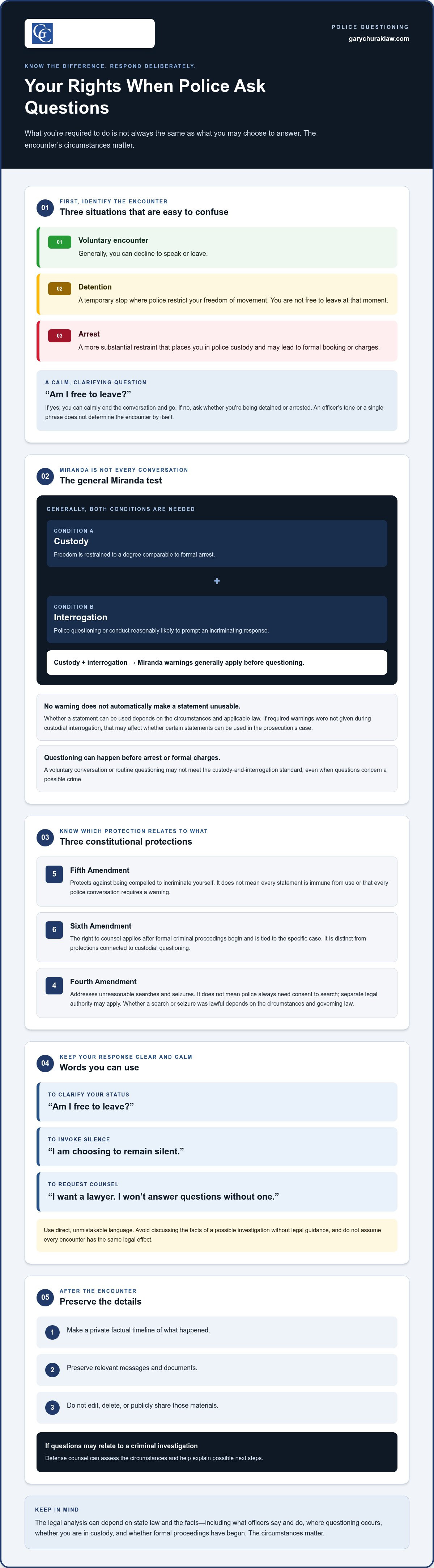
Three situations are easy to confuse. A voluntary encounter is generally one in which a person can decline to speak or leave. A detention is a temporary stop in which police restrict a person’s freedom of movement. An arrest involves a more substantial restraint and places the person in police custody. The precise legal analysis can depend on state law and the facts.
When is an encounter voluntary, and when are you detained?
Ask, “Am I free to leave?” If the officer says yes, you can calmly end the conversation and go. If the answer is no, ask whether you’re being detained or arrested. Don’t treat a friendly tone as proof that an encounter is voluntary, or assume that every question means you’re detained. The officer’s words and actions, the setting, and other circumstances can all matter.
A brief detention is not automatically an arrest, but it does mean you’re not free to leave at that moment. An arrest generally involves a greater restriction of movement and may lead to formal booking or charges. These labels aren’t determined by one phrase alone. How long the encounter lasts, whether you’re physically restrained, and what officers communicate may all be relevant.
Which constitutional rights may matter during questioning?
The Fifth Amendment protects against being compelled to incriminate yourself. It doesn’t make every statement immune from use or mean every police conversation requires a warning. Miranda warning rules generally concern custodial interrogation, a narrower situation than questioning in general.
The Sixth Amendment right to counsel applies after formal criminal proceedings begin and is tied to the specific case. It is distinct from protections connected to custodial questioning. The Fourth Amendment addresses unreasonable searches and seizures, but it doesn’t mean police always need consent to search. Separate legal authority may apply. Whether a search or seizure was lawful depends on its circumstances and governing law.
These constitutional protections provide a baseline, not a complete answer for every encounter. State laws and details such as where questioning occurs, whether you’re in custody, and whether formal proceedings have begun can affect how the rules apply. If police questioning relates to a possible criminal investigation, a criminal defense lawyer can assess the circumstances and explain what options may be available.
How the Right to Remain Silent and Miranda Warnings Work
The right to remain silent and Miranda warnings are connected, but they’re not the same thing. Miranda warnings generally apply before custodial interrogation, not every conversation with police. Officers don’t have to read your rights before asking any question, and not hearing a warning doesn’t automatically make a statement unusable. Whether a statement can be used depends on the circumstances and applicable law.
When must police give Miranda warnings?
Miranda generally requires both custody and interrogation. Custody means a person’s freedom is restrained to a degree comparable to formal arrest. Interrogation means police questioning or conduct reasonably likely to prompt an incriminating response. Courts consider the full circumstances. A routine conversation or voluntary questioning may not meet this standard, even if the questions concern a possible crime.
This distinction is central to understanding your rights when being questioned by police. If questioning is custodial and officers don’t provide the required warnings, that may affect whether the prosecution can use certain statements in its case. It doesn’t automatically erase the statement or resolve every legal issue. The details matter, including what was said, when questioning occurred, and whether you were in custody.
How should you invoke silence and ask for a lawyer?
Use direct, unmistakable language. For example: “I am choosing to remain silent,” or “I want a lawyer. I won’t answer questions without one.” The ACLU’s Know Your Rights guide also offers practical guidance for police encounters. Clear wording is safer than hints such as “Maybe I should talk to someone,” which could leave your intent uncertain.
After stating your choice, stop answering questions about the facts. Don’t explain, negotiate, or try to persuade officers that you’re innocent. Avoid discussing the case with anyone else in the room, including through casual conversation. You can remain calm and respectful while maintaining your position.
- Say clearly that you’re choosing to remain silent.
- If you want counsel, say clearly that you want a lawyer.
- Stop discussing the case after you invoke these rights.
Invoking a right doesn’t guarantee a particular outcome, and the rules can depend on whether you’re in custody and how questioning unfolds. If police contact relates to a potential criminal investigation, a criminal defense lawyer can review the circumstances and explain how your statements may affect your situation. You can learn more about criminal defense representation as a possible next step.
Do You Have to Answer Police or Consent to a Search?
The answer depends on what officers are asking and the circumstances of the encounter. You may generally decline to answer investigative questions, but some stops can involve specific duties, such as providing identification or documents. Rules vary by jurisdiction and situation, so don’t assume that a rule from one state applies everywhere. This distinction is central to understanding your rights when being questioned by police.
| Situation | Practical response |
|---|---|
| Voluntary questions | You can ask if you’re free to leave. If so, you may end the conversation rather than answer questions. |
| Detention | You may not be free to leave. Ask calmly whether you’re required to stay, and avoid guessing about any identification duty. |
| Arrest | Don’t resist. You can state that you wish to remain silent and want a lawyer, then stop discussing the facts. |
| Request for search consent | You can say, “I do not consent to a search.” Officers may still search if they rely on a warrant or another lawful basis. |
Can you refuse to answer questions or identify yourself?
Declining general questions is different from refusing a specific requirement that may apply during a lawful stop. Identification rules vary by state and by the reason for the stop. During a traffic stop, drivers generally must provide required driving documents, but obligations can depend on the circumstances and local law. If you’re unsure, ask, “Am I free to leave?” If the answer is no, ask what information you’re required to provide. Don’t lie or obstruct. If you don’t know, don’t guess.
Can you refuse consent to a search?
Yes. You can clearly refuse permission without physically interfering. Consent is one possible basis for a search, but a refusal doesn’t necessarily prevent officers from searching if they have a warrant or another legal basis. Keep your hands visible, don’t block officers, and don’t reach for or move anything during the encounter. You can calmly repeat your objection without escalating the situation.
The ACLU’s Know Your Rights When Stopped by Police guide offers additional practical information. Stay respectful while making your position clear. If you believe officers searched or questioned you unlawfully, don’t argue about it at the scene. Remember what happened and raise the concern with a criminal defense lawyer, who can assess the circumstances and applicable law.
What to Say and Do During Police Questioning
Under pressure, keep your response simple. You don’t need to fill the silence or explain every detail. These steps can help you communicate clearly while reducing the risk of saying something you didn’t intend:
- Stay calm. Keep your voice measured and your movements controlled.
- Clarify your status. Ask whether you’re free to leave.
- State your choice. If you don’t want to answer questions, say so directly.
- Request counsel. If you want a lawyer, make that request clear.
- Stop discussing the facts. Don’t continue explaining after you’ve stated your choice.
These examples are general communication guidance, not a guarantee of a legal result or a substitute for advice about a specific encounter. Your rights when being questioned by police can depend on the circumstances and applicable law.
What are clear, calm phrases you can use?
Short statements are easier to understand than hints or lengthy explanations. You might say:
- “Am I free to leave?”
- “I am choosing to remain silent.”
- “I want a lawyer. I won’t answer questions without one.”
Speak clearly, then stop. Avoid volunteering a version of events, joking about what happened, or speculating about evidence. Even an attempt to clear up confusion can lead to more questions or be understood differently than you intended. If an officer gives an instruction, don’t argue about it in the moment. You can state your objection calmly and address its legality later with counsel.
What should you avoid doing during questioning?
Don’t lie, destroy or hide evidence, obstruct officers, or physically resist. If you don’t know the answer to a question, don’t guess. If you don’t want officers to search, say, “I do not consent to a search,” but don’t interfere physically. Officers may proceed if they claim another lawful basis. A calm objection can still make clear that you haven’t agreed.
After the encounter, write down what you remember as soon as you can. Include the time and location, officers’ names or badge numbers if known, witnesses, and the exact words you recall. Separate what you directly observed from what you inferred. Preserve relevant messages and documents, and don’t post about the encounter or share details publicly. Discuss the situation with a lawyer instead.
If questioning may relate to a criminal investigation, contact criminal defense counsel to discuss the circumstances and understand possible next steps.
After Police Questioning: When to Contact a Lawyer
Once the encounter ends, take practical steps before details fade. Write a private, factual account as soon as you can and keep it for your lawyer rather than posting it or sending it around. If investigators contact you again, or you learn that you may be part of a criminal investigation, consider speaking with criminal defense counsel before answering questions or making decisions about a search or interview.
What information should you preserve for a lawyer?
Build a timeline in the order events occurred. Record the location, approximate times, who was present, what officers asked, how you responded, and whether they gave warnings. Note any words you remember clearly, but distinguish exact quotations from your general recollection. Mark details you’re uncertain about rather than filling gaps with guesses.
List witnesses and identify relevant messages, documents, photographs, or recordings. Preserve original files and messages without editing, deleting, or distributing potential evidence. Don’t ask witnesses to align their accounts or compare memories. Record who may have seen or heard events and let counsel determine how to follow up. Careful documentation can help a lawyer evaluate your rights when being questioned by police and the events that followed.
How can criminal defense counsel assess what happened?
A lawyer can review the sequence of questioning and assess whether custody, warnings, statements, a search, or later investigator contact raises legal issues. Counsel can also help you understand the possible consequences of what was said and how to respond to further questions. Learn more about the criminal defense attorney’s role in evaluating and addressing a case.
Bring your timeline and identify what records or witnesses may exist. Don’t alter materials to make them look clearer or more favorable. A lawyer can explain what additional information may be useful and discuss the circumstances with you. If you’re facing an investigation, you can prepare for a criminal defense consultation and raise your questions directly. A discussion can help you understand possible next steps, without promising any particular result. Ask counsel how confidentiality applies to your communications and materials.
Take Your Next Step With a Clear Plan
Police questioning can feel uncertain, but a few principles can help you respond with greater control. Ask whether you’re free to leave, distinguish a voluntary conversation from detention or arrest, and remember that Miranda warnings generally apply to custodial interrogation, not every police question. If you choose to remain silent or want a lawyer, state that clearly and stop discussing the facts.
Your rights when being questioned by police can depend on the encounter and applicable law. Afterward, preserve relevant records and write down what you remember while the details are fresh. Don’t delete, edit, or publicly share potential evidence. A criminal defense lawyer can assess the questioning, any statements or searches, and what to do if investigators contact you again.
The Law Offices of Gary Churak provides criminal defense representation and case analysis. Attorney Gary Churak has over four decades of experience. If questioning may relate to an investigation, contact the Law Offices of Gary Churak to discuss your situation. A focused conversation can help you understand possible next steps.
Frequently Asked Questions
Do police have to read you your rights before questioning you?
No, police don’t have to give Miranda warnings before every conversation or question. The warnings generally apply when a person is in custody and subject to interrogation. Whether someone is in custody depends on the circumstances, not simply on how serious the questions feel. If officers didn’t give a warning, that alone doesn’t automatically make a statement unusable. A lawyer can review how the questioning occurred and whether Miranda rules apply.
Can you remain silent when police question you?
Yes, you can choose not to answer questions that may incriminate you, but the practical rules depend on the encounter and jurisdiction. State your choice clearly rather than relying on silence to speak for itself. For example, say, “I am choosing to remain silent,” and, if you want counsel, “I want a lawyer.” Then stop answering substantive questions. Don’t lie, obstruct officers, or physically resist.
Should you ask for a lawyer during police questioning?
If you don’t want to answer questions, clearly say that you want a lawyer and are choosing to remain silent. Direct wording is less likely to be misunderstood than a vague comment such as, “Maybe I should talk to someone.” After making your request, stop discussing the facts. The effect can depend on custody and the circumstances, so contact a criminal defense lawyer promptly for advice about your situation.
Can you refuse to let police search your car or home?
You can clearly say, “I do not consent to a search.” That statement communicates that you haven’t voluntarily agreed, but it may not prevent officers from searching if they have a warrant or another lawful basis. Don’t physically interfere or resist. Search rules depend on the facts and jurisdiction. If officers search despite your objection, note what happened as accurately as you can and discuss the circumstances with a lawyer.
Do you have to identify yourself when police stop you?
There isn’t one answer for every police encounter. Identification requirements may depend on state law, the reason for the stop, and whether you’re detained or driving. You can ask, “Am I free to leave?” but that question doesn’t resolve whether you must identify yourself. Don’t guess about your legal obligations or provide false information. Because local rules vary, get legal advice based on the specific circumstances of the stop.
Can police keep questioning you after you ask for a lawyer?
The answer depends on whether you’re in custody, how clearly you requested counsel, and what happens afterward. A clear request for a lawyer during custodial interrogation can trigger Miranda protections, but an unclear statement may be treated differently. Don’t keep discussing the case or rely on a hint to communicate your choice. Clearly repeat that you want a lawyer and remain silent. A defense lawyer can assess whether later questioning complied with the law.
What should you do after police question you?
Write a factual timeline as soon as you can, including the questions asked, your responses, any warnings, witnesses, and searches. Preserve relevant messages and documents without deleting or altering them, and don’t post details publicly. Avoid discussing the facts with others beyond your lawyer. If you may be under investigation or expect more questions, contact a criminal defense lawyer. Counsel can assess the encounter and help you understand possible next steps.


