

A single phone call to 911 in Texas can trigger a legal landslide that buries your career, your parental rights, and your Second Amendment freedoms before you even have a chance to speak. You're likely feeling the crushing weight of a system that often assumes guilt the moment handcuffs click, leaving you anxious about how a permanent criminal record might dismantle everything you've worked to build. It's a terrifying position to be in, but an accusation is not a final verdict. Understanding the specific penalties for domestic violence in Texas is the first step toward reclaiming control of your life and your reputation.
This guide provides a comprehensive look at the 2026 legal landscape, promising to help you navigate the complexities of family violence allegations with professional confidence. You'll learn how a strategic defense can protect your freedom and keep your record clean. We will examine the full spectrum of consequences, from Class A misdemeanor jail time to first-degree felony prison sentences for aggravated assault. We'll also explore the critical paths for reducing charges, maintaining professional licenses, and ensuring you don't lose access to your children during this high-stakes process.
Key Takeaways
- Grasp how the Texas Family Code broadly defines "family violence" to include spouses, dating partners, and co-habitants, expanding the scope of potential charges.
- Identify the specific ranges of penalties for domestic violence in Texas, which vary from Class A misdemeanors to first-degree felonies based on the severity of the incident.
- Recognize the permanent collateral consequences of a conviction, including the loss of Second Amendment rights and the inability to seal your criminal record through non-disclosure.
- Understand that the State of Texas can pursue charges even without victim cooperation, requiring a defense strategy that scrutinizes evidence for constitutional violations.
- Discover how proactive legal advocacy and Grand Jury Packets can be used to dismiss charges before they result in a life-altering conviction.
Understanding the Legal Framework of Domestic Violence in Texas (2026)
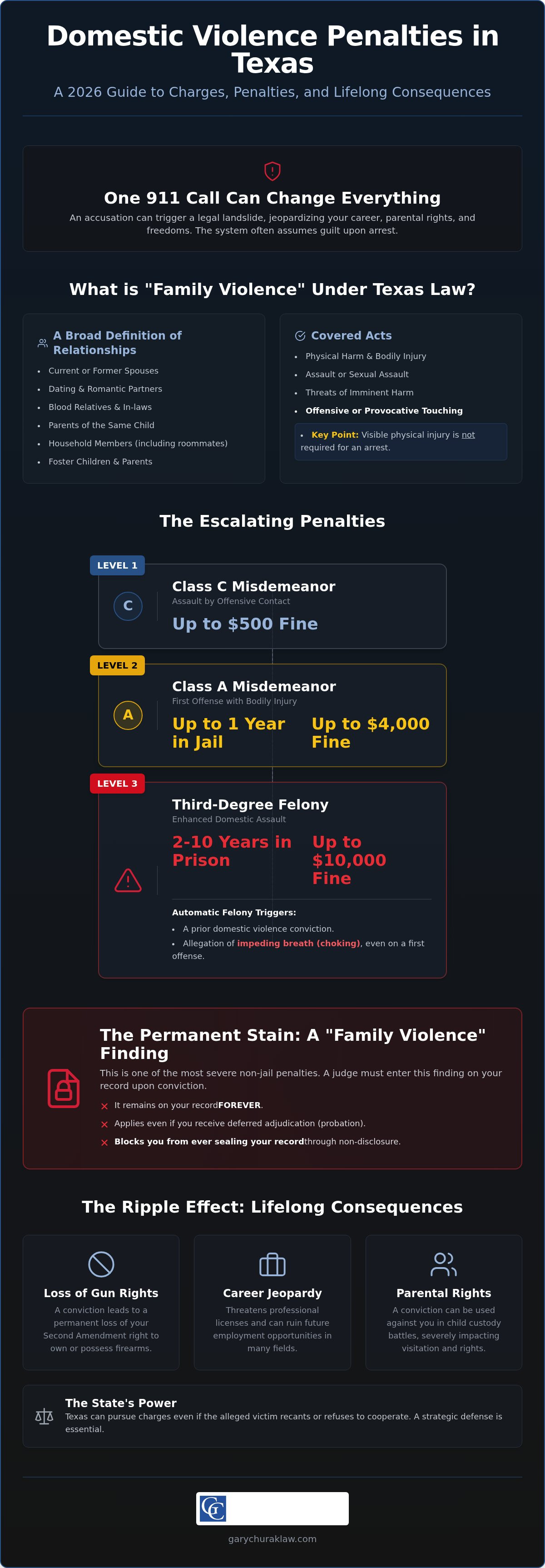
Texas law operates under a strict policy regarding domestic allegations. While many people associate violence with visible physical injury, the Texas Family Code defines "Family Violence" as any act intended to result in physical harm, bodily injury, assault, or sexual assault. It even includes threats that reasonably place a person in fear of imminent physical harm. This broad legal net ensures that the state can pursue domestic violence in the United States with significant force, regardless of whether the alleged victim wants to press charges.
A critical distinction in Texas is that physical evidence of injury isn't required for an arrest. "Offensive or provocative touching" can lead to a Class C misdemeanor assault charge. However, once that contact involves a family or household member, the potential penalties for domestic violence in Texas escalate rapidly. The legal framework classifies these offenses into three primary categories: Domestic Assault, Aggravated Domestic Assault, and Continuous Family Violence. Each carries specific burdens of proof and severe sentencing ranges that require a calculated defense response.
How Texas Law Defines Family and Dating Relationships
Texas statutes apply to a wide range of interpersonal connections. The law protects blood relatives, former spouses, and individuals who share a child, regardless of their current relationship status. Dating violence specifically covers current or former romantic partners; a breakup doesn't remove the "family violence" designation from a future dispute. Additionally, the code includes household members, such as roommates and foster children, under this protective umbrella. This means a simple disagreement between roommates can result in the same life-altering consequences as a dispute between spouses.
The Misdemeanor vs. Felony Distinction in 2026
Most first-time domestic assault cases involving bodily injury are filed as Class A misdemeanors. However, certain factors trigger an automatic elevation to a felony. If you have a prior conviction for domestic violence, even from another state, the charge becomes a third-degree felony. A major 2026 focus remains on "impeding breath or circulation." Any allegation involving choking or strangulation is an automatic third-degree felony on the first offense. This reflects the state's intent to impose maximum penalties for domestic violence in Texas in high-risk scenarios, even without a prior criminal history.
Statutory Penalties and Sentencing Guidelines for Family Violence
Judges and juries in Texas wield significant power when determining the outcome of a family violence case. While the Texas Penal Code on Assault provides the statutory framework, the actual penalties for domestic violence in Texas often hinge on the presence of aggravating factors. In Texas, a defendant has the unique right to elect whether a judge or a jury assesses their punishment. This choice is a critical strategic decision that your defense must weigh carefully, as juries may be more susceptible to emotional testimony, while judges often adhere strictly to sentencing patterns.
One of the most damaging aspects of a sentencing order is the mandatory "Family Violence" finding. Even if you receive deferred adjudication, this finding remains on your record forever. It acts as a permanent barrier, preventing you from ever seeking a petition for non-disclosure or record sealing. The 2026 legal climate has only intensified the pressure on repeat offenders, with prosecutors seeking maximum incarceration periods to deter future incidents. Seeking a personalized case analysis is the first step in avoiding these statutory maximums.
Misdemeanor Domestic Assault Penalties
A first-time offense involving bodily injury is typically charged as a Class A Misdemeanor. If convicted, you face up to one year in county jail and a fine of up to $4,000. Even a Class C Misdemeanor, which involves offensive contact without injury, carries a $500 fine and the same permanent "Family Violence" designation that ruins background checks. While many defendants hope for Community Supervision (probation), the conditions are often grueling, including mandatory batterers' intervention programs and strict no-contact orders that can keep you out of your own home for months.
Felony Domestic Violence and Aggravated Charges
The stakes escalate when the state alleges strangulation or a prior conviction, elevating the charge to a Third-Degree Felony. This carries a prison sentence of 2 to 10 years and fines up to $10,000. If a deadly weapon is used or serious injury occurs, the state will pursue Second-Degree or First-Degree Felony charges. For a deeper look at defending these high-level accusations, see our Texas Aggravated Assault: 2026 Strategic Defense Guide. These ranges can extend to 99 years or life in prison for the most severe allegations.
Continuous Family Violence Enhancements
The "Continuous Family Violence" statute is a powerful tool for prosecutors that many defendants overlook. If the state alleges you committed two domestic assaults within a 12-month period, they can charge you with a Third-Degree Felony. Crucially, the state doesn't need a prior conviction for the first incident to use this enhancement. They only need to prove both acts occurred during the current trial. Defending against multiple allegations simultaneously requires an aggressive, multi-layered strategy to prevent one weak claim from bolstering another.
Beyond Jail Time: The Collateral Consequences of a Conviction
A conviction in Texas carries weight far beyond the walls of a courtroom. While jail time and fines are immediate threats, the long-term penalties for domestic violence in Texas often manifest as invisible barriers that dismantle your lifestyle and career. Once a "Family Violence" finding is entered into your record, it remains there permanently. Texas law does not allow for the non-disclosure or sealing of records involving family violence; this means the event will appear on every background check for the rest of your life. This permanent stain can immediately disqualify you from professional licensing, impacting nurses, teachers, and pilots who must report such findings to their respective boards.
The immediate aftermath of an arrest often includes a Magistrate’s Order for Emergency Protection (MOEP). This order can be issued even if the alleged victim doesn't request it. It typically prohibits you from going near your home, your children’s school, or the victim’s place of employment for 31 to 91 days. Violating this order is a separate criminal offense that leads to additional jail time and higher bonds. It's essential to understand the specific Texas domestic violence laws governing these protective measures to avoid accidental violations that complicate your defense.
Firearm Possession and the Lautenberg Amendment
Federal law imposes a lifetime ban on firearm possession for anyone convicted of a misdemeanor crime of domestic violence. This is known as the Lautenberg Amendment. Even if your case is still pending, you may be required to transfer all firearms to a third party or law enforcement as a condition of your bond. Possessing a weapon while a protective order is in place isn't just a state violation; it's a federal crime that carries significant prison time. Protecting your Second Amendment rights requires a defense strategy that prevents a formal family violence finding from ever occurring.
Impact on Child Custody and Divorce Proceedings
Allegations of violence frequently surface during divorce or custody battles, where they are often used as strategic leverage. Texas courts operate under a "rebuttable presumption" that joint conservatorship is not in the best interest of a child if a parent has a history of family violence. This means a single conviction can strip you of your parental rights, forcing you into supervised visitation and limiting your influence on your children’s upbringing. Countering these claims requires aggressive advocacy to ensure that a momentary allegation doesn't dictate your future relationship with your family.
How to Build a Strategic Defense Against Family Violence Charges
A common misconception in Texas is that the alleged victim holds the power to "drop the charges." This is a dangerous myth. Once the police make an arrest, the State of Texas becomes the complainant, and the prosecutor decides whether to move forward. Even if the accuser recants their statement entirely, the state may pursue a conviction based on 911 audio, body-cam footage, or medical records. To avoid the life-altering penalties for domestic violence in Texas, your defense must shift the narrative from a passive response to an active investigation.
Effective defense begins with the immediate preservation of evidence. Digital footprints, including text messages, GPS data, and social media interactions, often provide the context that police reports ignore. We look for evidence of provocation, pre-existing motives for false claims, and inconsistencies in the accuser's timeline. This thorough case analysis allows us to challenge the prosecution’s "He Said, She Said" narrative with objective facts that create reasonable doubt. Securing witness statements before memories fade is another critical step in building a wall of protection around your future.
Asserting Affirmative Defenses: Self-Defense and Defense of Others
Texas law provides a robust framework for those who acted out of necessity. If you used force to protect yourself or another person from an immediate threat of harm, you can assert self-defense. The legal standard hinges on "reasonableness"; we must prove that a reasonable person in your situation would have believed force was necessary. This strategy is essential for dismantling the state's case and avoiding a permanent conviction. You can learn more about these standards in our article, Self-Defense Laws in Texas: A 2026 Guide to Your Legal Rights.
Challenging Credibility and False Accusations
False allegations are frequently used as weapons in high-conflict divorces or custody battles. We scrutinize the accuser's motives and look for patterns of behavior that suggest a desire for revenge or legal leverage. While an "Affidavit of Non-Prosecution" can signal a victim's desire to stop the case, prosecutors often view these documents with skepticism, assuming the victim is being coerced. Instead, we use inconsistent statements found in police reports to impeach the witness's credibility during cross-examination. If you are facing a coordinated attempt to ruin your reputation, you need to schedule a defense consultation to begin your counter-investigation immediately.
Constitutional Protections and Evidentiary Challenges
The legality of the police response is often a weak point in the prosecution's case. We analyze whether officers had probable cause to enter your home or if they conducted an illegal search without a warrant. Additionally, statements made during a custodial interrogation without proper Miranda warnings can often be suppressed. A dedicated criminal defense attorney meticulously reviews every detail of the arrest to identify these constitutional violations. By excluding illegally obtained evidence, we can often force the state to reduce or dismiss the charges, protecting you from the harshest penalties for domestic violence in Texas.
The Role of Aggressive Advocacy in Mitigating Penalties
Facing the full weight of the legal system requires more than just a passive response. It demands a battle-tested guide who understands that the most effective defense often happens before you ever step foot in a trial court. Aggressive advocacy is about disrupting the prosecution's momentum early. When you're staring down the severe penalties for domestic violence in Texas, every hour between your arrest and your first court appearance matters. Gary Churak leverages over 40 years of experience to intercede during this critical time, ensuring your side of the story is heard before the state finalizes its position.
A resilient defense isn't just about reacting to the evidence the state provides. It's about conducting an independent investigation to uncover the facts that police overlooked or ignored. Whether you're facing a misdemeanor or a high-stakes felony, the goal is always the same: to protect your freedom and prevent a permanent conviction from destroying your future. By taking a firm stance from day one, we can often negotiate from a position of strength rather than desperation.
The Pre-Indictment Window: Your Best Chance for a Dismissal
Many individuals believe they must wait for a court date to begin their defense. This is a costly error. The pre-indictment window is the period between your arrest and the formal filing of charges. During this phase, we can present a "Grand Jury Packet" to the district attorney. This packet contains exculpatory evidence, witness statements, and legal arguments that favor your defense. If the Grand Jury finds there isn't enough evidence to proceed, they issue a "No Bill," effectively dismissing the case before it ever becomes a felony indictment. This proactive approach is the most direct way to avoid the harshest penalties for domestic violence in Texas.
Preparing for a Legal Consultation with Confidence
Walking into a law office can feel overwhelming, but preparation provides clarity. To make the most of your free initial consultation, gather any documentation you have from the arrest. This includes bond paperwork, Magistrate's Orders for Emergency Protection, and any communication logs from the alleged victim. We use this information to conduct a personalized case analysis, identifying the specific vulnerabilities in the state's allegations. You don't have to face this uncertainty alone; a resilient defense starts with a single, strategic conversation.
Contact the Law Offices of Gary Churak today for a strategic defense evaluation.
Protecting Your Future Against Family Violence Allegations
The weight of an arrest doesn't have to crush your future. While the penalties for domestic violence in Texas are severe, they're often based on a single, unchallenged narrative that a skilled defense can dismantle. You've seen how the state prioritizes prosecution even without victim cooperation, making it vital to secure a legal guide who understands the nuances of the 2026 legal climate. Whether you're concerned about maintaining your professional license or protecting your access to your children, proactive movement is your most effective tool.
Gary Churak leverages over 40 years of battle-tested defense experience to provide the aggressive advocacy your case demands. We focus on results, scrutinizing every piece of evidence to identify the weaknesses in the prosecution's claims. By offering free initial consultations, we ensure you have immediate access to a seasoned expert who can provide a personalized case evaluation. You don't have to face the power of the state alone when you have a dedicated protector ready to fight for your rights.
Secure Your Aggressive Domestic Violence Defense Now. Your freedom is worth the fight, and a strategic path forward is within reach.
Frequently Asked Questions
Can the victim drop domestic violence charges in Texas?
No, the alleged victim does not have the authority to drop domestic violence charges in Texas once an arrest is made. The prosecutor represents the State of Texas and maintains sole discretion over whether to pursue the case. Even if the accuser signs an Affidavit of Non-Prosecution, the district attorney may continue the case using other evidence like police reports, medical records, or 911 recordings. This highlights why early intervention is necessary to challenge the state's narrative.
Is domestic violence a felony or a misdemeanor in Texas?
Domestic violence can be either a misdemeanor or a felony depending on the severity and prior history. A first-time offense with minor injury is typically a Class A misdemeanor. However, the penalties for domestic violence in Texas escalate to a third-degree felony if the state alleges strangulation or if you have a prior conviction. Aggravated charges involving deadly weapons or serious bodily injury are filed as second or first-degree felonies.
What happens if I am falsely accused of family violence?
If you are falsely accused, you must act quickly to preserve evidence that supports your innocence. False allegations often arise during divorce or custody disputes to gain legal leverage. We analyze digital communication, witness statements, and timelines to expose inconsistencies in the accuser's story. A strategic defense focuses on proving a motive for the false claim and identifying constitutional violations during the initial police response to secure a dismissal and protect your reputation.
Can I still own a gun if my domestic violence case was dismissed?
You can generally possess a firearm if your case was dismissed without a conviction or a finding of family violence. However, federal law under the Lautenberg Amendment permanently prohibits gun ownership for anyone convicted of a misdemeanor or felony domestic violence offense. It's vital to ensure that any dismissal or plea deal doesn't include a formal "family violence" finding, as this specific designation triggers the lifetime loss of your Second Amendment rights and firearm possession privileges.
What is a Magistrate’s Order for Emergency Protection (MOEP)?
A Magistrate’s Order for Emergency Protection is a temporary restraining order issued by a judge immediately following a domestic violence arrest. It typically lasts between 31 and 91 days and prohibits you from contacting the alleged victim or going near their home or workplace. Violating this order is a separate criminal offense. Judges often issue these orders automatically to protect the alleged victim while the initial investigation proceeds through the complex Texas court system.
Will a domestic violence charge show up on a background check for a job?
Yes, a domestic violence arrest or conviction will appear on criminal background checks conducted by employers or licensing boards. Because Texas law prohibits the non-disclosure or sealing of records containing a family violence finding, these entries are permanent. This can disqualify you from jobs in healthcare, education, or transportation. Avoiding a conviction is the only way to prevent these penalties for domestic violence in Texas from affecting your long-term career prospects and earning potential.
What is the difference between domestic assault and aggravated domestic assault?
The primary difference lies in the severity of the injury and the use of a weapon. Standard domestic assault involves causing bodily injury, such as pain or bruising. Aggravated domestic assault occurs when the state alleges serious bodily injury, like broken bones, or the use of a deadly weapon during the incident. While standard assault is often a misdemeanor, aggravated domestic assault is a high-level felony carrying a prison sentence of up to 20 or 99 years.
Can I get my domestic violence record expunged in Texas?
You can only expunge a domestic violence record in Texas if the case was dismissed without a conviction or if you were acquitted at trial. If you served community supervision or were convicted, the record is permanent. Texas statutes are exceptionally strict regarding family violence findings, as they block the path to both expunction and petitions for non-disclosure. Securing a "No Bill" or a dismissal early in the process is essential for maintaining your record eligibility.


