

A kitchen knife, a heavy boot, or even a vehicle can transform a simple confrontation into a life-altering felony charge based solely on a prosecutor's interpretation. When you face aggravated assault charges in Texas, the state isn't just accusing you of a crime; they're threatening your freedom with a second-degree felony that carries up to 20 years in prison. It's natural to feel overwhelmed by the "deadly weapon" designation or the prospect of a permanent criminal record. You deserve a defense that's as aggressive as the charges leveled against you.
This 2026 strategic guide navigates the complexities of Texas law to help you regain control. With over four decades of experience, we know that these cases often hinge on subjective definitions of serious bodily injury. You'll discover the proven defense methods used to challenge evidence, assert your right to self-defense, and pursue a reduction to simple assault or a full case dismissal. We'll outline exactly how to scrutinize the prosecution's claims to secure your path toward a clean slate.
Key Takeaways
- Understand how standard altercations escalate into aggravated assault charges in Texas based on the legal definitions of serious injury and deadly weapons.
- Navigate the 2026 sentencing landscape for second-degree and first-degree felonies to clearly understand the high stakes and potential prison terms you face.
- Explore strategic defense methods, including Texas "Stand Your Ground" principles and the defense of property, to actively challenge the state's allegations.
- Learn why 40 years of aggressive advocacy and thorough case analysis are essential for dismantling subjective evidence and pursuing a path to a clean slate.
What Constitutes Aggravated Assault in Texas?
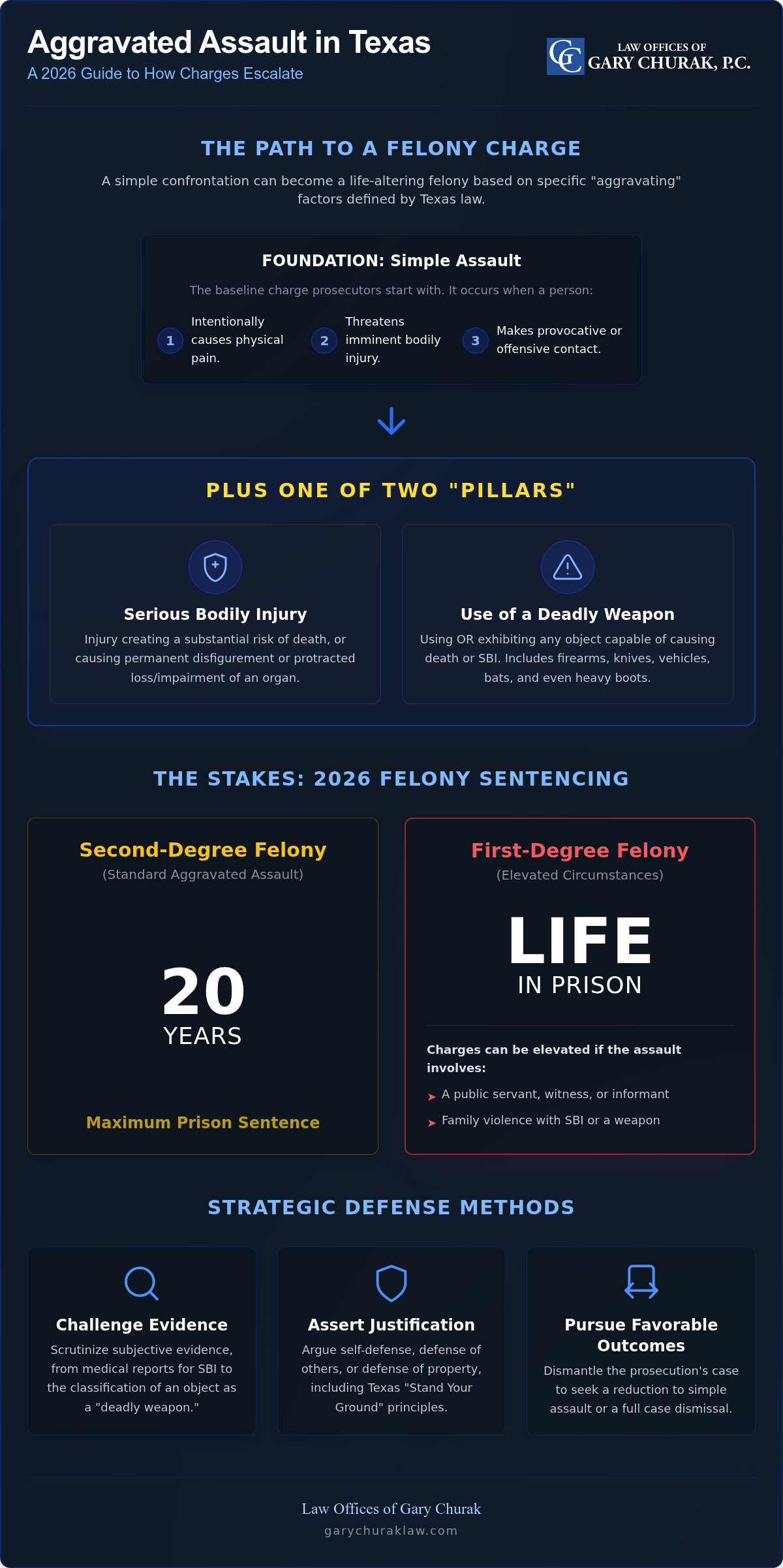
Under Texas Penal Code Section 22.02, an assault charge escalates when specific high-risk elements are present. You don't necessarily have to intend to cause permanent damage to face these consequences. The law scrutinizes your mental state, asking if your actions were intentional, knowing, or reckless. Recklessness is a frequent pitfall in these cases. It means you consciously disregarded a substantial and unjustifiable risk that your conduct would result in harm. In the 2026 legal climate, prosecutors are increasingly aggressive in seeking these enhancements. If the state determines you ignored that risk, they'll pursue aggravated assault charges in Texas with the same severity as a premeditated attack.
The Legal Threshold of Simple Assault
Every aggravated charge begins with the foundation of simple assault. Understanding What Constitutes Assault is vital because it sets the baseline for felony upgrades. In Texas, simple assault occurs when someone intentionally causes physical pain, threatens another with imminent bodily injury, or makes offensive physical contact. While "offensive contact" might only be a misdemeanor, any incident involving actual pain or threats provides the prosecutor with the starting point they need to build a felony case. We focus on dismantling this foundation to prevent the state from building a more serious narrative.
The "Aggravating" Factors Under Texas Law
Two primary factors push a case into the "aggravated" category. The first is the infliction of serious bodily injury. This isn't just a bruise or a small cut. It involves injuries that create a substantial risk of death, cause death, or result in permanent disfigurement or protracted loss of any bodily organ. The second factor is the use or exhibition of a deadly weapon. This is where many defendants are caught off guard. A "deadly weapon" isn't limited to firearms. It includes any object that, in the manner of its use, is capable of causing death or serious injury. Merely exhibiting the weapon, even without using it to strike someone, is enough for the state to upgrade the charge.
The state also elevates charges based on the victim's identity or the context of the relationship. If the alleged victim is a public servant performing their official duties, a witness, or an informant, the legal pressure becomes immense. Similarly, incidents involving family violence that result in serious injury or involve a weapon are treated with extreme scrutiny. These specific designations can move a case from a second-degree felony to a first-degree felony, which may carry a life sentence. Immediate legal intervention is required to analyze whether the prosecution has actually met these strict definitions or if they're overcharging you with aggravated assault charges in Texas based on a subjective reading of the event.
The Two Pillars: Serious Bodily Injury and Deadly Weapons
The state's strategy for pursuing aggravated assault charges in Texas in 2026 centers on two specific legal pillars. Prosecutors don't just look at the outcome of an altercation; they look for factors that suggest a heightened level of danger to the public. To secure a felony conviction, the prosecution must prove either the presence of serious bodily injury or the use of a deadly weapon. These are not just medical terms. They are rigid legal classifications that carry heavy consequences for your freedom.
Defining Serious Bodily Injury (SBI)
Serious bodily injury is defined as impairment involving a substantial risk of death or permanent disfigurement. This is a significantly higher threshold than mere "bodily injury," which only requires proof of physical pain or minor bruising. In court, the state often relies on clinical reports to prove SBI, citing instances like the loss of a limb, protracted impairment of an organ, or severe scarring. However, medical evidence is often more subjective than it appears. We scrutinize these records to determine if an injury truly meets the high legal standard set by Texas Penal Code § 22.02 or if the state is overreaching to justify a felony charge.
The Ambiguity of Deadly Weapons
The second pillar involves the use or exhibition of a deadly weapon. While firearms are inherently classified as such, the law allows for a surprisingly broad interpretation of what constitutes a weapon. Anything that is capable of causing death or serious bodily injury in the manner of its use can be labeled a deadly weapon. This includes vehicles, kitchen knives, or even heavy household objects like a baseball bat or a heavy glass.
A critical distinction in Texas law is the difference between using a weapon and merely exhibiting it. If you brandish an object in a way that threatens another person during an assault, the state can pursue an aggravated charge even if no physical contact occurred. Because these definitions are so expansive, having a battle-tested defense attorney to challenge the weapon's classification is vital to protecting your future. We focus on the "manner of use" to argue that an object was never intended or used as a lethal instrument, potentially stripping the "aggravated" designation from your case. Immediate scrutiny of the police report is necessary to ensure the state isn't building a case on exaggerations or mischaracterizations of your actions.
Felony Degrees and Sentencing in 2026
Facing a judge for aggravated assault charges in Texas carries profound consequences that extend far beyond the courtroom. While simple assault might be a misdemeanor, the legal definition of aggravated assault ensures that these cases enter the felony realm immediately. In 2026, the standard classification for this offense is a second-degree felony. This carries a prison sentence ranging from 2 to 20 years and a potential fine of up to $10,000. These aren't just numbers on a page; they represent a total disruption of your life and livelihood.
First-Degree vs. Second-Degree Felonies
Specific circumstances can elevate the charge to a first-degree felony. This shift increases the sentencing range to 5 to 99 years or even life in prison. The state typically pursues this higher degree if the assault involves a deadly weapon and causes serious bodily injury to a family member. Attacks against public servants, such as police officers or emergency personnel, also trigger this elevation. If the prosecution alleges you acted in retaliation against a witness or an informant, you're no longer fighting a standard felony. You're fighting for the rest of your life. Prosecutors look for any opportunity to upgrade these charges, making early intervention critical.
Collateral Consequences of a Felony Conviction
The damage of a conviction persists long after any prison sentence or fine is paid. Restitution to the victim for medical bills or property damage can create a crushing financial burden for years. Beyond the immediate costs, a felony record acts as a permanent barrier to professional licensing and career advancement. Most employers conduct thorough background checks; "felon" status often disqualifies you from roles in healthcare, education, or finance.
Your civil rights are also at stake. A conviction results in the permanent loss of your right to own or possess a firearm under both state and federal law. It can also complicate your ability to secure housing or obtain credit. Because the stakes involve every aspect of your existence, understanding how a criminal defense attorney protects your future is the first step toward reclaiming your life. We focus on mitigating these long-term risks by challenging the state's narrative at every turn. Aggressive advocacy is the only way to shield your rights from these life-altering penalties.
Strategic Defense Methods for Aggravated Assault
The prosecution's case for aggravated assault charges in Texas often relies on a narrow, one-sided narrative. Our role is to interrupt that story with facts that support your side. We don't just wait for the trial; we actively seek out evidence to undermine the state's claims from day one. Whether it's proving you acted in self-defense or demonstrating that an injury doesn't meet the legal definition of "serious," a strategic defense is built on meticulous scrutiny. A charge is an allegation, not a conviction, and we treat it as a challenge to be dismantled.
Asserting Self-Defense and Necessity
Texas law provides robust protections for those who act in self-defense. Under "Stand Your Ground" principles, you aren't required to retreat before using force if you're in a location where you have a legal right to be. The core of this defense is proving a "reasonable belief" that force was immediately necessary to protect yourself against another's use of unlawful force. We analyze witness testimony, surveillance footage, and 911 recordings to show that your actions were a proportional response to an imminent threat. This same logic applies to the defense of others or the protection of your property.
Dismantling the Prosecution’s Evidence
As established in our discussion of the legal pillars of these cases, the state must prove the involvement of a deadly weapon or serious bodily injury. We frequently challenge these designations by cross-examining medical experts. If a physician cannot definitively state that an injury created a substantial risk of death or permanent disfigurement, the "aggravated" label may be legally unsustainable. We also scrutinize the "manner of use" for household objects to argue they weren't used as deadly weapons. Identifying inconsistencies in victim statements or filing motions to suppress evidence obtained through illegal searches can further weaken the state's position.
Negotiation and Charge Reduction
Not every case ends in a dismissal, but many can result in a significant reduction of charges. Negotiating a charge down to simple assault, which is a misdemeanor, can save you from the lifelong stigma of a felony record. We also explore the concept of "Mutual Combat" under Texas law, which can be a valid defense if both parties consented to the altercation. This level of strategy requires a criminal defense expert who understands when to push for a trial and when to negotiate a favorable outcome. Just as a DWI defense attorney looks for procedural errors to protect a client’s license, we look for every legal opening to protect your freedom from aggravated assault charges in Texas.
Why Aggressive Advocacy Matters for Your Case
Aggravated assault charges in Texas represent a critical threat to your future. The state utilizes vast resources to secure convictions, often relying on the subjective evidence and broad definitions we explored in previous sections. You need a defense that is equally prepared and twice as relentless. Aggressive advocacy isn't just about showing up in court; it's about a thorough case analysis that begins the moment you're charged. Gary Churak utilizes over 40 years of experience in the Texas legal system to identify the procedural errors and evidentiary gaps that others might miss. This depth of knowledge allows us to project strength when facing prosecutors who are determined to see you behind bars.
Personalized Legal Strategy
High-stakes litigation requires a tailored approach. A "one size fits all" defense strategy inevitably fails in felony cases because it overlooks the specific context of the incident and the nuances of the law. We prioritize personalized consultations that focus on your desired outcomes rather than just the legal process. This protective stance begins early, often during police interrogations. Law enforcement officers are trained to elicit statements that support their narrative. Having a battle-tested guide by your side ensures you don't inadvertently provide the state with the tools they need to convict you. We act as your fierce protector, ensuring every decision is both strategic and pragmatic.
Securing Your Future
The weight of a felony charge can feel like a permanent shadow, but it doesn't have to be. Our commitment to client protection extends beyond the immediate courtroom battle. We focus on the long-term goal of achieving a clean slate. If we successfully secure a dismissal or a reduction to a charge that qualifies for record sealing, we guide you through the next steps. Evaluating your eligibility for expungement in Texas is a vital part of our comprehensive strategy for your future.
Taking the first step toward your defense is often the most difficult part of the process. The Law Offices of Gary Churak offers free initial consultations to help alleviate your anxiety and provide a clear path forward. We don't just manage the process; we fight for results that protect your freedom and your reputation. By intervening immediately, we can start the work of dismantling the state's case against you. Don't leave your freedom to chance when you can have a seasoned expert navigating the complexities of aggravated assault charges in Texas on your behalf.
Take Control of Your Legal Future
The transition from a simple altercation to a life-altering felony depends entirely on how the state interprets your actions. Understanding how the broad definitions of deadly weapons and serious bodily injury give prosecutors significant leverage is the first step in mounting a successful defense. These interpretations are not final. By identifying evidentiary gaps and asserting your rights through Texas's "Stand Your Ground" principles, you can begin to shift the momentum of your case. Navigating aggravated assault charges in Texas requires a steady hand and a strategic mindset that refuses to accept the state's narrative at face value.
The path toward a clean slate starts with immediate, professional intervention. At the Law Offices of Gary Churak, we leverage over 40 years of criminal defense experience to provide the aggressive advocacy and personalized case analysis your situation demands. We focus on results that protect your freedom, your family, and your career. Don't let a single event define the rest of your life. Contact the Law Offices of Gary Churak for a free consultation today. You have the right to a fierce protector; let's start building your defense together.
Frequently Asked Questions
What is the difference between simple assault and aggravated assault in Texas?
Simple assault is the baseline offense involving physical pain or threats. Aggravated assault charges in Texas escalate the crime to a felony when the state alleges you caused serious bodily injury or used a deadly weapon. Serious bodily injury involves a substantial risk of death or permanent disfigurement. While simple assault is often a misdemeanor, the addition of these aggravating factors triggers severe prison sentences and permanent felony records that simple assault avoids.
Can an aggravated assault charge be reduced to a misdemeanor?
Yes, it's possible to have these charges reduced to a Class A misdemeanor. This typically happens when a defense attorney successfully challenges the serious nature of an injury or the classification of a deadly weapon. If the prosecution realizes they cannot prove the aggravating elements beyond a reasonable doubt, they may agree to a reduction to simple assault. This outcome is critical for avoiding long term imprisonment and maintaining your civil rights.
What qualifies as a deadly weapon in a Texas assault case?
A deadly weapon includes firearms or anything designed, made, or adapted to inflict death or serious bodily injury. Texas law also includes any object that, in the manner of its use, is capable of causing death or serious injury. This broad definition allows prosecutors to label household items, tools, or vehicles as deadly weapons. We scrutinize the state's claims to argue that the object’s usage during the incident did not meet this lethal threshold.
Is self-defense a valid legal strategy for aggravated assault?
Self-defense is a frequent and valid strategy in these cases. Texas is a Stand Your Ground state, meaning you have no duty to retreat if you're in a place you have a right to be. To succeed, you must demonstrate a reasonable belief that force was immediately necessary to protect yourself against another's unlawful force. We use video evidence and witness testimony to prove your actions were a proportional response to a threat.
What are the minimum and maximum sentences for aggravated assault in Texas?
Aggravated assault is typically a second-degree felony with a punishment of 2 to 20 years in prison and a $10,000 fine. However, the charge elevates to a first-degree felony under specific conditions, such as assaults against public servants or family violence involving a weapon. A first-degree conviction carries a much heavier sentence, ranging from 5 to 99 years or life in prison. Immediate legal intervention is essential to prevent these maximum penalties.
Can I seal or expunge an aggravated assault conviction in Texas?
An aggravated assault conviction in Texas cannot be expunged or sealed through a nondisclosure order. This is a permanent mark on your record that affects housing and employment. However, if your case was dismissed, or if you were found not guilty at trial, you may be eligible for an expungement. We analyze your case history to determine if we can clear your record and secure a clean slate for your future career and reputation.
Do I need a lawyer if I was wrongly accused of aggravated assault?
You absolutely need a lawyer even if the accusations are false. The legal system doesn't automatically protect the innocent; it responds to evidence and strategic advocacy. Aggravated assault charges in Texas are often built on subjective victim statements that can be easily misinterpreted or exaggerated. An experienced attorney acts as your protector, ensuring the state doesn't secure a conviction based on flawed testimony or a lack of thorough investigation into the facts.
What should I do immediately after being charged with aggravated assault?
You should exercise your right to remain silent and contact an attorney immediately. Do not attempt to explain your side to the police, as they can use your statements against you. It's also vital to avoid any contact with the alleged victim or witnesses, as this can lead to additional charges or bond revocations. Securing a battle-tested guide early allows for the preservation of critical evidence, such as surveillance footage or digital communications.


