

In Texas, the difference between a justified act of protection and a life-altering felony conviction often hinges on a single split-second decision and your knowledge of the self-defense laws Texas enforces. You shouldn't have to fear a prison sentence for protecting your home or family from a violent intruder. It's a heavy burden to carry, especially when you're trying to make sense of complex statutes while your safety is on the line. When the stakes are this high, confusion about your rights isn't just stressful; it's dangerous.
This 2026 guide will empower you to master the nuances of these legal frameworks, ensuring you understand exactly where the legal boundaries lie. We'll break down the critical distinctions between the Castle Doctrine and Stand Your Ground laws, examine the justifications for deadly force under Chapter 9 of the Texas Penal Code, and clarify how to demonstrate that your actions were necessary to prevent serious harm. With over 40 years of experience in aggressive criminal defense, we provide the steady hand you need to understand your rights before a crisis occurs, ensuring you have the tools to protect both your life and your freedom.
Key Takeaways
- Learn how Chapter 9 of the Texas Penal Code establishes the "reasonable belief" standard, which serves as the critical foundation for any successful self-defense claim in 2026.
- Understand the legal nuances of the Castle Doctrine and Stand Your Ground to identify exactly when you have no duty to retreat from your home, vehicle, or workplace.
- Discover the specific high-stakes scenarios where deadly force is legally justified under self-defense laws Texas, including protection against murder, robbery, or sexual assault.
- Grasp the "Step into the Shoes" doctrine to understand your legal rights and limitations when intervening to protect a third party from an immediate threat.
- Gain strategic insights on why remaining silent and securing aggressive legal advocacy are the most vital steps to take immediately following a self-defense incident to protect your future.
Understanding Texas Penal Code Chapter 9: The Foundation of Self-Defense
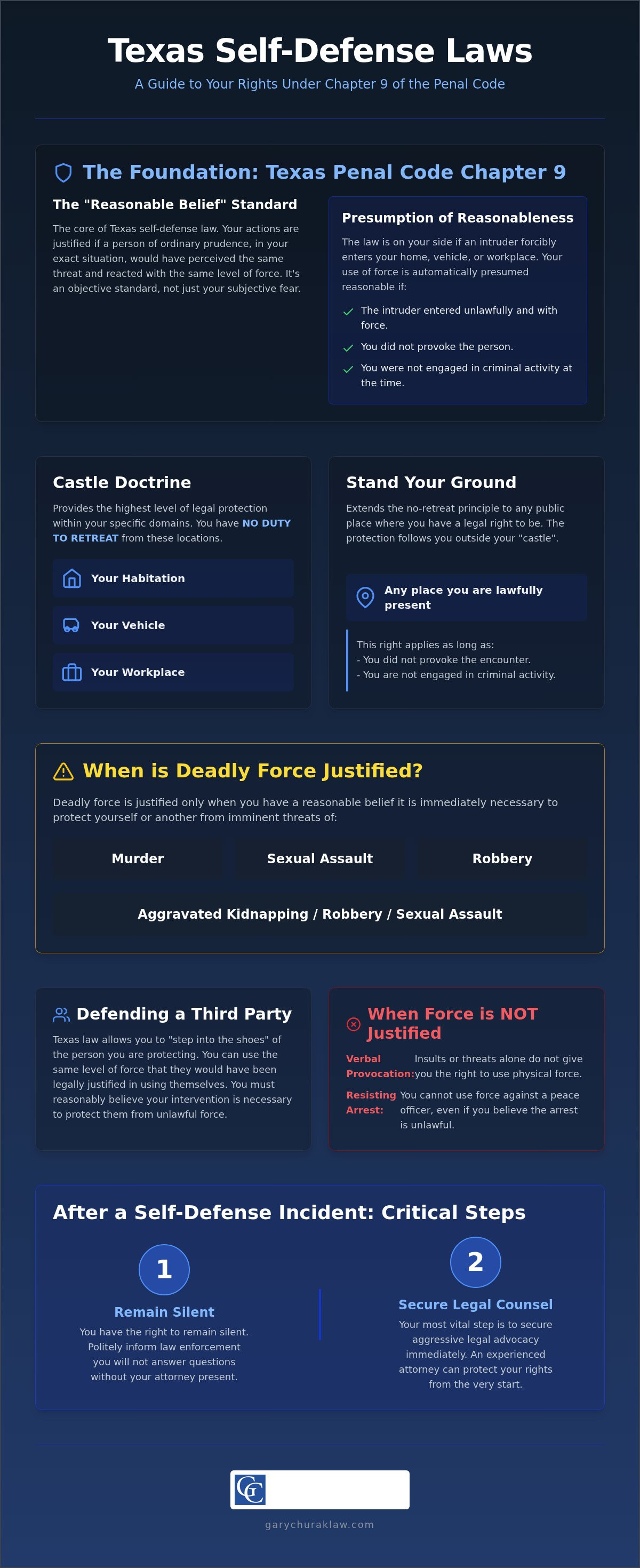
Texas law doesn't expect you to be a victim. Section 9.31 of the Penal Code provides the legal shield for those who use force to protect themselves from harm. The core of this statute is the "reasonable belief" standard. This isn't about what you felt subjectively in a moment of panic; it's about what a person of ordinary prudence would've done in your exact shoes. If a jury believes that a typical person would've perceived the same threat and reacted with the same level of force, your actions are legally justified under the self-defense laws Texas maintains in 2026.
Under the 2026 Texas Penal Code, unlawful force is defined as any physical act or threat that violates the law and is committed without the legal consent of the individual it's directed against. Asserting this justification is a powerful strategy because it acts as a "complete defense" in criminal proceedings. This means you aren't just asking for a lighter sentence. You're arguing that your actions weren't criminal at all, which can lead to a total dismissal of charges or an acquittal at trial.
The Presumption of Reasonableness
In many legal battles, the state holds every advantage. However, the "presumption of reasonableness" gives you a significant tactical edge. If an intruder enters your home, vehicle, or place of business by force, the law automatically assumes your use of force was reasonable. To trigger this protection, you must meet three specific criteria: you didn't provoke the attacker, you weren't engaged in criminal activity at the time, and the intruder entered unlawfully with force. This presumption shifts the legal burden, forcing the prosecutor to prove you weren't afraid for your life rather than requiring you to justify every second of your response. A thorough case analysis is essential to ensure these facts are presented clearly to the court.
When Force is NOT Justified
You must know where the legal line is drawn to avoid prosecution. Force is never justified by verbal provocation alone. Insults or threats, no matter how aggressive, don't give you the legal right to use physical force. Additionally, you cannot use force to resist an arrest, even if you believe the arrest is unlawful. The law prioritizes the safety of peace officers and requires you to settle disputes over arrest legality in a courtroom, not on the street.
It's also vital to dispel the "duty to retreat" myth that persists in other states. Under the Stand Your Ground law, you're not required to flee if you have a legal right to be in a location and haven't provoked the encounter. While self-defense laws Texas are robust, they require a methodical defense to ensure your right to stand your ground is respected by the justice system.
The Castle Doctrine vs. Stand Your Ground: Knowing the Difference
While many people use the terms interchangeably, the "Castle Doctrine" and "Stand Your Ground" represent two distinct pillars of self-defense laws Texas citizens rely on. The Castle Doctrine focuses on your specific domains: your habitation, your vehicle, and your place of business. Within these boundaries, the law grants you the highest level of protection. You have no legal duty to retreat when someone attempts to enter these spaces forcefully and unlawfully. This legal shield recognizes that in your home or car, there is often nowhere left to run, making immediate action a necessity for survival.
Stand Your Ground extends this principle into the public square. It removes the requirement to retreat in any location where you have a legal right to be, provided you didn't provoke the attacker. As detailed in Texas Penal Code Chapter 9, this protection follows you to the grocery store, the park, or a parking lot. It's vital to remember that Stand Your Ground only applies if the actor has a legal right to be in the location. If you're facing the aftermath of a defensive encounter, securing a thorough case analysis is the most effective way to ensure your side of the story is told with the gravity it deserves.
Habitation and Vehicle Protections
Texas law defines a "habitation" broadly. It includes any structure or vehicle adapted for overnight accommodation, even if it's a tent or an RV. The Castle Doctrine applies the moment an intruder uses force to enter. This includes breaking a window or kicking in a door. In your vehicle, these protections are equally fierce. If someone tries to remove you from your car by force or enter it while you're inside, the law presumes you acted reasonably if you used force to stop them. You aren't required to wait for an injury to occur before you defend your "castle."
Stand Your Ground in Public Places
The 2026 standard for public self-defense remains clear: if you aren't engaged in criminal activity and have a right to be present, you don't have to retreat. Proving you didn't provoke the encounter is often the most complex part of a defense. Prosecutors may scrutinize your words or gestures leading up to the event to argue you incited the violence. Additionally, if you're "otherwise engaged in criminal activity," such as possessing an illegal firearm, you may lose the "no duty to retreat" protection. We analyze every detail of the encounter to prove you were an innocent party forced into a difficult position.
When is Deadly Force Legally Justified in Texas?
Under the Texas Penal Code, deadly force is defined as force that's intended or known to cause, or is capable of causing, death or serious bodily injury. It's the most extreme level of response allowed by the self-defense laws Texas recognizes. The law doesn't permit you to use this level of force for minor disagreements or simple trespassing. It's strictly reserved for scenarios where you reasonably believe it's immediately necessary to protect yourself against another's use or attempted use of unlawful deadly force. While force involves physical contact to stop an action, deadly force is a lethal response reserved for threats of death or severe injury.
Timing is the most critical element in these cases. The "immediate necessity" threshold means the danger must be happening right now or is about to happen. You can't use deadly force to prevent a threat that might happen tomorrow or to punish someone for something they did yesterday. As noted in the Texas Law Review on self-defense, the legal scrutiny applied to the use of firearms often centers on whether the actor's perception of "immediate" danger was objective and grounded in reality. Our firm conducts a thorough case analysis to ensure the timeline of your encounter reflects the reality of the threat you faced.
Preventing Violent Felonies
Texas law explicitly allows for the use of deadly force to prevent the imminent commission of specific violent crimes. This includes murder, sexual assault, aggravated sexual assault, robbery, and aggravated robbery. It also covers aggravated kidnapping. In these high-stakes moments, the role of "imminent danger" is paramount. You must be able to show that the attacker had the ability, the opportunity, and the intent to carry out the crime. When a defender is facing Texas aggravated assault charges, a well-documented self-defense claim can serve as a powerful counter-argument to prove that the use of force was a justified reaction to a lethal threat.
The Limitations of Deadly Force
You cannot use deadly force to protect simple property in most situations. If someone is running away with your lawnmower, you aren't legally justified in using lethal force to stop them. The law generally requires a threat to human life or safety before deadly force is on the table. There's also the significant risk of "excessive force." Once a threat is neutralized, your right to use force ends. If an attacker is unconscious or disarmed and you continue to use force, you could face serious criminal charges. Prosecutors often use forensic evidence to reconstruct the sequence of events, looking at bullet trajectories and wound patterns to determine if the force used was truly necessary or if it crossed the line into a criminal act.
Defending Others and Protecting Property Rights
Texas law recognizes that your protective instincts often extend beyond your own person. Section 9.33 of the Penal Code justifies the use of force to protect a third person if you reasonably believe your intervention is immediately necessary. This is guided by the "Step into the Shoes" doctrine. Effectively, you possess the same legal rights and limitations as the person you're defending. If they would be justified in using force under the self-defense laws Texas mandates in 2026, then you're justified in acting on their behalf. You aren't required to have a pre-existing relationship with the person you're protecting; the law applies whether it's a family member or a stranger in a parking lot.
Protecting tangible assets involves a different set of rules under Sections 9.41 and 9.42. While you can use force to terminate a trespass or interference with your property, the legal bar is significantly higher than it is for personal safety. The law distinguishes between your habitation and movable property, such as a laptop or a vehicle. You must be able to prove that the force used was proportional to the threat and that you were acting to prevent the immediate loss of your possessions.
Defense of a Third Person
Intervening to help someone else carries significant legal weight. You must have a reasonable belief that the third person is under an unlawful attack and that your intervention is required to prevent harm. Misinterpreting a situation is a common trap for well-intentioned citizens. What looks like an unprovoked assault might actually be a lawful arrest by a plainclothes officer or a mutual fight where neither party has a right to self-defense. If you misread the scene, you could face criminal charges yourself. This is why thorough case analysis is vital. When multiple witnesses give conflicting accounts, we scrutinize every statement to prove your intent was purely protective and based on a reasonable perception of the facts.
Protection of Property and Habitation
You have the right to use force to eject a trespasser from your land or to recover stolen property if you act immediately. However, deadly force is restricted to extreme circumstances, primarily occurring at night. You might be justified in using lethal force to prevent arson, burglary, robbery, or "theft during the nighttime" if you reasonably believe the property cannot be recovered by any other means or that the use of non-deadly force would expose you to a substantial risk of death. Because these cases are often ambiguous, a skilled criminal defense attorney is necessary to build a narrative that justifies your actions. We focus on the specific threats to your security to ensure the justice system understands the necessity of your response. If you're facing charges for protecting what is yours, contact us for a personalized consultation to begin securing your future.
Strategic Defense: How to Assert Your Rights After an Incident
The moments following a defensive encounter are as critical as the event itself. You've protected your life; now you must protect your liberty. Under the self-defense laws Texas upholds in 2026, your words to law enforcement can become the prosecution's strongest weapon. It's essential to remain silent until your attorney is present. Even if you're certain your actions were justified, a high-stress statement to a responding officer can be misinterpreted or taken out of context. Silence isn't an admission of guilt; it's a strategic preservation of your rights.
Gary Churak provides the aggressive advocacy needed to ensure your narrative isn't lost in the chaos. We immediately move to preserve vital evidence, including surveillance video, 911 recordings, and witness contact information. These elements are the building blocks of your defense and must be secured before they're lost or overwritten. A personalized consultation allows us to assess the facts before the state builds its case against you, providing a grounded, steady hand to navigate the high stakes of a criminal investigation.
The Importance of Thorough Case Analysis
We don't just accept the police report as a final account of the facts. Our firm deconstructs the prosecution’s narrative of "aggression" by performing a thorough case analysis that looks at the situation from every angle. We often utilize expert testimony to establish the "reasonable belief" required by law, proving that your actions were a necessary response to an imminent threat. With 40+ years of experience, Gary Churak possesses the strategic wisdom to know when a forceful stance at trial is necessary and when negotiation serves your best interests. This depth of knowledge is your greatest asset in a system that often assumes the worst about defensive actions.
Navigating the Legal Process
In Texas, most serious self-defense cases must pass through a grand jury. This is a pivotal moment where we can present evidence of your justification to citizens who understand the right to bear arms and protect one's home. Our goal is to secure a "no bill," which effectively dismisses the charges before a full trial ever begins. We understand the anxiety that comes with a criminal investigation and work tirelessly to resolve the matter as early as possible. Contact the Law Offices of Gary Churak for a strategic defense consultation to ensure your rights are fiercely protected from day one.
Protect Your Freedom with Decisive Legal Action
Understanding the self-defense laws Texas enforces in 2026 is the first step toward ensuring your actions stay within the boundaries of justice. You've learned how the "reasonable belief" standard under Chapter 9 serves as your primary shield and how the Castle Doctrine provides a presumption of reasonableness within your home or vehicle. These legal frameworks are designed to protect those who act to save lives, but they require a meticulous defense to be successfully asserted in court. Misinterpreting a single detail can be the difference between a justified act and a life-altering conviction.
When you're facing the aftermath of a defensive encounter, you need a battle-tested guide who understands the nuances of violent crime defense. Gary Churak brings over 40 years of experience and a commitment to aggressive advocacy to every case, ensuring your side of the story is heard with clarity and strength. Don't leave your future to chance or a prosecutor's interpretation of events. Secure Your Future with a Strategic Defense Consultation today. You have the right to defend yourself; we have the skill to defend your liberty.
Frequently Asked Questions
Is Texas a "Stand Your Ground" state in 2026?
Yes, Texas remains a Stand Your Ground state in 2026. The law removes any duty to retreat for individuals who have a legal right to be in a location, provided they didn't provoke the attacker. This protection applies in public spaces and private property alike. It ensures that you aren't penalized for standing your ground when facing an immediate threat of unlawful force or a violent felony.
Can I use deadly force to protect my car in Texas?
Yes, but the law imposes strict limitations. You can use deadly force to protect your car if someone is attempting to remove you by force or if you're preventing a robbery or burglary at night. The law assumes your actions are reasonable during an active carjacking. However, you generally cannot use lethal force to stop someone from merely vandalizing an empty vehicle or stealing it during daylight hours without a threat to your safety.
What is the "Castle Doctrine" in Texas?
The Castle Doctrine is a legal principle that presumes your use of force is reasonable when defending your habitation, vehicle, or place of business. If an intruder enters these spaces forcefully and unlawfully, the law doesn't require you to retreat before taking action. In 2026, this doctrine remains a powerful shield for homeowners and business owners, ensuring they can protect their "castle" from violent intrusion without the fear of immediate prosecution.
Do I have a duty to retreat before using force in Texas?
No, you don't have a duty to retreat in Texas if you have a legal right to be present. This is a fundamental pillar of the self-defense laws Texas enforces to protect its citizens. As long as you aren't the aggressor and aren't engaged in criminal activity, you can stay and defend yourself. The law prioritizes your safety over the obligation to flee from a violent encounter.
Can I be sued civilly if I am cleared of criminal charges for self-defense?
While a criminal acquittal is a significant victory, it doesn't prevent a plaintiff from filing a civil suit. However, Texas law provides immunity from civil liability if your use of force is found to be justified under Chapter 9 of the Penal Code. If we can prove your actions met the legal standard for self-defense, the court can dismiss the civil claim entirely, shielding you from paying damages to an attacker.
What happens if I accidentally hurt a bystander while defending myself?
If a bystander is injured, you could face charges for manslaughter or reckless endangerment. Even if your use of force against the primary threat was justified, the law requires you to act with a degree of care for innocent parties. Prosecutors will scrutinize whether your response was reckless under the circumstances. We analyze forensic data and witness statements to prove that your actions were a necessary and focused response to a lethal threat.
Can I use a firearm for self-defense if I have a prior felony conviction?
Generally, no. Individuals with prior felony convictions are prohibited from possessing firearms under both state and federal statutes. While you maintain the right to use self-defense laws Texas provides, using a gun can trigger a "felon in possession" charge. This remains true even if the shooting itself was justified. Navigating these overlapping legal restrictions requires an aggressive defense strategy to protect your freedom from secondary weapons charges.
How does a jury decide if my use of force was "reasonable"?
A jury applies the "reasonable person" standard to your case. They'll determine if an average person, facing the same circumstances and possessing the same information, would've believed force was immediately necessary. They look at the imminence of the threat and the proportionality of your response. Our thorough case analysis focuses on reconstructing the event to ensure the jury understands the gravity of the situation you faced during those critical seconds.


