

A drug charge is only as strong as the search that produced the evidence. When you're facing the weight of prosecution and the terrifying prospect of three-strike sentencing, it's easy to feel like the system has already decided your fate. You might read a police report that doesn't match your memory of the encounter, or feel certain that the officer had no right to open your trunk or search your pockets. In many illegal search and seizure drug cases, the difference between a conviction and a dismissal often comes down to whether law enforcement respected your Fourth Amendment rights.
You deserve to know if the evidence against you was obtained through an unconstitutional shortcut. This article provides a clear roadmap for identifying Fourth Amendment violations and explains the strategic legal steps required to suppress illegally obtained evidence in drug prosecutions. We'll break down complex concepts like probable cause and examine how a seasoned attorney scrutinizes every detail of a police encounter to build a powerful defense. By understanding these protections, you can move from a state of uncertainty toward a proactive strategy to protect your freedom.
Key Takeaways
- Understand how the Fourth Amendment and the Texas Constitution provide a shield against unreasonable government intrusion during a drug investigation.
- Learn to identify common signs of law enforcement overreach, such as prolonged traffic stops that frequently result in illegal search and seizure drug cases Texas residents face.
- Discover the power of a Motion to Suppress as a strategic legal tool to exclude unlawfully obtained evidence from your trial.
- Recognize how police may try to bypass your rights through "consent" requests or by claiming exigent circumstances to justify a warrantless search.
- Gain insight into how an aggressive defense attorney scrutinizes dashcam footage and witness accounts to challenge the official police report.
The Foundation of Defense: Fourth Amendment Rights in Texas Drug Cases
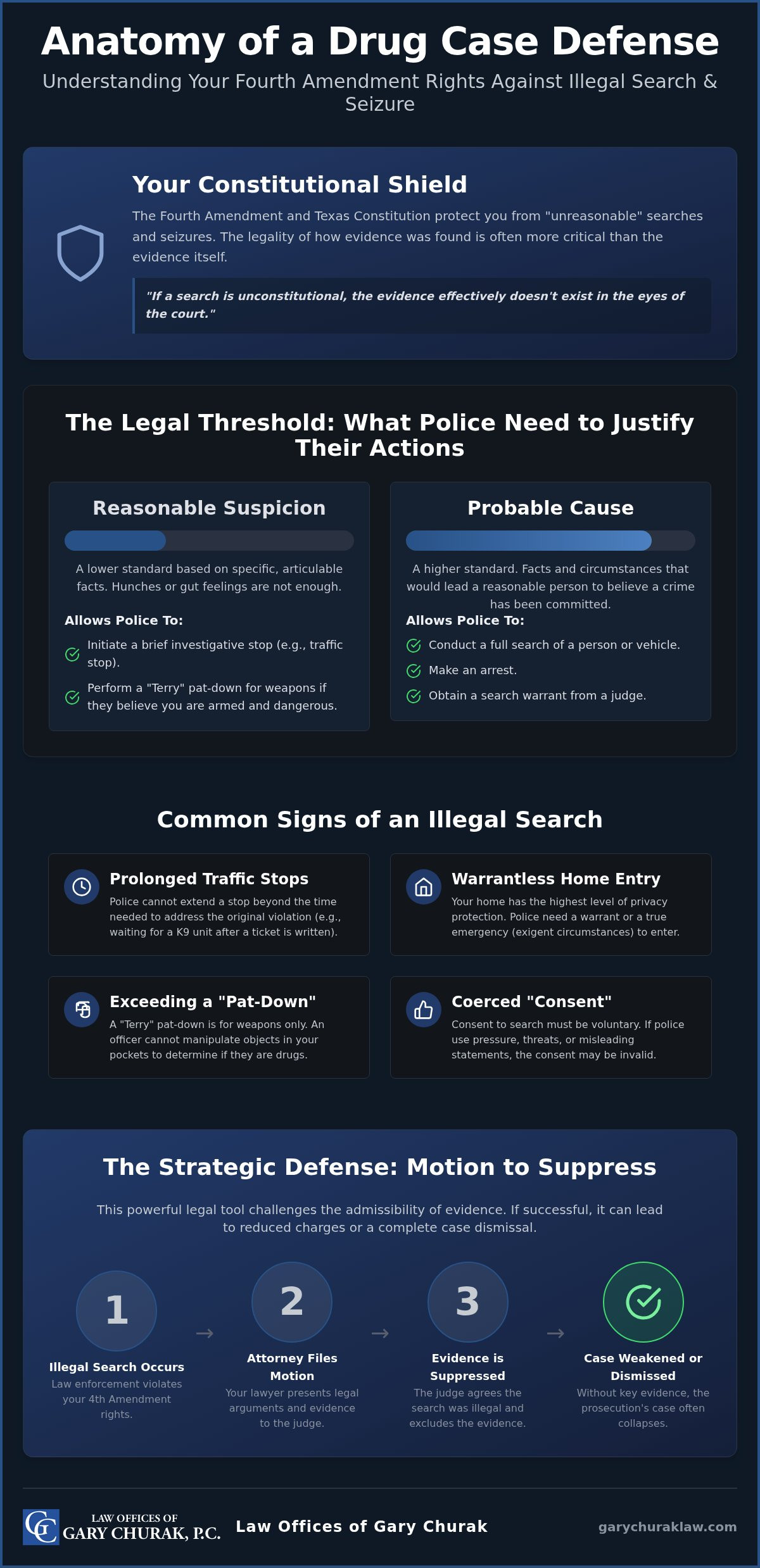
The Fourth Amendment serves as the bedrock of your defense against government overreach. It explicitly prohibits "unreasonable" searches and seizures, ensuring that law enforcement cannot simply rifle through your property on a whim. In illegal search and seizure drug cases Texas residents often find that the state's own governing document, Article I, Section 9 of the Texas Constitution, mirrors these federal protections. In some specific scenarios, Texas law provides parallel or even broader safeguards for residents than the federal standard. This legal framework exists to strike a delicate balance between public safety and your individual right to be left alone. In a drug prosecution, the physical evidence of a controlled substance often matters less than the method used to find it. If the search was unconstitutional, the drugs effectively don't exist in the eyes of the court.
Defining "Reasonable Expectation of Privacy"
Your right to privacy isn't a static bubble; it fluctuates based on where you are and what you're doing. The law treats your home as a sanctuary where privacy rights are at their absolute highest. Conversely, your expectations are naturally lower in public spaces or while walking down a crowded sidewalk. Texas courts apply specific scrutiny to vehicles and personal belongings like bags or smartphones. While you have a reduced expectation of privacy in a car compared to a bedroom, police still need a valid legal reason to intrude. When a judge determines that an officer violated a legitimate expectation of privacy, it often triggers a chain reaction that leads to the total dismissal of the case. We look for these violations to dismantle the prosecution's narrative from the ground up.
Probable Cause vs. Reasonable Suspicion
Understanding the difference between these two standards is vital for any drug defense strategy. Law enforcement only needs "reasonable suspicion" to initiate a brief investigative stop, such as pulling you over for a traffic violation. However, a full search requires a much higher threshold. Probable cause is a set of facts that would lead a reasonable person to believe a crime has occurred. Officers cannot rely on "gut feelings" or vague hunches to justify searching your vehicle or person. If an officer's testimony relies on subjective intuition rather than objective facts, the search is likely illegal. We scrutinize the officer's initial justification to ensure they didn't bypass these constitutional requirements just to secure an arrest. Hunches don't hold up in court, and they shouldn't be the reason you lose your freedom.
When Law Enforcement Oversteps: Common Illegal Search Scenarios
Police officers are trained to secure arrests; sometimes, that drive for results leads them to ignore constitutional boundaries. If you've been arrested, you need to evaluate the encounter against a clear framework of what is legally permissible. Many illegal search and seizure drug cases Texas prosecutors handle are built on shaky foundations where the officer overstepped their authority during the initial contact. Identifying these errors is the first step toward a successful defense.
- Prolonged Detention: Officers often try to "stall" a traffic stop to wait for a drug dog or backup.
- Pretextual Terry Stops: A pat-down for weapons is legally distinct from a search for drugs; officers cannot exceed that scope.
- Warrantless Home Entry: Your residence has the highest level of protection. Without a warrant or a genuine emergency, police cannot cross your threshold.
- Coerced Consent: "If you have nothing to hide, you'll let me look" is a common pressure tactic that may invalidate a search.
Traffic Stops and Vehicle Searches
The Supreme Court's "Rodriguez" rule is a critical shield during roadside encounters. It dictates that police cannot extend a traffic stop beyond the time reasonably required to handle the initial violation. If an officer waits for a K9 unit to arrive after they've already finished writing your speeding ticket, they've likely violated your rights. We also scrutinize the misuse of the "plain smell" doctrine. Because hemp is legal in Texas, the smell of cannabis alone is increasingly difficult for the state to use as the sole basis for a search. If you suspect your stop was unlawfully extended, you can schedule a personalized consultation to review the specific facts of your arrest.
Digital and Phone Privacy in 2026
Your smartphone contains the most private details of your life, from GPS location history to private messages. In 2026, the law remains firm: police generally need a specific warrant to search your digital data during a drug arrest. They cannot browse through your device simply because you are in custody. Some officers attempt to bypass this by pressuring individuals for "consent" while they are in a high-stress situation. If that consent was obtained through intimidation or by suggesting you had no legal right to refuse, it isn't valid. Protecting your digital footprint is just as vital as protecting your physical property in a modern drug prosecution.
The Motion to Suppress: How Illegal Evidence is Thrown Out
A Motion to Suppress serves as a critical shield when the state attempts to use unlawfully obtained evidence against you. It's a formal legal request asking the judge to permanently exclude specific items, such as controlled substances or drug paraphernalia, from the trial. In many illegal search and seizure drug cases Texas prosecutors manage, the physical evidence is the only thing linking a defendant to a crime. If that evidence is suppressed, the prosecution's foundation often crumbles. This process is rooted in the "Exclusionary Rule," a legal principle designed to deter police misconduct by ensuring law enforcement doesn't benefit from violating your constitutional rights.
The "Fruit of the Poisonous Tree" Doctrine
This doctrine expands the reach of the Exclusionary Rule to cover every piece of evidence derived from an initial illegal act. It dictates that if the first interaction with police was unconstitutional, anything discovered afterward is "tainted." For example, if an officer pulls you over without a valid legal reason, any drugs found in your trunk during that stop are considered "poisonous fruit." We use this doctrine as a primary weapon in drug defense because it can invalidate an entire investigation based on a single procedural error. One wrong move by law enforcement can lead to a total dismissal of the charges against you.
The Suppression Hearing Process
Winning a motion to suppress requires a methodical approach and a deep understanding of Texas criminal procedure. It isn't enough to simply claim a violation; we must prove it through a structured four-step process.
- Step 1: Filing the Motion. We submit a detailed legal document outlining the specific ways your Fourth Amendment rights were violated during the arrest or search.
- Step 2: The Evidentiary Hearing. This is a high-stakes proceeding where the arresting officer must testify under oath about their actions and justifications.
- Step 3: Cross-Examination. We scrutinize the officer's testimony, comparing it against dashcam footage and official reports to highlight contradictions or "hunches" that don't meet legal standards.
- Step 4: The Judge's Ruling. After hearing arguments from both sides, the judge decides if the evidence is admissible or if it must be thrown out.
When the judge rules in our favor, the primary evidence is suppressed. Without the drugs to present to a jury, the prosecution usually has no choice but to drop the charges entirely. This outcome isn't a loophole; it's the law functioning as intended to protect citizens from government overreach. Because illegal search and seizure drug cases Texas courts hear often rely on officer credibility, having a battle-tested advocate to challenge that testimony is vital.
Warrant Exceptions: How Police Attempt to Bypass Your Rights
While the warrant requirement is the legal standard, Texas law recognizes several exceptions that officers frequently use to circumvent your Fourth Amendment rights. In many illegal search and seizure drug cases Texas courts review, the prosecution argues that a warrant wasn't necessary because of specific, high-pressure circumstances. Understanding these exceptions allows us to identify when a "legal" shortcut was actually an unconstitutional detour. Police often rely on these four primary justifications:
- Consent: This is the most common way officers bypass your rights; they simply ask for permission in a way that feels like a command.
- Exigent Circumstances: Officers may enter a home without a warrant if they believe evidence is being destroyed or if there's an immediate threat to life.
- Plain View: If an officer sees a controlled substance sitting in the open, such as on a car dashboard during a valid stop, they don't need a warrant to seize it.
- Search Incident to Lawful Arrest: Once you're in handcuffs, police can search your person and the area within your immediate reach for weapons or evidence.
The Myth of "Voluntary" Consent
Law enforcement officers are trained in the "knock and talk" technique. They arrive at a residence without enough evidence for a warrant and use social pressure to gain entry. You have the absolute right to refuse these requests, even if you have nothing to hide. If an officer implies that your refusal is an admission of guilt or threatens to get a warrant anyway, the resulting consent may be legally involuntary. We challenge these searches by proving that the client felt coerced or under duress. If the consent wasn't truly voluntary, the search is unconstitutional.
Inventory Searches and the "Inevitable Discovery" Rule
When a vehicle is impounded, police perform an "inventory search" to catalog the contents. They often use this as a pretext to look for drugs without probable cause. To be legal, the department must follow a strictly standardized, written policy. If they deviated from that policy to "fish" for evidence, the search is illegal. Prosecutors also rely on the "inevitable discovery" rule, claiming they would've found the drugs eventually. We counter this by showing that without the initial illegal act, the discovery wouldn't have occurred. If you believe an officer used a loophole to bypass your rights, you need an aggressive advocate. Contact the Law Offices of Gary Churak today to evaluate your case and start building your defense.
Strategic Defense: How a Lawyer Challenges Unlawful Evidence
Scrutinizing the prosecution's evidence requires a methodical approach that goes far beyond simply reading the police report. We don't take the state's narrative at face value. In illegal search and seizure drug cases Texas authorities often rely on a version of events that smooths over procedural shortcuts or ignores constitutional boundaries. By meticulously reviewing body camera and dashcam footage, we can identify the exact moment an officer exceeded their legal scope. We also interview independent witnesses who can provide an objective perspective on the encounter, which frequently contradicts the "official" police account. These contradictions are vital for undermining the officer's credibility during a suppression hearing.
Many drug warrants are built on tips from confidential informants. These warrants are inherently vulnerable if they lack sufficient probable cause or if the informant's reliability wasn't properly established. We dissect the affidavit supporting the warrant to ensure it meets strict constitutional standards. This aggressive stance positions the defense to negotiate from a place of strength, often leading to a dismissal or a significant reduction of a felony charge in Texas. When the state knows their evidence is on shaky ground, they're much more likely to reconsider their position.
The Importance of Thorough Case Analysis
With over 40 years of legal experience, Gary Churak has developed a keen eye for spotting "boilerplate" language in police reports. These repetitive, canned phrases often hide a lack of genuine probable cause or a failure to follow department protocols. We also collaborate with forensic experts to challenge how substances were handled, tested, or seized. If a warrant was based on stale information or lacked the necessary specificity, it's a "bad warrant" that we can move to invalidate. This level of scrutiny ensures that every possible avenue for defense is explored and utilized.
Next Steps: Protecting Your Future
Protecting your rights begins the moment law enforcement initiates contact, and it continues long after the initial arrest. You should never provide a statement or attempt to "explain your way out" of a situation without an attorney present. Anything you say can be twisted to justify an illegal search after the fact. A successful challenge to unlawful evidence doesn't just help with your current case; it paves the way for expungement or record sealing in the future. This ensures that one unconstitutional encounter doesn't haunt your record for the rest of your life. If you suspect your rights were violated, you should schedule a free consultation with the Law Offices of Gary Churak to evaluate the legality of your search and protect your future.
Secure Your Defense by Challenging the Prosecution's Evidence
Your constitutional rights are the most effective tool you have when facing a drug charge. By understanding the complexities of Fourth Amendment protections and the specific ways law enforcement might overstep, you can transform a defensive position into a proactive strategy. In many illegal search and seizure drug cases Texas courts handle, the prosecution's entire case relies on evidence that was never supposed to be collected. Identifying these procedural errors is the first step toward getting your life back on track and ensuring the system treats you fairly.
You don't have to navigate these high-stakes legal waters alone. With over 4 decades of aggressive criminal defense experience, the Law Offices of Gary Churak is dedicated to protecting the constitutional rights of every client. We provide the scrutiny and battle-tested guidance required to challenge police accounts and fight for a dismissal or reduction of charges. Protect your rights-contact the Law Offices of Gary Churak for a free case evaluation today. We offer a free initial consultation for all drug-related cases to ensure you have a clear understanding of your legal options. Your future is worth the fight, and a strong defense starts with the right advocate by your side.
Frequently Asked Questions
Is it illegal for police to search my car without a warrant in Texas?
Police can search your vehicle without a warrant if they have probable cause to believe it contains contraband. This is known as the "automobile exception." However, they cannot search simply because they have a hunch or because you were speeding. If an officer lacks a specific, articulable reason to believe drugs are present, the search is unconstitutional. We scrutinize the officer's justification to determine if they bypassed your rights during the roadside encounter.
Can a drug case be dismissed if the search was illegal?
A dismissal is a very likely outcome if the court determines the evidence was obtained unlawfully. In many illegal search and seizure drug cases Texas courts oversee, the physical drugs are the only evidence the state has. Once a judge grants a Motion to Suppress, the prosecution loses its ability to present those drugs to a jury. Without evidence, the state typically cannot prove its case beyond a reasonable doubt and must drop the charges.
What is the "plain smell" rule in Texas drug cases?
The "plain smell" rule allows officers to search a vehicle if they detect the odor of a controlled substance. In 2026, this rule is under intense scrutiny because the smell of legal hemp is indistinguishable from illegal marijuana. Officers can no longer rely solely on a vague scent to justify a full search without additional corroborating facts. We challenge these searches by highlighting the officer's inability to differentiate between legal and illegal substances by smell alone.
What should I do if a Texas police officer asks to search my phone?
You should clearly and politely state that you don't consent to a search of your device. Police generally need a specific search warrant to access your digital data, even after an arrest. Don't provide your passcode or use biometric unlocking under pressure. If an officer proceeds without a warrant or your voluntary consent, they've likely violated your Fourth Amendment rights. Your digital privacy is a critical line of defense that we fight to protect.
Can police search my house if someone else gives consent?
Police can only search shared areas if a co-occupant with "common authority" provides consent. However, that person generally cannot give permission for officers to search your private bedroom or locked containers that belong only to you. If you are present and explicitly object to the search, your refusal typically overrides the other person's consent. We investigate the relationship and living arrangements to prove the consenting party lacked the legal authority to waive your rights.
What happens if the police report is different from what actually happened?
Discrepancies between a police report and reality are common in illegal search and seizure drug cases Texas residents experience. We resolve these conflicts by securing dashcam footage, body camera recordings, and independent witness statements. When the objective evidence contradicts the officer's written narrative, it severely damages their credibility. This often forms the basis for a successful Motion to Suppress, as the judge sees the officer's justification was fabricated or exaggerated to secure an arrest.
How long can police detain me during a traffic stop to wait for a drug dog?
Police cannot extend a traffic stop longer than necessary to address the initial reason for the pull-over. If the officer has finished writing the citation or checking your license, they cannot legally make you wait for a K9 unit to arrive. Any detention beyond that point requires a separate, reasonable suspicion of criminal activity. We analyze the timing of the stop to ensure law enforcement didn't use a minor traffic violation as a stall tactic.


