

What if the evidence currently being used against you was never supposed to be found in the first place? It's a question that can change the entire trajectory of a criminal case, yet many people feel completely powerless when facing law enforcement. You've likely felt that surge of anxiety when an officer insists they have "probable cause" to search your vehicle or home, leaving you confused about whether you can actually say no. It's intimidating to stand your ground when the person with the badge acts as if your consent is just a formality.
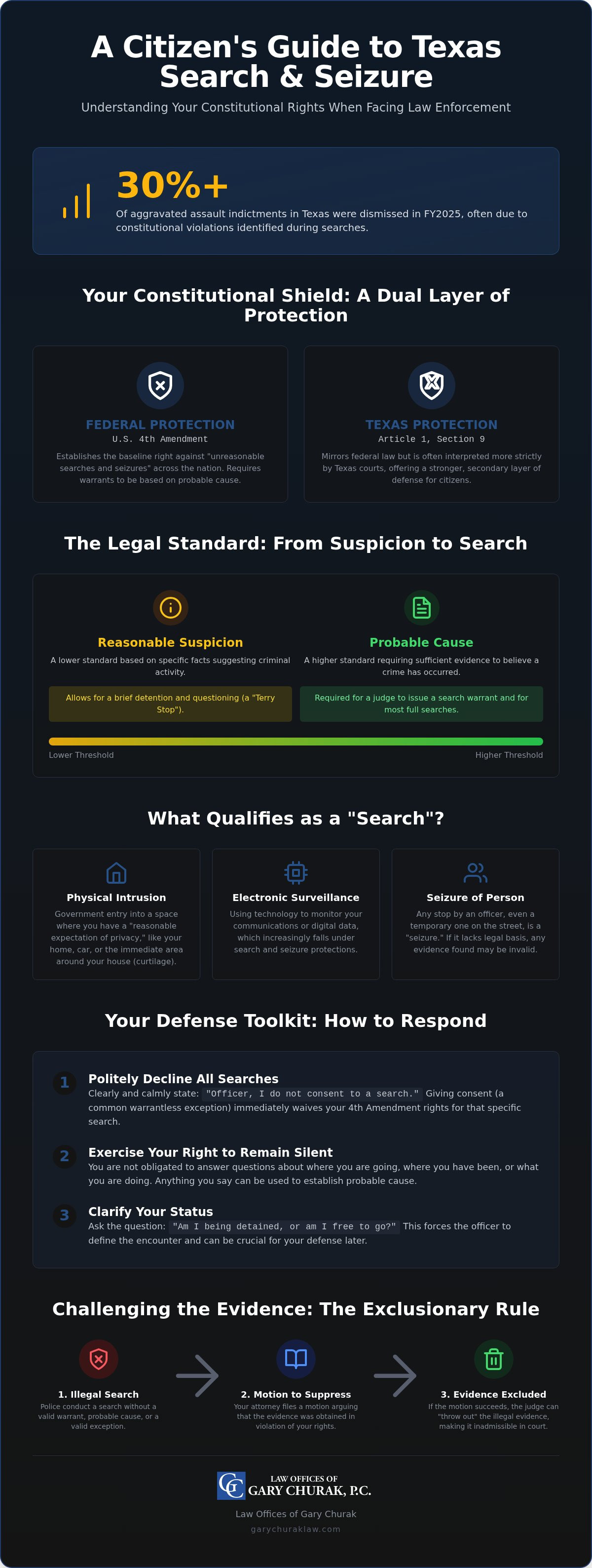
Understanding the current search and seizure laws in Texas is your first line of defense against police overreach. Data from Fiscal Year 2025 reveals that over 30% of aggravated assault indictments in the state were dismissed, often because a seasoned legal eye identified a constitutional violation that a less experienced advocate might have missed. This guide will help you master these complexities so you can protect yourself from unlawful conduct and preserve your future. We'll examine the strict legal boundaries police must follow, show you how to identify if your rights were violated, and explain the methodical process of challenging illegal evidence in court.
Key Takeaways
- Understand how the Fourth Amendment and Texas Article 1, Section 9 provide a dual layer of protection against unreasonable government interference.
- Learn the specific legal thresholds required under search and seizure laws in Texas to determine if an officer's "probable cause" actually meets judicial standards.
- Identify common warrantless exceptions like consent and plain view to avoid accidentally waiving your rights during a high-pressure encounter.
- Discover why maintaining your silence and politely declining voluntary searches are your most effective tools for preserving a future legal defense.
- Explore how the Exclusionary Rule allows you to file a Motion to Suppress and potentially throw out evidence obtained through illegal police conduct.
Understanding the Constitutional Shield: The Fourth Amendment and Texas Article 1, Section 9
The legal framework protecting your privacy isn't a single wall; it's a reinforced structure built from both federal and state mandates. At its foundation lies the Fourth Amendment to the U.S. Constitution, which establishes the fundamental right of the people to be secure in their persons, houses, papers, and effects. This federal protection serves as a baseline, prohibiting law enforcement from conducting "unreasonable" searches without a warrant based on probable cause. However, relying solely on federal law can leave you vulnerable.
Texas provides a secondary, often more robust layer of defense through Article 1, Section 9 of the Texas Constitution. While the language mirrors the federal version, Texas courts have historically interpreted these protections to provide a safety net that can catch violations federal law might overlook. This dual-track system is essential for anyone dealing with search and seizure laws in Texas. In 2026, Texas courts define the "Reasonableness Standard" as an objective assessment of whether an officer's actions were justified at their inception and reasonably related in scope to the circumstances that prompted the interference.
The Federal vs. State Protection Loophole
Texas courts are obligated to follow the minimum standards set by the U.S. Supreme Court, but they possess the authority to set higher bars for state and local police. This creates a strategic advantage for your defense. A seasoned attorney doesn't just challenge a search under one constitution; they attack it under both simultaneously. If a search is deemed "reasonable" under federal precedents, it may still fail the stricter scrutiny applied by Texas state law. This dual-layered strategy ensures that every technicality and procedural error committed by law enforcement is leveraged to protect your future.
What Constitutes a "Search" in Texas?
The definition of a search has evolved significantly by 2026. It no longer requires a physical officer rummaging through your pockets. A search occurs whenever the government violates a "reasonable expectation of privacy." This includes physical intrusions into your home or car, but it also extends to advanced electronic surveillance. Your rights are strongest within your home and its "curtilage," which is the immediate area surrounding the house used for private activities. Even a temporary "stop" on the street is a seizure of your person. If that stop lacks a legal basis, everything the police find afterward could be thrown out. Identifying the exact moment a consensual encounter turns into a forced seizure is a critical component of mastering search and seizure laws in Texas.
Defining Probable Cause: When Can Texas Law Enforcement Legally Conduct a Search?
Probable cause is the high legal hurdle that separates a lawful investigation from an unconstitutional intrusion. Under search and seizure laws in Texas, an officer can't simply act on a gut feeling or a vague hunch. Instead, they must present a magistrate with a sworn affidavit containing facts and circumstances sufficient to lead a person of reasonable caution to believe that evidence of a crime is located in a specific place. This process relies on the "totality of the circumstances" test, where a judge evaluates the entire picture rather than isolated, context-free facts.
Distinguishing between reasonable suspicion and probable cause is vital for your defense. Reasonable suspicion is a lower standard that allows police to briefly detain you for questioning, but it doesn't grant them the right to tear apart your vehicle or enter your home. If an officer crosses that line without the higher standard of probable cause, they've likely violated the Texas Constitution Article 1, Section 9. A magistrate acts as a neutral gatekeeper, tasked with scrutinizing these police claims for truthfulness and accuracy before signing off on a warrant.
The Anatomy of a Texas Search Warrant
A valid warrant must be incredibly specific. It must describe the exact location to be searched and the particular items the police are authorized to seize. If a warrant is too broad, it becomes a "general warrant," which the law strictly prohibits. Timing is also a critical factor. The "staleness" rule dictates that if the information provided to the magistrate is too old, it can't support a finding of probable cause. For instance, a tip about drug activity from six months ago rarely justifies a search today. If an officer provides false information or omits facts with reckless disregard for the truth, the entire warrant may be invalidated.
Challenging the Credibility of Informants
Police often rely on tips from anonymous sources or confidential informants, especially in drug crimes defense. However, these tips aren't automatically reliable. Texas courts require evidence that the informant has a track record of truthfulness or that the police have independently corroborated the details. While the rigid Aguilar-Spinelli two-pronged test has evolved into the more flexible totality of circumstances standard, its legacy ensures that an informant's basis of knowledge and personal credibility remain under the microscope during modern Texas warrant challenges. If you believe your rights were compromised by a questionable informant, seeking a personalized case analysis is the first step toward exposing those flaws and protecting your record.
Warrantless Exceptions: Identifying When Police Do Not Need a Judge’s Signature
While the law generally requires a warrant, the reality of police encounters often involves specific exceptions that bypass the judge's signature. Consent is the most frequent way individuals lose their constitutional protection. Officers often frame a search as a polite request, leading many to believe they have no choice but to agree. This is a primary concern for civil rights advocates, particularly regarding the potential for coercion in consent searches in traffic stops. If you provide consent, you effectively waive your rights under search and seizure laws in Texas, making it nearly impossible to challenge the evidence later.
The Plain View Doctrine applies when an officer is legally present in a location and sees contraband out in the open. If an officer stands on your porch and sees illegal substances through a window, they don't need a warrant to act. Exigent circumstances involve high-stakes emergencies, such as chasing a fleeing suspect or preventing the imminent destruction of evidence. In these moments, the delay of obtaining a warrant is legally excused to protect public safety. Search incident to arrest also allows police to search a suspect and the area within their immediate reach to secure weapons or preserve evidence once they're in custody.
Vehicle Searches and the "Automobile Exception"
Texas law acknowledges that vehicles have a lower expectation of privacy than homes because they're mobile and highly regulated. Under the "automobile exception," police only need probable cause to search a car without a warrant. They also frequently rely on the "inventory search" loophole. If your vehicle is impounded following an arrest, police can search it under the administrative guise of cataloging your personal belongings. This tactic is a frequent point of contention for a DWI defense attorney, as it often uncovers evidence that would otherwise be protected by a warrant requirement.
The "Stop and Frisk" (Terry Stop) Reality
A "Terry Stop" allows an officer to pat you down for weapons if they have reasonable suspicion that you're armed and dangerous. It isn't a license to search for drugs, yet the "plain feel" doctrine allows them to seize contraband if its identity is immediately apparent during the pat-down. By 2026, courts have strictly limited how long police can hold you at a traffic stop. They can't prolong a detention indefinitely just to wait for a K-9 unit without additional evidence. Understanding these nuances is critical for navigating the complexities of search and seizure laws in Texas.
Rights When Being Questioned by Police: Managing a Search Encounter
Managing a police encounter requires a calm, strategic presence. Many people believe they can "talk their way out" of a search, but this is a dangerous misconception. Under search and seizure laws in Texas, your words are more likely to be used as evidence than as a tool for de-escalation. Your most powerful shield is the right to remain silent. While you must generally provide identification if you're legally detained or arrested, you're under no obligation to answer investigative questions about your destination, your passengers, or the contents of your property.
The "Am I Free to Go?" rule is your primary tool for establishing the nature of the encounter. If an officer stops you, ask this question clearly and politely. If the answer is yes, leave immediately. If the answer is no, you're being detained. In that situation, you should stop answering questions and clearly state that you wish to speak with an attorney. Exercising these rights isn't an admission of guilt; it's a necessary step to protect your constitutional standing.
The Danger of "Consenting" Through Silence
Silence isn't always golden when it comes to consent. In some scenarios, failing to object when an officer begins a search might be interpreted by Texas courts as implied consent. You must be vocal and unambiguous. Use the exact phrase: "I do not consent to any searches." If the officer proceeds anyway, don't physically resist. Physical resistance can lead to additional charges like assault on a public servant. Instead, remain calm and note the details for your legal representative. Documenting the lack of consent is crucial for a later challenge in court.
Questioning After an Illegal Search
If the initial search was illegal, everything that follows is often tainted. This is known as the "Fruit of the Poisonous Tree" doctrine. If the police violate search and seizure laws in Texas to find evidence, any statements you make afterward or additional evidence found as a result can often be suppressed. This mistake by law enforcement can become the cornerstone of your defense strategy. When you're preparing for a criminal defense consultation, documenting these specific interactions is vital. If you believe your rights were disregarded during an encounter, you need to consult with a seasoned criminal defense attorney who can analyze the police conduct for constitutional errors.
Challenging Unlawful Evidence: How the Exclusionary Rule Protects Your Defense
The Exclusionary Rule serves as the ultimate penalty for law enforcement's failure to respect your constitutional boundaries. If police violate search and seizure laws in Texas, the evidence they obtain is generally inadmissible in court. This isn't an automatic process. You don't simply walk free because an officer made a mistake. Instead, your defense must actively challenge the evidence by filing a Motion to Suppress. This formal legal request asks the judge to throw out specific evidence, such as drugs, weapons, or incriminating statements, because they were seized through unconstitutional means.
When evidence is successfully suppressed, it often dismantles the prosecution's entire narrative. Without the physical evidence or the confession, the state frequently lacks the necessary proof to move forward, leading to a complete dismissal of criminal charges. You should be aware of the "Good Faith" exception, however. This rule allows evidence to be used if police acted in reasonable reliance on a warrant that was later found to be technically invalid. A seasoned attorney focuses on proving that the officer's actions weren't just a technicality but a fundamental breach of your rights.
Strategic Case Analysis for Search Violations
Success in a suppression hearing requires a methodical review of every second of the encounter. We scrutinize body cam footage and police reports to find inconsistencies that indicate a violation of search and seizure laws in Texas. Many cases hinge on "pretextual stops," where an officer uses a minor traffic violation, like a broken taillight, as an excuse to conduct a deeper investigation without probable cause. This analysis is particularly critical in drug possession cases, where the legality of the search is often the only viable path to a defense.
The Burden of Proof in Suppression Hearings
In a suppression hearing, the legal burden shifts in a way that favors the prepared defendant. While the defense typically carries the burden for warranted searches, the state must prove that a warrantless search was legally justified. This creates an opportunity to cross-examine officers on their specific "reasonable suspicion" or "probable cause" justifications. By highlighting gaps in their testimony, we can demonstrate that the search was an unreasonable intrusion rather than a lawful procedure. The Motion to Suppress is the most powerful tool in the defense arsenal because it forces the government to justify its intrusion into your private life under the strict light of constitutional law.
Secure Your Future by Asserting Your Rights
The legal landscape of search and seizure laws in Texas is designed to protect your privacy, but those protections only work if you know how to invoke them. You've learned that a police officer's request for a search is often a tactical choice rather than a legal requirement, and that your clear refusal is the foundation of a strong defense. Whether it's identifying a flawed warrant or challenging a pretextual traffic stop, every detail of your encounter matters. A single procedural error by law enforcement can be the difference between a conviction and a complete dismissal of your charges.
Navigating these high-stakes situations requires a guide who understands the nuances of the courtroom. With over 40 years of aggressive criminal defense experience, the Law Offices of Gary Churak is battle-tested in both federal and state courts. We focus on identifying the constitutional violations that others miss to ensure your rights remain intact. Don't leave your freedom to chance after an unlawful encounter. Contact the Law Offices of Gary Churak today for a free consultation to discuss your case and begin building a strategic defense. You have the power to challenge the state's evidence, and we're here to provide the steady hand you need to succeed.
Frequently Asked Questions
Can Texas police search my car if they smell marijuana in 2026?
In 2026, the smell of marijuana still frequently serves as probable cause for a vehicle search under search and seizure laws in Texas. However, this is a highly contested area of law. Since legal hemp and illegal marijuana smell identical, seasoned attorneys argue that an officer's nose isn't a reliable tool for establishing probable cause. Challenging the officer's sensory claims is a critical strategy in modern drug defense.
What should I do if police show up at my house without a warrant?
You should remain inside, keep the door closed, and ask if they have a warrant. If they don't, you aren't required to let them in or even step outside to speak with them. Politely state, "I do not consent to a search and I will not let you in without a warrant." Unless there are exigent circumstances like an active emergency, they must leave immediately to respect your privacy.
Can my roommate or spouse give police consent to search my private room?
Generally, a roommate or spouse can only consent to a search of common areas they share with you. They cannot legally waive your rights for a space where you have an exclusive expectation of privacy, such as a locked bedroom or a private office. If police enter your private room based on a roommate's consent, the evidence found there is often subject to a Motion to Suppress during your defense.
Do I have to unlock my phone for the police during a search in Texas?
No, you don't have to provide your passcode or biometric data like a fingerprint or face scan without a specific warrant for the device. The Supreme Court has established that cell phones contain vast amounts of private data, requiring high levels of protection. If an officer threatens you for refusing to unlock your phone, remain silent and request to speak with your attorney. Protecting your digital privacy is a fundamental right.
What happens to my case if the police conducted an illegal search?
An illegal search can lead to the suppression of evidence, which often results in the dismissal of your case. Under search and seizure laws in Texas, the Exclusionary Rule prevents the state from using evidence obtained through constitutional violations. If the primary evidence against you is thrown out, the prosecution may be forced to drop the charges because they can no longer prove their case beyond a reasonable doubt.
Can police search my trash once it is on the curb in Texas?
Yes, police can search your trash once it's placed on the curb for collection. Texas courts follow federal precedent, which suggests that you've abandoned your expectation of privacy once the trash is left in a public area for a third party to take. If you're concerned about sensitive materials, it's best to shred documents before disposal, as law enforcement doesn't need a warrant to rummage through discarded bags.
How long can police detain me during a search encounter?
Police can only detain you for a reasonable amount of time to complete the initial purpose of the stop. For a traffic violation, this usually means the time it takes to check your license and issue a citation. They can't prolong the detention to wait for a drug dog or conduct a deeper investigation unless they develop additional reasonable suspicion during the encounter. If the stop is unnecessarily long, it may become an illegal seizure.
Is a "no-knock" warrant legal in Texas?
No-knock warrants are still legal in Texas, but they're subject to increasing scrutiny and specific departmental restrictions. An officer must demonstrate to a magistrate that knocking and announcing their presence would be dangerous or lead to the immediate destruction of evidence. If you've been the target of such a warrant, a thorough case analysis is required to determine if the high legal threshold for a no-knock entry was actually met.


