

Could the lowest legal quote end up costing you more? If you’re asking how much does a criminal defense lawyer cost, you’re likely weighing more than the fee. You want to know what you’re paying for, whether unexpected expenses could arise, and whether a lower-priced lawyer can provide the defense your case demands.
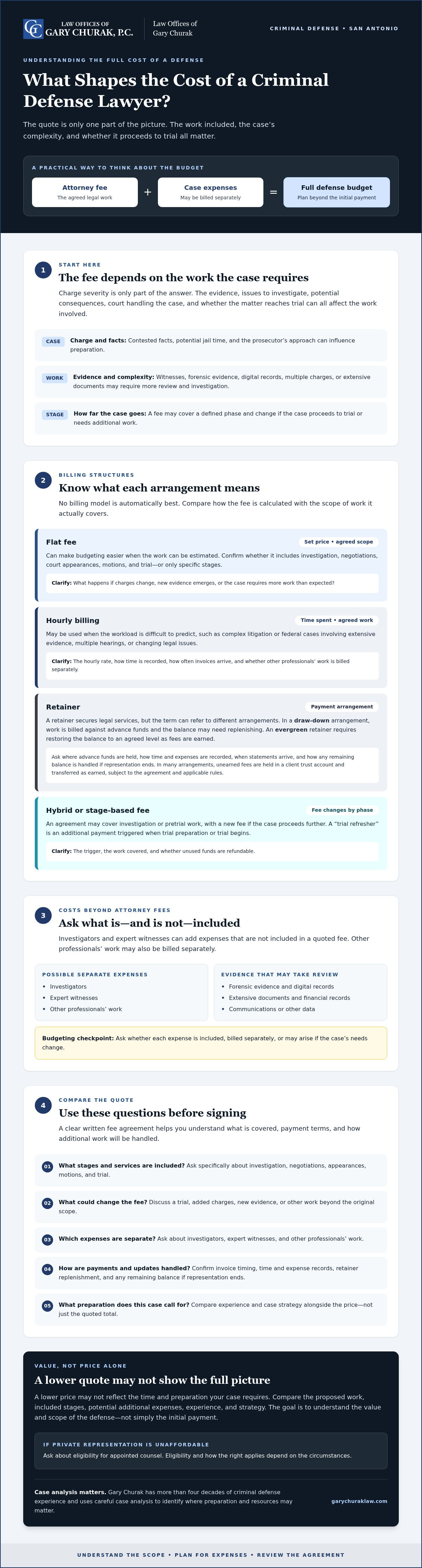
Those concerns are reasonable. The total cost depends on the charge, the complexity of the case, and whether it proceeds to trial. Attorney fees may be only part of the budget: investigators and expert witnesses can add expenses that aren’t included in a quoted fee. A clear written agreement helps you understand what’s covered before you commit.
This guide explains how flat fees, hourly rates, and retainers work, what additional defense costs to ask about, and how to assess a lawyer’s quote. It also offers a practical framework for budgeting for the full case, not just the initial payment. With more than four decades of criminal defense experience, Gary Churak uses careful case analysis to identify where preparation and resources may matter, helping you compare value rather than price alone.
Key Takeaways
- To understand how much does a criminal defense lawyer cost, compare the fee structure and scope of work, not just the quoted total.
- Clarify which stages of your case are covered and what could change the fee if the matter becomes more complex or goes to trial.
- Ask whether investigators, expert witnesses, and other case expenses are included or billed separately so you can plan for the full defense.
- Evaluate a lawyer’s experience and case strategy alongside the price. A lower quote may not reflect the time and preparation your case requires.
- Use a written fee agreement to confirm payment terms, included services, and how additional work will be handled.
Understanding Legal Fee Structures: Flat Fees vs. Hourly Rates
How a lawyer bills can shape your budget as much as the charge itself. A flat fee sets a price for an agreed scope of work, while hourly billing ties fees to time spent on the case. Neither structure is automatically better. The right fit depends on how predictable the work is and exactly what the fee covers.
When to Expect a Flat Fee
A flat fee may be practical when the lawyer can reasonably estimate the work involved, such as handling a defined portion of a DWI or drug possession case. A set fee can make budgeting easier, but only if you know which services and stages it includes.
Read the agreement carefully. Ask whether the fee covers investigation, negotiations, court appearances, motions, and trial. A quote may cover representation only through a particular stage and exclude trial, expert witnesses, investigators, or other case expenses. Confirm what happens if charges change, new evidence emerges, or the case requires more work than expected.
The Mechanics of a Legal Retainer
A retainer is a payment made to secure legal services, but the term can describe different arrangements. In a draw-down arrangement, the lawyer bills work against funds paid in advance; when the balance runs low, you may need to replenish it. An evergreen retainer requires you to restore the balance to an agreed level as fees are earned.
Ask where advance funds will be held, how time and expenses will be recorded, and when you’ll receive statements. In many arrangements, unearned fees are held in a client trust account and transferred as the lawyer earns them, subject to the fee agreement and applicable rules. Request a written explanation of how any remaining balance will be handled if representation ends.
Hourly and Hybrid Billing
Hourly billing may be used when the workload is difficult to predict, including complex litigation or federal cases involving extensive evidence, multiple hearings, or changing legal issues. You’re billed for time spent on agreed work, so ask for the hourly rate, how time is recorded, how often invoices arrive, and whether other professionals’ work is billed separately.
Some agreements combine approaches. A stage-based fee may cover an investigation or pretrial phase, with a new fee if the case proceeds further. A “trial refresher” is an additional payment triggered when trial preparation or trial begins. Before signing, ask the lawyer to identify the trigger, the work it covers, and whether any unused funds are refundable.
If you can’t afford private representation, ask about eligibility for appointed counsel. The right to appointed counsel provides important background, but eligibility and how the right applies depend on the circumstances. Whatever the billing model, a clear fee agreement gives you a stronger basis for planning and asking informed questions.
Cost Breakdown by Charge Severity: Misdemeanors to Federal Felonies
Charge severity gives only part of the answer to how much does a criminal defense lawyer cost. The workload also depends on the evidence, the issues to investigate, the potential consequences, and the court handling the case. A misdemeanor with disputed evidence can demand substantial preparation, while a federal prosecution may require extensive review and familiarity with federal procedures.
Misdemeanor vs. Felony Cost Drivers
Misdemeanor cases may involve a narrower set of evidence and fewer stages than serious felony cases, but a conviction can still affect a person’s record and future opportunities. The prosecutor’s approach, contested facts, and potential jail time can influence how much investigation and preparation the defense requires. State felonies may involve more witnesses, forensic evidence, digital records, or multiple charges, increasing the time needed to examine the case and develop a strategy.
Ask an attorney which facts drive the proposed fee, what work is included, and how the plan could change if the evidence or charges expand. Use this guide to choosing a criminal defense attorney to assess experience and approach alongside the quote.
The Complexity of Federal Defense Fees
Federal cases can require a different level of preparation than state cases. Counsel must address federal procedures and evidentiary rules, assess how sentencing provisions may apply, and examine the government’s evidence in detail. In federal drug or white-collar matters, discovery may include extensive documents, financial records, communications, or other data. Reviewing and organizing that material takes time, and the defense may need additional investigative or expert work.
That added scope helps explain why federal representation can require more resources than a less complex state case. The fee should reflect the actual demands of the prosecution and the preparation needed to respond, not simply the label “federal.” Ask whether the quote covers investigation, pretrial proceedings, and trial, or whether representation is priced in stages. Gary Churak has more than four decades of criminal defense experience in state and federal courts. Learn more about Gary Churak’s criminal defense experience.
Expungements and Record Sealing
Expungement or record sealing is a separate legal matter from defending a new charge. The work and fee depend on the record, eligibility, and steps required. Ask whether the quoted fee covers the full process or only specified stages, and confirm whether filing or other record-related expenses are separate. Treat the decision as a way to address the long-term effects of a record, not as an automatic or guaranteed clean slate.
Key Factors That Influence the Price of Your Defense
The answer to “how much does a criminal defense lawyer cost” depends on the work your case demands, not just the name of the charge. Multiple counts, co-defendants, conflicting accounts, and large volumes of digital evidence can expand the time needed to investigate and prepare. Each issue may require separate review, coordination, or legal analysis.
Experience also affects a quote, but a higher rate doesn’t automatically mean a higher total bill. An attorney with more than four decades in criminal defense may be able to identify which evidence deserves close scrutiny and where additional investigation may be justified. Evaluate the proposed strategy and work plan, not the hourly rate alone.
The Impact of Thorough Case Analysis
Thorough case analysis starts with examining the evidence and how it was obtained. A defense lawyer may identify inconsistencies, gaps, or potential procedural issues that could support a legal challenge. No finding guarantees dismissal, but overlooking a viable issue can weaken the defense. Reviewing discovery, including reports, recordings, and digital material, takes focused time. To help an attorney assess the work involved, gather relevant documents and prepare a clear timeline and questions about the fee’s scope before a criminal defense consultation.
Trial Preparation and Courtroom Time
A case resolved through a negotiated outcome may require less trial preparation than one that proceeds to court. If trial becomes necessary, the lawyer may need to prepare witnesses, develop arguments, review exhibits, and spend substantial time in hearings and trial. Check whether the agreement includes trial work or calls for a separate trial fee, additional hourly billing, or a stage-based charge.
Trial readiness matters before the case reaches a courtroom. A lawyer prepared to test the prosecution’s evidence can negotiate from a more informed position. That doesn’t guarantee a better offer or outcome, and no one should pressure you into a plea simply to avoid trial costs. Ask how the lawyer will prepare for either path and what each could mean for your budget.
A firm’s reputation may contribute to its fees, but reputation alone doesn’t establish value. Ask how the attorney will handle your case, who will do the work, and how progress will be communicated. Gary Churak brings more than four decades of criminal defense experience and emphasizes thorough case analysis. A personalized consultation can help clarify the issues and resources your defense may require.
Beyond the Attorney: Investigators and Expert Witness Costs
The attorney’s fee may not cover every resource a defense requires. Investigators, forensic specialists, and other third parties can add costs, so ask early which expenses are anticipated, who approves them, and how they’ll be billed. A useful resource should address a specific question or help test the prosecution’s evidence; unnecessary work can increase the budget without strengthening the defense.
A private investigator may locate witnesses, follow up on conflicting accounts, or look for evidence that wasn’t included in the initial investigation. Forensic experts can assess technical evidence such as DNA, breath test results, or digital records. Depending on the case, medical or psychological experts may also help evaluate evidence or explain specialized issues. Ask what question each professional would address and how the work fits the defense strategy.
When Is an Expert Witness Necessary?
An expert may be useful when the prosecution relies on technical evidence that requires specialized knowledge to evaluate. The defense can ask whether the methods, assumptions, or interpretation are sound, and whether another qualified expert reaches a different conclusion. In court, expert testimony may help jurors understand disputed evidence. Before agreeing to the expense, ask what the expert will review, whether a written report or testimony is anticipated, and how the work could inform the defense. No expert can guarantee an outcome.
Budgeting for Third-Party Expenses
Expert and investigator fees are often separate from attorney fees. The total may depend on the professional’s specialty, the amount of review required, and whether testimony or additional analysis is needed. Court-related expenses, such as filing fees or transcript charges, and case-related travel may also be billed separately, depending on the matter and the fee agreement.
Before work begins, ask the lawyer to explain anticipated out-of-pocket costs and how new expenses will be approved. Get clear answers to these questions:
- Which experts or investigators might the case need, and why?
- Are their fees paid directly or through the law firm?
- Will you receive notice before additional work is authorized?
- Could testimony, extra testing, transcripts, or travel create further costs?
Cutting an investigator or expert solely to reduce expenses can leave important evidence unexamined, but not every case needs every specialist. A careful defense lawyer should explain how each proposed expense serves the case, helping you weigh its likely value against the cost. To discuss how investigative resources may fit into a defense strategy, contact Gary Churak about your criminal defense case.
Evaluating Value: Why the 'Cheapest' Lawyer is Often the Most Expensive
A low quote can look appealing under pressure, but price alone doesn’t show how carefully a lawyer will examine the evidence or prepare your defense. A lawyer who pushes for a quick plea without assessing the facts or explaining the tradeoffs may leave important questions unanswered. A plea can be appropriate in some cases, but you should understand the evidence, options, and consequences before deciding. The value of representation lies in informed strategy, not simply avoiding court.
Calculating the True Cost of a Criminal Record
The financial impact of a conviction may extend beyond court-imposed penalties. Depending on the offense and circumstances, a record can complicate employment, housing, or professional licensing. Insurance costs may also change, and the effect on voting rights varies by jurisdiction and situation. These consequences aren’t automatic in every case, so ask a lawyer which may apply to you. A thorough defense can help you understand and respond to the potential effects on future opportunities. Learn more about how a criminal defense attorney can protect your future.
Peace of mind matters, too. A prepared advocate can help you understand what’s happening and make decisions with a clearer view of the risks. That doesn’t mean any lawyer can promise a result. It means you should expect careful analysis, candid guidance, and a defense plan tailored to the facts.
Questions to Ask About Fees During Your Consultation
Use a consultation to assess both the proposed fee and the work behind it. Bring the charge information and any relevant documents you have, then ask direct questions:
- Does the fee include trial representation, or would trial work require a separate agreement?
- How are expert witness and investigator costs handled, and will I be consulted before expenses are incurred?
- Who will work on my case, and how will you update me about progress and billing?
- What experience do you have with cases similar to mine, and what factors could change the fee?
As you consider how much does a criminal defense lawyer cost, compare the scope of work, communication, and relevant experience, not just the initial quote. Gary Churak brings more than four decades of criminal defense experience and offers personalized consultations to discuss a case. For an assessment of your situation and a clearer view of the defense ahead, schedule a criminal defense consultation.
Take the Next Step With a Clear Defense Plan
Understanding how much does a criminal defense lawyer cost means looking beyond the initial quote. The fee structure, complexity of the charge, trial preparation, and third-party expenses all affect your budget. A clear agreement helps you understand what’s included, while an informed comparison weighs experience and strategy alongside price.
The right defense is built around the facts of your case, not a one-size-fits-all fee or quick promise. Gary Churak brings more than 40 years of criminal defense experience, with advocacy in state and federal cases. A personalized case analysis can help clarify the work your defense may require and where resources may matter most.
Schedule a Personalized Case Analysis with the Law Offices of Gary Churak to discuss your situation and consider a path forward. You don’t have to make this decision without guidance. A clear next step can help you move ahead with greater confidence.
Frequently Asked Questions
Is a flat fee better than an hourly rate for criminal defense?
Neither option is always better; the right choice depends on the case and the work covered. A flat fee can make budgeting more predictable when the scope is defined. Hourly billing may suit cases where the workload is harder to estimate, such as complex litigation. Before agreeing, ask what stages and services are included, what could trigger additional fees, and how expenses are billed. Compare the written scope, not just the payment method.
What is a typical retainer fee for a felony case in 2026?
There isn’t one standard retainer for every felony case, and the Law Offices of Gary Churak doesn’t publish a universal fee for its services. The amount depends on factors such as the allegations, evidence, expected workload, and whether the case may go to trial. Ask whether the payment is a draw-down against billed work or an evergreen retainer, what it covers, and when you may need to replenish it. Get the terms in writing.
Do criminal defense lawyers offer payment plans if I can't pay all at once?
Some lawyers may discuss payment arrangements, but availability and terms vary by attorney and case. Don’t assume a payment plan is offered. Ask directly about the initial payment, due dates, accepted payment methods, and what happens if you can’t meet a scheduled payment. Have any arrangement documented in the fee agreement. If private representation is beyond your means, ask the court or a qualified legal resource about whether you may be eligible for appointed counsel.
What happens to my retainer if the charges are dropped early?
Charges being dropped doesn’t automatically mean you receive the entire retainer back. With a draw-down retainer, fees for work already performed may be deducted, and any remaining unearned funds are handled under the written agreement and applicable rules. Ask for an itemized accounting showing the work billed and the balance. Before hiring counsel, confirm how unused funds are treated if the case ends early or representation terminates.
Why is a federal criminal defense lawyer so much more expensive than a state lawyer?
Federal cases can involve distinct procedures, extensive discovery, complex legal issues, and substantial preparation, all of which can increase the work required. Some federal matters are billed in stages, with separate scopes for investigation, pretrial proceedings, and trial. The fee should reflect the demands of the specific case, not just its federal status. Ask about the lawyer’s federal experience and which phases, court appearances, and case expenses the proposed fee includes.
Are expert witness fees included in the lawyer's flat fee?
Not necessarily. A flat fee may cover the lawyer’s agreed work while expert fees, investigators, testing, transcripts, or other case expenses are billed separately. The fee agreement should spell out what’s included and how additional costs are approved. Ask whether an expert is likely to be needed, what issue they would address, and whether you’ll be consulted before work begins. Don’t rely on verbal assumptions; request clear written terms.
Can I get a refund if I am not satisfied with the lawyer's representation?
Being dissatisfied doesn’t automatically entitle you to a refund. Your options depend on the fee agreement, the work already completed, and applicable professional rules. Raise specific concerns with the lawyer and request a clear accounting of fees and expenses. If representation ends, ask how any unearned funds will be handled. For a serious fee dispute, consider contacting the relevant lawyer-regulation authority or seeking independent legal guidance about your options.
How much does it cost to defend a first-time DWI charge?
The cost to defend a first-time DWI charge varies with the evidence, case complexity, location, and whether the matter proceeds to trial. There is no single figure that applies to every case, and the Law Offices of Gary Churak doesn’t publish a universal fee for this service. Ask for a written quote that defines the stages covered and identifies possible separate expenses, such as expert analysis or testing, before deciding how to proceed.


