

A single mistake from years ago shouldn't have the power to derail your career in 2026, yet for many individuals, a background check remains a permanent barrier to progress. You likely feel a sharp pang of anxiety every time you submit a job application, wondering if an old arrest will resurface to sabotage your hard work. It's exhausting to live under the shadow of a record that no longer reflects your current character or capabilities.
You deserve a clear path to seal a criminal record and reclaim your professional reputation. This guide delivers the exact steps to obtain an Order of Nondisclosure, allowing you to legally hide your history from public view and private employers. You'll gain vital clarity on the 2026 legal landscape, including how new legislation impacts automatic sealing and the specific eligibility requirements for certain first-time convictions.
We'll break down the mandatory waiting periods for various offenses, explain the crucial distinctions between expunction and nondisclosure, and show you how a seasoned attorney protects your future by navigating the complex petition process with precision.
Key Takeaways
- Understand the vital legal distinction between sealing a record through nondisclosure and clearing it via expunction to ensure you choose the correct path forward.
- Identify the specific criteria for mandatory and discretionary relief, including how deferred adjudication impacts your eligibility to seal criminal record texas files.
- Master the procedural steps for drafting a petition with the correct statutory references to prevent common filing errors and administrative delays.
- Discover how a battle-tested attorney identifies hidden eligibility windows and navigates complex court requirements that self-represented individuals often miss.
- Learn how to strategically utilize your sealed record to confidently approach job interviews and housing applications in the 2026 professional market.
Understanding Nondisclosure: What It Means to Seal a Criminal Record in Texas
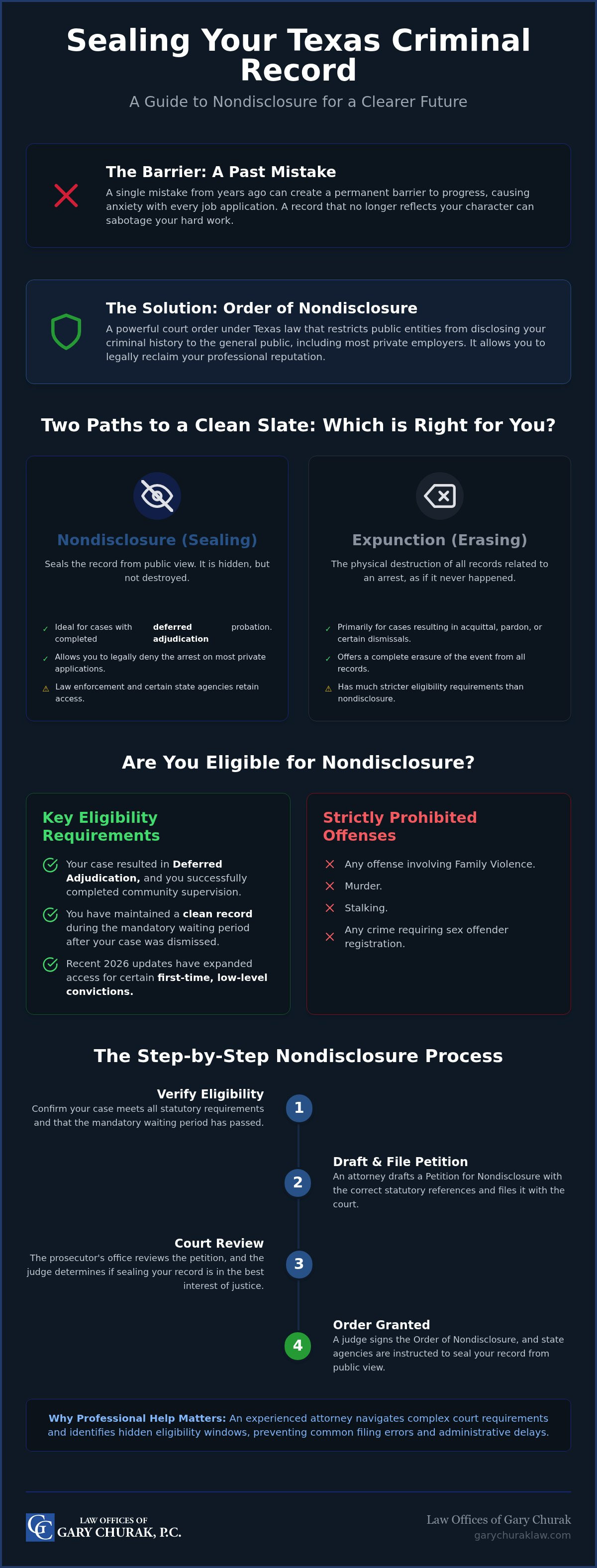
An Order of Nondisclosure is a powerful legal tool established under Texas Government Code Chapter 411. If you seek to seal criminal record texas details, you are requesting a court mandate that restricts public entities from disclosing your criminal history to the general public. This is not a mere suggestion; it is a judicial directive that changes how your past is handled by the state. While the record is not physically destroyed, it is removed from public search portals and official registries that employers typically use during the hiring process.
You must recognize that sealing a record is a strategic maneuver designed to protect your privacy without erasing the event from the eyes of the law. Law enforcement agencies, prosecutors, and specific state regulatory bodies retain access to this information. However, for the vast majority of private sector interactions, the record effectively ceases to exist for public viewing. This provides a vital layer of security for those rebuilding their lives in 2026.
The Legal Effect of Sealing Your Record
Once a judge signs the Order of Nondisclosure, your professional landscape shifts immediately. You gain the legal right to deny the existence of the arrest or conviction on most private job applications and housing forms. This removes the "background check anxiety" that haunts many qualified candidates. If an employer uses a third-party screening company, the Texas Department of Public Safety is required to notify these private vendors to purge your sealed data from their systems.
There are limits to this protection that you must understand. State licensing boards for professions such as nursing, teaching, or pharmacy will still see the sealed history during their background checks. These agencies operate under a higher level of scrutiny to ensure public safety. Despite these exceptions, the shield provided against general public inquiries is often the difference between a rejected application and a successful career move.
Sealing vs. Expunction: Which Path Is Right?
Distinguishing between these two legal paths is critical for your defense strategy. The legal nuances of Expungement in Texas focus primarily on cases that resulted in acquittals, pardons, or certain dismissals. Expunction is a total erasure, resulting in the physical destruction of the records. Nondisclosure is the more common "second chance" for individuals who successfully completed deferred adjudication probation and maintained a clean record afterward.
Choosing the wrong path can lead to wasted time and unnecessary filing fees. If your case was dismissed without a conviction or a period of probation, you should review our specific guide on how to get a record expunged in texas. For those who stayed the course through a deferred adjudication agreement, sealing the record via nondisclosure is the standard and most effective way to restore your future.
Determining Your Eligibility: Who Can Seal Their Texas Criminal Record?
Eligibility for an Order of Nondisclosure is not a matter of luck; it is a rigid statutory checklist. To seal criminal record texas entries, your case must typically have resulted in deferred adjudication. This means you entered a plea, the judge deferred a finding of guilt, and you successfully completed your community supervision. If you were instead convicted and sentenced to straight jail time or regular probation, your options are significantly more limited, though recent 2026 updates have expanded access for certain low-level offenses. You must also maintain a clean record during your waiting period. Any new criminal charge, even a minor misdemeanor, can reset your progress or disqualify you entirely.
The law is protective of public safety, which means certain "stains" cannot be hidden. Offenses involving family violence, murder, stalking, or any crime requiring sex offender registration are strictly prohibited from being sealed. For a comprehensive look at the legal framework, this Texas guide to sealing your criminal record provides an excellent breakdown of the various government codes involved. If you are unsure if your specific charge qualifies, a consultation with a record sealing expert can provide the clarity you need to move forward.
Misdemeanor vs. Felony Waiting Periods
As of 2026, the timing of your petition depends heavily on the severity of the original charge. Many non-violent misdemeanors now qualify for an immediate filing once you receive your discharge and dismissal paperwork. However, if your misdemeanor fell under specific chapters of the Texas Penal Code, such as assault, disorderly conduct, or weapons charges, you must wait two years from the date of discharge. Felonies require a more patient approach, carries a mandatory five-year waiting period. Under the new SB219 regulations, some of these processes have become automated for specific low-level offenses, but most individuals still require a proactive petition to ensure the record is properly restricted across all databases.
Special Provisions for DWI Sealing
Texas law provides a specific "Second Chance" path for first-time DWI convictions, provided the circumstances meet strict criteria. To be eligible, your blood alcohol concentration (BAC) must have been below 0.15, and the incident cannot have involved an accident with another person. The waiting period is dictated by your compliance with technology. If you used an ignition interlock device for at least six months as part of your sentence, you may petition to seal the record two years after completing your probation. Without the interlock device, the waiting period extends to five years. These cases face high levels of judicial scrutiny, making a professionally drafted petition essential for a successful outcome.
The Step-by-Step Process for Filing a Petition for Nondisclosure
Securing an Order of Nondisclosure requires a precise, tactical approach. You can't simply fill out a generic form and hope for a favorable result. To seal criminal record texas entries, you must execute a rigid procedural path that begins in the specific court where your case was originally handled. This is a formal legal action that demands accuracy; any discrepancy in case numbers or dates can lead to an immediate administrative rejection.
As of January 1, 2026, new provisions under SB219 have streamlined the process for some, potentially waiving filing fees for specific petitioners. However, for most individuals, the process remains a proactive legal battle. Once you file your petition, the District Attorney’s office receives notification. They have the right to review your history and contest the request if they believe sealing the record isn't appropriate for public safety reasons. Having a strategic defense prepared for this review stage is vital to keep your petition moving forward.
Drafting a Compelling Petition
Your petition is more than a request; it's a legal argument that must cite the exact sections of the Texas Government Code that grant you eligibility. You must include verified case numbers, the specific date of your discharge, and proof that you successfully completed all court requirements. Beyond these facts, your petition must articulate why sealing the record is in the "best interest of justice." This is a subjective standard, and a well-drafted statement explains how your rehabilitation outweighs the public's interest in seeing your past mistakes. Failure to address this standard is a common reason why self-represented petitions are denied.
Navigating the Court Hearing
If the prosecution objects to your petition, the judge will schedule a hearing. You should expect a formal environment where you may be asked to present evidence of your rehabilitation. This could include proof of steady employment, community service, or advanced educational achievements. The judge's primary focus is determining if you've truly moved beyond your past. A seasoned attorney will help you prepare for these questions, ensuring you present a narrative of resilience and responsibility.
Once the judge signs the order, the final administrative phase begins. You must ensure the court clerk transmits the signed Order of Nondisclosure to the Texas Department of Public Safety. The DPS is then responsible for notifying other state agencies and private background check companies. This multi-agency notification is what finally places the seal on your history, ensuring that private entities can no longer access or distribute your sensitive data.
Strategic Comparison: Why Finding Reliable DWI Lawyers Matters for Record Sealing
Representing yourself in a Texas courtroom is a high-stakes gamble that often ends in procedural failure. While generic legal aid sites might offer basic templates, they don't provide the strategic advocacy needed to overcome a prosecutor's formal objection. If you file a petition incorrectly, you risk a permanent denial that could stall your career for years to come. A seasoned expert knows how to seal criminal record texas entries by identifying technical loopholes and "hidden" eligibility windows that an untrained eye will simply miss.
Choosing an attorney with over 40 years of experience ensures that your petition is built on a foundation of deep legal knowledge. You need a protector who understands when to negotiate quietly and when to take a forceful stance before a judge. This strategic balance is what separates a successful nondisclosure order from a wasted filing fee. Your professional future is too valuable to leave to chance or automated forms.
The Value of Finding Reliable DWI Lawyers
DWI cases are arguably the most technically demanding records to seal under current 2026 statutes. Because these petitions involve specific blood alcohol thresholds and interlock compliance, the margin for error is razor-thin. Finding a specialized dwi defense attorney allows you to benefit from their ability to negotiate with the State before you ever step into the courtroom. This proactive negotiation often prevents the District Attorney from filing an objection in the first place, smoothing the path for the judge's signature.
How a Criminal Defense Attorney Protects Your Petition
Your legal journey doesn't end when the judge signs the order. A dedicated advocate acts as a final check against the administrative errors that frequently leave records visible even after a judge has ruled. They verify that the court clerk transmits the order correctly to all necessary state and private databases. You can learn more about how a criminal defense attorney protects your future by managing these high-stress details on your behalf.
This professional buffer allows you to focus on your career while your lawyer handles the aggressive advocacy required in the 2026 legal system. If you are ready to permanently close the door on your past, request a case evaluation with Gary Churak to start your petition today.
Restoring Your Future: Taking Action with a Professional Defense Strategy
The signed Order of Nondisclosure serves as the definitive finish line of a long legal journey. In the competitive 2026 Texas job market, the ability to seal criminal record texas entries is a strategic advantage that cannot be overstated. You're no longer forced to lead with your past mistakes when meeting a potential employer or a new landlord. This legal shield empowers you to present your current character and professional qualifications without the shadow of an old arrest or conviction looming over the conversation. It's about more than just privacy; it's about reclaiming your agency in a world that often refuses to forget.
With housing barriers removed, you can focus on the long-term responsibilities of homeownership; for those managing property in the Austin area, transitionroofing.com provides expert residential roofing solutions to ensure your home remains a secure and well-maintained asset.
Investing in professional legal representation today is a commitment to your long-term stability. While the initial process requires patience, the professional dividends of a sealed record last a lifetime. You've worked hard to move beyond your past, and ensuring that your record reflects that growth is the final step in a comprehensive defense strategy. By securing an Order of Nondisclosure, you're not just hiding a file; you're actively protecting your right to a fair and prosperous future.
Life After the Order of Nondisclosure
Your responsibility doesn't end the moment the judge signs the order. You must verify that your history has been successfully purged from public view. It's a wise practice to run a self-background check through a reputable private screening service 60 to 90 days after the order is finalized. If a background check company still reports the sealed offense, you have the right to demand an immediate correction. Your attorney can assist in enforcing the "duty to notify," ensuring that private databases comply with the court's mandate. Maintaining a clean record moving forward is also vital, as new legal issues can complicate your newly restored status.
Schedule Your Strategic Consultation
Every criminal case has unique nuances that a generic online guide simply cannot address. Whether you're navigating the complexities of a first-time DWI or a completed deferred adjudication for a misdemeanor, a personalized case analysis is essential. Gary Churak brings over 40 years of battle-tested experience to your defense, providing the seasoned wisdom needed to navigate the 2026 Texas court system. We offer aggressive advocacy and a steady hand to guide you through the petition process from start to finish.
Before you take action, review this final checklist:
- Have you successfully completed all terms of your deferred adjudication?
- Has the mandatory waiting period (immediate, 2 years, or 5 years) elapsed?
- Is your record currently free of any new criminal charges or convictions?
- Do you have your official discharge and dismissal paperwork ready for review?
Don't let your past dictate your professional potential any longer. Take the first step toward a genuine clean slate by contacting our firm for a free initial consultation. We are ready to provide the strategic legal protection you need to seal criminal record texas files and restore your professional future today.
Reclaim Your Reputation and Secure Your Future
You've navigated the challenges of the legal system and completed your requirements; now it's time to ensure your record reflects your growth. Securing an Order of Nondisclosure is the definitive final step to seal criminal record texas entries and remove the public barriers that stall your career. This process requires a strategic legal argument to prove that hiding your history is in the best interest of justice, especially under the 2026 statutory updates. A mistake from the past shouldn't have the power to dictate your professional trajectory today.
Gary Churak offers the aggressive advocacy and steady guidance earned through over 40 years of criminal defense experience. We provide a personalized strategic case analysis to identify your eligibility and ensure your petition is filed with precision. Don't allow an old arrest to limit your potential for another year. Schedule a Free Consultation to Seal Your Texas Record and take the first step toward the clean slate you deserve. Your future is worth protecting, and we are ready to stand by your side as your fierce advocate.
Frequently Asked Questions
Is an Order of Nondisclosure the same as an expungement?
An Order of Nondisclosure is not the same as an expungement. Expungement results in the permanent destruction of records, which is typically reserved for cases involving acquittals or certain dismissals. A nondisclosure order merely seals the history from public view. While sealing allows you to deny the event on most job applications, the record remains accessible to certain state agencies and law enforcement.
Can a felony record be sealed in Texas?
Certain felony records can be sealed in Texas if you successfully completed deferred adjudication and the offense is not strictly prohibited by law. You must typically wait five years after your discharge and dismissal before you are eligible to petition the court. Crimes involving family violence or those requiring sex offender registration are never eligible for sealing under current 2026 statutes.
How much does it cost to seal a criminal record in Texas?
The cost to seal criminal record texas entries varies depending on the specific county and court where you file your petition. As of 2026, new legislation under SB219 has introduced provisions that may waive filing fees for certain eligible individuals. You should consult with an attorney to determine the exact administrative costs and filing fees applicable to your specific jurisdiction and case type.
Will a sealed record still show up on a background check for a job?
A sealed record will not appear on background checks conducted by private employers or landlords. Once the Order of Nondisclosure is signed, the state notifies private background check companies to remove the data from their systems. However, the record remains visible to law enforcement and state licensing boards for high-security professions like nursing, teaching, or pharmacy.
How long do I have to wait before I can petition for nondisclosure?
Waiting periods are determined by the severity and type of the original offense. Many non-violent misdemeanors qualify for an immediate petition upon completion of deferred adjudication. Other specific misdemeanors require a two-year wait; whereas felonies carry a mandatory five-year waiting period. This period begins on the date the judge signs the order of discharge and dismissal at the end of your supervision.
Can I seal a DWI conviction in Texas?
You can seal criminal record texas files for a first-time DWI conviction provided your blood alcohol concentration was below 0.15 and no accident occurred. If you utilized an ignition interlock device for at least six months, the waiting period is two years. Without the device, you must wait five years after completing your sentence and all court-ordered requirements.
What happens if the District Attorney objects to my petition?
If the District Attorney objects to your petition, the judge will schedule a formal hearing to resolve the dispute. During this hearing, the prosecution must present their reasons for the objection, and your attorney will provide evidence of your rehabilitation. The judge then decides if sealing the record serves the best interest of justice based on the evidence presented.
Do I need to go to court to have my record sealed?
You may not need to personally appear in court if the prosecution does not object to your petition. In many cases, your attorney can handle the entire process administratively. However, if a hearing is required due to an objection or specific court policy, your presence ensures the judge can directly assess your rehabilitation. Your attorney will prepare you for any questions the judge may ask.


