

Texas courts often treat a criminal record as a permanent life sentence, even if your case resulted in a dismissal or an acquittal. You likely feel a surge of anxiety every time a potential employer mentions a background check, wondering if a past mistake will once again derail your professional goals. It is a heavy burden to carry, but the law provides a specific, strategic window to reclaim your reputation and your peace of mind. Determining your expungement eligibility texas status is the first step toward moving from a state of uncertainty to one of total professional confidence.
We understand that the legal system often feels like a complex maze designed to keep you trapped. This article offers a clear, attorney-backed checklist to help you navigate the updated 2026 requirements for Chapter 55 petitions. You'll learn the precise waiting periods for various offenses, the vital distinctions between record sealing and full expunction, and how to prepare a petition that stands up to aggressive scrutiny. This guide provides the logical path you need to determine if you qualify for a clean slate and how to choose a seasoned advocate to protect your future.
Key Takeaways
- Understand the vital distinction between a full expunction, which destroys records, and a nondisclosure order that merely seals them from public view.
- Use our expert checklist to evaluate your expungement eligibility texas based on case outcomes like acquittals, pardons, or dismissals.
- Identify the specific 2026 statutory waiting periods required before filing, ensuring your petition meets every legal deadline.
- Learn which outcomes, such as final convictions or specific types of probation, may disqualify you from pursuing a total record erasure.
- Discover why a precise, attorney-backed petition is necessary to ensure all state agencies comply with a court order to clear your name.
Expunction vs. Nondisclosure: Defining Your Path to a Clean Slate
Texas law offers two primary mechanisms for clearing a criminal record, but they provide vastly different levels of protection. Most individuals seeking to improve their professional prospects start by investigating expungement eligibility texas under Chapter 55 of the Texas Code of Criminal Procedure. This statute dictates whether your history can be completely erased or merely hidden from the general public. Choosing the wrong path can leave sensitive information vulnerable to discovery by licensing boards or high-level employers. We focus on identifying the most aggressive remedy available to ensure your past doesn't dictate your future.
The Power of a Texas Expunction Order
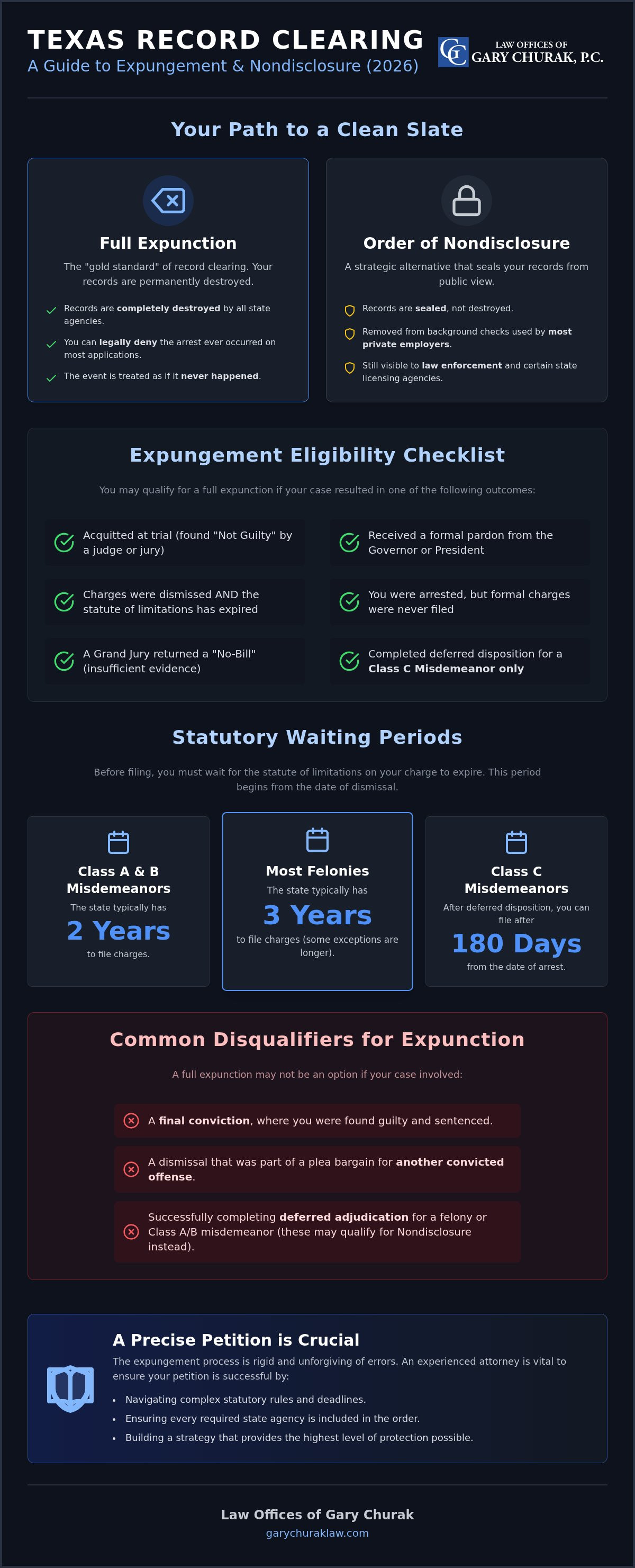
A successful expunction is the gold standard for record clearing. It results in the permanent destruction of all digital and physical records related to an arrest. This means state agencies, including the Department of Public Safety and local police departments, must purge their files. Once the court signs the order, you can legally deny that the arrest ever occurred on most job or housing applications. This level of finality is unique to Texas expungement law; it treats the event as if it never existed. If you don't qualify for this absolute erasure, an order of nondisclosure is often the strategic fallback to shield your privacy.
Identifying Which Remedy Fits Your Case
Your eligibility path is determined by the specific outcome of your case. Generally, those who were acquitted at trial or had their charges dismissed without probation are prime candidates for a full expunction. However, if you successfully completed deferred adjudication, your record typically qualifies for a nondisclosure order instead. This seals the record from public view but leaves it visible to law enforcement and certain state agencies. While it isn't a total destruction of the record, it effectively removes the arrest from the background checks used by most private employers.
Determining your expungement eligibility texas requires a meticulous review of court documents and statutory wait times. Because the petition process is rigid and unforgiving of errors, partnering with a seasoned criminal defense attorney is vital. An expert advocate ensures your petition includes every required agency and follows the specific procedural rules of the court. We analyze the nuances of your case to build a strategy that provides the highest level of protection possible for your future.
Texas Expungement Eligibility Checklist: Do You Qualify?
Meeting the criteria for a clean slate is about more than just having a case dismissed. Texas law establishes a high bar for total record destruction, requiring specific legal outcomes before a judge will sign an order. To help you understand your standing, we've developed this expungement eligibility texas checklist based on current 2026 statutes. Generally, you qualify for relief if you were acquitted of the charge at trial by a judge or jury, or if you received a formal pardon from the Governor of Texas or the President of the United States. These outcomes represent a total vindication, and the law rewards that victory with the right to a permanent erasure.
Eligibility also extends to cases where the state's window for prosecution has closed. If your charge was dismissed and the statute of limitations has expired, you're likely a candidate for expunction. This also applies if you were arrested but no formal charges were ever filed against you. The statute of limitations varies by the level of the offense; for many misdemeanors, the state has two years to file, while most felonies require three years or longer. You shouldn't have to carry the weight of an arrest record when the state has no legal path to prosecute you.
Eligibility for Dismissals and No-Bills
When a Grand Jury issues a "No-Bill," it effectively means there was insufficient evidence to move forward with a prosecution. This outcome is a powerful trigger for eligibility. However, it's vital to distinguish a straight dismissal from a "dismissal after probation." If you successfully completed a deferred adjudication for a Class A or B misdemeanor, you're likely looking at a nondisclosure order rather than a full expunction. Class C misdemeanors are the exception. Successful completion of a deferred disposition for these low-level offenses frequently opens the door for a full expunction petition, allowing you to bypass the long-term consequences of a minor mistake.
Special Circumstances: Identity Theft and Pardons
Specific hardships also create unique paths to relief. If someone else used your identity during an arrest, you shouldn't carry the burden of their criminal history. You can use an expungement eligibility checklist to see if your situation meets the strict criteria for identity theft relief. Juvenile records also provide a distinct opportunity for erasure, protecting young people from the weight of early errors as they enter the workforce. Even if you were convicted, the rare path of a post-conviction pardon can restore your expungement eligibility texas status. Because every case has a unique paper trail, a personalized case analysis is the most reliable way to confirm your next steps and protect your future.
Statutory Wait Times: When Can You File Your Petition?
Timing is the most critical element of a successful petition. Even if you meet the substantive requirements for expungement eligibility texas, filing before the law allows results in an immediate dismissal of your request. Texas law establishes specific periods during which you must wait before the court can even consider your petition. These periods are designed to give the state ample time to investigate and potentially file charges. If you jump the gun, you'll risk losing the reinstated 2026 filing fees and delaying your clean slate.
The 2026 statutory guidelines for expungement eligibility texas are rigid. For a Class C misdemeanor, you must wait 180 days from the date of your arrest. Class A and B misdemeanors require a full one-year waiting period if no charges were filed. Felonies demand the longest period of patience, requiring three years from the date of the arrest. These timelines serve as a buffer, ensuring the state has exhausted its investigative options before the records are destroyed. We don't guess when it comes to these deadlines; we verify them against the official arrest record.
These timelines generally apply when no formal charges were ever filed. However, the 'Statute of Limitations' also plays a pivotal role in your readiness. If you are filing because the statute of limitations has expired, you must wait until that legal deadline has passed for the specific offense. Understanding how Texas expungement and nondisclosure laws interact with these deadlines is essential for a clean filing. We meticulously track these dates to ensure your petition is filed at the earliest possible moment without risking a denial.
Calculating Your Specific Filing Window
Filing too early leads to an automatic denial by the court. You must distinguish between 'waiting periods' and 'statutes of limitations' to ensure your petition is ripe for review. Statutory Wait Time is the mandatory period of inaction required by Chapter 55. If you file even one day before this period expires, the state will likely object, forcing you to restart the process and pay additional filing fees. This is why we conduct a thorough audit of your arrest history before drafting any paperwork.
The Impact of Formal Charges on Your Timeline
If a charge was filed but later dismissed, the timeline changes. You typically cannot file for expunction until the statute of limitations for that offense has expired, unless the dismissal was based on a lack of probable cause or a similar legal deficiency. In some instances, a prosecutor's 'certification' that the records are no longer needed for prosecution can shorten the wait. We rely on verified court records to calculate these dates with precision. Accuracy is your best defense against procedural delays and ensures your petition moves through the system without friction.
Common Disqualifiers: Why Some Records Cannot Be Expunged
Not every legal victory leads to a total erasure of your past. While we fight for every client's right to a clean slate, certain judicial outcomes act as statutory roadblocks that even the most aggressive advocacy cannot bypass. Generally, a final conviction is an absolute bar to relief. If a judge or jury found you guilty and sentenced you to jail time or a fine, your expungement eligibility texas status is likely void for that specific offense. The law views a conviction as a permanent acknowledgment of guilt that cannot be unwritten through the expunction process.
Another significant hurdle is the 'Criminal Episode' rule. If your arrest involved multiple charges and you were convicted of even one of them, the entire event might be ineligible for expunction. The state argues that if any part of the episode resulted in a final conviction, the records of the related dismissals must also remain visible. Additionally, your conduct after an arrest matters. If you absconded or were charged with jumping bail, you've likely forfeited your right to clear that specific arrest record. These procedural missteps create a permanent paper trail that judges are often unwilling to ignore.
The Problem with 'Regular' Probation
Many individuals believe that successfully completing a term of community supervision qualifies them for a clean record. However, Texas judges view regular community supervision, also known as straight probation, as a conviction for expunction purposes. Even if you never spent a day in a cell, the court record of the guilty plea remains. It's essential to distinguish this from deferred adjudication, which offers a different legal path. If you find yourself in this position, we often shift our strategy toward a nondisclosure order instead. This doesn't destroy the record, but it effectively shields it from the public eye and most private employers.
Felony Disqualifiers and 'Crime Sprees'
Certain high-level felonies are subject to even stricter scrutiny and statutory bars. Offenses involving family violence, sex crimes requiring registration, or capital murder are almost always ineligible for any form of record clearing. During an expunction hearing, the prosecutor will scrutinize your entire criminal history. If they can demonstrate a pattern of behavior or a 'crime spree' where multiple offenses are linked, they will aggressively oppose your petition. We prepare for these challenges by conducting a comprehensive audit of your background before stepping into the courtroom. If you're unsure if a past conviction or probation term has ruined your expungement eligibility texas, contact us for a direct case evaluation to explore your viable options.
Executing Your Petition: The Strategic Role of Legal Advocacy
Executing a petition is a high-stakes maneuver that requires a steady hand and a battle-tested strategy. Your expungement eligibility texas status is the foundation, but the execution of the petition is what delivers the final result. Filing isn't merely an administrative task; it's a formal legal action that demands surgical precision. Your petition must include every state agency, law enforcement department, and central database that currently holds your arrest history. If you omit a single entity, that agency isn't bound by the court order, leaving a digital ghost of your past to haunt future background checks. We meticulously gather this data to ensure the scope of your protection is absolute.
Many people assume a dismissal guarantees a signed order, but the process is frequently adversarial. The District Attorney or the Department of Public Safety (DPS) may file a formal opposition to your request. They might challenge your expungement eligibility texas based on technicalities or misinterpreted statutes. This is where aggressive advocacy becomes your shield. We don't just file paperwork; we stand in court to dismantle the state's objections and prove you've met every legal requirement for a clean slate. Serving notice to all state agencies holding your records is a mandatory step that must be handled with care to avoid procedural delays.
Navigating the Adversarial Hearing
The burden of proof rests on the petitioner to demonstrate they satisfy the rigid criteria of Chapter 55. An experienced expungement lawyer anticipates these challenges and prepares a strategic response before the hearing begins. We scrutinize the state's evidence and leverage our deep knowledge of Texas law to protect your interests. Our goal is to secure a signed order that leaves no room for ambiguity or further legal dispute. We represent your interests at the mandatory court hearing to ensure your voice is heard and your rights are defended.
Post-Order Verification: Ensuring the Slate is Clean
The 'Compliance Gap' is a common point of failure in the expunction process. A signed court order is a powerful document, yet some state agencies are slow to update their digital databases. Simply obtaining the order isn't enough; you must ensure every agency actually destroys the records. We follow up with the relevant departments to verify compliance, ensuring your digital footprint is truly erased. This final verification is the ultimate protection before you apply for your next high-stakes job or professional license. We don't consider the job done until your record is confirmed clear across all official platforms.
Reclaim Your Future and Your Reputation
Securing a clean record is a strategic legal process that requires meticulous timing and aggressive advocacy. You've learned that expungement eligibility texas depends on the specific outcome of your case and your ability to meet rigid statutory wait times. Whether you're seeking a full expunction for a dismissed charge or a nondisclosure order to seal a past mistake, the margin for error is non-existent. A single mistake in your petition can lead to a permanent denial, leaving your professional life in jeopardy. It's not just about filing paperwork; it's about ensuring every agency complies with the court's order.
Attorney Gary Churak brings over 40 years of Texas criminal defense experience to every case he handles. He provides personalized case analysis to determine the most protective path forward for your specific situation. Don't let a past arrest dictate your professional potential. Schedule a free consultation with Gary Churak to review your eligibility today and benefit from aggressive advocacy in contested hearings. It's time to move forward with the steady hand of an expert and the confidence that your past is truly behind you.
Frequently Asked Questions
Can I expunge a DWI in Texas if it was my first offense?
Generally, a DWI conviction remains on your record permanently. However, if your DWI case was dismissed or you were acquitted at trial, you may qualify for a full expunction. First-time offenders with a BAC below 0.15 who completed their sentence might be eligible for a nondisclosure order instead of an expunction. We analyze your specific case details to determine if your expungement eligibility texas status allows for a total record erasure or a sealing order.
How long does the expungement process take in Texas in 2026?
In 2026, the expungement process typically takes three to six months to complete. This window accounts for the time required to draft the petition, serve notice to all involved state agencies, and secure a hearing date. While some administrative steps are fixed by statute, court backlogs can influence the final timeline. We track every stage of the process to ensure your petition moves through the system without unnecessary delays or procedural friction.
What is the difference between an acquittal and a dismissal for expunction?
An acquittal is a formal finding of "not guilty" by a judge or jury, while a dismissal is the termination of charges by the prosecutor or court. While both can lead to a clean slate, an acquittal often triggers immediate expungement eligibility texas, bypassing the waiting periods required for dismissals. Understanding these legal outcomes is vital for your strategy, as they dictate exactly when you can file your petition to destroy the records.
Do I need to go to court for an expungement hearing?
Your presence in court is usually not required if you are represented by an attorney. We attend the hearing on your behalf to present legal arguments and ensure the judge signs the order. However, if the District Attorney or another agency files a formal objection, the court may require a more detailed evidentiary hearing. In those specific cases, we prepare you for every step to ensure your rights are protected throughout the proceedings.
Can a denied expungement petition be appealed?
A denied petition can be appealed if the court made a legal error in its ruling. The appeal process involves taking the case to a higher court to review the application of Chapter 55 statutes. Success on appeal requires a precise identification of where the lower court failed to follow the law. We scrutinize every denial to determine if a strategic appeal can successfully overturn the decision and secure your record erasure.
Will an expunged record still show up on a federal background check?
A Texas expunction order binds state and local agencies, but it lacks the jurisdiction to compel federal agencies like the FBI to destroy their records. This means an arrest might still appear on high-level federal background checks used for national security clearances. However, for the vast majority of private employers and licensing boards, the state-level destruction of records effectively clears your history and allows you to legally deny the arrest occurred.
How much does a lawyer charge for an expungement in Texas?
Attorney fees for an expunction depend on the complexity of the arrest history and the number of agencies that must be served. While we don't offer generic price quotes, our fee structure reflects the 40 years of expertise required to navigate contested hearings. Investing in professional representation protects you from the cost of a denied petition or a procedural error that leaves your record visible to the public.
What happens if the District Attorney opposes my expunction?
When the District Attorney opposes an expunction, the process becomes a contested legal battle. The state may argue that you haven't satisfied the statutory waiting periods or that your case doesn't meet specific eligibility criteria. We counter these challenges with aggressive advocacy, presenting the legal proof required to overcome the state's objections. Our goal is to dismantle their arguments and convince the judge that you are legally entitled to a clean slate.


