

A conviction doesn't require a smoking gun or a confession to hold up in a court of law. You likely feel that the prosecution's case is built on nothing more than guesses, yet the legal reality is often much more complex. In May 2026, the Justice Department recorded 6,372 new convictions, illustrating a steady reliance on indirect proof to secure results. It's natural to feel anxious about how a jury will interpret these facts, especially when the line between a proven fact and a mere inference seems blurred.
By reviewing specific circumstantial evidence examples, you'll gain a clearer understanding of the legal weight these claims carry in modern litigation. This guide explains how indirect proof functions and, more importantly, how a strategic defense identifies the flaws in the prosecution's logic. You'll learn exactly what circumstantial evidence is through real-world examples and discover how a strategic defense challenges these indirect claims. We'll lead you through the nuances of the law to ensure you move from uncertainty toward a position of strength and clarity.
Key Takeaways
- Understand how legal inferences turn separate facts into a narrative of guilt during a criminal trial.
- Identify common circumstantial evidence examples in DWI and drug cases to better understand the specific allegations you face.
- Recognize that a conviction can rest entirely on indirect proof if the prosecution's story is the only logical conclusion remaining.
- Learn how a strategic defense challenges the prosecution by offering alternative explanations that create reasonable doubt.
- Distinguish between direct evidence that stands alone and circumstantial proof that requires a jury to make a mental leap.
What is Circumstantial Evidence? Defining the 'Inference' Proof
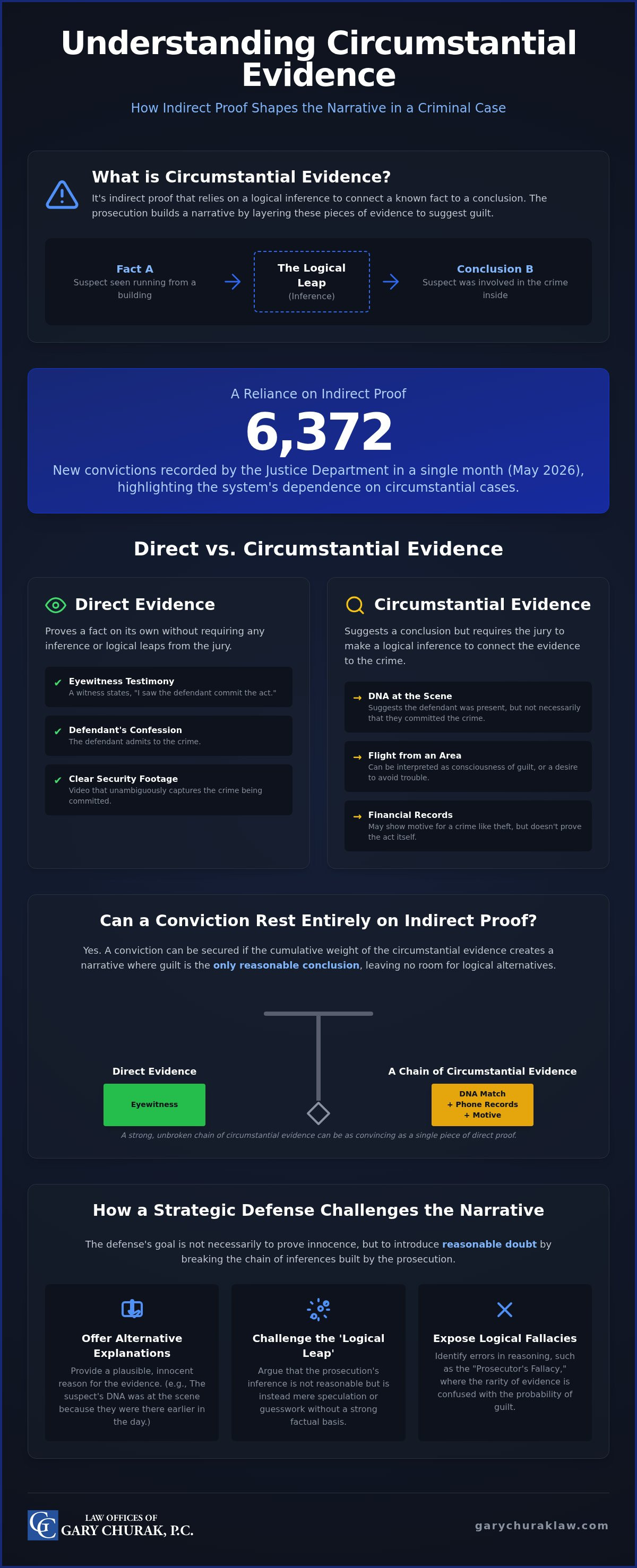
Many people mistakenly believe that "circumstantial" is synonymous with "weak" or "unreliable." In reality, Circumstantial Evidence serves as a foundational pillar of the American legal system. It is defined as indirect proof that does not directly witness or record the alleged criminal act but instead relies on a logical inference to connect a known fact to a conclusion. You are not just fighting a set of isolated facts; you are fighting a narrative the prosecution has carefully constructed to suggest guilt.
The state uses an inference mechanism to move a jury from "Fact A" to "Conclusion B." For instance, if a witness sees you running out of a building where a crime just occurred, the prosecution will argue that your flight proves your involvement. They build a story by layering various circumstantial evidence examples until they believe the picture is clear enough for a conviction. This process requires the jury to make a mental leap, and your defense must ensure that leap isn't based on a shaky foundation.
The Logic of Legal Inferences
For an inference to hold weight in court, it must be reasonable rather than speculative. Courts distinguish between a legitimate logical leap and mere guesswork. Speculation is an assumption without a factual basis; a reasonable inference is a conclusion drawn directly from established data. Circumstantial evidence is the connecting of dots between known facts and unknown actions. To secure a conviction, the prosecution must establish a logical nexus between the evidence presented and the crime alleged. If the link is too tenuous, the evidence may be challenged as insufficient to support a guilty verdict. These concepts aren't limited to criminal law; they are also fundamental in civil litigation, where you can find out more about how indirect proof is used to establish liability in personal injury cases.
Admissibility Under Modern Evidence Rules
Despite popular misconceptions, most evidence presented in a 2026 criminal trial is circumstantial. Under the Federal Rules of Evidence: Criminal Defense Guide, the primary threshold for admissibility is relevance. Evidence is considered relevant if it has any tendency to make a fact more or less probable than it would be without that evidence. This broad standard allows prosecutors to introduce a wide array of circumstantial evidence examples, from cell phone location data to financial records. Because the threshold for relevance is relatively low, your protection lies in a thorough case analysis that exposes the fragility of the prosecution's inferences. We scrutinize the state's story to find where the logic fails, ensuring that assumptions aren't mistaken for proof.
Direct vs. Circumstantial Evidence: Identifying the Critical Differences
Differentiating between direct and indirect proof is essential for understanding the strength of the case against you. Direct evidence is straightforward; it proves a fact without requiring any interpretation or logical leaps. If a witness testifies, "I saw him take the money," that's direct evidence. However, the legal definition of circumstantial evidence focuses on facts that suggest a conclusion but don't prove it outright. These circumstantial evidence examples, such as finding a suspect's DNA at a crime scene, require the jury to infer that the presence of biological material means the suspect committed the crime.
There's a persistent debate in legal circles regarding which type of evidence is more reliable. While direct evidence seems more powerful, it often relies on fallible human memory. Eyewitnesses can be mistaken, biased, or influenced by the stress of the moment. Conversely, physical circumstantial evidence, like a digital footprint or a fingerprint, doesn't forget. The danger lies in the "Prosecutor’s Fallacy," where the state assumes that the statistical rarity of a match equals the probability of guilt. They might argue that because a hair sample matches yours, you must be the perpetrator, ignoring other logical explanations for how that hair arrived at the scene.
Examples of Direct Proof in the Courtroom
Direct proof leaves very little room for interpretation because it speaks to the act itself. Common forms include eyewitness testimony where a person describes the actual commission of the crime, or high-definition security footage that captures the event clearly. Even a defendant's own confession is categorized as direct evidence. If you're facing these types of claims, you need a seasoned defense attorney to scrutinize the validity of the testimony or the legality of how the confession was obtained.
The Inference Chain in Circumstantial Proof
Every piece of indirect proof is a link in a chain, and that chain is only as strong as its weakest connection. Consider a scenario where your fingerprints are found on a safe that was recently burglarized. The prosecution presents this as a clear path to guilt, but the chain is actually composed of separate steps:
- Fact: Your fingerprints are physically present on the safe.
- Inference: You opened the safe specifically to steal its contents.
A strategic defense identifies "breaks" in this logical chain. We look for the alternative explanation that explains the evidence without leading to a conviction. Perhaps you were an employee who touched the safe during a legitimate business transaction days earlier. By providing a competing narrative, we prevent the jury from accepting the prosecution's inference as the only possible truth. We analyze these circumstantial evidence examples to ensure that mere presence isn't mistaken for criminal intent.
Common Circumstantial Evidence Examples by Case Type
Prosecutors rely on various indicators to build a case when direct proof is absent. These circumstantial evidence examples vary significantly based on the specific charges, but they all share one trait: they require a jury to draw a conclusion from an observation. In theft cases, for instance, being found in possession of stolen property shortly after a crime is a classic example of indirect proof. Whether it's a forensic fiber found at a scene or the timing of a phone call, these pieces of data are the building blocks of the state's narrative. The Circumstantial evidence presented in court must be scrutinized to ensure the jury isn't making an irrational leap.
Circumstantial Proof in DWI Cases
Police officers often testify about "clues" observed during a traffic stop. Erratic driving patterns, such as swerving or delayed braking, serve as circumstantial evidence of intoxication. Physical symptoms like red eyes, fumbling for a driver's license, or the smell of alcohol are indicators, not direct proof of a specific blood-alcohol concentration. Without a chemical blood or breath test, the state's case rests entirely on these inferences. Navigating these claims requires a Strategic Defense for DUI and DWI Charges to challenge the officer's subjective interpretations and provide alternative explanations for physical distress.
Drug Crimes and 'Intent to Distribute'
In drug cases, the prosecution often tries to upgrade a simple possession charge to "possession with intent to deliver." They do this by presenting circumstantial evidence examples like digital scales, large amounts of cash, or individual "baggies." The quantity of a substance also serves as proof of intent; the state argues no one would possess that much for personal use. We frequently challenge the "constructive possession" theory, especially in multi-person households where the state assumes everyone in the home knew about and controlled the illegal items. Simply being near a substance doesn't mean you intended to sell it.
Assault and Domestic Violence Indicators
Violent crime cases often rely on forensic evidence like hair, fibers, or blood spatter to place a suspect at a specific location. In domestic situations, 911 recordings or photographs of bruising are used as circumstantial evidence of an altercation. The timing of a suspect’s presence at a residence is another "dot" the jury is asked to connect to the injury. Understanding how these factors fit into A Comprehensive List of Crimes helps you see how the state builds its case from the ground up and where those foundations can be dismantled.
The Weight of Indirect Proof: Can You Be Convicted on 'Just' Circumstantial Evidence?
The legal reality is stark; convictions can and do happen based entirely on indirect proof. You don't need a "smoking gun" for a jury to return a guilty verdict. Many people assume that without a confession or video footage, the state's case is too weak to survive. However, the law often treats direct and indirect facts with equal weight. Judges typically instruct jurors that they may find a defendant guilty based on a chain of inferences, provided that chain leads to only one logical conclusion.
The danger often lies in "cumulative evidence." While one isolated fact might seem insignificant, the prosecution tries to stack dozens of small details to create a compelling picture. They want the jury to believe that the sheer volume of circumstantial evidence examples makes the conclusion of guilt inescapable. Our role is to show that a pile of weak inferences doesn't equal a strong case. We scrutinize every "dot" the state tries to connect to ensure they aren't leading the jury toward a false conclusion.
Overcoming the 'Reasonable Doubt' Threshold
To win a conviction using indirect proof, the prosecution's narrative must exclude every other reasonable hypothesis. If there's a plausible explanation for the facts that doesn't involve criminal activity, the jury is legally required to acquit. We focus on presenting these "alternative theories" to shatter the state's carefully built narrative. One strong alternative can bring down an entire circumstantial case. The burden of proof remains on the state to prove every element of the crime, and they cannot meet that burden if a reasonable alternative exists.
The Power of Forensics as Circumstantial Evidence
Many people are surprised to learn that DNA, fingerprints, and ballistics are actually forms of circumstantial evidence. They don't show the crime happening; they only show that a person or a weapon was present at some point. The "CSI Effect" has led many jurors to overvalue forensic data, assuming it's infallible. We challenge this by scrutinizing the chain of custody and the methods used to collect these forensic "dots." If the state cannot prove exactly who handled the evidence from the scene to the lab, the entire inference chain collapses. These circumstantial evidence examples are only as reliable as the people who processed them.
The integrity of evidence is equally paramount in personal injury cases; for instance, those in California may explore Car Accident Legal Representation to ensure that circumstantial data from a collision scene is handled with the precision necessary to prove liability.
If you're worried about how a jury will interpret the indirect facts in your case, you need an experienced criminal defense attorney to protect your rights and challenge the prosecution's assumptions.
How a Strategic Defense Attorney Challenges Circumstantial Allegations
Defeating a case built on indirect proof requires more than a simple denial. It demands a methodical dismantling of the state's narrative. A seasoned defense attorney performs an aggressive case analysis to locate the "missing dots" that the prosecution has conveniently ignored. While the state presents Fact A to demand Conclusion B, we introduce Fact C. This third fact provides a logical, non-criminal explanation for the evidence, effectively breaking the link the state worked so hard to forge. We don't just wait for the trial; we proactively seek out every flaw in the prosecution's logic.
Identifying Alternative Theories of the Crime
We prioritize creating a competing narrative that is just as plausible as the one offered by the prosecution. If circumstantial evidence examples like cell tower pings place you near a crime scene, we don't just hope the jury ignores it. We use expert witnesses to offer different interpretations of that data, perhaps showing that the tower covers a three-mile radius including your own home or place of work. Our investigation seeks out exculpatory evidence; these are indirect facts that suggest your innocence and provide the jury with a reason to doubt the state's narrow focus. By offering a different, legal reason for your actions, we prevent the jury from assuming guilt is the only option.
Dismantling the Prosecution's Inference Chain
The state’s case often relies on a series of logical leaps. We expose these jumps by highlighting where the evidence ends and where the prosecutor's imagination begins. Many police investigations are plagued by confirmation bias, where officers only collect data that supports their initial theory while discarding anything that contradicts it. We bring this bias to light, showing the jury that the story they were told was edited to ensure a conviction. We also attack the reliability of the underlying facts through several tactical methods:
- Challenging a witness's perception based on poor lighting, distance, or physical obstructions.
- Filing a Motion to Suppress to keep illegally obtained evidence out of the courtroom entirely.
- Exposing flaws in forensic collection methods that could lead to sample contamination.
- Questioning the chain of custody for any physical items presented as evidence.
Facing charges based on indirect evidence? Contact the Law Offices of Gary Churak for a thorough case analysis.
Protect Your Future Against Indirect Allegations
Navigating a criminal case where the state relies on indirect proof is a high-stakes challenge. You now understand that circumstantial evidence examples, from forensic data to physical symptoms in a DWI stop, are not insurmountable obstacles. They are simply interpretations of facts that require a jury to make a mental leap. A successful defense relies on exposing the fragility of these leaps and providing alternative, plausible narratives that support your innocence.
The prosecution's story only holds power if it remains the only logical explanation. By scrutinizing every detail and challenging the state's assumptions, we ensure that guesses are never mistaken for proof. You don't have to face these complex felony charges alone. With over 40 years of courtroom experience, the Law Offices of Gary Churak provides the aggressive advocacy and personalized case analysis you need to protect your rights.
Secure an Aggressive Defense; Schedule Your Free Consultation with Gary Churak Today. Take the first step toward reclaiming your peace of mind and building a future defined by strength, not uncertainty.
Frequently Asked Questions
Is circumstantial evidence enough to convict someone of a crime?
Yes, convictions happen frequently based entirely on indirect proof. Juries are instructed that circumstantial evidence carries the same legal weight as direct evidence if it proves guilt beyond a reasonable doubt. The prosecution must establish a chain of facts so strong that it leads to no other logical conclusion than the defendant's guilt.
What are the most common examples of circumstantial evidence?
Common circumstantial evidence examples include digital footprints like GPS data, physical traits like the smell of alcohol during a traffic stop, or possession of stolen items. Other instances include forensic fibers, financial records showing motive, or a suspect's flight from a crime scene. These facts require a jury to infer that a specific criminal action occurred.
Can DNA evidence be considered circumstantial?
DNA is technically circumstantial because it only proves a person's biological material was present at a location. It doesn't show the person actually committing the crime. A jury must infer that the DNA's presence means the individual was involved in the act. This distinction is critical when our defense team challenges the timing or reason for the DNA's transfer.
How is circumstantial evidence different from hearsay?
Circumstantial evidence consists of facts that suggest a conclusion, whereas hearsay is an out of court statement offered to prove the truth of the matter asserted. Hearsay is often inadmissible because the person who made the statement isn't available for cross examination. Indirect proof relies on logic and physical facts rather than secondhand verbal reports or rumors.
What is the 'Reasonable Hypothesis' rule in criminal trials?
This rule requires that if the evidence supports two reasonable interpretations, one pointing to guilt and the other to innocence, the jury must acquit. In many jurisdictions, the prosecution must exclude every reasonable hypothesis except for guilt. If your defense provides a plausible, non-criminal explanation for the facts, the state has failed to meet its burden of proof.
Can a lawyer get circumstantial evidence thrown out of court?
Attorneys can file a Motion to Suppress to exclude evidence obtained through illegal searches or seizures. If the police violated your Fourth Amendment rights, the court may rule the evidence inadmissible regardless of its relevance. We also challenge evidence that is overly prejudicial or lacks a proper foundation, ensuring the jury only sees legally obtained and reliable facts.
Is eyewitness testimony always better than circumstantial evidence?
Not necessarily, as eyewitness testimony is notoriously fallible and subject to bias or poor memory. While it is direct evidence, juries often find physical circumstantial evidence examples like fingerprints or ballistic logs more reliable. A strong defense exposes the flaws in a witness's perception while highlighting alternative explanations for any physical evidence presented by the state.
What happens if there is no direct evidence in my case?
The case will rely entirely on the prosecution's ability to build a narrative through inferences. Without a confession or video footage, the state must prove that the only logical explanation for the gathered facts is your guilt. This creates a significant opportunity for a defense team to introduce reasonable doubt by highlighting missing links or providing alternative theories of the crime.


