

The federal courtroom isn't just a stage for facts; it's a battleground where the federal rules of evidence determine which stories are told and which are silenced. When you're facing the full weight of the government, it's natural to feel a deep sense of anxiety that "unfair" evidence will be used to secure a conviction. You might find yourself overwhelmed by complex jargon like "hearsay" or "relevance," fearing that the truth of your situation will be buried under a mountain of government exhibits. It's a high-stakes environment where the wrong piece of information can change the course of your life.
These rules aren't just procedural hurdles; they're the primary shield a defense attorney uses to prevent the government from using unreliable or prejudicial information against you. This guide provides the clarity you need to understand the complex framework that dictates what a jury is actually allowed to see. We'll explore how a strategic advocate leverages these mandates to protect your freedom and ensure your side of the story is heard with precision. By mastering these procedures, you can move from a state of uncertainty toward a clear, confident defense strategy built on rigorous scrutiny and professional preparedness.
Key Takeaways
- Scrutinize the 11 articles of the federal rules of evidence to identify which government proofs are procedurally sound and which are legally flawed.
- Identify the legal threshold for relevance under Rule 401 and understand why even "relevant" facts can be barred from the courtroom.
- Leverage the Rule 403 balancing test to challenge evidence that prioritizes emotional prejudice over logical fact-finding.
- Protect your right to confrontation by understanding the complex exceptions to the hearsay rule that often keep unreliable statements out of trial.
- Evaluate the reliability of scientific testimony through the lens of the Daubert Standard to ensure only qualified expert opinions reach the jury.
Understanding the Federal Rules of Evidence (FRE): Scope and Purpose
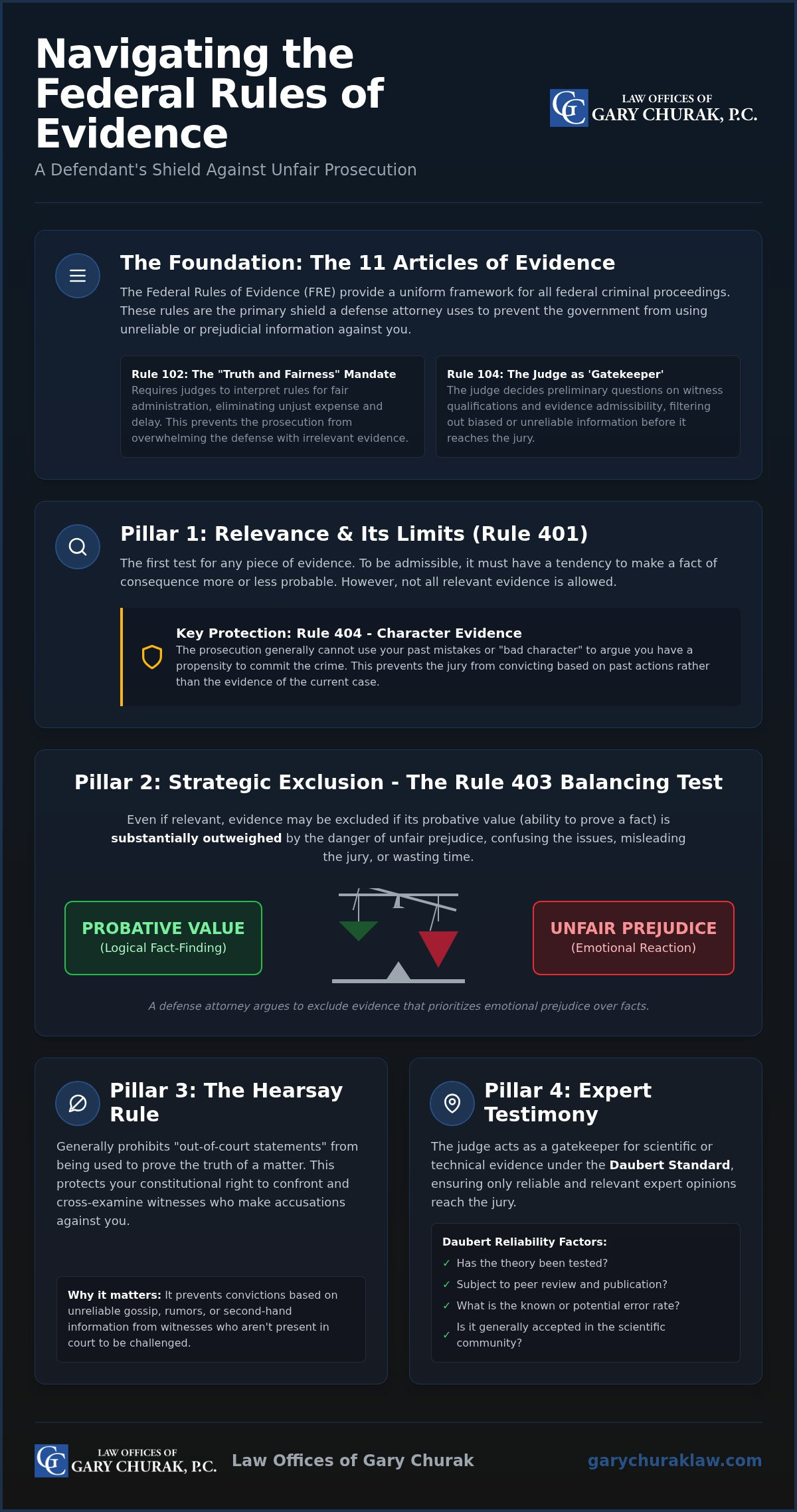
The Federal Rules of Evidence serve as the definitive framework for every criminal proceeding in the United States district courts. Established to provide a uniform standard of justice, these rules consist of 11 articles that dictate exactly how facts are presented and proven before a jury. While state courts often follow their own unique evidentiary codes, the federal system relies on these specific mandates to maintain a high standard of legal integrity. For a defendant, these rules represent the boundaries that the prosecution cannot cross without a fierce legal challenge.
Rule 102 establishes what many call the "Truth and Fairness" mandate. This rule requires judges to interpret the federal rules of evidence in a way that secures fairness in administration and eliminates unjust expense and delay. It's a critical tool for a defense team. It ensures that the government cannot use its vast resources to overwhelm you with irrelevant or needlessly cumulative evidence. By focusing on the "just determination" of every proceeding, Rule 102 provides the legal basis for challenging government overreach and ensuring the focus remains on the actual facts of your case.
The Role of the Judge as 'Gatekeeper'
Under Rule 104, the presiding judge acts as a vital filter between the prosecution's claims and the jury's ears. The judge decides preliminary questions regarding whether a witness is qualified or if specific evidence is admissible. These high-stakes decisions often occur during hearings held outside the jury’s presence to prevent them from being influenced by biased or unreliable information. A seasoned attorney like Gary Churak, who brings over 40 years of experience to federal cases, understands that winning a trial often starts with these gatekeeping battles. If the judge excludes a piece of defense evidence, your lawyer must "proffer" it, making a formal offer for the record to ensure the higher courts can see exactly what was left out.
Preserving the Record for Appeal
Your trial is the first stage of your defense, but it isn't always the last. Rule 103 requires your attorney to make timely, specific objections whenever the prosecution attempts to introduce improper evidence. If a lawyer remains silent during a violation, you typically waive your right to challenge that error in a later appeal. While the "plain error" doctrine exists to address obvious mistakes that affect your fundamental rights, the threshold for reversal is incredibly high. Protecting your freedom requires a proactive stance; every objection made today is a potential lifeline for an appeal tomorrow. Strategic defense isn't just about what happens in front of the jury, but about building a bulletproof record for the future.
The Pillars of Admissibility: Relevance and Its Limits
The core of any trial revolves around what the jury is permitted to see. Under Rule 401, evidence is relevant if it has any tendency to make a fact more or less probable than it would be without the evidence. While this sounds like a broad invitation to the prosecution, the federal rules of evidence actually impose strict boundaries through Rule 402. Even if a piece of information is technically relevant, it must still pass through a gauntlet of constitutional and statutory exceptions before it reaches the jury box. The law doesn't just ask if a fact matters; it asks if its inclusion is fair and legally sound.
One of the most powerful protections for a defendant is found in Rule 404. This rule generally prohibits the government from using your past mistakes or "bad character" to prove that you committed the crime currently in question. The law recognizes that juries are easily swayed by "propensity" arguments; the idea that because someone did something once, they must have done it again. However, Rule 404(b) allows the prosecution to introduce "other acts" for specific purposes, such as proving motive, opportunity, or intent. Because these exceptions are often used as backdoors for prejudicial information, you need a defense that subjects every government motion to intense scrutiny. If you're facing these complex challenges, seeking a federal criminal defense consultation can help you identify which parts of your history the prosecution is legally barred from using.
Proving Character: Methods and Restrictions
When character evidence is admissible, Rule 405 dictates how it can be proven. Typically, this is limited to testimony about a person’s reputation or an opinion from a witness who knows them. The "mercy rule" allows a defendant to introduce evidence of their own good character to rebut the charges. Be aware that doing so "opens the door," allowing the prosecution to cross-examine your witnesses about specific instances of your past conduct. It’s a tactical decision that requires a deep understanding of the official Federal Rules of Evidence to avoid unintended consequences.
Policy-Based Exclusions
The law also excludes certain information for public policy reasons, regardless of its relevance. Rule 410 is particularly vital in criminal defense. It protects plea discussions, ensuring that statements made during failed negotiations cannot be used against you at trial. Similarly, Rule 407 prevents the use of subsequent remedial measures to prove negligence, and Rule 411 limits the mention of liability insurance. These rules exist to encourage honest communication and safety improvements without fear of legal reprisal. Your attorney must ensure the government respects these boundaries throughout the entire litigation process.
Strategic Exclusion: Challenging Evidence Under Rule 403
While the prosecution often believes that any relevant fact should be heard by a jury, the federal rules of evidence provide a critical safeguard known as the "Balancing Test." Under Rule 403, a judge has the authority to exclude relevant evidence if its probative value is substantially outweighed by the danger of unfair prejudice, confusing the issues, misleading the jury, or wasting time. This rule serves as the ultimate filter in a federal trial. It ensures that the verdict is based on logical proof rather than emotional manipulation or procedural clutter. A seasoned defense attorney scrutinizes every piece of government evidence through this lens, seeking to protect the integrity of the proceeding.
Unfair prejudice occurs when evidence appeals to a jury’s base instincts or emotions rather than their capacity for rational thought. For example, the government might attempt to introduce graphic, inflammatory photographs or details of a defendant's unrelated past behavior that have little to do with the current charges. According to Cornell Law's overview of the FRE, the goal of this rule is to prevent the jury from making a decision on an improper basis. When the government tries to "pile on" by introducing cumulative evidence; essentially repeating the same point with multiple witnesses or documents; Rule 403 allows the defense to object to this unnecessary and prejudicial repetition.
The Motion in Limine: A Defense Attorney's Best Tool
Success in a federal courtroom often depends on the battles fought before the jury ever enters the room. A motion in limine is a strategic strike against inadmissible government evidence. By filing these motions, your defense team can proactively block the prosecution from mentioning inflammatory testimony or prior unrelated convictions during their opening statements or witness examinations. This prevents the jury from ever hearing damaging information that could unfairly color their perception of the case. Common targets for these motions include hearsay statements, unauthenticated digital records, and expert testimony that fails to meet federal standards.
Limiting Instructions: When Evidence is Partially Admissible
Sometimes, a judge may decide that evidence is admissible for one specific purpose but not for another. Rule 105 allows the defense to request a "limiting instruction," where the judge explicitly tells the jury how they may and may not use a particular piece of information. However, a strategic advocate understands that it is incredibly difficult for a jury to "un-ring the bell" once they have heard something prejudicial. We must decide whether requesting an instruction helps clarify the law or simply draws more attention to damaging facts. Every decision is made with the singular goal of protecting your record and ensuring a fair trial.
The Hearsay Rule and the Right to Confrontation
Hearsay is perhaps the most misunderstood concept in the federal courtroom. At its core, Rule 801 defines hearsay as an out-of-court statement offered to prove the truth of the matter asserted. The federal rules of evidence generally bar these statements because they're inherently unreliable. When a witness repeats what someone else said, you lose the ability to cross-examine the original speaker. This isn't just a technicality; it's a direct threat to your Sixth Amendment right to confront your accusers. Without the ability to test a speaker's memory, perception, or sincerity, the jury is left with "he said, she said" testimony that can lead to a wrongful conviction.
The law distinguishes between hearsay and statements that are legally "not hearsay." Under Rule 801(d), admissions made by an opposing party or certain prior statements by a witness who is currently testifying are admissible. Beyond these, Rule 803 outlines numerous exceptions where the circumstances of the statement suggest it is likely true. Common examples include:
- Excited Utterances: Statements made while under the stress of a startling event.
- Present Sense Impressions: Descriptions of an event made while or immediately after perceiving it.
- Business Records: Documents kept in the regular course of business, which are presumed reliable due to their routine nature.
Deconstructing these exceptions requires a battle-tested perspective. If you're concerned about unreliable testimony being used against you, contact Gary Churak for a federal crimes defense strategy that focuses on excluding improper hearsay.
The 'Unavailable' Witness and Residual Exceptions
Rule 804 addresses situations where a witness is legally "unavailable," such as through death, illness, or a valid claim of privilege. In these cases, the court may allow dying declarations or statements that were so contrary to the speaker’s interests that they're presumed honest. The most dangerous tool for the prosecution is Rule 807, the "Residual Exception." This is a catch-all provision that allows evidence not specifically covered by other rules if it has "equivalent circumstantial guarantees of trustworthiness." Defeating a Rule 807 motion requires a meticulous analysis of the statement's origins to prove it lacks the necessary reliability for a federal trial.
Witness Competency and Impeachment
While Rule 601 presumes almost every person is competent to testify, their credibility is always subject to attack. Under Rule 607, any party may impeach a witness, including the party that called them. We use various methods to undermine government witnesses, such as highlighting their bias, showing a lack of personal knowledge, or introducing prior inconsistent statements. Gary Churak brings over 40 years of experience to this process, using prior statements to show the jury when a witness is being untruthful or inconsistent. Protecting your freedom means ensuring that no government witness goes unchallenged.
Expert Testimony and the Path to a Strategic Defense
The federal rules of evidence draw a sharp line between what a regular witness can say and what a qualified expert can claim. Under Rule 701, lay witnesses are restricted to opinions based on their own direct perceptions; things they actually saw or heard. Expert testimony, governed by Rule 702, allows individuals with specialized knowledge, skill, or education to offer opinions that help the jury understand complex technical facts. In federal criminal defense, these experts often focus on forensics, digital data, or financial records. A strategic defense involves scrutinizing these witnesses to ensure their "expertise" isn't just a polished version of the prosecution's theory.
The law doesn't just trust every expert. The Daubert Standard serves as the primary gatekeeping mechanism in federal court. It requires that an expert's methodology be scientifically valid and applicable to the specific facts of the case. We look at whether the theory has been tested, peer-reviewed, and has a known error rate. If the prosecution attempts to introduce "junk science" that lacks a reliable foundation, a forceful defense must move to exclude it entirely. This thorough case analysis is what separates a standard defense from one that truly protects your freedom.
Challenging the Government's 'Junk Science'
Scrutinizing an expert's methodology is only the first step. Under Rule 703, we examine the underlying data the expert used to form their opinion. If the foundation is weak or based on inadmissible hearsay that shouldn't be disclosed to the jury, the entire testimony becomes vulnerable. We also leverage Rule 704, which prevents experts from testifying to the "ultimate issue" in a criminal case. An expert cannot tell the jury whether the defendant had the specific mental state required for the crime. That decision belongs solely to the jury, and a defense attorney must be vigilant to prevent experts from overstepping these legal boundaries.
Securing Your Defense with Gary Churak
Facing the federal government requires more than just a basic understanding of the law. It demands a battle-tested guide who has spent decades dissecting government proofs. Gary Churak brings over 40 years of experience in federal crimes defense to every case. He emphasizes aggressive advocacy and thorough case analysis to expose evidentiary weaknesses that others might overlook. In the high-stakes environment of a federal trial, you need a defender who knows when to negotiate and when to take a forceful stance against government overreach. Your future depends on a defense that is as strategic as it is unwavering.
Contact the Law Offices of Gary Churak for a free consultation today and ensure your side of the story is heard with the protection you deserve.
Take Command of Your Federal Defense
Success in a federal trial depends on more than just the facts; it requires a meticulous command of the federal rules of evidence. From blocking prejudicial information under Rule 403 to dismantling unreliable hearsay, these mandates are the primary tools used to ensure the government respects your constitutional rights. We've seen how a judge’s gatekeeping role and the rigorous standards for expert testimony can become the deciding factors in your case. You don't have to face this complex process alone or unprepared.
Gary Churak provides the steady hand and aggressive advocacy needed to navigate these high-stakes proceedings. With over 40 years of criminal defense experience, he delivers personalized case analysis and a battle-tested strategy designed to protect your future. Don't let your side of the story be silenced by procedural complexity or government overreach. Protect your rights with an aggressive federal defense; schedule your free consultation with Gary Churak. Resilience and thorough preparation are your best assets in the pursuit of justice.
Frequently Asked Questions
What are the Federal Rules of Evidence and who do they apply to?
The rules are a standardized set of 11 articles governing the admissibility of facts in federal courtrooms. These mandates apply to all parties in federal criminal trials, grand jury proceedings, and civil litigation within the United States district courts. Their purpose is to ensure fairness and prevent the introduction of unreliable or prejudicial information that could lead to an unjust verdict against the accused.
Can a judge throw out evidence that was obtained illegally?
Yes, a judge can exclude evidence obtained through constitutional violations under the "Exclusionary Rule." While the federal rules of evidence focus on admissibility based on reliability and fairness, the Fourth Amendment protects you from illegal searches and seizures. If the government violated your rights to obtain proof, your attorney files a motion to suppress, ensuring that tainted information never reaches the jury's ears.
What is the difference between direct and circumstantial evidence in federal court?
Direct evidence proves a fact without requiring an inference, such as an eyewitness account of a crime. Circumstantial evidence requires the jury to draw a logical conclusion from a set of facts, like finding a defendant's fingerprints at a specific location. Both types are legally valid in federal trials, but circumstantial cases often require more rigorous scrutiny to ensure the prosecution's logic holds up under pressure.
Why is hearsay usually not allowed in a criminal trial?
Hearsay is generally barred because it lacks the "indicia of reliability" found in live testimony. When a witness repeats an out-of-court statement, the defense cannot cross-examine the original speaker to test their memory or sincerity. This exclusion protects your Sixth Amendment right to confront your accusers. It ensures that only evidence that can be scrutinized through direct questioning is used to determine your guilt or innocence.
What is a Rule 403 objection and why is it important for my defense?
A Rule 403 objection is a request to exclude evidence because its "probative value" is substantially outweighed by the risk of unfair prejudice. This is a vital shield for your defense. It prevents the prosecution from using inflammatory photos or confusing details that might distract the jury from the actual facts. It forces the court to prioritize rational logic over emotional reactions that could unfairly influence the outcome.
How do the Federal Rules of Evidence differ from state rules?
While many states model their evidentiary codes after the federal system, the federal rules of evidence are strictly uniform across all 94 U.S. district courts. State rules can vary significantly on specific issues like hearsay exceptions, expert witness standards, or the admissibility of prior bad acts. Federal cases typically involve more complex procedural requirements, making it essential to have a defender who is specifically experienced in the federal judiciary's unique environment.
Can my past criminal record be used against me under the FRE?
Generally, the government cannot use your past criminal record to prove you have a "propensity" to commit crimes. However, Rule 404(b) allows the prosecution to introduce prior acts for specific purposes, such as proving motive or intent. Additionally, if you testify, your record might be used for impeachment under Rule 609. A strategic attorney works to block these disclosures to ensure the jury focuses only on the current charges.
What happens if my lawyer fails to object to inadmissible evidence?
If your lawyer fails to make a timely objection, you generally waive your right to challenge that evidence on appeal. The trial record is permanent. Once improper information is admitted without a protest, higher courts will usually only review it for "plain error," which is an incredibly high legal standard to meet. Effective defense requires a proactive, alert presence in the courtroom to preserve every possible avenue for your future protection.


