

A single mistake or a momentary lapse in judgment can rewrite the rest of your life in an instant. When confronted with a felony charge in Texas, you aren't just looking for a legal definition. You're confronting a direct threat to your freedom, your right to bear arms, and your ability to vote. The Texas justice system is notoriously aggressive, and the confusion surrounding different felony degrees only adds to the weight of the situation.
It's natural to feel a sense of dread when facing the possibility of years in a state facility or a permanent criminal record. You deserve a clear path forward that replaces fear with a strategic plan. The Law Offices of Gary Churak are dedicated to providing that clarity and support. This guide provides a comprehensive look at the five felony degrees, ranging from state jail offenses to capital crimes, and the specific penalties associated with each. We'll explore the long-term consequences of a conviction and provide a framework for building a defense strategy that protects your future. By understanding the trial process and the potential for sentencing enhancements, you can move from a state of uncertainty toward a position of strength and preparedness.
Key Takeaways
- Learn exactly what is a felony charge in texas and how the "one-year rule" distinguishes these serious offenses from misdemeanors.
- Identify the sentencing ranges for all five felony degrees, from state jail facility terms to the life-altering stakes of capital offenses.
- Understand the permanent collateral consequences of a conviction, including the loss of your right to own firearms and restrictions on voting.
- Gain a methodical overview of the legal process, starting with the critical Grand Jury phase and the determination of probable cause.
- Discover how early intervention and aggressive case analysis can identify constitutional violations to protect your future.
Defining the Felony: How Texas Distinguishes Serious Offenses
Texas law doesn't treat all crimes with the same brush. When you ask what is a felony charge in texas, you're looking at the most severe classification of criminal conduct recognized by the state. A felony is a crime punishable by death or confinement in a state prison or state jail facility. This distinction matters because it dictates where you serve time and how your case moves through the court system.
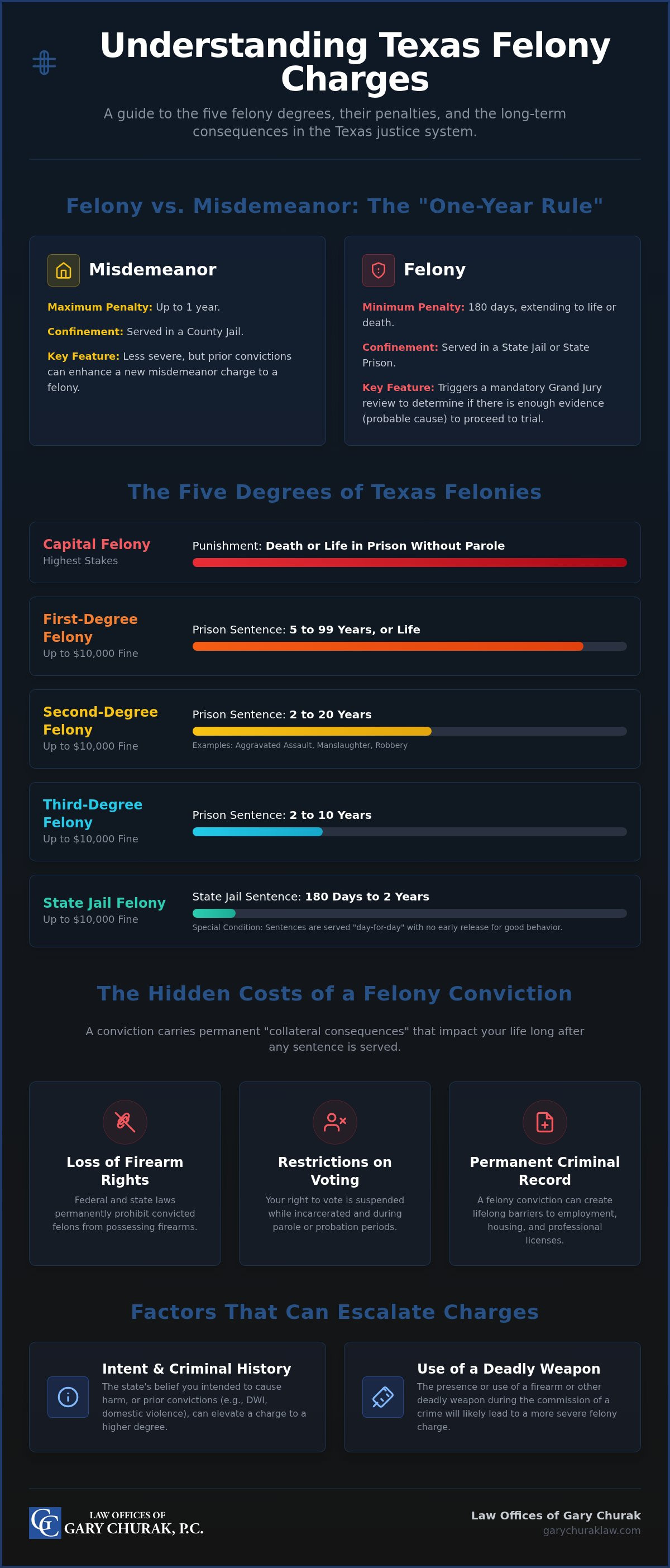
The "One-Year Rule" serves as the primary dividing line between minor and major offenses. Misdemeanors generally carry a maximum of one year in a county jail. Felonies, however, involve sentences starting at 180 days and extending to life in prison. Beyond the length of time, a felony arrest triggers a mandatory Grand Jury review. The state must present evidence to a group of citizens to secure an indictment before they can proceed. This process is supposed to protect you from baseless charges; however, without early intervention, the Grand Jury often hears only the prosecutor's side. The immediate impact of an arrest is a heavy blow to your reputation and civil liberties, often involving restrictive bond conditions that limit your movement and associations.
Misdemeanors vs. Felonies in the Texas System
Distinguishing between a Class A misdemeanor and a state jail felony can feel like splitting hairs, but the legal consequences are vastly different. While a Class A misdemeanor can result in up to a year in county jail, the lowest level felony starts at 180 days in a state jail facility. Certain misdemeanors don't stay minor forever. If you have a prior history of convictions, such as multiple DWI offenses or domestic violence incidents, the state can "enhance" a new charge. This means a crime that would normally be a misdemeanor is legally elevated to a felony due to your criminal record.
The Role of the Texas Penal Code
The Texas Legislature uses the Penal Code to categorize every criminal act based on its perceived harm to society. Felony classifications in Texas generally fall into two categories: crimes against persons and crimes against property. Crimes against persons, such as assault or robbery, often carry harsher penalties because they involve physical harm to a victim.
The specific degree of a charge often hinges on two factors: intent and the presence of a deadly weapon. If the state believes you intended to cause serious bodily injury or used a firearm during the commission of a crime, they will likely escalate the charge to a higher degree. Understanding what is a felony charge in texas requires recognizing how these small details can transform a manageable legal issue into a high-stakes battle for your freedom.
The Five Degrees of Texas Felonies and Their Penalties
Texas uses a tiered system to determine the severity of a crime and its corresponding punishment. When evaluating what is a felony charge in texas, you must look at the five distinct degrees defined by the state. Each level carries a specific sentencing bracket that judges and juries must follow during the punishment phase of a trial. Understanding these tiers helps you grasp the true gravity of the situation you're facing.
Sentencing Ranges and Potential Fines
The Texas Penal Code establishes clear boundaries for incarceration. Capital felonies represent the highest stakes, punishable by the death penalty or life in prison without the possibility of parole. First-degree felonies follow closely, with a range of 5 to 99 years or life. Second-degree offenses carry 2 to 20 years, while third-degree felonies are punishable by 2 to 10 years. In almost every case, the court can also impose a fine of up to $10,000.
State jail felonies are a unique Texas category designed for non-violent crimes, carrying a sentence of 180 days to two years. It's vital to understand that "state jail" isn't the same as prison. In the Texas prison system, inmates may be eligible for parole or "good time" credits. State jail sentences are typically served "day-for-day," meaning there's no early release for good behavior. This nuance makes even the lowest level felony a significant threat to your freedom, as you'll likely serve every single day of the sentence handed down by the judge.
Common Examples of Felony Charges
The specific degree of your charge depends on the nature of the act and any aggravating factors. For instance, manslaughter and aggravated assault are typically second-degree felonies, but they can be elevated under certain conditions. Robbery is also a second-degree offense unless a deadly weapon is used, which bumps it to the first degree. If you've been arrested for a crime involving controlled substances, a drug possession lawyer can analyze the specifics of your case to determine if the state has overcharged you based on the weight or type of substance involved.
Repetitive behavior also triggers higher degrees. While a first or second DWI is usually a misdemeanor, a third offense is automatically charged as a third-degree felony. This escalation highlights why what is a felony charge in texas depends so heavily on your prior record. If you're facing these high-stakes allegations, securing professional representation early is the most effective way to challenge the prosecution's narrative and fight for a reduction or dismissal.
Collateral Consequences: The Hidden Costs of a Felony Conviction
Prison sentences are only the beginning of the legal fallout. When people ask what is a felony charge in texas, they often overlook the penalties that occur outside the courtroom. A conviction initiates a series of civil penalties that remain long after the case ends. These collateral consequences strip you of fundamental rights that most citizens take for granted, creating a barrier between you and a normal life.
You lose your right to vote until your sentence, including any parole or probation, is fully discharged. You're barred from serving on a jury or holding public office. Perhaps most significantly, both state and federal laws impose strict bans on firearm possession. Under the Texas Penal Code, possessing a firearm as a felon, even in your own home five years after release, can lead to new, high-stakes charges. Federal law is even more restrictive, often creating a lifetime ban that state-level permissions cannot override. Understanding the full scope of what is a felony charge in texas means recognizing that the punishment rarely stops at the prison gates.
Impact on Professional and Personal Life
A conviction jeopardizes your livelihood and professional standing. If you hold a Commercial Driver's License (CDL) or a nursing license, a felony often triggers an automatic suspension or permanent revocation. Professional boards view felony conduct as a fundamental breach of ethics, making it nearly impossible to maintain your career or find new employment in licensed fields. Beyond the professional impact, the financial burden of court-mandated fees and high fines adds a layer of long-term economic stress. Socially, the stigma often isolates you from your community and places an immense, recurring strain on family relationships that can take years to mend.
The Permanency of a Felony Record
Your record doesn't just disappear with time. Current technology allows companies to archive criminal data indefinitely, making it difficult to "hide" a past mistake. Finding a place to live becomes a significant challenge because most landlords use background checks that flag any felony record instantly. This "Scarlet Letter" effect makes it difficult to secure stable housing, even for non-violent offenses. However, legal pathways exist to mitigate this damage. Learning how to get a record expunged in texas is a vital step for anyone seeking a clean slate. While not every charge is eligible, exploring these options is the only way to move past the shadow of a conviction and reclaim your future.
Navigating the Legal Process: From Indictment to Verdict
The path from an arrest to a final verdict is often long and complex. Understanding what is a felony charge in texas involves more than just knowing the potential prison time; you must also understand the rigorous procedural steps the state must follow. Unlike misdemeanors, where a prosecutor can file charges directly, a felony requires a formal indictment by a Grand Jury. This procedural hurdle is designed to ensure the state has a baseline of evidence before upending your life with a serious prosecution.
The Power of the Grand Jury
The Grand Jury acts as a check on the prosecutor's power to charge individuals with serious crimes. This group of citizens reviews the evidence presented by the District Attorney to decide if probable cause exists. If they find sufficient evidence, they issue a "True Bill," and the case proceeds toward trial. If the evidence is weak or the prosecution's narrative is flawed, they may issue a "No Bill," which effectively dismisses the charge. Early defense intervention is critical during this phase. A proactive attorney can sometimes present evidence to the Grand Jury that contradicts the state's version of events, potentially stopping the case before an indictment is even handed down.
Plea Bargaining vs. Trial Advocacy
Once an indictment is secured, the case moves into the discovery phase. This is where your defense team scrutinizes every piece of evidence, from police body camera footage to witness statements and lab results. We look for constitutional violations that could lead to pre-trial motions to suppress evidence. If the state obtained evidence through an illegal search, a successful motion can often gut the prosecution's case entirely. Many individuals find that what is a felony charge in texas can be negotiated down to a lesser offense if the defense identifies significant evidentiary gaps.
Most felony cases are resolved through negotiation rather than a jury trial. A seasoned attorney focuses on leveraging these weaknesses to reduce a felony to a misdemeanor or secure a deferred adjudication. However, if the state refuses to be reasonable, trial advocacy becomes the only viable path. Taking a case to a jury involves high stakes, but it's often the only way to fight for a total exoneration. Understanding how a criminal defense attorney protects your future is essential when making these life-altering decisions. If you're currently facing the weight of a felony investigation, contact Gary Churak today to ensure your rights are protected from the very beginning.
Protecting Your Future: The Necessity of Experienced Advocacy
Facing a felony allegation is a high-stakes crisis that demands more than a standard legal defense. When you grasp what is a felony charge in texas, you recognize that the prosecution is already moving to dismantle your freedom. Passive representation often leads to predictable, harsh outcomes. Aggressive advocacy is the only viable response to these charges, ensuring that every piece of evidence is scrutinized and every constitutional right is fiercely defended.
Thorough case analysis is the foundation of a successful defense. It's not enough to simply show up in court; we must identify constitutional violations that the state would rather ignore. This includes challenging illegal searches, improper seizures, or violations of your right to remain silent. Over 40 years of legal experience translates directly into the ability to spot these weaknesses in complex litigation. Taking control of your situation starts the moment you're charged. You must remain silent and secure a battle-tested guide who understands how to navigate the Texas Penal Code with precision.
Challenging the Prosecution's Narrative
Prosecutors work to build a story that leads to a conviction, but that story is often full of holes. We focus on identifying inconsistencies in police reports and witness statements that can turn the tide of a case. By using expert witnesses to challenge forensic evidence or digital data, we provide a technical counter-weight to the state's assertions. The goal is always to establish reasonable doubt. If a jury or a judge cannot be certain of your guilt, they can't convict you. This methodical dismantling of the state's case is what separates a standard defense from a results-oriented strategy.
Securing a Clean Slate with Gary Churak
The Law Offices of Gary Churak focus on more than just the immediate legal battle; we prioritize protecting your long-term reputation and future. We don't believe in one-size-fits-all legal advice. Instead, we provide personalized, battle-tested defense strategies tailored to the unique facts of your situation. Whether you're dealing with a violent crime allegation or a high-stakes drug charge, our commitment to your advocacy is unwavering. You don't have to face the state's power alone. Contact the Law Offices of Gary Churak for a Free Confidential Consultation to begin building your defense today.
Reclaim Control of Your Legal Defense
A felony allegation in Texas is a life-altering event, but it doesn't have to be a life-defining one. By understanding what is a felony charge in texas and the specific degrees of penalties you face, you've already taken the first step toward a strategic defense. From the initial Grand Jury indictment to the final verdict, every stage of the process offers an opportunity to challenge the state's evidence and protect your civil rights. You've seen how the collateral consequences of a conviction can linger for decades, impacting everything from your career to your right to bear arms.
This is why aggressive advocacy isn't just an option; it's a necessity. Gary Churak brings over 40 years of criminal defense experience to every case, providing the battle-tested guidance required for high-stakes litigation in both state and federal jurisdictions. We focus on thorough case analysis to identify the constitutional violations that can turn the tide in your favor. Protect Your Future: Schedule Your Free Consultation with Gary Churak. You don't have to navigate this complex system alone. With a seasoned expert at your side, you can face the future with confidence and strength.
Frequently Asked Questions
What is the difference between a state jail felony and a third-degree felony?
A state jail felony carries a sentence of 180 days to two years in a state jail facility, while a third-degree felony is punishable by two to ten years in prison. Crucially, state jail sentences are typically served day-for-day without the possibility of parole. In contrast, third-degree felony offenders may be eligible for early release. Both levels of what is a felony charge in texas can carry a fine of up to $10,000.
Can a felony charge in Texas be reduced to a misdemeanor?
Yes, the prosecution can reduce a felony to a misdemeanor during the plea bargaining process. This often happens when a defense attorney identifies weaknesses in the evidence or constitutional violations. In some cases, a prosecutor may agree to punish a state jail felony as a Class A misdemeanor under the Texas Penal Code. This strategy protects your long-term record while significantly reducing the potential incarceration time and associated penalties.
How long does a felony stay on your criminal record in Texas?
A felony conviction remains on your criminal record permanently in Texas unless you secure an expunction or an order of non-disclosure. Expunctions are generally reserved for cases that resulted in an acquittal or a dismissal without probation. If you were convicted or completed deferred adjudication, you may only be eligible to seal the record. Because records are digital, they will appear on background checks indefinitely without specific legal intervention.
What happens at a felony arraignment?
During a felony arraignment, the judge formally reads the charges against you and explains your constitutional rights. You'll be asked to enter an initial plea, which is almost always "not guilty" at this early stage. The court also addresses bond conditions and sets dates for future hearings. This is a procedural step that ensures you understand what is a felony charge in texas and the specific allegations the state is making.
Do all felony charges in Texas go to a Grand Jury?
Every felony charge requires a Grand Jury review under the Texas Constitution unless you voluntarily waive that right. The prosecutor must present evidence to a panel of citizens who decide if there is enough probable cause to issue an indictment. If the Grand Jury issues a "No Bill," the charges are dismissed. If they issue a "True Bill," the case moves forward. This process acts as a vital check on government power.
Can I lose my right to vote if I am charged with a felony but not convicted?
No, you don't lose your right to vote simply by being charged with a felony. In Texas, your civil rights are only restricted after a final conviction and the completion of your entire sentence, including parole or probation. If you're currently out on bond or awaiting trial, you remain eligible to vote. Protecting your record through aggressive advocacy is the only way to ensure these rights are never permanently taken away.
What are the sentencing guidelines for a first-time felony offender?
Texas uses statutory sentencing ranges rather than a strict points-based guideline system. For a first-time offender, the judge or jury considers the specific degree of the felony, which dictates the minimum and maximum possible prison time. Many first-time offenders are eligible for community supervision or deferred adjudication. These programs allow you to avoid a final conviction and prison time if you successfully complete the court's requirements and follow all conditions.
How much does a felony defense attorney cost in Texas?
The cost of a felony defense depends on the complexity of the case and the severity of the charges. Factors such as the amount of evidence to review, the need for expert witnesses, and whether the case goes to trial all influence the total fee. Most experienced attorneys use a flat-fee or retainer structure based on the specific degree of the felony. You should view this as an investment in protecting your future and freedom.


