

An “expunged” record doesn’t always disappear completely, and a “sealed” record may still be visible in some circumstances. That’s why sealing vs expunging a criminal record is not simply a choice between two labels. The terms and their effects vary under the law governing the record, which can affect what employers, licensing agencies, or others may see.
If you’re concerned that a past case could affect an application or background check, the uncertainty is understandable. The right remedy depends on more than its name. The case outcome, offense, time since the case ended, and the jurisdiction’s current rules may all matter.
This article explains what sealing and expungement generally change, who may still be able to access a record, and why eligibility differs. It also outlines what to gather before seeking legal guidance. Reviewing the case outcome and applicable law can clarify potential options without assuming every record will be erased or every disclosure prevented.
Key Takeaways
- Sealing and expungement can affect access to a record in different ways, but their legal meanings vary by jurisdiction.
- Restricted public access doesn’t necessarily mean courts, government agencies, or background-check databases can’t retain or show information.
- Case outcome, offense category, prior history, case status, and time elapsed may all affect eligibility.
- When weighing sealing vs expunging a criminal record, focus on the practical effect you need and the law that governs your case.
- Gather case documents, disposition details, and any prior record-clearing orders for a focused legal review.
Sealing vs. Expunging a Criminal Record: What Each Term Usually Means
A case can end without every trace disappearing from public view. If information still appears in a search or application process, “sealed” and “expunged” may sound like clear answers, but neither term has one universal meaning. The law governing the record determines what each remedy does and who may still access the information.
Generally, sealing limits access to a record, while expungement may involve removing or destroying eligible records. These are starting points, not guarantees. The same label can have different legal effects in different jurisdictions, and the result may depend on the order and the specific records it covers.
What does sealing a criminal record generally mean?
Sealing generally restricts access to a record under conditions set by applicable law. It may reduce public visibility, but it doesn’t necessarily destroy the record or prevent every agency or authority from accessing it. The jurisdiction and the terms of the sealing order determine its effect.
A record may therefore be less accessible to the public while still being retained by a court or another government entity. An order may also cover only particular records or parts of a case, rather than every document connected to it. Don’t assume that a sealed record is invisible in every setting.
What does expunging a criminal record generally mean?
Expungement is a legal remedy that may remove or clear eligible criminal records under the law that applies to the case. In some jurisdictions, the term can refer to records being destroyed; in others, it may describe a different process or degree of restricted access. The label alone doesn’t establish exactly what will happen.
For a broader overview of the expungement of criminal record, including how the concept varies across jurisdictions, readers can consult Wikipedia. That general reference can explain terminology, but it can’t determine how a particular court order works or whether an individual case qualifies. Those questions depend on current governing law and the records at issue.
Rather than choosing based on which term sounds more complete, identify the case and find out what the relevant law means by sealing or expungement, which records the remedy covers, and what access restrictions apply. A dismissal, acquittal, conviction, or other case outcome may be treated differently under the rules governing the record.
That is the key to sealing vs expunging a criminal record: the terms often describe different approaches to access or removal, but their legal effects aren’t consistent nationwide. A precise answer requires reviewing the applicable law and the case’s formal disposition, rather than relying on a general definition.
Does Sealing Hide a Record? Understand Access and What May Remain
A sealed record isn’t necessarily inaccessible to everyone. Sealing may limit public access, but its effect depends on the jurisdiction, the order, and the circumstances in which someone seeks the information. Assuming “sealed” means “erased from every system” can create false confidence, especially when an application or background check asks about a past case.
Who might still access a sealed record?
Access rules vary. Depending on the law and circumstances, a court, government agency, or authorized screening process may be treated differently from a member of the public. The controlling law and order determine whether access is allowed, restricted, or unavailable for a particular purpose.
This distinction can matter during a licensing review, official inquiry, or other formal process. Don’t assume every employer or licensing body can see a sealed record, or that none can. The answer may depend on the requesting party, the purpose of the request, and the exact records covered.
Disclosure questions also require care. An application may ask whether you have been arrested, charged, or convicted, and those terms aren’t interchangeable. Whether a sealed matter must be disclosed can depend on the wording of the question and the law governing the record. Read the question closely and seek case-specific legal guidance before deciding how to answer.
Can an old record remain in a background-check database?
It can. A court record and a commercial background-check database are separate information sources. A legal order may address records held by a court or other entities identified by law, while a private database may retain information collected earlier or fail to reflect a later change promptly. This possibility doesn’t establish what any particular database contains.
If a report shows information you believe should no longer appear, save a copy of the report and the relevant court order or case documents. Note the report’s date and source, identify the information that seems inaccurate, and review the correction or dispute process that applies. Keep copies of anything you submit and any response. A court record and a private report may require separate steps to correct.
When assessing sealing vs expunging a criminal record, separate three questions: what the order changes, who may access the official record under current law, and what a private database displays. Reviewing the case and applicable rules can help distinguish these issues. For a case-specific assessment of record-sealing options, gather the order and any background-check report that raises concerns.
Eligibility for Sealing or Expungement Depends on the Case and the Law
A case’s outcome is a starting point, not a complete eligibility decision. The rules may treat an arrest with no filed charge differently from a dismissed charge, an acquittal, a conviction, or a deferred outcome. Even similar results can lead to different options under different laws, so a general checklist can’t confirm whether a particular record qualifies.
Eligibility may also depend on the offense category, the case’s current status, prior cases, and how much time has passed since a relevant event. The law may define which dates count and which records must be considered. For example, remembering that a case was “dismissed” may not capture the precise disposition entered by the court. The details matter.
How can the case outcome affect eligibility?
A dismissal or acquittal may open different routes than a conviction, but neither outcome automatically qualifies a record for clearing. A deferred outcome can have its own legal meaning, and its effect may depend on how the case concluded and what conditions applied. The formal disposition, rather than a broad description of what happened, is essential to assessing available remedies.
Other factors can affect the analysis. A rule may distinguish among offense types, consider related cases, or require time to pass. These are possible criteria, not a nationwide standard. The key is how the current law governing the record treats its exact outcome and history.
Which case details should someone gather?
Before seeking a case-specific review, assemble the records you have. Official documents help counsel compare the case outcome with the requirements that apply, rather than relying on memory or assumptions. Gather:
- The final disposition for each relevant charge, including any dismissal, acquittal, conviction, or deferred outcome.
- The offense information shown in court records, such as the charge and its classification, if recorded.
- Available court documents, orders, and records showing how the case ended.
- Relevant dates, including the arrest, filing, disposition, and completion of any sentence or court-ordered conditions.
- Information about prior related cases or record-clearing orders, if relevant to the governing eligibility rules.
If documents are missing or appear inconsistent, note what you have and what remains uncertain. Don’t assume a shorthand entry in a background report reflects the full court disposition. Reviewing the official case record and applicable law can help identify whether sealing, expungement, or another remedy may be available.
The phrase sealing vs expunging a criminal record describes a general comparison, not an eligibility answer. For a procedural overview, see this step-by-step expungement guide. Its rules should not be assumed to apply to records governed by another jurisdiction’s law.
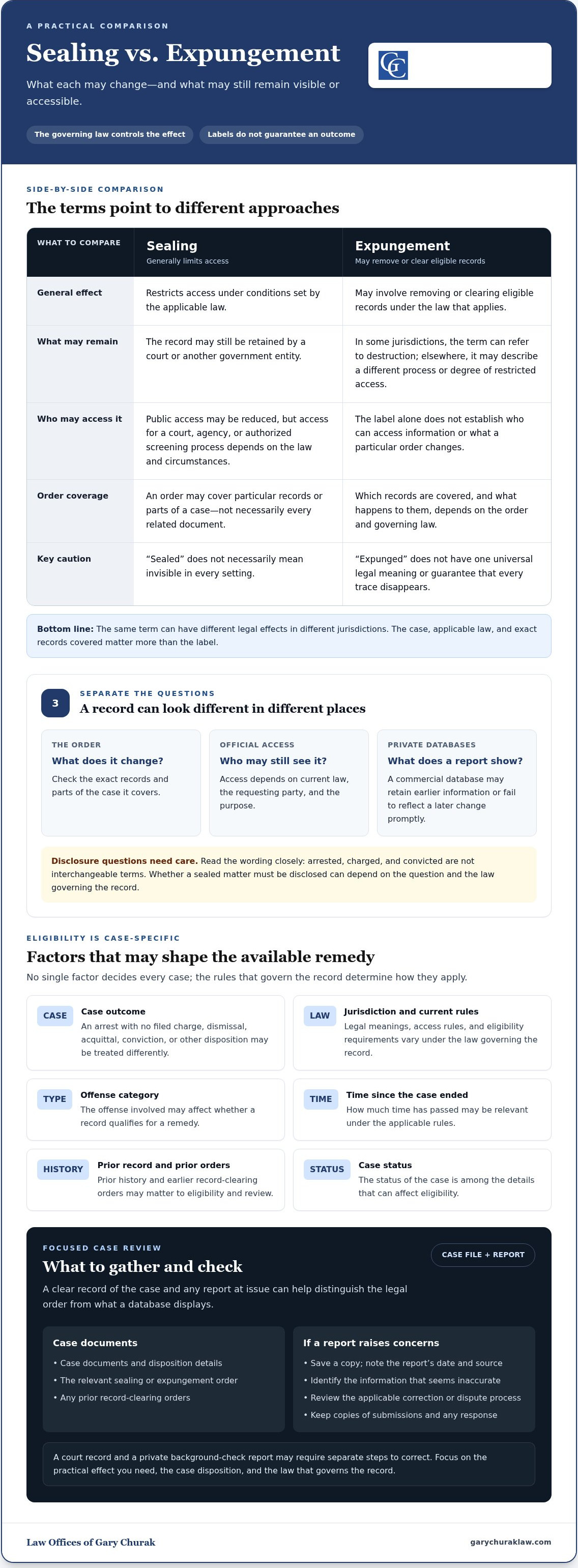
Compare Sealing and Expungement by Your Goal, Not Just the Label
A useful comparison starts with the result you need, not with which term sounds stronger. You may want to know whether a case could appear in a public search, whether an official agency can access it, or how to respond to a particular application question. These are separate issues, and a remedy’s name alone can’t answer all of them.
The table below is a general framework for comparing the concepts. Each row describes a possibility, not a universal legal result.
| General concept | Sealing | Expungement | Important uncertainty |
|---|---|---|---|
| General purpose | May restrict access to specified records. | May remove or clear eligible records under applicable law. | The jurisdiction defines what each term means and which records may qualify. |
| Possible access limits | May reduce public visibility without ending all access. | May provide a different form or degree of record clearing. | The law and order determine who may access records and for what purpose. |
| Records and systems affected | May address records identified by law or in the order. | May apply to eligible records as defined by the governing process. | A court order’s reach may not match every government record or private database entry. |
| Disclosure questions | May affect whether a record must be disclosed in some contexts. | May affect disclosure differently, depending on applicable rules. | The exact wording of the question and governing law matter. |
Which practical questions should guide the comparison?
Start by naming your goal, then identify the records and rules relevant to it. Ask which records the order addresses, which entities it binds, and whether it changes public visibility, government access, or private database reporting. If an application is the concern, note its exact wording and who will review your answer. These details help focus a case-specific legal review.
Why is the record's legal terminology not enough?
Similar labels can carry different consequences under different laws. A general explanation can help you understand the concepts, but it isn’t a legal conclusion about your case. The order’s exact language and scope, as well as its relationship to current law, all matter. Don’t rely on a label without reviewing the document that applies to your record.
The governing law and the exact order determine a remedy’s practical effect, not the label alone. This is the central point in sealing vs expunging a criminal record: compare what each option changes for your goal, then assess the actual order and applicable rules. For a case-specific review, request a review of your record-clearing options.
Prepare for a Case-Specific Review of Sealing vs. Expungement
A focused legal review starts with the record itself. Gather the documents you have, identify what you’re unsure about, and describe the problem you want to solve. You don’t need to know which remedy applies before you begin. Bringing the facts together allows counsel to evaluate the governing law and potential options.
What should you bring to a legal review?
Collect documents connected to the case, even if you’re unsure which ones matter. A timeline and copies of court orders can help clarify what happened and when. If you can’t locate a document, note its name or the court that handled the case instead of filling gaps from memory.
- Case identifiers: Case numbers and charging documents, if available.
- Outcome records: The final disposition for each charge and documents showing how the case concluded.
- Related orders: Court orders involving the case or any previous attempt to seal or clear a record.
- Relevant dates: Dates tied to the case outcome and completion of any sentence or court-ordered conditions.
- Your practical concern: The application, background-check result, or other situation that prompted you to seek a review.
Write down your questions, too. Ask which records an order could address, whether the law may limit access or disclosure, which eligibility factors need review, and what procedural steps could apply. Specific questions keep the discussion grounded in your circumstances instead of assumptions about record-clearing terms.
How can legal counsel assess the available remedy?
Counsel can compare the official case history with the current law governing the record. This includes examining charges, dispositions, related cases, and relevant orders, then assessing which options may fit and what each could change. A general explanation of sealing vs expunging a criminal record can orient you, but it can’t replace case-specific analysis.
Attorney Gary Churak has more than four decades of experience and emphasizes thorough case analysis and personalized consultations. Reviewing the case history and relevant orders can help clarify the issues that may affect the analysis. For context on counsel’s broader role in criminal matters, see this explanation of a criminal defense attorney’s role.
You can start with the records you have, even if your file isn’t complete. Discuss your record-clearing options with Gary Churak to review the case history, applicable law, and potential paths forward.
Take the Next Step With a Clear Plan
You don’t have to resolve every question about your record before asking for guidance. Identify what you hope to change and collect the documents you have. A focused review can turn uncertainty into a practical plan based on the facts of your case and the law that applies.
The question of sealing vs expunging a criminal record is about how a remedy may affect your circumstances, not which term sounds more complete. A careful assessment can clarify potential options and the limits that may matter to your goals. The Law Offices of Gary Churak assists with expungement and record-sealing matters through personalized consultations and thorough case analysis, drawing on Attorney Gary Churak’s more than four decades of legal experience.
Discuss your record-clearing options with Gary Churak to review your case and understand potential next steps.
Frequently Asked Questions
Is sealing a criminal record the same as expungement?
No, not necessarily. Sealing generally limits access, while expungement may clear or remove eligible records, but the terms can mean different things under different laws. An order labeled “expungement” may have a different effect in one jurisdiction than an order using the same term elsewhere. When comparing sealing vs expunging a criminal record, review the specific law and order governing your case.
Can a sealed or expunged record still appear in an online search?
Yes, it may. Search results can include copies or references from websites that don’t update in step with court records. A result appearing online doesn’t, by itself, establish the record’s official legal status. Likewise, a court order doesn’t necessarily remove every online copy. Save the result, note where and when you found it, and seek guidance on the correction process that applies to that source and order.
Does expungement remove a record from private background-check companies?
Not automatically in every situation. A private screening company may hold outdated or incomplete information, and the remedy’s scope depends on the governing law and order. Keep a copy of the order and any report that still displays the case. A case-specific review can help determine whether the order addresses the information shown and what steps may be available to correct the report.
Can a federal criminal record be sealed or expunged?
Federal records follow distinct rules, and a state procedure doesn’t automatically apply to a federal case. Federal law has no general remedy for sealing or expunging federal convictions, though a 2026 statute authorizes conviction expungement for survivors of human trafficking. Other federal record situations may involve different rules. Have the court, agency, and case documents reviewed under the law that governs them before relying on a remedy.
Is expungement the same as a pardon?
No. A pardon and a record-clearing remedy are distinct legal actions, and they can serve different purposes. A pardon doesn’t necessarily seal or remove a record, while the effect of expungement depends on the applicable law and order. If both terms arise in your situation, identify the specific action taken and the records involved. Reviewing the governing rules can clarify what each action may mean for your case.
Can you apply for sealing or expungement before a waiting period ends?
There’s no single nationwide waiting period. Timing can depend on the jurisdiction, the case outcome, and the remedy sought. Filing before the required time has passed may affect a request, so don’t calculate eligibility from the arrest or case-ending date alone. Gather the final disposition and records showing completion of court-ordered conditions, then confirm which dates and timing rules apply to your case.
What happens if a background check shows a record after a court order?
Compare the report with the court order and final disposition before drawing conclusions. The report may be outdated, or the order may cover only certain records. Keep copies of both documents, note the reporting company and date, and identify the specific entry that concerns you. The appropriate correction process depends on the information source, the order’s scope, and the rules that apply.


