

Could sealing a juvenile record ease the path to a job or education without making the past disappear? That’s the key distinction behind the benefits of sealing a juvenile record: sealing may reduce public access to a record, but it doesn’t necessarily erase it or prevent every employer, school, or agency from seeing it. The rules depend on the jurisdiction and the type of record.
It’s understandable to worry that a youthful mistake could follow someone into adulthood. To assess what sealing may change, start by distinguishing the records involved and the people or organizations that may access them. This article explains potential privacy benefits and the limits to consider. Sealing doesn’t guarantee employment, admission, housing, or any other outcome.
You’ll learn who may still have access, how sealing differs from expungement, and why eligibility and process vary by location. The right next step depends on the specific record and applicable law. The Law Offices of Gary Churak provides juvenile defense and record-sealing representation, with thorough case analysis and personalized consultations to assess an individual case.
Key Takeaways
- Sealing may limit public access to a juvenile record, but it doesn’t necessarily destroy every copy.
- The benefits of sealing a juvenile record may include less public exposure as a young person pursues adult milestones, but no outcome is guaranteed.
- Courts, law enforcement, licensing bodies, or others may retain access depending on the applicable jurisdiction’s rules.
- Gather the court, case outcome, relevant dates, and records involved to support a focused assessment of potential options.
- Careful legal analysis can clarify realistic next steps based on the specific record and governing law.
What Are the Benefits of Sealing a Juvenile Record?
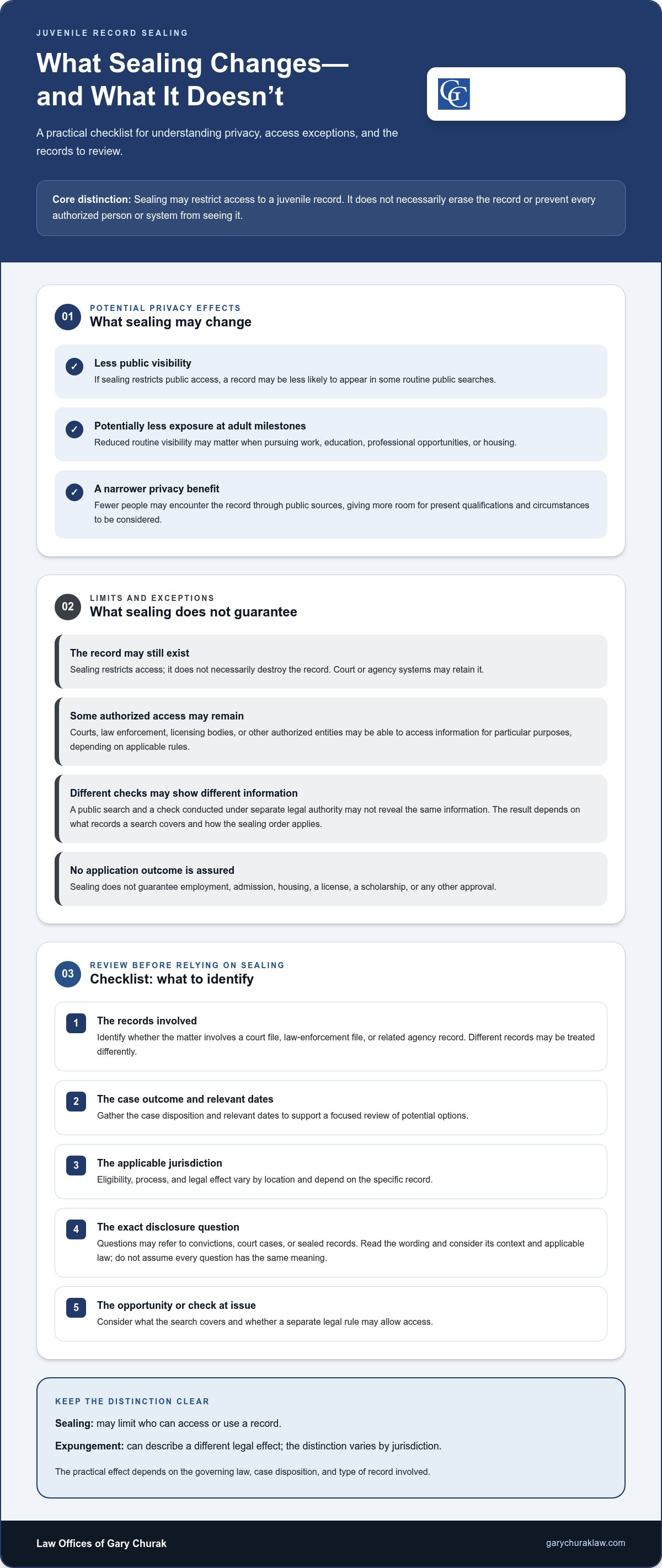
Sealing can reduce who is allowed to see or use a juvenile record, but it doesn’t necessarily destroy the record or make it unavailable in every setting. The legal effect depends on the jurisdiction, the case disposition, and the type of record involved. A court file, law-enforcement file, and related agency record may be treated differently.
The potential benefits of sealing a juvenile record center on privacy and reduced public visibility. If sealing limits access through ordinary public searches, a record may be less likely to shape how others view a young person applying for work, education, or housing. That can matter when moving into adulthood. But sealing doesn’t guarantee an application will be approved, prevent every background check from finding information, or provide a complete clean slate.
For a general explanation of the concept and how it differs from expungement, see Understanding Record Sealing. The practical effect depends on the rules that apply to the specific record.
How can sealing affect future applications?
Some background checks rely on information available to the public. If sealing restricts public access to a particular record, that reduced visibility may matter when an employer, school, or housing provider conducts a routine search. The effect depends on what records the search covers and how the sealing order applies.
Other checks may follow separate legal rules. Certain agencies, licensing processes, or proceedings may be permitted to access information that the general public cannot. Application questions also differ, and disclosure duties depend on the wording, context, and applicable law. Don’t treat sealing as a promise that every employer, school, or landlord will be unable to discover a record.
Does sealing mean the juvenile record disappears?
Sealing restricts access to a record; it does not necessarily erase the record. A record may remain in court or agency systems even when access is limited. Under applicable law, courts, law enforcement, or other authorized entities may retain access for particular purposes. That is why sealing and expungement should not be used interchangeably: the terms can describe different legal effects, and the precise distinction varies by jurisdiction.
Before relying on a sealed record’s effect, identify which records are involved and what the relevant law says about access. A court file and a separate law-enforcement record, for example, may be treated differently. Reviewing the case disposition and record types can clarify what privacy protections sealing may provide and what exceptions could remain. That gives families a more realistic basis for deciding whether to pursue relief.
How Sealing a Juvenile Record May Improve Future Opportunities
A juvenile record can be a concern at adult milestones, from applying for a first job to pursuing further education, professional opportunities, or housing. When sealing limits routine public visibility, it may reduce the chance that a record appears in some searches or becomes an immediate focus. That may give a person more room to be considered for their present qualifications and circumstances.
These are potential privacy benefits, not changes to the underlying case. The State Laws on Juvenile Record Sealing overview describes how approaches vary and why juvenile records can affect education, employment, and housing. Whether sealing changes what a particular decision-maker can see depends on the governing rules and the records involved.
Can sealing help with employment and education?
Sealing may limit exposure in some routine background-check processes, but application questions and screening rules differ by jurisdiction, employer, school, and opportunity. A public search and a check conducted under separate legal authority may not reveal the same information. Sealing therefore can’t guarantee a job, admission, license, scholarship, or other approval.
Read each disclosure question closely. It may ask about convictions, court cases, or sealed records, and those terms can have different legal meanings. Don’t assume that a sealed record should always be disclosed or that it never needs to be disclosed. The right response depends on the exact wording and applicable law.
How might sealing support privacy and a fresh start?
Reduced routine visibility may mean fewer people encounter a record while reviewing public sources. That can lessen the risk of a youthful case defining someone before they have a chance to explain their growth, experience, and current goals. For the person and their family, knowing that access may be restricted can also bring emotional relief.
Still, sealing doesn’t undo the events behind a case, erase every record, or automatically restore every right. Its value is narrower: it may change who can access information and in what circumstances. Sealing may improve privacy, but it does not guarantee a particular decision.
Understanding that distinction helps set realistic expectations. A careful review can consider the case outcome, the opportunity at stake, and the rules that govern any disclosure or background check. A consultation with juvenile record-sealing counsel can help clarify what privacy protections may apply and what limits remain.
What Sealing Does Not Do: Limits and Access Exceptions
Sealing can limit access, but it doesn’t make a juvenile record invisible to every person or system. The benefits of sealing a juvenile record depend on what the governing law restricts, which records are covered, and why someone is seeking access. A sealed court file, for example, may be treated differently from a separate law-enforcement or licensing record. Don’t assume that one sealing order changes every record connected to a case.
Use this comparison as a starting point, not a statement of universal rules:
| Access or effect | What to understand |
|---|---|
| Public access | Sealing may limit access through public records or routine searches, depending on the order and applicable law. |
| Restricted access | A court or authorized agency may retain access for purposes allowed by the jurisdiction’s rules. |
| Unresolved legal effects | Disclosure duties, licensing reviews, and treatment of separate records may require a specific legal analysis. |
Who may still access a sealed juvenile record?
Some jurisdictions allow particular courts or agencies to access sealed information in defined circumstances. Which entities may see it, and for what purpose, depends on the law governing that record. A rule in one jurisdiction cannot establish who has access elsewhere. Before relying on sealing for a specific application or proceeding, determine which records the order covers and whether a relevant access exception applies.
This distinction matters when a background check, licensing review, or later court matter is involved. The answer may turn on the type of inquiry, the case outcome, and the specific statute or court order. Avoid treating “sealed” as shorthand for “unavailable to all government agencies.”
How is sealing different from expungement?
Sealing and expungement are distinct remedies in many jurisdictions, but their meanings and effects aren’t uniform. Sealing generally restricts access; expungement may provide for destruction or removal of records under applicable law. Neither label alone tells you exactly what happens to every file or what a person must disclose. The controlling statute and order matter.
For a separate discussion of expungement procedures, see the firm’s guide to getting a record expunged and pursuing a clean slate. Its procedural guidance addresses a particular legal framework and shouldn’t be treated as a rule for juvenile records in every jurisdiction.
The practical limit is clear: sealing may reduce access, but it doesn’t necessarily erase the underlying case, bind every agency, or settle every future disclosure question. A careful review should identify the jurisdiction, the disposition, the records covered, and the purpose of any later inquiry. Those details determine what the order may protect and which questions remain.
How to Assess Whether Juvenile Record Sealing Could Help
Start with the records, not assumptions about what sealing usually does. The benefits of sealing a juvenile record depend on the case history and the law that governs it. A focused assessment can clarify which records may be involved, what outcome the case produced, and whether sealing could address a specific concern, such as a future background check.
Use this as an information-gathering framework, not a universal filing guide:
- Identify the court. Note where the juvenile case was handled and gather paperwork that identifies the court.
- Confirm the case outcome. Locate disposition records and note the outcome and relevant dates.
- List related records. Include available court documents and information about any separate law-enforcement records tied to the matter.
- Flag later or pending matters. Note any subsequent cases or unresolved proceedings for a complete review.
What information helps assess a sealing option?
Collect what’s available, even if the file is incomplete. Case paperwork, disposition details, and the court’s name give a reviewer a starting point. Record dates carefully, since timing may matter under the governing rules. Keep copies organized and distinguish juvenile court documents from separate agency records. Don’t post names, birth dates, case numbers, or document images publicly when seeking general information online.
Related records deserve attention. A court file and a law-enforcement record may be maintained separately, so reviewing one doesn’t necessarily explain the status of the other. Identifying what exists helps avoid treating the case as a single file with one uniform result.
Why does jurisdiction-specific legal review matter?
Eligibility, waiting periods, required filings, and the effect of an order can vary by jurisdiction and case details. The law governing the juvenile case is the relevant starting point, not a process described for a different jurisdiction. Attorney Gary Churak’s thorough case analysis considers the record and applicable law, and the firm represents people facing juvenile matters.
With those details assembled, a lawyer can assess whether sealing may be available, what records an order could address, and what limitations may remain. A personalized consultation can help turn scattered paperwork into a clearer picture of realistic options.
For broader context on expungement and sealing, the firm’s guide to getting a record expunged and pursuing a clean slate discusses a particular legal framework and shouldn’t be treated as a guide to every jurisdiction. For a case-specific review of juvenile records, request a personalized legal consultation with the Law Offices of Gary Churak.
Plan a Clear Next Step With Juvenile Record-Sealing Counsel
Sealing may offer meaningful privacy protections, but it doesn’t guarantee that a record will be erased or that every future decision-maker will be unable to access it. A careful legal review can replace guesswork with a clearer assessment of what relief may apply to the specific case. That review should account for the case outcome, the records involved, the governing law, and the person’s practical concerns.
What can a legal consultation clarify?
A consultation can help identify which records exist, whether they relate to a juvenile court case or another agency, and which legal process may fit the circumstances. Counsel can assess potential benefits alongside exceptions and limitations, so a family understands what a sealing order may change before making decisions about filing. The goal is a realistic picture of options, not a promise of a particular result.
Clear guidance also helps turn legal terms into practical expectations. A person concerned about a particular application, for example, can explain the situation and learn what questions the relevant law may raise. The Law Offices of Gary Churak emphasizes thorough case analysis and personalized consultations. Attorney Gary Churak brings over four decades of experience to juvenile defense and record-sealing matters.
How can a young person or family prepare?
Preparation makes the discussion more focused. Bring available case paperwork and note the court, disposition, and key dates. Then write down the concern driving the inquiry, such as privacy or a future employment or education application. Broader questions about defense and protecting future opportunities are discussed in How a Criminal Defense Attorney Protects Your Future and Your Freedom.
A short checklist can help organize the conversation:
- Collect court papers and any documents that identify related records.
- Write a simple timeline of the case and any later or pending matters.
- Describe the specific concern and any application or decision that prompted the review.
- List what remains unclear, including which records an order could address and what limitations may apply.
Keep sensitive details private when gathering general information online. Share case documents through an appropriate, secure process rather than posting identifying information publicly. If paperwork is missing, explain what you have and what you’re still trying to locate. An initial discussion can still help identify what information would be useful for a fuller assessment.
The benefits of sealing a juvenile record are best understood in light of the particular case, not as a universal guarantee. A consultation can help a young person or family weigh realistic options and understand next steps in plain language. If you’re ready to discuss the circumstances, schedule a personalized consultation about juvenile record sealing.
Move Forward With a Clearer Plan
A past juvenile case shouldn’t have to define every future decision. The benefits of sealing a juvenile record are most useful when considered in light of a real concern, such as an upcoming application or uncertainty about what may be disclosed. Pinpointing that concern can help make the next conversation practical and focused.
You don’t need to have every answer before seeking guidance. Start by identifying what feels most pressing, then discuss how the case and applicable law relate to that concern. Attorney Gary Churak brings over four decades of experience, with thorough case analysis and personalized consultations focused on understanding each situation. No review can promise a particular outcome, but informed guidance can help replace uncertainty with a clearer sense of available options.
Discuss your juvenile record concerns with the Law Offices of Gary Churak. A measured next step can help you approach the future with greater clarity and confidence.
Frequently Asked Questions
What are the main benefits of sealing a juvenile record?
The main potential benefit is reduced public exposure, which may help keep an old juvenile case from becoming an unnecessary focus in some routine searches. That privacy can support a young person as they build a record of education, work, and personal growth. The benefits of sealing a juvenile record depend on the governing law and what records are covered, and they don’t guarantee that an employer, school, or other decision-maker will reach a particular outcome.
Can sealing a juvenile record help with employment or college applications?
It may reduce the chance that a record appears in some public-facing searches, but it can’t guarantee a job offer or college admission. For example, a routine search and a check conducted under separate legal rules may not access the same information. Read application questions carefully, especially if they ask about court involvement or sealed records. If the wording is unclear, get legal guidance before deciding how to answer.
Does sealing a juvenile record mean it is completely erased?
No. Sealing generally limits access under applicable law; it doesn’t necessarily delete every copy or remove information from every system. Separate agencies may maintain separate records, so the status of one file may not establish the status of another. To understand what remains, identify the court record and any related agency records, then review how the relevant order and law apply to each.
Who can still see a sealed juvenile record?
Access may remain available to courts, law-enforcement agencies, or other authorized entities in circumstances permitted by the law that governs the record. The rules can depend on both the jurisdiction and the reason for the inquiry. Don’t rely on a list of exceptions from another jurisdiction as a guide to your case. A legal review can clarify which access rules apply to the specific record and situation.
Is a sealed juvenile record visible on a background check?
It depends on the records searched, the source of the information, and the rules governing that particular check. A search of public court information may differ from an inquiry that can access restricted records. If a sealed case appears in a report, keep a copy of the report and the relevant sealing paperwork. Those documents can help a lawyer assess what information appeared and whether further steps may be appropriate.
Can a juvenile record be sealed automatically?
Yes, some jurisdictions provide automatic sealing for certain records, while others require a person to take action. Automatic processes may apply only to specified case types or under particular conditions. Don’t assume a record was sealed just because time has passed or a case appears to qualify. Confirm the law that applies and, where possible, verify the record’s current status with the relevant court or agency.
How do I find out whether a juvenile record is eligible for sealing?
Eligibility depends on the jurisdiction and details such as the case outcome, record type, and relevant dates. Gather available court documents, identify where the case was handled, and note any later or pending matters. Then have the applicable law reviewed before relying on a general online checklist. A focused assessment can distinguish which records may qualify from related records that may require separate consideration.
Is a sealed juvenile record the same as expungement?
No, the terms can refer to different legal remedies, though their precise meanings vary among jurisdictions and statutes. Sealing often restricts access, while expungement may involve different treatment of the record. The label alone doesn’t establish what happens to every copy or what disclosure rules apply. Review the specific law and court order, rather than assuming that a remedy called “expungement” has the same effect everywhere.


