

Could the record holding you back be eligible for a remedy, even if you’re unsure how the case ended? An expungement lawyer can review the exact arrest, charge, or conviction and the law that applies, rather than relying on a broad promise that every record can be cleared. The distinction matters: eligibility and available options vary by jurisdiction and by case outcome.
If you’re worried a record could affect future opportunities, it’s reasonable to want a clear answer before taking action. This article explains what a lawyer can assess, how expungement differs from sealing and other record remedies, and what information to gather for a meaningful review.
You’ll also learn what to expect from the assessment process, including how the underlying case and its final disposition can shape the next steps. A careful, case-specific review can help you understand your options without assuming that the same rules apply everywhere.
Key Takeaways
- An expungement lawyer can assess the records, case outcome, and governing law to identify potential record-clearing options, but can’t guarantee eligibility or a particular result.
- Expungement, sealing or nondisclosure, and a pardon can have different effects; legal terms and access rules depend on the applicable law.
- A dismissal, acquittal, completed sentence, or older record doesn’t automatically mean relief is available. Eligibility may depend on several details of your history and case.
- Gather court and case records, including the final disposition, to support a more informed eligibility review and clarify possible next steps.
- Learn what to expect from a review through potential filings and order confirmation, and how Gary Churak’s thorough case analysis and personalized consultations support record-specific guidance.
What an expungement lawyer can, and cannot, do for your record
A past arrest or court case can raise difficult questions about employment, housing, education, or how others see you. It’s understandable to want a clear answer about what appears on a record and whether anything can be done. An expungement lawyer can examine the case and applicable law, explain potential remedies, and assess what steps may be required. That review is specific to your record, not a promise that relief is available.
An expungement is a legal remedy granted under applicable law, not an automatic deletion that occurs when a case ends. The terms “expungement,” “expunction,” “sealing,” and “nondisclosure” can describe different processes or effects depending on the jurisdiction. The Expungement in the United States overview illustrates how approaches differ, but the governing law for your case determines what an order can do.
An attorney can’t guarantee eligibility, court approval, or complete erasure of every record. Even when a court grants relief, the order’s effect may depend on the law and the records it covers. A careful assessment helps separate what may be possible from what cannot responsibly be promised.
Why a record may remain visible after a case ends
A case outcome and a later order affecting record access are separate events. Arrest, charging, court, and disposition information may be maintained by different systems or agencies, so resolving a case doesn’t necessarily change every record associated with it. For example, a dismissed charge may have a final court disposition while a separate arrest record still exists. That doesn’t mean every employer or background check will see the same information; access depends on the records involved and applicable rules.
What an expungement lawyer reviews
To assess options, counsel examines the case disposition, record identifiers, and jurisdiction whose law governs the record. Details such as a charge amended during the case or a disposition recorded differently across documents can affect the analysis. The lawyer can identify potential remedies and procedural requirements, then explain what needs clarification before action. This individualized review is more reliable than assuming that a familiar case outcome automatically qualifies.
Gather any paperwork you already have, such as court documents, case numbers, or records showing how the matter ended. If details are missing, note the court or agency involved and any names or identifying information used at the time. These materials can help counsel distinguish one record from another and assess whether the available information is complete.
Thorough case analysis matters because a remedy must fit both the record and the law that applies. A lawyer can help you understand the limits of an order as well as its potential benefits, so you can make an informed decision before filing or relying on a record-clearing outcome.
Expungement, record sealing, and other remedies are not interchangeable
People often use “expungement” as a broad term for clearing a record, but the legal remedy available may work differently from what that word suggests. Some processes remove or destroy certain records; others restrict public access while leaving records in existence. A pardon is a separate form of relief. The governing law determines the meaning and effect of each term, so rules from one state shouldn’t be assumed to apply elsewhere.
Don’t treat expungement, sealing, and a pardon as synonyms: they can involve different decision-makers, processes, and consequences. This distinction matters because changing who can access a record is not the same as changing the outcome of the underlying case. A case disposition describes how the matter ended; a later remedy may affect how specified records are maintained or disclosed.
| Remedy | General purpose | Important limit |
|---|---|---|
| Expungement or expunction | May remove, destroy, or otherwise change the treatment of covered records. | The term and legal effect vary; don’t assume every record is erased or inaccessible. |
| Nondisclosure or sealing | May limit access to covered records or restrict their public visibility. | Records may still exist, and access rules for government or other entities depend on governing law. |
| Pardon | May provide a form of clemency for an offense under the authority that grants it. | A pardon isn’t automatically a court order sealing or erasing the record. |
How expungement and sealing may differ
An expungement or expunction may be described as removing or destroying records, while sealing or nondisclosure may focus on limiting access. Those are general descriptions, not universal definitions. The law may treat court files, arrest records, and other records differently, and may set distinct rules for public, government, licensing, or law-enforcement access. A useful overview of expungement and record-sealing procedures can provide context, but it can’t replace analysis of the law governing your case.
Why a pardon is a separate question
A pardon is generally a form of clemency, not simply another name for a court record remedy. Its availability, process, and effect depend on the authority and law involved. It may not seal or erase court records. If your goal is to limit access to a record, address the consequences of a conviction, or pursue both, an expungement lawyer can assess which legal questions apply rather than treating one remedy as a substitute for another.
Before acting, identify the outcome you’re seeking and the records or consequences causing concern. A personalized review can help clarify which remedy may fit and what it can realistically accomplish. You can discuss record-clearing options with the Law Offices of Gary Churak through a personalized consultation.
How an expungement lawyer evaluates eligibility and the record
A dismissed case, acquittal, old arrest, or completed sentence may seem like a clear reason for relief. None guarantees that a record qualifies. Eligibility depends on the exact case record and the law governing that record. An expungement lawyer considers how the case ended, the offense involved, any applicable waiting period, later cases, and local procedures before identifying possible options.
These details can change the analysis. A charge may have been amended, several cases may be connected, or records may show different identifying information. Even when a legal remedy appears possible, the law may require additional steps or limit which records an order affects. The goal of an initial review is to establish the facts first, then assess options without relying on a broad rule of thumb.
Records and details to gather for an initial review
Bring what you have, even if the file feels incomplete. Accurate names, dates, and case information help distinguish your records from other matters with similar identifiers. The following items can support an initial assessment, though not every item will be necessary in every case:
- Case numbers, court paperwork, and any documents showing how each case ended.
- Arrest details, including the approximate date, arresting agency, and charges you recall.
- Final disposition documents, such as paperwork reflecting dismissal, acquittal, or another outcome.
- Information about later arrests or charges, even if they involved a separate matter.
- Records of court conditions or other requirements and whether you completed them, if relevant.
If you can’t locate a document, note where the case was handled and what you remember. Don’t guess at dates or outcomes. Mark uncertain details clearly so they can be distinguished from information supported by paperwork.
Questions the legal review should resolve
Once the case details are organized, counsel can compare them with the law that governs the records. A sound review identifies what is known, what remains uncertain, and which questions must be answered before discussing likely options. It should address more than a simple “yes” or “no” eligibility label.
- Which remedy, if any, may apply to the case outcome and offense?
- Could other records, agencies, or court orders affect the analysis or the practical reach of relief?
- Are key facts or documents missing, and how could those gaps change the assessment?
Location matters because legal procedures and terminology are not uniform across different jurisdictions. A comprehensive guide for one specific state or region discusses that particular legal process; it should not be treated as a general eligibility test for records governed by another jurisdiction’s laws.
A careful review turns a confusing file into a clearer set of questions and next steps. Law Offices of Gary Churak emphasizes thorough case analysis and personalized consultation, helping ensure that the assessment begins with your actual records rather than assumptions about what a particular outcome automatically means.
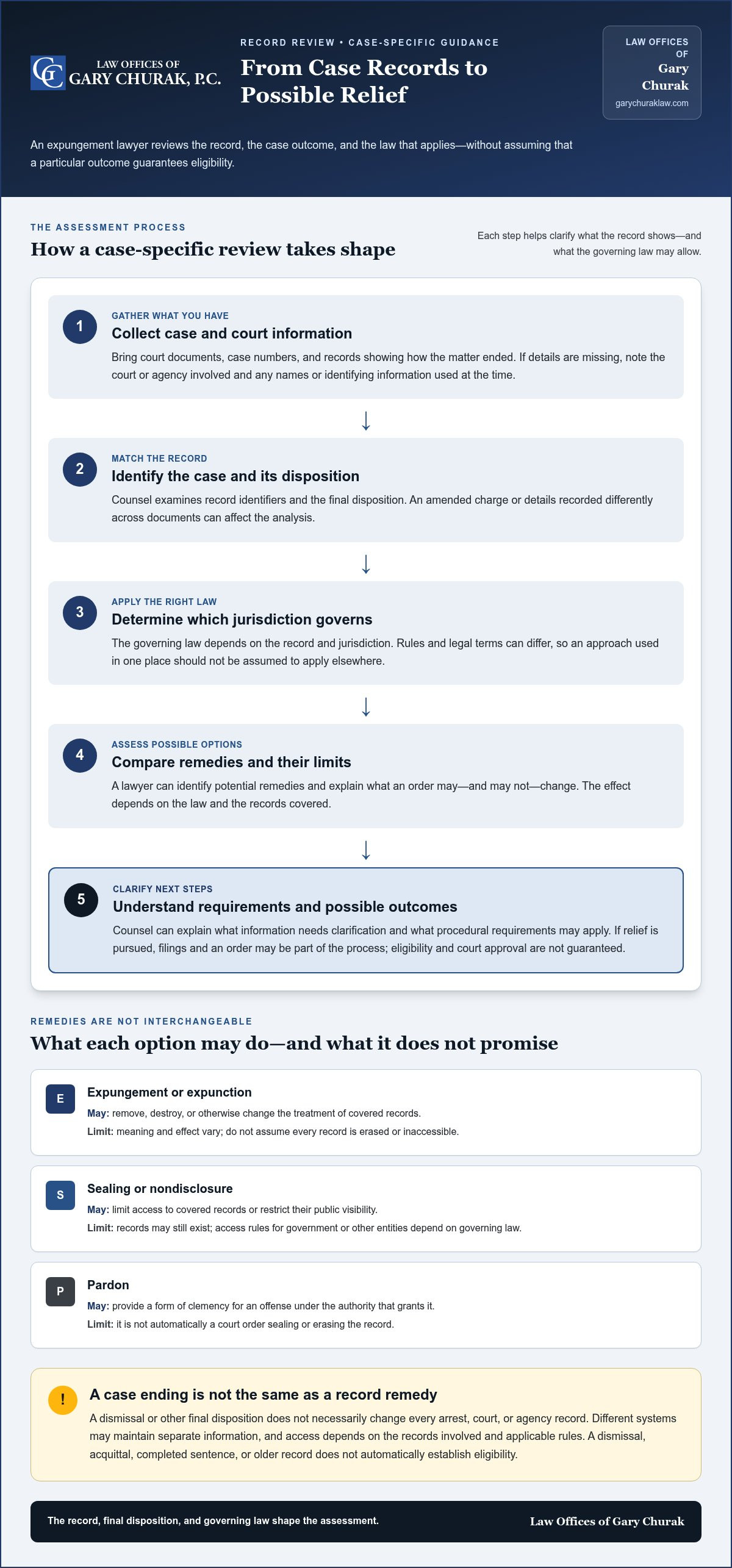
What happens during an expungement case, from review to court order
An expungement case moves through a series of checks, filings, and decisions, but no single sequence applies everywhere. The court or agency involved, required notices, review process, and timing depend on the law governing the record. Missing documents, conflicting record details, or an objection may also change what happens next. An expungement lawyer can help you understand the path based on your case, without promising a particular outcome or timeline.
- Gather records. Collect available case paperwork and identify the courts, agencies, and records connected to the matter. Gaps or inconsistent details can require further clarification before a request is prepared.
- Assess possible remedies. Counsel compares the case disposition and records with potentially applicable law, then identifies the relief that may fit and any questions that remain.
- Prepare the filing. A petition or application should identify the records accurately and state the relief being requested. The documents and filing process depend on the jurisdiction and type of remedy.
- Address review. A court or relevant agency may review the request. Depending on the process, it may ask for additional information, require notice to another party, or schedule a hearing.
- Confirm the order. If relief is granted, review the final order to understand which records it covers and what effect it has. Don’t assume every related record or system is included.
From case assessment to filing
Before filing, counsel matches the disposition and available records to the legal requirements that may apply. Accuracy is essential: a filing that identifies the wrong case or omits a relevant record can create confusion or require correction. The requested relief should also be clear. Requirements differ, so this stage shouldn’t be treated as a standard form-and-wait process or a guarantee that a court will grant the request.
Use the time before a consultation to organize key documents and write down what you want to understand about the process. This criminal defense consultation preparation guidance can help you arrange your questions and paperwork for a focused discussion.
After a petition or application is submitted
Submission starts a review; it doesn’t establish that relief has been approved. The reviewing court or agency may need clarification, and some matters may involve additional review or a hearing. A record discrepancy, missing document, or objection can affect the steps required. The exact process and timing depend on governing law, so avoid relying on someone else’s case as a schedule for your own.
Read any final order carefully. Confirm the records and relief it names, and make sure you understand its stated effect before assuming that a record has been removed or access restricted. For a case-specific assessment of possible filings and next steps, discuss your expungement matter with the Law Offices of Gary Churak.
Working with Gary Churak on an expungement or record-sealing matter
After reviewing the general process, the next step is applying it to your own case. The Law Offices of Gary Churak handles expungement and record-sealing matters, with an emphasis on thorough case analysis and personalized consultation. A focused review can help distinguish what the documents establish from what still needs to be clarified.
An expungement lawyer’s role isn’t to promise that a record qualifies or that a court will grant relief. The value is in assessing the facts and applicable law, explaining potential options, and identifying uncertainties before you decide how to proceed. The discussion should leave you with a clearer picture of the questions your case raises.
As you prepare, consider what you want the review to resolve: the outcome recorded in court, what records may exist, or what a particular remedy could mean for your circumstances. These guidelines for choosing a criminal defense attorney can also help you think through the questions that matter when seeking legal guidance.
What a personalized record review should clarify
A useful consultation should start with the case outcome and the records available, then connect those details to the law that may apply. Ask which options might be relevant, what limits or uncertainties could affect them, and whether additional information is needed before counsel can offer a clearer assessment. This helps set realistic expectations and keeps the discussion grounded in your actual record.
- Which case outcome and records are being reviewed?
- What possible remedies should be considered, and what can each accomplish?
- What steps or records may still be outstanding?
- What is included in the legal representation, and what should you expect from the process?
Clear answers may require examining more than one document or resolving inconsistencies between records. If important details remain unavailable, counsel should explain how those gaps affect the assessment rather than treating assumptions as settled facts.
Take a clear, informed next step
You don’t need to arrive with every answer. Bring the case information and paperwork you have, and note the questions or concerns you want to address. A personalized consultation can help organize the facts, discuss potential options, and identify what remains uncertain. The first step is careful review, not a guaranteed eligibility decision or result.
If you’re concerned about an arrest, charge, or conviction record, request a consultation with the Law Offices of Gary Churak to discuss your expungement or record-sealing circumstances.
Turn uncertainty into a deliberate next step
A useful next step begins with the concern that matters most to you. Is there a particular record you’re worried about, or a future situation where you want to understand what may need to be disclosed? Naming that goal can make a legal discussion more focused and help keep expectations grounded in what the governing law allows.
You don’t need to resolve every question before seeking guidance. Bring the facts you know, identify what you’re unsure about, and be open about the outcome you hope to achieve. An expungement lawyer can help assess your circumstances and explain the limits as well as the potential options, without promising an outcome in advance.
The Law Offices of Gary Churak welcomes conversations about expungement and record sealing. A careful first discussion can help replace guesswork with a clearer plan, even if some answers require further review. Request a personalized consultation about your record and take an informed step toward understanding your options.
Frequently Asked Questions
Can an expungement lawyer tell me if I qualify before reviewing my records?
An expungement lawyer can explain which legal criteria may matter, but a reliable assessment usually requires the case history and the law governing the record. Gather any case numbers, court paperwork, and documents showing the final disposition. If you don’t have everything, share what you know and identify what’s missing. An initial conversation can clarify questions and possible next steps, but it can’t guarantee eligibility or court approval.
Does a dismissed charge automatically disappear from my record?
No, a dismissal doesn’t necessarily make every related record disappear. For example, a court document may show that prosecution ended while a separate record still reflects the arrest. Whether another process could change access to or treatment of those records depends on the exact disposition and applicable law. Keep any dismissal paperwork you have; counsel can use it to assess whether a remedy may be available for the records involved.
Is expungement the same as record sealing or nondisclosure?
No, these labels can refer to different remedies, and their effects vary under different laws. One process might limit public access, while access for certain agencies may be treated differently; another remedy may have a different legal effect. Don’t assume a term means the same thing everywhere. Ask counsel to explain the specific remedy being considered, which records it addresses, and what the order may mean for your circumstances.
How long does it take to get a record expunged?
There’s no single timeline that applies to every expungement matter. The process may depend on the governing jurisdiction, the records involved, court scheduling, required notices, and whether additional information or review is needed. A lawyer can describe the stages that may apply after reviewing your case, but a fixed completion date shouldn’t be assumed before those factors are understood. Ask what could affect timing and how you’ll learn about significant steps.
Do I need a lawyer to expunge a criminal record?
Whether you can file without counsel depends on the applicable procedure, but interpreting the rules and identifying the correct records can be challenging. A lawyer can assess the case, explain possible remedies, and prepare or review filings. For example, if paperwork uses different names or case details, counsel can help identify the discrepancy before it complicates a request. Representation can provide informed guidance, but it can’t guarantee that relief will be granted.
Will an expunged record still appear on a background check?
It depends on the remedy, the law that governs it, the records searched, and who conducts the check. A particular order may affect access to some records without establishing that every copy is inaccessible to every agency. If a background check raises a concern, preserve the report and note which record or entry appears. Counsel can explain the potential scope of the order and what questions the result raises.
What should I bring to an expungement lawyer consultation?
Bring any arrest or court paperwork, case numbers, final disposition documents, and records showing completed court requirements that you have. Include the names used during the case and note any later proceedings that may be relevant. A simple timeline of arrests, charges, court dates, and outcomes can help organize the discussion. If documents are missing, explain what you remember and where the case was handled so counsel can identify possible information gaps.


