

A search for a skilled criminal defense attorney may bring up confident promises, but a promise is not a defense plan. After an arrest, accusation, or investigation, it’s natural to want immediate certainty. The right counsel should first understand the allegations, examine the available evidence, and explain what may realistically happen next.
Choosing a criminal defense attorney is an important decision. A rushed choice can leave you unclear about your options. An attorney can assess your case, advise you about legal decisions, and advocate on your behalf, but no attorney can guarantee a particular result. Useful guidance is tied to the facts and the procedural stage of your case.
This article explains what a criminal defense attorney does, how to assess an attorney’s approach, and what questions and case details can make an initial discussion more useful. It also covers how to prepare a clear account of events and organize relevant information so you can seek informed legal guidance. At the Law Offices of Gary Churak, case analysis and personalized legal guidance help shape a defense strategy around the circumstances of each case.
Key Takeaways
- An investigation, an arrest, a formal charge, and a court proceeding are different stages. Knowing where your case stands can help you identify what information matters next.
- A defense strategy takes shape through fact gathering, evidence review, and case-specific assessment. The process and timing depend on the allegations and circumstances.
- When evaluating counsel, focus on relevant experience, clear communication, a thorough case review, and practical explanations of options and uncertainties.
- Organize relevant dates, notices, charging paperwork, and contact information before an initial discussion. A factual timeline can clarify events without relying on speculation.
- Attorney Gary Churak brings over four decades of experience to criminal defense matters, with strategy shaped by the allegations, evidence, and procedural posture.
When Should You Contact a Criminal Defense Attorney?
A criminal defense attorney advises and represents people facing a criminal investigation or criminal charges. That work can include explaining the process, reviewing information about the allegations, assessing available options, and advocating for the client. For a broad overview of the role, see Criminal Defense Attorney.
The legal process has distinct stages. An investigation means authorities are gathering information; it does not necessarily mean someone has been arrested or charged. An arrest is a detention by law enforcement, while a formal charge is an accusation filed through the legal process. A court proceeding is a step in that process, such as an appearance or hearing. Each stage can raise different questions and decisions, so don’t assume one automatically means another will follow.
Legal procedures and rights depend on the applicable jurisdiction and the facts of the case. Individualized legal guidance can clarify the stage you’re facing, the decisions that may be required, and any applicable deadlines or obligations. Getting advice early can also help you avoid relying on assumptions while the facts are still being established.
Investigation, arrest, or charge: when legal advice may matter
Consider seeking legal advice if investigators contact you, ask you to provide a statement, or request an interview. A request to speak may feel informal, but your answers could matter later. Before responding, get advice about the context and potential implications. Don’t guess, speculate, or treat a request as proof that you’ve been charged.
Advice may also be useful after an arrest, when you receive charging paperwork, or before a court appearance. Keep notices and documents, note when and how investigators contacted you, and share those details with counsel. An investigation may end without charges, and no early conversation can predict the outcome. The point of seeking guidance is to understand your position and choices, not to assume the worst.
What a defense attorney can and cannot promise
Representation may include reviewing the allegations and available evidence, explaining options, communicating about the case, and advocating for you as the matter progresses. The appropriate strategy depends on the facts, evidence, and procedural posture. Counsel can help you understand uncertainties and make informed decisions, but cannot control every decision made by others or guarantee a result.
A legal strategy is a reasoned plan based on the facts; a promised result is no substitute for that plan. When speaking with a criminal defense attorney, notice whether the explanation is tied to your circumstances and acknowledges what remains unknown. Clear, case-specific guidance gives you a firmer basis for decisions than certainty offered without a review of the matter.
How a Criminal Defense Attorney Builds and Manages a Case
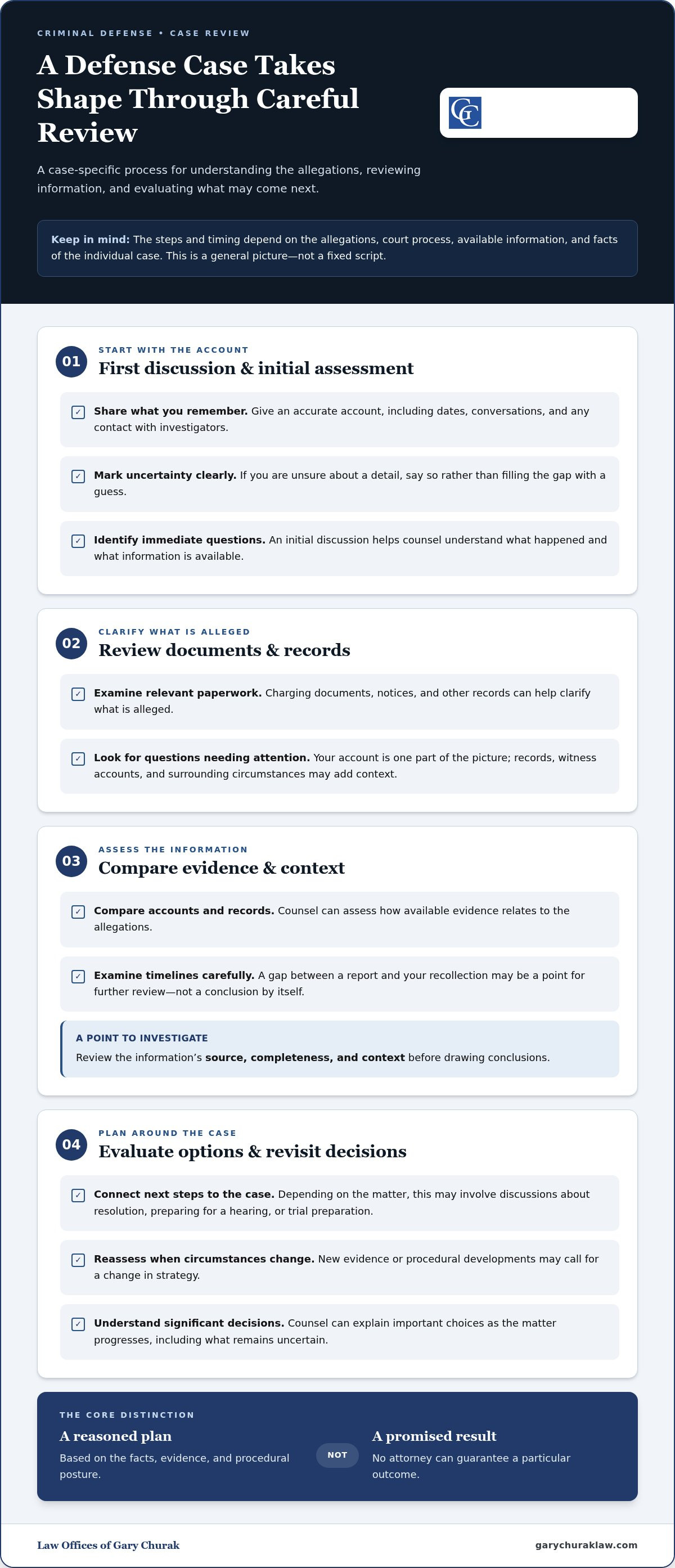
A defense case develops through careful review, not a one-size-fits-all checklist. Counsel needs to understand what has happened, what the accusation involves, and where the matter stands in the legal process. The stages below offer a general picture. Actual steps and timing depend on the allegations, court process, available information, and facts of the individual case.
From first discussion to case-specific assessment
An initial discussion gives counsel an opportunity to hear your account, identify immediate questions, and understand what information is available. Share what you remember as accurately as possible, including dates, conversations, and any contact with investigators. If you’re unsure about a detail, say so rather than filling the gap with a guess. Counsel can explain how communications are treated and the limits of confidentiality in the circumstances.
With appropriate information, an attorney may examine charging documents, notices, and other records relevant to the matter. This review can clarify what is alleged and identify questions that need further attention. Your account is one part of the picture. Records, witness accounts, and the circumstances surrounding the allegations may add context or raise issues to investigate.
Evidence review, legal options, and ongoing decisions
As information becomes available, counsel can compare accounts, examine records, and assess how the evidence relates to the allegations. For example, a timeline may reveal a gap between events described in a report and your recollection. That observation isn’t a conclusion by itself. It’s a point for further review, including examination of the information’s source, completeness, and context.
Case management may then involve evaluating legal options and planning next steps. Depending on the case, those steps could include discussions about resolution, preparing for a hearing, or trial preparation. New evidence or procedural developments may require a reassessment of the strategy. Counsel can help you understand significant decisions as the matter progresses. For more on that advocacy, read about how a criminal defense attorney protects your future and your freedom.
Defense decisions should follow a case-specific review, not a standard script. A sound explanation connects the recommended next step to the allegations, evidence, and stage of the case, while making clear what remains uncertain. In an initial discussion, focus on how counsel will understand and assess your particular circumstances.
You can make that discussion more productive by organizing relevant documents and preparing a factual timeline. Keep original materials intact, and avoid editing or deleting potentially relevant messages, photographs, or records. For personalized guidance based on a careful case review, you can discuss your criminal defense matter with the Law Offices of Gary Churak.
How to Evaluate a Criminal Defense Attorney Without Relying on Promises
Credentials and confident marketing can attract attention, but they don’t show how an attorney will approach your specific case. Look for a clear explanation of relevant experience, how counsel reviews allegations and evidence, how communication works, and what decisions may come next. You’re assessing the quality of the process, not trying to predict the outcome from a sales pitch.
Use these criteria to compare what you hear during an initial discussion:
- Relevant experience: Does the attorney explain experience related to the type of allegation and the stage of your matter? Specific examples of relevant work are more useful than a broad claim of expertise in every kind of case.
- Clear communication: Does counsel explain legal terms in plain language and give you a practical sense of how important developments will be communicated?
- Case-review approach: Does the attorney ask about the circumstances and available information before discussing possible strategies, or offer broad conclusions before learning the facts?
- Next-step explanations: Can counsel identify immediate questions, possible decisions, and information that may be needed to assess your options further?
Questions that reveal how counsel approaches your case
Ask how the attorney would begin reviewing the specific allegations and what documents or information could help clarify them. You can also ask who will communicate important developments and decisions, and how you’ll be kept informed. Listen for a direct explanation of what counsel can assess now, what remains uncertain, and what further review may be needed.
These questions aren’t a test of whether an attorney can predict the future. They help you determine whether the discussion is grounded in your circumstances. A useful answer may identify an issue to investigate without claiming that the issue will determine the result. For a more detailed checklist, explore this criminal defense attorney selection guide.
Experience, communication, and realistic expectations
Experience matters most when it helps counsel recognize relevant issues and explain how they apply to your case. Attorney Gary Churak has over four decades of experience, and his approach emphasizes careful case analysis and personalized legal guidance. Awards and professional recognition may provide context, but they don’t replace an explanation of how counsel will review your particular allegations and evidence.
Pay attention to how the attorney handles uncertainty. Direct communication should make it easier to understand your options, the questions still under review, and the decisions that may require your attention. No attorney can responsibly guarantee a particular case result. A credible assessment explains possible paths without presenting any one outcome as certain.
As you compare counsel, consider whether you leave the discussion with a clearer understanding of the review process and your next questions. For guidance based on a careful review of your circumstances, you can discuss your criminal defense case with the Law Offices of Gary Churak.
What to Prepare Before Speaking With a Criminal Defense Attorney
A little organization can make an initial legal discussion more focused. You don’t need to solve the case or arrive with every document. Bring what you have, separate what you know from what you’re unsure about, and be ready to explain the sequence of events as accurately as possible. A clear starting point helps counsel identify which questions and information may matter next.
Documents and details to organize
Gather paperwork and contact details connected to the matter. Keep documents in their original form, and make a separate list of questions so you don’t have to rely on memory during the conversation.
- Notices, charging paperwork, court documents, and any written communication you’ve received about the matter.
- Dates and times of important events, including contact with investigators or other officials.
- Names and contact information for relevant agencies, court contacts, witnesses, or other people involved.
- A factual timeline describing what you remember, with uncertain times or details clearly noted.
Keep the timeline neutral. Record what you recall, not what you think someone else intended or what you assume happened. If you later find a document or message that changes your understanding, keep the original and note the difference rather than rewriting your earlier account. For more practical preparation ideas, consult this criminal defense consultation preparation guide.
Preserve potential evidence as it is. Don’t edit or delete text messages, photographs, emails, call records, or other materials that may relate to the matter. If you’re unsure whether something is relevant, keep it intact and raise the question with counsel. Avoid altering files or adding annotations to original records; you can make separate notes about what you remember.
Protecting your position while seeking advice
Be cautious about discussing case details in public or online. Social media posts, comments, and messages can reach people beyond the intended audience, so avoid sharing details or speculating about the matter. Don’t discuss sensitive facts casually with people who don’t need to know. Instead, organize your account and raise questions directly with counsel.
Pay attention to official notices and dates. Don’t ignore a letter, document, or stated deadline because you’re unsure what it means. Keep a copy, note when you received it, and seek legal advice about how to respond. The appropriate steps depend on the document, the case, and the applicable process, so avoid relying on a general assumption when making an important decision.
Preparation doesn’t require perfect recall. It means preserving what you have and being candid about what you know, what you don’t know, and what needs clarification. To discuss your situation with the Law Offices of Gary Churak, contact the firm for personalized legal guidance.
How the Law Offices of Gary Churak Can Help With Criminal Defense
Choosing counsel means looking beyond a list of charges to how an attorney will examine the circumstances behind them. Attorney Gary Churak has over four decades of experience representing people facing misdemeanor and felony matters. That experience informs the firm’s criminal defense work, but it cannot predict what any individual case will bring. Each matter calls for its own careful assessment.
The Law Offices of Gary Churak represents clients facing a range of allegations, including:
- DWI and drug offenses
- Assault and domestic violence allegations
- Sex crime allegations
- Federal criminal matters
- Juvenile offenses
A defense approach grounded in case-specific review
A defense strategy should respond to the actual case, not rely on a standard formula. The firm emphasizes thorough case analysis, advocacy, and personalized legal guidance. That means considering the allegations, available evidence, procedural posture, and client’s circumstances before evaluating possible options. Details that seem minor at first may deserve closer review, while an early impression may change as more information becomes available.
Clear explanations matter throughout the process. Clients should be able to understand what questions remain, what choices may arise, and why a particular next step is being considered. Counsel can assess options and advocate on a client’s behalf, but no attorney can promise a specific result. A sound approach relies on reasoned analysis and preparation, not certainty unsupported by the facts.
That distinction can help set realistic expectations. A personalized consultation is an opportunity to discuss the basic nature of the matter, share relevant information, and identify questions that may need further examination. It can also clarify which documents or details could make a fuller case review more useful. The strategy must remain tied to the evidence and circumstances, not to a broad promise made before those elements are understood.
Start a focused conversation about your case
Before speaking with counsel, be prepared to describe the type of matter involved and mention any urgent notice, upcoming court date, or deadline you know about. You don’t need every answer. Sharing what you know and identifying what remains unclear can help focus the discussion on your immediate concerns and possible next steps.
The Law Offices of Gary Churak offers personalized consultations and careful case analysis for people facing criminal allegations. The discussion can help identify questions that deserve attention and provide a clearer basis for deciding what to do next. Learn more about discussing your circumstances with the Law Offices of Gary Churak.
Take the Next Step With a Clearer Plan
Uncertainty can make it tempting to wait until every detail is settled. An informed conversation can help identify what needs attention now and which questions deserve a closer look. If you’re considering a criminal defense attorney San Antonio, focus on finding counsel who will listen carefully, explain what can and can’t be assessed, and connect possible next steps to your circumstances.
At the Law Offices of Gary Churak, Attorney Gary Churak brings over four decades of experience to criminal defense representation. The firm emphasizes thorough case analysis and personalized consultations, giving you an opportunity to discuss the situation and understand how its specific facts may shape the legal guidance you receive. No attorney can promise a particular result, but a focused discussion can help replace guesswork with a more informed path forward.
Discuss your case with the Law Offices of Gary Churak. Bring your questions and share what you know. A measured first step can help you move ahead with greater clarity.
Frequently Asked Questions
When should I contact a criminal defense attorney?
Seek individualized legal guidance promptly if investigators contact you, you learn you’re under investigation, or you’re arrested or receive charging paperwork. You don’t need to wait until you know whether formal charges will follow. For example, if an investigator asks to interview you, advice can help you understand the situation before deciding how to respond. Timing and circumstances vary, so discuss the specific facts with counsel rather than assuming what will happen next.
What does a criminal defense attorney do?
A criminal defense attorney advises and represents someone facing criminal allegations, helping them understand the process and make informed decisions. Counsel can review the matter, discuss potential legal options, advocate for the client, and communicate about important developments. The attorney’s role is to assess the individual circumstances and provide guidance, not to control every decision or promise a particular outcome. Ask for plain-language explanations if legal terms or next steps aren’t clear.
Can a criminal defense attorney get charges dismissed?
A dismissal may be one possible outcome in some cases, but it can’t be predicted from the charge alone. The facts, available evidence, procedural history, and applicable law all matter. An attorney can evaluate potential issues and explain what options may be available as more information is reviewed. No attorney can guarantee dismissal or any other specific result. Be cautious of assurances made before counsel has assessed your circumstances.
How do I choose the right criminal defense attorney?
Look for relevant experience, careful attention to your circumstances, clear communication, and a practical explanation of possible next steps. Notice whether counsel asks focused questions and distinguishes known facts from unresolved issues. You should leave with a better understanding of what will be reviewed and what decisions may arise, not a guaranteed prediction. For more points to consider, use this criminal defense attorney selection guide.
What should I bring to a criminal defense consultation?
Bring notices, charging paperwork, court documents, and any relevant contact information you have. Write down important dates and prepare a factual timeline, marking details you’re unsure about instead of guessing. Keep original messages, images, and records intact; don’t edit or delete material that may relate to the matter. If you don’t have paperwork, explain what you received and when. A clear account of what you know can help focus the discussion.
How much does a criminal defense attorney cost?
Representation terms vary depending on the case and the work involved, so there isn’t one fee that applies to every matter. Ask counsel to explain the proposed arrangement, what work it covers, and how additional work or changes in the case may be handled. Make sure you understand the terms before deciding how to proceed. Discussing these details directly can help you assess the arrangement against your needs without relying on broad estimates.
What happens after I hire a criminal defense attorney?
After you hire counsel, the initial steps depend on the case’s status and circumstances. The attorney may gather information, review documents you provide, clarify questions about the allegations, and discuss a strategy for addressing the matter. You may be asked to share additional records or explain a particular event. Keep communication clear, raise new concerns as they arise, and ask which decisions or upcoming dates need your attention.


