

If you’re asking, “can a domestic violence charge be dropped,” the answer depends on who has authority over the case, what evidence is available, and the law where it was filed. A complainant can ask for the case to stop, but that request does not automatically end a criminal prosecution.
That uncertainty can be unsettling, particularly if you’re concerned about a no-contact order, other restrictions, or what to do next. Prosecutors may consider evidence beyond the complainant’s testimony, such as recordings, photographs, or witness accounts. A changed statement or request to drop charges may affect the case, but neither guarantees dismissal.
This article explains who makes decisions at each stage, why a case may continue or end, and how evidence and local procedure can affect the outcome. It also covers practical steps you can take to protect your position: follow every court order, preserve relevant information, and avoid contact that could violate restrictions. Reviewing the allegations, evidence, and procedural status can help clarify the next steps without promising a particular result.
Key Takeaways
- Can a domestic violence charge be dropped? A complainant can ask, but only the appropriate legal authority can formally dismiss a criminal case.
- A case can move from law enforcement review to a charging decision and court proceedings. Timing and procedures vary by jurisdiction.
- A request to drop charges, a changed account, noncooperation, and a formal dismissal have different legal effects.
- Protect your position by preserving relevant information, meeting deadlines, and complying with every release condition and court order.
- A defense lawyer can review the allegations, evidence, and procedure, then advocate for an appropriate resolution without guaranteeing an outcome.
Can a Domestic Violence Charge Be Dropped Once a Case Begins?
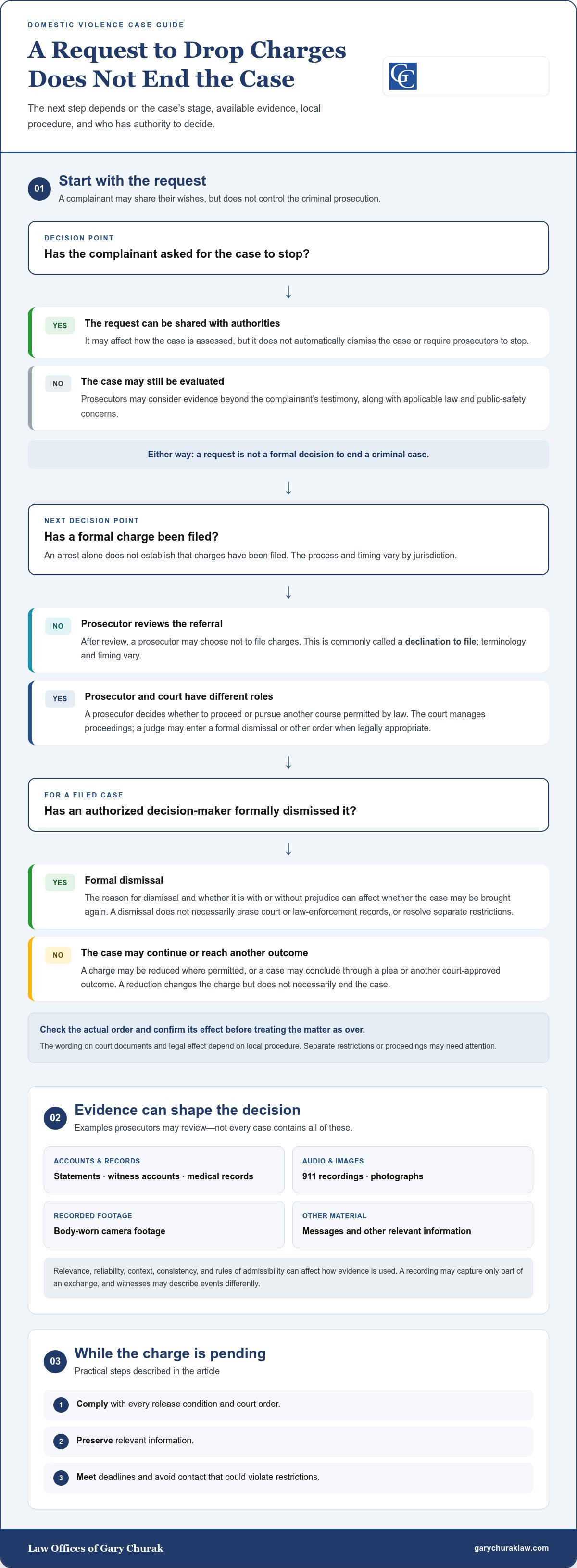
Yes. A domestic violence charge may be dismissed or otherwise resolved after a case begins, but the complainant cannot guarantee that result. Criminal charges are brought in the name of the government, not privately owned by the person who reported the incident. A complainant can tell authorities they do not want the case to continue, but that is different from an official decision to end or change the case.
“Domestic violence” can refer to different allegations and legal categories. The Domestic Violence Overview provides broader context about how the term is used. The charge and possible outcomes depend on the allegations, evidence, stage of the case, and law and procedures in the relevant jurisdiction.
Who controls a domestic violence prosecution?
Different participants have different roles. Police respond to an incident, gather information, and may arrest someone or refer the matter for review, depending on local law. A prosecutor reviews the case and decides whether to file charges or proceed with charges already filed. Once the case is before a court, a judge handles court proceedings and may enter a formal dismissal or other order when legally appropriate. The precise process and division of authority vary by jurisdiction.
The complainant’s perspective can still matter. They may share concerns, correct information, or explain their wishes to the authorities handling the case. However, a prosecutor may consider other evidence and public-safety concerns, and the complainant’s request does not replace the court’s role. To understand what may happen next, identify the case’s procedural stage and who has authority to make the next decision.
What does it mean for a charge to be dropped?
People use “dropped” as shorthand for several distinct outcomes. The wording on court documents and the legal effect depend on local procedure, so do not assume that an informal statement means the case has ended.
- Declination to file: After reviewing a referral, a prosecutor chooses not to file charges. This usually happens before a formal prosecution begins, though terminology and timing vary.
- Dismissal: A court or other authorized decision-maker formally ends a filed charge or case. The reason and whether the dismissal is with or without prejudice can affect whether the case may be brought again.
- Reduction: The prosecutor may pursue a different or less serious charge where permitted. This changes the charge, but does not necessarily end the case.
- Other resolution: A case may conclude through a plea or another court-approved outcome rather than dismissal. The consequences depend on the specific resolution.
None of these terms automatically means every record or consequence disappears. A dismissal may leave court or law-enforcement records, and separate restrictions or proceedings may need attention. Read the order and confirm its effect before treating the matter as over. A defense review can clarify the case’s status, identify who controls the next decision, and assess which outcomes may be available under the applicable law.
How Prosecutors Decide Whether a Domestic Violence Case Continues
The path from an incident report to a court outcome usually involves several decisions, but the order, timing, and responsible officials vary by jurisdiction. Whether a domestic violence charge can be dropped depends on more than whether the complainant wants to proceed. Prosecutors may assess the available evidence, applicable law, and procedural stage before deciding how to handle a case.
- Law enforcement responds. Officers may speak with people at the scene, document what they observe, and collect available information. Depending on local procedure and the circumstances, they may make an arrest or send their findings to a prosecutor.
- The case is reviewed. A prosecutor may examine reports and other materials to assess whether the evidence supports filing or continuing charges. Review may continue as additional information becomes available.
- A charging decision is made. Depending on the jurisdiction and stage, a prosecutor may file charges, decline to file, or pursue another course permitted by law. An arrest alone does not establish that charges have been filed.
- Court proceedings follow. If charges proceed, the court manages hearings and other required steps. The case may change as legal issues are addressed and evidence is evaluated.
A complainant can share their wishes, but the prosecutor decides whether to pursue the criminal case, subject to the court’s authority and local law.
What evidence may prosecutors review?
The record may include statements from the people involved, 911 recordings, photographs, medical records, and witness accounts. Depending on the incident, investigators may also collect body-worn camera footage, messages, or other relevant material. These are examples, not a checklist every case will contain.
Prosecutors must assess what the material shows and whether it can be used in court. Relevance, reliability, and rules of admissibility can affect the role evidence plays. A recording, for example, might capture only part of an exchange, while witnesses may describe events differently. A defense review can examine the source, context, and consistency of the evidence rather than treating every report as conclusive.
Can the case proceed without the complainant’s cooperation?
It may. A complainant’s refusal to participate does not automatically require prosecutors to dismiss a case. They may consider other evidence, such as recordings, photographs, officer observations, or witness accounts, if applicable rules permit its use. Whether a particular prior statement can be introduced depends on the facts, evidence, and local law. Do not assume that a statement will be admitted or excluded without reviewing the circumstances.
The practical question for someone facing a charge is what evidence the prosecution can rely on and what issues may affect its use. A domestic violence defense case review can help clarify the allegations, evidence, and procedural status without assuming a particular result.
Does a Recantation or Request to Drop Charges End the Case?
A complainant may ask for the case to stop, change an earlier account, or decide not to participate. None of those actions, by itself, guarantees dismissal. Reconciliation does not automatically end a prosecution either. The prosecutor may reassess the case, but a formal outcome depends on the evidence, the procedural stage, and the law where the case is being heard.
A complainant’s preference can inform the case, but it does not replace the prosecutor’s decision or a formal court action. These terms describe different situations:
| Situation | What it generally means | What it does not establish |
|---|---|---|
| Request to drop | The complainant tells authorities they do not want the case to continue. | It is not, by itself, an order ending the case. |
| Changed account | The complainant gives a different or revised account of events. | It does not automatically erase earlier statements or other evidence. |
| Noncooperation | The complainant declines or is unavailable to participate in some part of the process. | It does not necessarily prevent prosecutors from considering other evidence. |
| Formal dismissal | An authorized decision-maker formally ends a filed charge or case. | It does not always mean every record or related consequence disappears. |
What happens if the complainant changes their account?
Investigators or prosecutors may compare the updated account with earlier statements, recordings, photographs, witness accounts, and other evidence in the case. A difference may prompt questions about timing, context, or what can be established from the full record. On its own, a changed account does not prove that either version is true, false, or the result of pressure.
The legal effect depends on the facts, the stage of the case, and local evidentiary rules. A defense review can assess how statements were obtained, where accounts differ, and whether other evidence supports or conflicts with them.
Can a case be reduced or resolved another way?
Possibly, but available outcomes depend on the charge, facts, prosecutor, court, and jurisdiction. A negotiated resolution may involve an agreement about how the case concludes. It is not the same as a dismissal, and the court may have a role in approving or entering the result. A dismissal formally ends a charge or case, subject to the applicable procedure.
Neither outcome is automatic. A changed account or renewed relationship may be relevant, but it does not decide the case on its own. Do not assume the case is over unless you receive formal confirmation through the proper legal process. A lawyer can assess how the evidence and procedure affect potential resolutions without promising a particular result.
What to Do While a Domestic Violence Charge Is Pending
The steps you take now can help protect your position and avoid creating new problems. While a lawyer reviews the allegations, evidence, and court process, focus on complying with the rules, preserving information, and getting timely legal advice. Do not try to influence what anyone says.
- Follow every release condition and court order. Read the written terms closely, including any no-contact restriction. If a term is unclear, seek legal guidance before acting on an assumption.
- Do not pressure or contact the complainant or witnesses about the case. Avoid repeated messages, requests to change an account, coaching, threats, or asking someone else to make contact for you. Even well-intended communication may create risk or be misunderstood.
- Preserve relevant information. Keep messages, call records, photos, and other potentially relevant material in their original form. Do not delete, edit, or selectively forward records.
- Get legal advice promptly. Share the paperwork you received and ask about upcoming deadlines, hearings, and conditions. Do not miss a court date while waiting for the case to change.
How to protect your position without interfering
Use the written orders as your guide. If you are unsure whether a restriction permits a particular interaction, do not test its limits. Ask your lawyer how to handle it. Avoid discussing the allegations publicly or posting about the case on social media. Online comments can be saved, shared, or taken out of context, and public discussion can complicate a careful defense.
Preserve original records rather than altering them. Keep full message threads and note where files came from and when you received them. If you need to point out a relevant passage, make a separate note instead of changing the underlying material. This helps preserve context for a later review.
What information should you organize for a case review?
Prepare a factual timeline while details are fresh. Record dates, approximate times, locations, communications, and the names of people who may have relevant information. Separate what you personally observed from what someone else told you, and mark details you are unsure about rather than filling in gaps.
- Gather charging documents, release paperwork, court notices, and any written orders.
- Save relevant messages, call logs, photos, and records without changing their original form.
- List upcoming hearing dates and questions about restrictions or deadlines.
- Note potential witnesses and what each person may have directly observed, without contacting them to shape their account.
Organizing this material can make a legal review more focused. The Law Offices of Gary Churak provides domestic violence defense consultations and can assess the allegations and court paperwork. A lawyer can explain practical next steps, but no action guarantees a particular outcome.
How a Domestic Violence Defense Lawyer Can Assess Your Options
A focused legal review can replace guesswork with a clearer view of the case. A domestic violence defense lawyer can examine the allegations, available evidence, court paperwork, procedural history, and release conditions. That review can identify questions to address and possible defense issues, including whether the evidence supports the allegations or whether procedural concerns need attention.
If you are asking whether a domestic violence charge can be dropped, counsel can evaluate whether dismissal or another resolution may be a defensible option and advocate accordingly. No lawyer can promise a particular result. The available strategy depends on the specific facts, applicable law, and stage of the case.
What does a focused case review examine?
Counsel can compare the timeline in the charging documents with witness accounts, available recordings, messages, and other relevant material. The review may look for missing context, inconsistencies, or evidence that supports or challenges the allegations. A lawyer can also examine the procedural status and release conditions, then explain how those details shape potential legal strategies.
One detail rarely tells the whole story. A message, for example, may read differently when considered with the full conversation and timeline. Preserving original records and sharing them with counsel can help ensure the review considers context rather than an isolated excerpt.
What should you expect from an initial consultation?
Be prepared to describe what happened as accurately as you can, including details that may feel difficult or unfavorable. Bring charging documents, release paperwork, court notices, and a timeline of important events. If you have relevant messages or recordings, preserve them in their original form. These materials can help counsel understand the allegations and identify questions for further review.
A consultation is an opportunity to discuss the case, clarify immediate concerns, and understand potential next steps. Counsel can explain possible options and advocate for a dismissal or another appropriate resolution, but cannot guarantee an outcome. Gary Churak and the firm provide personalized consultations and thorough case analysis for people facing domestic violence charges.
To learn about the attorney’s approach to criminal cases, review the firm’s criminal defense attorney overview. A careful review can help you understand the issues that matter and make informed decisions as the case moves forward.
Take the Next Step With a Clear Plan
Uncertainty can make it tempting to wait for the situation to resolve itself. A more useful next step is to understand where your case stands and what decisions may be coming, so you can respond deliberately rather than rely on assumptions. Whether a domestic violence charge can be dropped in your case depends on its facts, stage, and applicable law. A careful legal assessment can help identify the questions that deserve attention and prepare you for the choices ahead.
The Law Offices of Gary Churak represents people facing domestic violence charges and provides personalized consultations focused on each case. Use that conversation to explain your concerns, clarify what you need to address next, and discuss how counsel may advocate for you. No outcome can be promised, but informed decisions can help you approach the process with greater confidence.
Discuss your domestic violence charge with the Law Offices of Gary Churak and take a measured step toward understanding your options.
Frequently Asked Questions
Can the alleged victim drop domestic violence charges?
No. An alleged victim generally cannot personally withdraw a government-filed criminal charge. They can communicate their wishes or provide updated information, but that does not itself end the case. A related protective-order matter may follow a separate process, so do not assume that a change in one matter resolves the other. Rely on the official status of the criminal case rather than informal conversations.
Can a domestic violence case continue if the complainant does not want to testify?
Yes, a case may continue, depending on the evidence and local rules. Prosecutors may assess whether other witnesses or records are relevant, but that does not establish that the case can be proved without the complainant. If a witness receives a subpoena or court notice, they should not ignore it. Anyone facing questions about testimony or a court appearance should get legal advice specific to the case.
Does a recantation automatically get a domestic violence charge dismissed?
No. A recantation is a change in an account, not a court order dismissing a charge. Authorities may consider when the statements were made, what changed, and whether other information supports or conflicts with either account. If you learn that a statement has changed, do not try to influence what the complainant says next. Share relevant information with your defense lawyer so it can be assessed appropriately.
Who decides whether a domestic violence charge is dismissed?
The decision depends on the case stage and local procedure. A prosecutor may decide not to pursue a charge, while a court may enter a formal dismissal after a case has been filed. Police, prosecutors, and judges have distinct roles, and the precise process varies. To avoid misunderstandings, rely on official case records or court notices, and ask your lawyer to explain what a specific order means.
Can domestic violence charges be reduced instead of dismissed?
They may be, depending on the facts, applicable law, and decisions by the prosecutor and court. A reduction means the case proceeds under a different charge. It is not the same as dismissal and may carry different consequences. Before agreeing to a proposed resolution, make sure you understand the exact charge, terms, and possible effects. A defense lawyer can review those details and explain the available choices.
Should I contact the complainant to ask them to drop the charge?
No, not to discuss or influence the case. Contact could violate a no-contact order or release condition, and repeated or indirect messages may create additional concerns. Do not ask friends or relatives to deliver the request for you. If communication seems necessary, speak with your lawyer first to understand the restrictions and identify a lawful way to address the issue without pressuring the complainant.


