

Could a quick response to a first drug charge create consequences you didn’t expect? A first-time label doesn’t determine how a case will end. The first time drug offense options available to you depend on factors such as the jurisdiction, the allegation, the evidence, and your record.
It’s understandable to want a clear answer or choose what seems like the simplest path. But diversion, plea negotiations, and trial are different routes, and diversion isn’t automatic. Before deciding, find out what the evidence shows, what each option requires, and how a possible outcome could affect your record or other priorities.
This article compares common pathways without assuming any result is guaranteed. You’ll learn what may shape eligibility and strategy, which records and case details may be useful to gather, and what to discuss with a qualified criminal defense attorney. The substance and amount alleged, how evidence was collected, any statements you made, and your prior history may all warrant careful review. A focused conversation can help you understand which choices may apply in your jurisdiction.
Key Takeaways
- A first charge doesn’t guarantee a particular result. The legal meaning of “first offense” depends on applicable law and your record.
- Compare diversion, negotiated resolutions, and litigation by their purpose, potential benefits, limits, and eligibility requirements.
- Assess your first time drug offense options using the exact charge and applicable law, not a generic label found online.
- Preserve case-related paperwork and record important dates. Don’t alter or delete potential evidence.
- A defense attorney can review the evidence and discuss possible paths based on your case, jurisdiction, and priorities.
First-Time Drug Offense Options: What a First Charge Does, and Does Not, Mean
A first drug charge can feel like a verdict, but it is not the same as a conviction. “First-time drug offense” is a general description, not a universal legal category. Its meaning, and the paths that may be available, depend on the jurisdiction and the details of the case.
In brief: First-time drug offense options depend on local law, the specific charge, the evidence, and eligibility rules. A first arrest or charge does not guarantee dismissal, diversion, or a reduced consequence.
What does “first-time drug offense” mean legally?
Courts and laws may define a qualifying prior record differently. Some rules focus on prior convictions; others may consider earlier cases or additional record details. A person with no prior conviction may still have a previous arrest, but an arrest alone is not proof of guilt. A “clean record” also does not necessarily meet a program’s legal definition of a first offender. Because terminology and eligibility vary, ask qualified counsel to explain how the relevant law applies to your record.
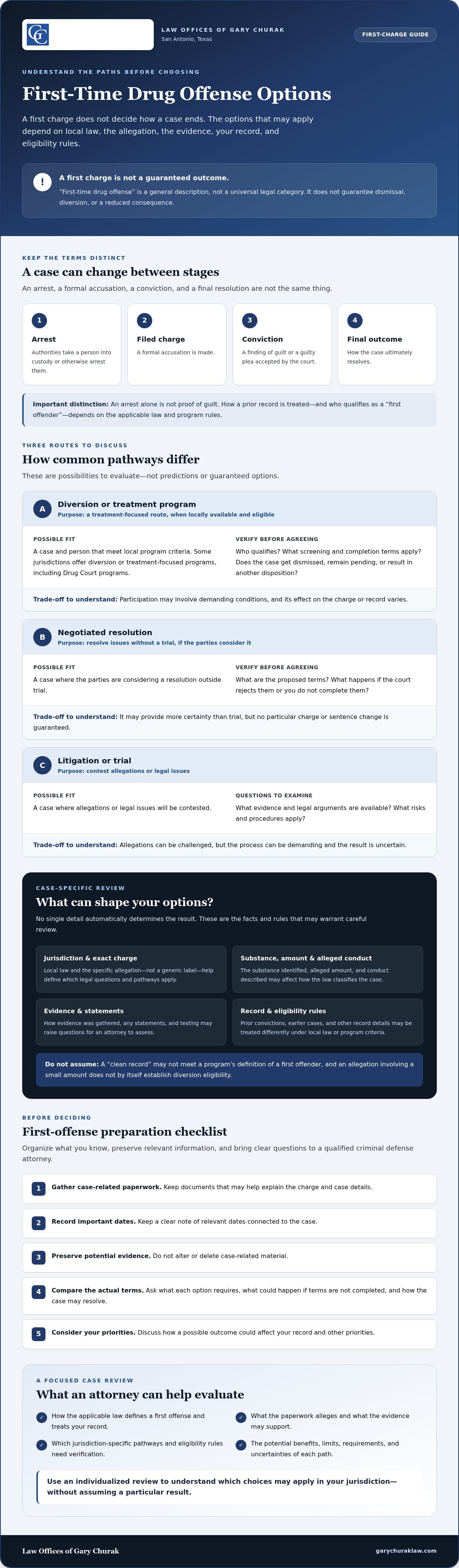
Keep the stages clear: an arrest means authorities have taken a person into custody or otherwise arrested them; a filed charge is a formal accusation; a conviction is a finding of guilt or a guilty plea accepted by the court; and the final outcome is how the case ultimately resolves. A case may change course between these stages. The broad framework of drug prohibition laws helps explain why possession and other conduct can be criminalized, but it cannot establish the rules that apply to an individual case.
Why do the facts of the charge matter?
The exact allegation determines which legal questions need attention. Counsel may need to examine the substance identified, the alleged amount, the conduct described, and whether the charge involves possession or another type of alleged activity. These details can affect how the law classifies the case and which pathways are worth evaluating.
Other circumstances matter too. Prior history, how evidence was gathered, statements, and testing may raise questions that influence an attorney’s assessment. No single detail automatically determines the result. For example, an allegation involving a small amount does not by itself establish diversion eligibility or guarantee a particular resolution.
Approach the first time drug offense options as questions to investigate, not outcomes to assume. An individualized review can help distinguish what the paperwork alleges from what the evidence may support, and identify which jurisdiction-specific rules counsel should verify before you decide.
How Common First-Time Drug Charge Paths Differ
There isn’t one route that fits every case. Diversion or treatment programs, negotiated resolutions, and litigation each serve different purposes. Their availability and legal effects depend on local law and case-specific facts. Use this comparison to frame questions for counsel, not to predict which option you’ll receive.
| Pathway | Possible fit | Questions to verify | Potential trade-offs |
|---|---|---|---|
| Diversion or treatment program | A case and person that meet local program criteria | Who qualifies? What screening and completion terms apply? How does the case end? | May offer a treatment-focused route, but participation can involve demanding conditions, and the effect on the charge or record varies. |
| Negotiated resolution | A case where the parties consider resolving issues without trial | What are the proposed terms? What happens if the court rejects them or you don’t complete them? | May provide more certainty than trial, but no particular charge or sentence change is guaranteed. |
| Litigation or trial | A case where allegations or legal issues will be contested | What evidence and legal arguments are available? What risks and procedures apply? | Allows allegations to be challenged, but the process can be demanding and the result is uncertain. |
When might diversion or a treatment-focused program be considered?
Some jurisdictions offer diversion or treatment-focused programs, including Drug Court programs. These are not universal entitlements. Eligibility may depend on the charge, record, screening, and decisions by legal authorities. Before agreeing, ask what participation requires, what happens if you don’t complete the terms, and whether the case is dismissed, remains pending, or results in another disposition. Confirm with counsel how participation could affect your record and whether the program’s conditions are practical for you.
How do negotiated resolutions and trial differ?
Negotiation is a process for discussing a possible resolution, not a promise of a reduced charge or sentence. Counsel can assess the evidence and legal issues, communicate with prosecutors, and explain any proposal before you decide whether it fits your priorities. Trial takes a different approach: it contests the allegations through court procedures, and the result remains uncertain until the process concludes. Evidence strength, potential legal challenges, personal priorities, and risk tolerance all matter. Neither path is automatically preferable.
Program names, availability, completion rules, and outcomes vary by jurisdiction. Before comparing the first time drug offense options in your case, have a qualified attorney check current local rules and explain the consequences of each path. A focused drug charge defense review can help you understand how evidence and negotiation may inform that assessment.
What Should You Compare Before Choosing a First-Offense Strategy?
Before choosing a path, start with the exact charge and the law that applies to it. General online labels can blur important distinctions between conduct, substances, amounts, and charge levels. For example, federal allegations may be governed by different rules than state charges; the DEA’s Federal drug trafficking penalties resource illustrates why identifying the precise allegation and jurisdiction matters. A lawyer can confirm which statutes and current procedures apply to your case.
Eligibility and evidence need to be reviewed together. The charge and applicable law define which pathways may be available, while the evidence and your history help counsel assess whether those paths fit your case.
Which evidence and procedural issues deserve review?
Ask counsel to examine how authorities obtained and handled the evidence, rather than assuming a search or test was valid or invalid. The complete record and governing law matter. Relevant materials may include:
- Police reports, charging documents, and records describing any search or seizure
- Statements, messages, and other communications connected to the allegation
- Test results, laboratory records, and information about how samples were handled
- Recordings, photographs, and names or contact details for potential witnesses
These materials may help counsel identify factual disputes, procedural questions, or evidence that needs further examination. A concern about how evidence was collected is a question for legal review, not proof by itself that the evidence cannot be used.
How could each path affect your record and obligations?
Look beyond the immediate charge. Ask what the proposed outcome means legally in the relevant jurisdiction, including whether it involves a conviction, dismissal, or another disposition. Then confirm any conditions that apply. Depending on the specific program or resolution, requirements might include supervision, treatment, testing, education, or other obligations. Don’t assume a program’s name tells you how it will affect your case or record.
Your deadlines and personal circumstances also deserve attention. Work, caregiving, health needs, and the ability to comply with proposed conditions may affect how practical a path is. Raise those concerns with counsel before agreeing to terms.
Finally, don’t assume that a favorable outcome automatically clears a record. Expungement and record sealing have separate eligibility rules, and their availability and effect vary under local law. Ask whether you may qualify, when you can apply, and what the process would change. Comparing evidence, legal consequences, conditions, and personal priorities can help you make an informed decision.
What to Do Before Deciding: First-Offense Checklist
Before choosing among first time drug offense options, take steps to preserve important information and get advice based on the law where your case is being handled. Avoid rushing into a decision before you understand the proposed terms and possible consequences.
- Seek prompt, jurisdiction-appropriate legal advice. Ask a qualified criminal defense attorney to explain the charge, relevant deadlines, and options that may apply under local law.
- Preserve your paperwork and potential evidence. Keep charging documents, release conditions, notices, and other case-related records. Don’t alter or delete messages, photos, files, or other information that could relate to the case.
- Record dates and prepare a factual timeline. Note known court dates and important events as accurately as you can. Separate what you personally remember from what you learned later; don’t guess or rewrite existing records.
- Protect case discussions. Avoid posting details publicly or discussing the allegations on social media. Don’t contact witnesses to discuss or influence their accounts. Ask your attorney how to handle communications about the case.
- Prepare questions before agreeing to a resolution. Clarify the possible outcomes, eligibility factors, obligations, deadlines, and consequences of not meeting any requirements.
What information should you gather for a legal consultation?
Bring available charging documents, release conditions, notices, and information about known court dates. A simple timeline and written questions can make the meeting more focused. If medications, treatment history, or personal circumstances may be relevant, share them privately with counsel so the attorney can assess whether they matter to the case or a proposed pathway. Keep the information factual and don’t change original documents.
If you’re unsure what to bring or how to organize your account, review this guide on preparing for a criminal defense consultation.
What should you ask before agreeing to a resolution?
Ask what outcomes are legally available in your jurisdiction and which facts could affect eligibility. Before accepting proposed terms, make sure you understand any supervision, treatment, testing, education, or other requirements, along with deadlines and what may happen if a requirement isn’t met. Ask how the proposed disposition could affect your record and future eligibility for record sealing. Those rules vary, so have counsel verify them under local law.
A careful review can help you make a more informed choice. To discuss a drug charge and possible defense paths, contact the Law Offices of Gary Churak.
How a Drug Defense Attorney Can Help Evaluate Your Options
A defense attorney can turn allegations and documents into a case-specific assessment. Counsel may review available evidence, examine how it was collected, identify potential legal or procedural issues, and assess which paths may be available under the law where the case is pending. If appropriate, the attorney can communicate with prosecutors about the case or a possible resolution.
That work helps you understand the questions and trade-offs involved, not predict a guaranteed result. The first time drug offense options worth considering depend on the complete case record, jurisdiction, your priorities, and informed legal advice.
What does individualized case analysis involve?
Case analysis begins with the specific allegations and available records. Counsel may review charging documents, reports, statements, test results, procedural history, and other evidence to understand what the prosecution claims and what issues may need further investigation. The attorney can then compare possible paths, explain eligibility questions, and clarify uncertainties or potential consequences.
For broader context, read the firm’s drug crimes defense overview. A general guide can help you prepare, but it can’t determine how local law applies to your individual case. No review can promise dismissal, acceptance into a program, reduced charges, or another specific outcome.
How can you take the next step with confidence?
Use an initial conversation to assess both the legal analysis and whether the attorney can assist in the jurisdiction handling your case. Ask about relevant experience with drug charges, how evidence and legal issues will be reviewed, how the attorney communicates about developments, and how your priorities will inform the strategy. You can also ask which documents would be useful to provide and what deadlines need attention.
The Law Offices of Gary Churak handles drug-offense defense, including case analysis, negotiation, and courtroom representation. Ask whether the firm can advise on your matter and what information would be useful for an initial discussion. A clear conversation can help you understand the next questions to address without assuming a particular result.
Request a confidential case consultation to discuss your situation and ask whether the firm can assist with your drug charge.
Take the Next Step With a Clearer Plan
A first charge doesn’t decide how your case will end. The first time drug offense options available depend on the jurisdiction, the specific charge, the evidence, and your eligibility. Diversion, negotiation, and litigation each carry different requirements and uncertainties, so compare them only after reviewing the facts and potential effects on your record.
Preserve case-related documents, track important dates, and prepare questions for a qualified criminal defense attorney before agreeing to a resolution. The Law Offices of Gary Churak provides criminal defense representation for people facing drug charges, including case analysis and courtroom representation. Attorney Gary Churak has more than four decades of experience.
A focused review can help you understand which questions to address and what steps may be available in your jurisdiction. Request a confidential case consultation to discuss your situation with the firm and ask whether it can assist with your case.
Frequently Asked Questions
Does a first-time drug offense automatically qualify for diversion?
No. Diversion eligibility depends on the jurisdiction, the specific charge, a person’s history, and the rules of the particular program. Some programs also require screening or completion of conditions. A first charge alone doesn’t establish eligibility or guarantee acceptance. Ask a qualified defense attorney to verify current local requirements, explain what participation involves, and clarify how the program could affect the charge and final case outcome.
Can a first-time drug charge be dismissed?
It may be possible in some cases, but first-offense status alone doesn’t require or guarantee dismissal. The outcome may depend on the governing law, evidence, and case-specific legal or factual issues. An attorney can review how evidence was collected, the reports and test results, and whether potential challenges or other legal grounds deserve consideration. Get advice based on the complete case record before assuming a charge will be dismissed.
What options are available for a first-time drug offense?
Possible first time drug offense options may include diversion or treatment-focused programs, a negotiated resolution, or contesting the allegations in court. Which paths exist depends on the jurisdiction, charge, evidence, and eligibility rules. Each can involve different requirements and uncertainties. A defense attorney can explain the legal effect of any proposed disposition, identify questions that need investigation, and help you compare available paths without promising a particular result.
Will a first-time drug offense stay on my record?
It depends on how the case ends and the law where it’s handled. An arrest, filed charge, conviction, and final disposition are distinct events, and each may be treated differently in records. Dismissal or program completion doesn’t necessarily mean all records are automatically removed. Record sealing or expungement has separate eligibility rules that vary by jurisdiction. Ask counsel to verify what may appear on your record and whether any later remedy may apply.
Should I accept a plea deal for a first drug offense?
Don’t accept a plea deal until you understand its terms and have reviewed it with qualified defense counsel. Ask what the plea means legally, what evidence supports the case, what obligations or deadlines apply, and what may happen if you don’t meet a condition. Discuss reasonable alternatives and possible consequences, including effects on your record. The right decision depends on the facts, applicable law, and your priorities, not simply on having no prior conviction.
Can a drug charge be reduced if it is my first offense?
A charge reduction may be discussed in some cases, but it isn’t automatic because someone has no prior qualifying record. Whether negotiation is possible can depend on the evidence, applicable law, alleged conduct, and other case circumstances. A defense attorney can assess the record and communicate with prosecutors where appropriate. Before agreeing to a proposed change, confirm its legal effect and any conditions with counsel. No specific reduction or outcome can be guaranteed.
What should I do after being charged with a drug offense for the first time?
Preserve case-related documents, note court dates and other deadlines, and promptly consult a qualified defense attorney familiar with the relevant jurisdiction. Keep messages and other potential evidence unchanged, and don’t delete or alter records. Avoid discussing case details publicly or contacting witnesses about their accounts. Gather charging papers, release conditions, and notices for your consultation. Counsel can review the charge and explain which next steps may fit your circumstances.


