

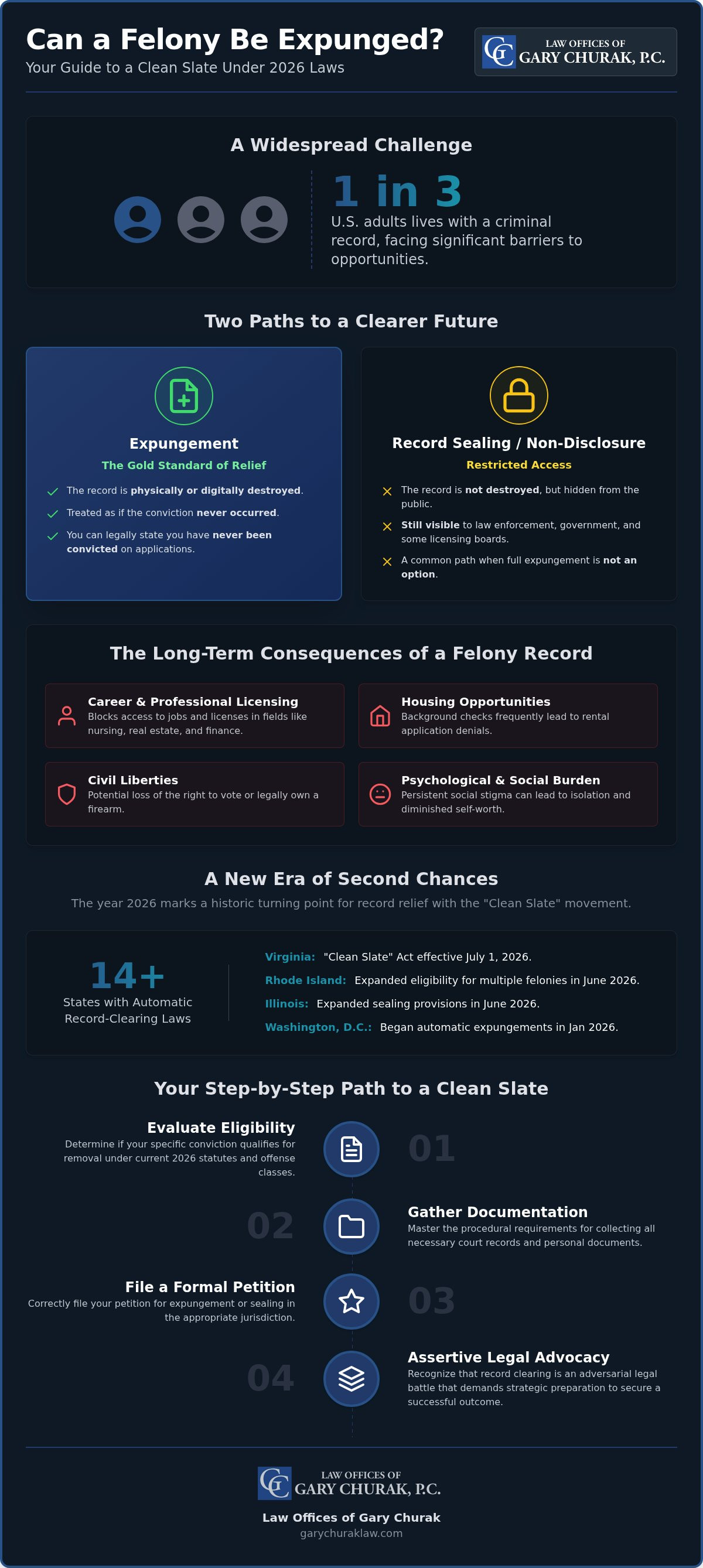
Approximately one in three U.S. adults lives with a criminal record, a statistic that represents millions of people sidelined from the workforce and their communities. If you're reading this, you've likely experienced the crushing weight of a background check that closes doors on housing or career advancement. You want to know: can a felony conviction be expunged? The legal landscape for record clearing shifted significantly in 2026, offering new hope for those who previously believed their records were permanent.
We understand the anxiety that comes with a past mistake. It's exhausting to feel like a second-class citizen while you're working hard to build a better life. You deserve a clear path forward that restores your professional reputation and your civil rights. This guide provides the strategic clarity you need to determine if your conviction qualifies for removal under the latest legal standards.
We'll examine the specific criteria for eligibility, the procedural hurdles of the petition process, and how new laws might automate your path to a fresh start. You'll learn the methodical steps required to reclaim your future and apply for new opportunities with total confidence.
Key Takeaways
- Identify the critical legal differences between the total destruction of a record and the restricted access granted by record sealing or non-disclosure.
- Evaluate eligibility criteria across various offense classes to determine if your specific felony conviction can be expunged under current 2026 statutes.
- Master the step-by-step procedural requirements for gathering necessary documentation and filing a formal petition in the appropriate jurisdiction.
- Recognize that record clearing is an adversarial legal battle that demands strategic preparation and assertive advocacy to secure a successful outcome.
- Position yourself for a clean slate by understanding how to restore your reputation and regain access to housing and career opportunities.
Understanding Felony Expungement and the Possibility of Legal Relief
A felony record often feels like a permanent weight, but the legal reality is changing rapidly. Many individuals spend years wondering, can a felony conviction be expunged, only to be met with conflicting advice from outdated sources. While some believe a conviction is a lifelong mark, the national "Clean Slate" movement is dismantling that misconception. By 2026, at least 14 states have enacted automatic record-clearing legislation, signaling a massive shift toward restoration and second chances. It's no longer a matter of if relief is possible, but rather how you navigate the specific legal channels available to you.
The Long-Term Consequences of a Felony Conviction
Living with a felony conviction creates a cascade of professional and personal obstacles. Even in states with "ban the box" laws, high-level employers and professional licensing boards for nursing, real estate, or finance often maintain strict disqualification criteria. These restrictions don't just limit your income; they fundamentally cap your potential. Beyond the workplace, a record can strip you of fundamental civil liberties, such as the right to vote or legally possess a firearm. This legal exclusion is often coupled with a heavy psychological burden. The social stigma of a past mistake can lead to a persistent sense of isolation and a diminished sense of agency in your own life.
Defining Expungement in a Modern Legal Context
Felony expungement is a court-ordered process that removes a conviction from public records to restore an individual's legal standing. This mechanism is distinct from a pardon; it focuses on the accessibility of the record itself. While Understanding Felony Expungement requires looking at specific state statutes, the core goal is always the same: providing a clean slate. It's a strategic legal battle that requires precision and a deep understanding of the court's expectations.
The year 2026 marks a historic turning point for record relief across the United States. Laws like Virginia’s "Clean Slate" Act, which became effective July 1, 2026, and Rhode Island’s expansion of multiple-felony eligibility in June 2026, have opened doors that were previously locked tight. Illinois also expanded its sealing provisions in June 2026, while Washington, D.C. began automatic expungements for certain offenses in January of the same year. These updates reflect a growing bipartisan consensus that economic stability improves when people can move past their history. While federal convictions remain more difficult to challenge, the momentum at the state level provides a clear, actionable path for those ready to fight for their future.
Expungement vs. Record Sealing: Identifying the Right Path
Determining which legal mechanism applies to your situation is the first step in reclaiming your future. While the terms are often used interchangeably, they represent distinct legal outcomes. If you're asking if a felony conviction can be expunged, you must first identify if your state offers the total destruction of records or merely restricts access to them. The distinction involves who can see your history and how you can represent yourself to others.
Expungement: The Gold Standard of Record Relief
Expungement provides the most comprehensive relief available. It typically results in the physical or digital destruction of the criminal record. Once the court grants an expungement, the conviction is treated as if it never occurred. You can legally state on job or housing applications that you have never been convicted of a crime. This permanence is why it's the preferred outcome for many. However, many jurisdictions limit this relief to non-convictions or specific low-level felonies. As of June 22, 2026, Rhode Island expanded this relief to allow for the expungement of up to four felony convictions, provided the individual remains conviction-free for fifteen years after completing their last sentence.
Record Sealing and Non-Disclosure Agreements
Record sealing, often called an order of non-disclosure, functions differently. It doesn't destroy the record; it hides it from the general public and private-sector background check companies. Law enforcement, government agencies, and certain professional licensing boards can still view the conviction. This is a common path when full expungement is unavailable. Virginia's 2026 "Clean Slate" law emphasizes this approach, allowing individuals to petition to seal certain felony records after a ten-year waiting period. This is a pragmatic route for securing stable employment in the private sector where most background checks occur. Understanding whether your felony conviction can be expunged or merely sealed requires a close look at the specific relief your state provides.
A pardon is often confused with these processes but serves a different purpose. A pardon is an executive act of forgiveness from a governor or the president. While a pardon is a significant achievement, it doesn't always result in the removal of the conviction from your record. In many states, a pardon is merely a prerequisite to then filing for expungement. It is often a slower and more politically charged process compared to the judicial route of record clearing. Many successful petitioners find that the court-driven process offers a more direct path to a clean slate.
Navigating these nuances requires a strategic approach and a thorough analysis of state statutes. Consulting with a professional specializing in expungements and record sealing can help you determine the most effective path for your specific jurisdiction and ensure your petition meets every legal requirement.
Evaluating Eligibility: Which Felony Offenses Qualify for Relief?
Legal eligibility hinges on the classification of the crime, and many individuals remain uncertain if their specific can a felony conviction be expunged under new 2026 standards. Courts generally categorize felonies into distinct tiers of eligibility. Non-violent offenses, drug-related crimes, and property crimes like theft or fraud are the most common candidates for relief. These offenses are viewed as more amenable to rehabilitation compared to violent crimes or sex offenses, which many jurisdictions still consider permanent bars to record clearing. Your path to a clean slate starts with a hard look at the statutory classification of your original charge.
The most frequent question we encounter is whether a violent felony can ever be removed. While the path is significantly narrower, it's no longer a universal "no." Recent legislative shifts, such as Rhode Island's June 2026 updates, now allow for the expungement of multiple felonies after a fifteen-year conviction-free period. However, for most violent offenses, the legal standard remains exceptionally high. In many states, you might still need to secure an executive pardon as a prerequisite before a court will even consider a petition for record destruction.
The Role of Completion and Rehabilitation
A judge won't entertain a petition for expungement until you've fully satisfied every requirement of your sentence. This means completing parole or probation is a non-negotiable prerequisite. You must also prove that all court-ordered fines, fees, and restitution payments have been settled in full. Beyond these administrative requirements, you must demonstrate genuine rehabilitation. Evidence of stable employment, community involvement, or completion of educational programs acts as a persuasive tool. These facts show the court that you're no longer a risk to public safety and have earned the right to a restored reputation.
Waiting Periods and Statutory Requirements
State laws mandate a specific waiting period that must elapse before you can file. These periods typically range from five to ten years depending on the felony class. The clock starts ticking on your final discharge date, which is the day you officially finish all supervision, not the day you leave prison. Maintaining a completely clean record during this time is essential; any new arrests or convictions can reset the clock or disqualify you entirely. For instance, understanding how to get a record expunged in Texas provides a clear look at how these statutory timelines function in a major jurisdiction. Strategic planning ensures you file at the earliest possible moment without wasting resources on a premature application.
The Step-by-Step Process of Filing for a Felony Expungement
Clearing your record is a methodical legal procedure that requires more than just filling out forms. It's a formal challenge to a permanent public record, and the court expects a high level of precision. Many people start this journey by asking can a felony conviction be expunged through a simple application, but the reality is an adversarial process that demands thorough preparation. You must navigate a specific sequence of filings and notifications to ensure your petition isn't dismissed on a technicality.
Gathering Essential Legal Documentation
Your petition is only as strong as the evidence supporting it. The first step involves obtaining a certified copy of the judgment and sentence from the clerk of the court where your conviction occurred. This document confirms you've satisfied all terms of your sentence. You also need a comprehensive criminal history report, often obtained through a Live Scan or an FBI background check, to prove you've remained conviction-free during the mandatory waiting period. Beyond these legal records, compiling character references and proof of steady employment helps build a narrative of rehabilitation. These documents provide the foundation for your argument that clearing your record serves the interests of justice.
Once your documentation is in order, you must file the formal petition in the specific court where the conviction was originally entered. This isn't a private matter; you're legally required to notify the District Attorney or the prosecutor's office. They have the right to review your request and file a formal objection. If the prosecution believes your record should remain public, they'll present their arguments to the judge, making it essential that your initial filing is legally sound and strategically prepared.
The Court Hearing: Presenting a Strategic Case
Most felony expungements require a formal court hearing. During this proceeding, the judge exercises broad discretion to decide if your felony conviction can be expunged based on your conduct since the offense. The prosecutor might object based on the nature of the crime or a perceived risk to public safety. Your advocate must be prepared to counter these objections with facts and a clear demonstration of your successful reintegration into society. If the judge is satisfied, they'll sign an expungement order. This order must then be distributed to various state and federal agencies to ensure your record is updated across all databases. If you're ready to begin this process, contact an expert in Expungements & Record Sealing to ensure your petition is handled with the precision it requires.
Overcoming Procedural Challenges with Strategic Legal Advocacy
Many individuals believe that clearing a record is a simple matter of administrative filing. It isn't. Felony expungement is an adversarial legal process where the state has the right to challenge your request. When you ask, can a felony conviction be expunged, you aren't just inquiring about eligibility; you're asking if you can win a strategic argument in a courtroom. The prosecutor represents the public interest, and they may actively oppose your petition if they believe the record should remain accessible. Navigating this opposition requires more than just paperwork; it requires a grounded, steady hand to advocate for your future.
The most effective way to approach this challenge is through comprehensive preparation. We recommend preparing for a criminal defense consultation to discuss the specifics of your record clearing. This initial meeting allows for a thorough case analysis, identifying potential hurdles before they reach a judge. An experienced attorney often negotiates with prosecutors behind the scenes, addressing their concerns and potentially securing their agreement before the formal hearing even begins. This proactive strategy transforms a high-stakes confrontation into a methodical path toward a clean slate.
Why Self-Representation Often Fails in Felony Cases
While court websites often provide generic forms for self-representation, these documents don't offer legal strategy. Technical mistakes in the filing or the service of process are the leading causes of petition denials. If you fail to notify the correct government agency or miss a statutory deadline, the court may dismiss your case without ever hearing your arguments. Furthermore, arguing complex legal standards like the "interests of justice" is difficult without seasoned counsel. A single denial can prejudice future attempts at expungement, making it significantly harder to clear your record in the years to follow. You don't want to risk your reputation on a procedural technicality.
The Advantage of 40+ Years of Legal Experience
The Law Offices of Gary Churak acts as a fierce protector for clients facing the weight of a criminal history. With over four decades of legal experience, Attorney Gary Churak provides the aggressive advocacy necessary to succeed in high-stakes courtroom environments. His "Clean Slate" philosophy is built on the belief that everyone deserves a second chance, but that chance must be fought for with precision and resilience. Understanding what to look for in a criminal defense attorney is essential when selecting counsel for record clearing. You need a battle-tested guide who possesses the wisdom to navigate complex state statutes and the strength to stand unwavering in the face of opposition. By focusing on results and thorough case preparation, we help you reclaim your civil rights and your confidence in the future.
Reclaim Your Future with a Clean Slate
The legal landscape of 2026 offers more opportunities for record clearing than ever before, but success is never guaranteed by paperwork alone. Determining if can a felony conviction be expunged requires a precise analysis of your specific offense, waiting periods, and the current statutes in your jurisdiction. Whether you're pursuing the total destruction of records or a strategic non-disclosure agreement to secure employment, the process remains an adversarial battle that demands professional scrutiny.
You don't have to face the court's opposition without a battle-tested guide. With over 40 years of aggressive criminal defense experience, the Law Offices of Gary Churak provides a personalized case analysis for every client. We maintain a proven track record in record sealing and expungements, serving as a fierce protector of your civil rights and professional reputation. Contact the Law Offices of Gary Churak for a free consultation on your expungement case and begin the process of restoring your future. A clean slate is within reach, and we're ready to help you secure it.
Frequently Asked Questions
Can a violent felony conviction ever be expunged?
Expungement for violent felonies remains rare but is no longer impossible in every jurisdiction. While most states prioritize non-violent offenses, some 2026 legislative updates have expanded eligibility for those who've remained conviction-free for extended periods. Success often requires a high burden of proof regarding rehabilitation and community safety. Whether can a felony conviction be expunged in these situations depends on the specific tier of the offense and the judge's discretion.
How much does it cost to get a felony expunged in 2026?
The total cost of clearing your record involves court filing fees and professional legal representation. Filing fees typically range from $50 to $500 depending on the county and state where the conviction occurred. Legal fees for complex felony cases vary based on the level of advocacy required and the complexity of the original charges. In states with "Clean Slate" laws, automatic sealing processes for eligible low-level offenses are often conducted without any associated filing fees.
How long does the felony expungement process take from start to finish?
Most petitioners should expect the process to take between three and six months from the initial filing to the final court order. This timeline includes the time needed for the prosecutor's office to review the petition and for the court to schedule a hearing. Complex cases involving older records or multiple jurisdictions can extend toward a full year. Deliberate preparation and accurate documentation are essential to avoid unnecessary delays caused by procedural errors.
Will an expunged felony still show up on a federal background check?
An expunged state felony may still appear on federal background checks conducted by agencies like the FBI or the Department of Homeland Security. While state-level expungement removes the record from public view and private employer databases, federal systems often maintain their own repositories. It's essential to understand that state court orders don't always bind federal authorities. This distinction is critical for those seeking federal employment or navigating complex immigration and international travel issues.
Can I get my gun rights back if my felony is expunged?
Restoration of firearm rights often follows a successful expungement, but it isn't always automatic. Many states link the restoration of civil liberties, including gun ownership, directly to the record-clearing process. However, some jurisdictions require a separate petition specifically for the restoration of rights. Federal law generally recognizes state-level expungements as a valid means of removing the federal firearm prohibition, provided the court order doesn't specifically restrict your right to possess a weapon.
What happens if the prosecutor objects to my expungement petition?
If a prosecutor objects, the court will hold a contested hearing to weigh the merits of your petition. The prosecutor may argue that your record should remain public for the sake of public safety or due to the nature of the offense. This is an adversarial stage where assertive legal advocacy becomes vital. Your counsel must present a strategic case demonstrating your rehabilitation and proving that the benefits of your expungement outweigh any potential risks.
Do I need to go to court for my expungement hearing?
Many jurisdictions require the petitioner to attend a formal hearing, though some allow an attorney to appear in your place. Your presence is often beneficial when the judge has specific questions about your conduct since the conviction or your current professional status. If the petition is uncontested, the judge may sign the order without a hearing. We always prepare our clients for the possibility of providing testimony to support their request for a clean slate.
Can I expunge a felony if I have multiple convictions on my record?
You can often expunge multiple convictions depending on the specific laws of your state. Recent 2026 updates, such as those in Rhode Island, have specifically expanded eligibility to include individuals with two to four felony convictions after a 15-year waiting period. Other states are following this trend by allowing for the sealing of multiple non-violent offenses. Determining can a felony conviction be expunged when you have a complex history requires a thorough analysis of state-specific statutory requirements.


