

What is considered aggravated assault, and does a weapon or serious injury automatically make an accusation more serious? The answer depends on the law in the jurisdiction and the facts prosecutors allege. A weapon, severe injury, or another circumstance may elevate an assault, but there is no single nationwide formula for every case.
An aggravated assault allegation can feel alarming. But a charge is not a conviction, and its label alone does not establish what happened or how the law applies. The specific statute, available evidence, and circumstances all matter.
This guide explains common factors associated with aggravated assault, how it may differ from simple assault, and why definitions and penalties vary by state. It also covers practical steps for preserving relevant information, such as messages, photos, and witness details. A defense attorney can review the statute and evidence in your case and identify the issues that need attention.
Key Takeaways
- To understand what is considered aggravated assault, compare the alleged conduct with the exact statute charged, not just a general definition.
- A weapon allegation alone does not establish that an object meets the law’s definition or that the charge’s elements are supported.
- Assault labels, aggravating factors, and classifications differ across jurisdictions, so do not assume the same rules apply everywhere.
- Preserve relevant messages, photos, documents, and witness contact details without changing or deleting them.
- Defense counsel can assess the statute and examine witness accounts, physical evidence, records, and the sequence of events.
What Is Considered Aggravated Assault Under the Law?
Aggravated assault generally means an assault that the law treats as more serious because of specified circumstances. The exact elements come from the statute that applies. Depending on the jurisdiction, the law may focus on the alleged conduct, the object involved, the person allegedly assaulted, or the outcome. A general overview can explain the concept, but it cannot establish which legal test governs a particular charge.
There is no single nationwide statutory definition of aggravated assault. When asking, “what is considered aggravated assault?” start with the law that governs the charge, not a general description or a label in a crime report. Aggravated assault is a violent crime that involves violence or the threat of violence. That overview provides context, but it does not replace the elements prosecutors must prove under the statute charged.
A charge name does not establish guilt or prove that every required element is present. The prosecution must prove the elements that apply in the case. The defense can examine whether the alleged facts and evidence support each element. Keeping those points separate helps prevent an accusation from being mistaken for a legal conclusion.
How criminal statutes differ from crime-reporting definitions
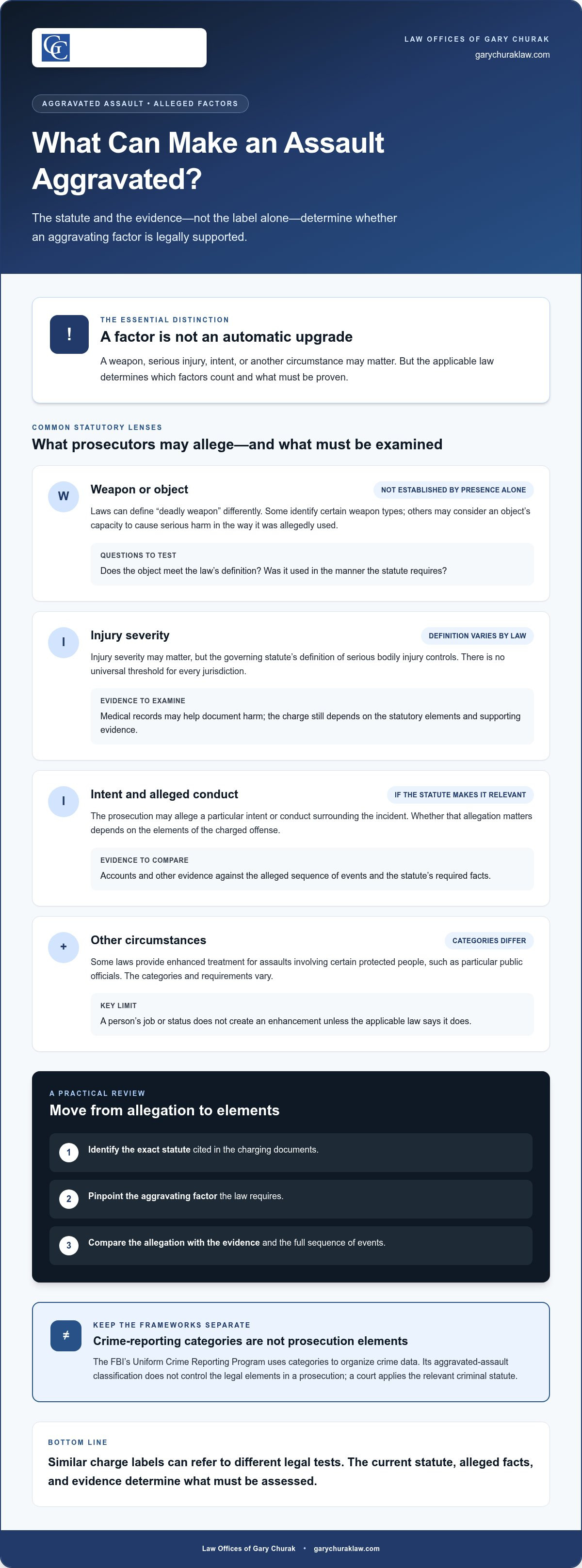
The FBI’s Uniform Crime Reporting Program uses categories to organize and report crime data. Its aggravated-assault classification describes an unlawful attack intended to inflict severe or aggravated bodily injury, typically involving a weapon or other means likely to cause death or great bodily harm. This framework helps classify reported incidents; it does not control the legal elements in a prosecution. A court applies the relevant criminal statute, not the FBI’s reporting category.
Why the applicable jurisdiction matters
Each jurisdiction’s statutes set the elements and classifications used for criminal charges. Similar labels can therefore refer to different legal tests, and the same alleged circumstance may be treated differently under different laws. Penal codes across different states address assault and aggravated assault with distinct statutory sections. The current statutory text and the specific charge matter, so an explanation of another region's law cannot determine how a local allegation is assessed.
For a detailed discussion of how the statute and alleged facts shape a defense, see this comprehensive aggravated assault defense guide provided by the Law Offices of Gary Churak. In any jurisdiction, a practical starting point is to identify the statute cited in the charging documents, then compare its elements with the evidence and circumstances alleged. This helps counsel assess the accusation in context instead of relying on its label alone.
Which Alleged Facts Can Make an Assault Aggravated?
Whether an assault becomes aggravated depends on the statute charged and the facts alleged to satisfy its elements. A weapon, serious injury, intent, or another circumstance may matter, but none should be treated as an automatic upgrade without examining the applicable law. The key question is not just whether an incident involved an object or an injury. It is whether the evidence supports the aggravating factor the statute requires.
For example, an object’s presence at a scene does not by itself establish that it legally qualifies as a deadly weapon or that it was used as the law requires. Investigators and prosecutors may rely on witness accounts, photographs, medical records, or other evidence to describe what happened. A defense review tests those claims against the statutory language and the full sequence of events.
How a deadly weapon allegation may affect a charge
Statutes can define or interpret “deadly weapon” differently. Some laws identify certain weapon types, while others may consider an object’s capacity to cause serious harm in the manner it was allegedly used. An everyday object could therefore be assessed differently depending on the circumstances. The allegation alone does not prove that the legal definition is met or that every element of an aggravated offense is established.
How injury and other circumstances may be assessed
Injury severity can be significant, but the law’s definition of serious bodily injury controls. There is no universal threshold for every jurisdiction. A medical record may help document harm, yet the charge still depends on the statutory elements and what the evidence can establish. Cornell Law School’s overview describes one general formulation: aggravated assault is an assault that causes serious bodily injury. That summary is background, not a substitute for the law governing a specific prosecution.
Other facts may also matter if the statute makes them relevant. The prosecution may allege a particular intent, conduct surrounding the incident, or an aggravating circumstance tied to the person allegedly assaulted. Some laws provide enhanced treatment for assaults involving protected people, such as certain public officials, but the categories and requirements vary. A person’s job or status does not create an enhancement unless the applicable law says it does.
In a case-specific review, counsel can break the allegation into questions that can be tested:
- What exact aggravating factor does the charged statute require?
- What evidence supports the claim about the object, injury, intent, or other circumstance?
- Does the evidence establish the required facts, rather than merely raise suspicion?
This focused analysis can clarify which parts of the allegation may be disputed and what evidence deserves closer scrutiny. The Law Offices of Gary Churak can assess the statute and evidence in an assault case.
Aggravated Assault vs. Simple Assault: What Changes Legally?
The difference between simple and aggravated assault is not determined by how serious an incident sounds in everyday conversation. The applicable statute sets out the elements for each offense, and an aggravated charge generally alleges an additional factor or more serious conduct. That factor might involve a weapon, injury, or another circumstance specified by law. The charge label is an accusation, not a finding of guilt.
The table below offers a general comparison, not a rule that applies in every state. Use it to identify the relevant questions, then review the statute named in the charging documents.
| Comparison point | Simple assault | Aggravated assault |
|---|---|---|
| Alleged conduct | Conduct that the jurisdiction’s assault statute defines as assault. | Assault alleged to include the additional conduct or circumstance specified by the relevant law. |
| Aggravating factors | The offense may not require an aggravating factor, depending on the statute. | The charge may allege a qualifying weapon, injury, intent, victim status, or another statutory factor. |
| Classification | The offense level and possible consequences depend on local law and the case. | The classification and sentencing rules also depend on the jurisdiction, charged provision, and circumstances. |
Which legal elements may distinguish the charges?
Start with the statutory language, not the everyday meanings of “simple” or “aggravated.” A statute may define assault through particular conduct, intent, or circumstances. A separate provision may elevate the offense if the prosecution alleges a qualifying weapon, a specified level of injury, or another listed factor. An object’s presence, for example, may not establish that it meets the law’s definition or was used as alleged.
Prosecutors must prove the elements of the charged offense under the governing law. A defense review should consider each requirement separately: what conduct is alleged, what the law requires, and what evidence supports the allegation. If an aggravating element is unsupported, disputed, or legally inapplicable, that issue may be central to the case. The charge itself does not resolve it.
Why charge level and consequences vary
State statutes do not use identical assault labels or elements. One jurisdiction may classify an offense differently from another, and consequences can depend on the specific provision, alleged facts, and applicable sentencing rules. Even within one jurisdiction, related charges may carry different classifications. Do not rely on a penalty range from a general online explanation unless it matches the law and charge at issue.
Possible legal exposure is not a prediction of the outcome. The prosecution’s allegations still need to be tested against the statute and evidence. To understand what is considered aggravated assault in a particular case, identify the exact offense charged and compare its required elements with the alleged facts. Case-specific legal analysis can clarify whether the distinction between simple and aggravated assault is supported by evidence or merely assumed from the charge name.
What Should You Do After an Aggravated Assault Allegation?
An aggravated assault allegation can create pressure to explain yourself immediately. Slow the process down where you can. Preserve relevant information, avoid changing or circulating material, and seek advice tailored to the charge and jurisdiction. These steps do not decide the case, but they can keep important details available for a careful review.
Preserve information relevant to the allegation
Preserve evidence in its original form. Keep potentially relevant messages, photographs, documents, and records as they are. Do not edit, delete, crop, annotate, or repost them. Avoid circulating material connected to the allegation, including on social media. Changes or missing context can make information harder to assess accurately.
Use this sequence to organize what you know:
- Save relevant material. Preserve communications, images, documents, and other records that may relate to the incident. Keep original files where possible, rather than relying only on screenshots or edited copies.
- Record witness details. Write down names and contact information for people who may have relevant knowledge. Note what you personally observed them do or say, without assuming what they must have seen.
- Write a private timeline. As soon as you can, note the sequence of events, approximate times, locations, and people present. Separate what you remember firsthand from what someone else told you or what you later inferred. Mark uncertainty instead of filling gaps with guesses.
- Keep related paperwork together. Save documents connected to the allegation, such as notices or records you received, and note when and how they came to you.
Get advice before making consequential decisions
Before making decisions that could affect the case, seek case-specific legal advice. Counsel can review the charge, identify the applicable statute, and compare the alleged facts with the evidence. That analysis can clarify which issues need attention, but it cannot guarantee dismissal, a reduced charge, or any other particular result.
Preparation can make that review more focused. Gather the charging paperwork and your timeline, then identify what you know directly, what remains uncertain, and where relevant records may be found. This criminal defense consultation guide can help you organize information for a legal discussion. Do not try to resolve gaps by altering records or relying on memory alone.
If you are facing an allegation, the Law Offices of Gary Churak can review the statute, evidence, and circumstances specific to your case. Learn about discussing an aggravated assault allegation with defense counsel.
How a Criminal Defense Attorney Evaluates an Aggravated Assault Case
A defense review begins with the actual charge, not assumptions based on its name. Counsel identifies the statute that governs the case, compares the charging language with its required elements, and asks whether the alleged facts and available evidence support each one. This method separates what has been alleged from what can be established.
Reviewing the charge, evidence, and competing accounts
Evidence needs to be assessed in context. Counsel may compare witness accounts with physical evidence, records, photographs, and the timeline of events. Differences between accounts do not automatically establish what happened, but they can point to details that need closer examination. The review also looks for corroboration, missing context, and unanswered questions without treating an accusation as proof.
The analysis may examine:
- The statute and charging language: Which elements must be proved, and what aggravating circumstance does the charge allege?
- Witness accounts: What did each person directly observe, and are there meaningful differences in their recollections?
- Physical evidence and records: Do available materials support, contradict, or leave unanswered questions about the alleged conduct?
- The sequence of events: Does the timing and context help explain how the incident unfolded?
These questions help counsel assess both the strength and the limits of the available evidence. They can also guide further investigation where appropriate. For instance, a timeline may help identify records or witnesses that could clarify a disputed point, while preserving the distinction between firsthand observations and later interpretations.
Planning informed next steps with counsel
After reviewing the charge and evidence, counsel can use that analysis to consider next steps. Depending on the facts and procedural posture, options may include pursuing a negotiation, filing an appropriate motion, or preparing for trial. The available paths depend on the governing law and the record in the case. No strategy can guarantee a particular result, and a careful assessment should account for both favorable and challenging evidence.
Case analysis is individual. Attorney Gary Churak has over four decades of experience and emphasizes thorough review and personalized consultations. A criminal defense attorney’s case-analysis guide offers further context on how counsel can evaluate a case and plan informed next steps.
If you are facing an aggravated assault charge, consider discussing the specific statute, evidence, and circumstances with defense counsel. A focused review can help you understand the issues and make decisions based on the case, not the charge label alone.
Move Forward With a Clear, Case-Specific Plan
Knowing what is considered aggravated assault is a starting point, not a plan for responding to an accusation. The next step is to understand how the allegation applies to your circumstances and which decisions deserve careful attention. The charge name alone does not tell you what the evidence establishes or how the law applies.
A focused conversation with defense counsel can help identify the questions that matter, explain the process ahead, and support informed decisions based on the facts of your case. The Law Offices of Gary Churak represents people facing assault and other criminal charges, with an approach centered on careful, individualized review.
Contact the Law Offices of Gary Churak to discuss your aggravated assault case and take a deliberate next step toward understanding your options. A charge is serious, but it does not decide the outcome.
Frequently Asked Questions
Is aggravated assault defined the same way in every state?
No. State laws define assault offenses and aggravating factors differently, so what is considered aggravated assault depends on the statute in the jurisdiction handling the case. One law may focus on the alleged use of a particular kind of weapon, while another may specify injury, intent, or the person’s status. Review the cited statute and its current wording rather than assuming a definition from another state applies.
Can an aggravated assault allegation be based on a threat without physical contact?
It can in some circumstances, depending on the jurisdiction’s assault law and the aggravating factor alleged. Some laws recognize conduct that places another person in fear of imminent harm, even if no contact occurs. But a threat alone does not automatically establish aggravated assault. The words, context, alleged intent, and statutory requirements must be evaluated under the law governing the charge.
Does aggravated assault always require a serious physical injury?
No. Some statutes allow an aggravated assault charge based on a qualifying weapon or another aggravating circumstance even if the person allegedly assaulted was not seriously injured. Other laws may make the injury’s nature or severity central to the charge. An allegation involving a weapon may raise different legal questions from one based on the extent of harm. The statute and evidence determine which elements matter.
What happens if the person who reported the assault wants to drop the charges?
The reporting person generally cannot personally dismiss a criminal case. Prosecutors decide whether to continue pursuing charges, though the person’s wishes or later statements may be considered. They may still be asked to provide information or testify. Do not pressure or repeatedly contact the reporting person about changing their account. A defense attorney can explain how the person’s statements and other evidence may affect the case.
How much jail time can aggravated assault carry?
There is no single nationwide jail or prison term for aggravated assault. The possible sentence depends on the jurisdiction, the specific offense classification, the alleged circumstances, and applicable sentencing rules. Prior convictions or other case-specific factors may also matter under local law. To understand possible exposure, review the precise charge and governing statute with a defense attorney. A general online penalty range may not fit your case.
Can aggravated assault charges be dismissed?
Yes, a charge may be dismissed in some cases, but dismissal is not automatic and cannot be promised. The legal and factual basis matters. Counsel may examine whether the evidence supports each required element, whether important evidence can be challenged, or whether a procedural issue affects the case. A lawyer can assess the available records and court posture to determine whether seeking dismissal is appropriate.
What is the difference between assault and battery?
The distinction varies by jurisdiction. In some legal systems, assault refers to an attempt or threat that creates fear of imminent harm, while battery refers to unlawful physical contact. Other jurisdictions combine the concepts or define them differently in statutes. A shove, for example, may be charged under a law that uses different terminology from a threat made without contact. The specific charge language determines the legal issue.


