

A criminal charge is not a conviction; it is a legal hypothesis that the state must prove under intense strategic scrutiny. You might feel the crushing weight of the legal system right now, but many criminal charges fail to result in a penalty when met with a seasoned defense. We understand the fear of jail time and the deep anxiety that comes with the threat of a permanent record. It is a high-stakes environment where the jargon often feels designed to keep you in a state of uncertainty.
You can navigate these complexities with this expert-led breakdown of how the system functions and how to protect your rights. In a 2026 legal environment where sentencing guidelines and court procedures continue to evolve, staying informed is your first line of defense. This guide provides the clarity you need to move from a state of confusion to one of prepared action. We'll examine the specific levels of charges, the immediate next steps in the legal process, and how to build a defense strategy that challenges the prosecution's narrative. You'll gain the confidence to make informed decisions that prioritize your future and your freedom.
Key Takeaways
- Understand that criminal charges represent formal accusations that the state is required to prove, providing you with the opportunity to mount a strategic defense.
- Learn to distinguish between infractions, misdemeanors, and felonies to accurately assess the potential impact on your future and your freedom.
- Examine the "Elements of a Crime" to understand exactly what the prosecution must prove beyond a reasonable doubt to reach a conviction.
- Prepare for the legal process from booking through arraignment, ensuring you are ready for your first official court appearance.
- Discover how an aggressive case analysis can identify procedural errors and leverage independent evidence to challenge the state's narrative.
What Are Criminal Charges and How Do They Originate?
A criminal charge is a formal accusation issued by a governmental authority. It signifies that the state or federal government believes you violated a specific statute. When analyzing What is a criminal charge?, you must understand that it is not a declaration of guilt. Instead, it is the mechanism that triggers your right to a defense. In this process, the prosecutor represents the interests of the public or the government. You stand as the defendant, and you must protect your liberty through strategic legal action and thorough scrutiny of the state's claims.
The path to criminal charges often begins long before you enter a courtroom. Most cases originate from a police report filed after an officer observes an incident or responds to a call. In other instances, a citizen complaint can prompt an investigation. For more complex or high-stakes matters, such as federal offenses, a grand jury might issue an indictment after reviewing evidence presented by the prosecution. It is vital to recognize the difference between being under investigation and being formally charged. An investigation is a period of scrutiny where law enforcement gathers facts. A formal charge is the moment the government officially commits to a prosecution, filing paperwork that starts the clock on your legal proceedings.
The Role of Probable Cause in Issuing Charges
Law enforcement cannot simply arrest someone based on a hunch. They must meet the legal standard of probable cause. This standard serves as a safeguard against arbitrary government overreach. When officers seek an arrest warrant, a neutral judge must review the supporting evidence to ensure it meets this threshold. Probable cause is a reasonable belief that a specific person committed a specific crime. If the evidence fails to meet this standard, the foundation of the case is weak. A seasoned defense can often challenge the validity of an arrest if the underlying probable cause was insufficient or based on flawed information.
Criminal vs. Civil Charges: Key Differences
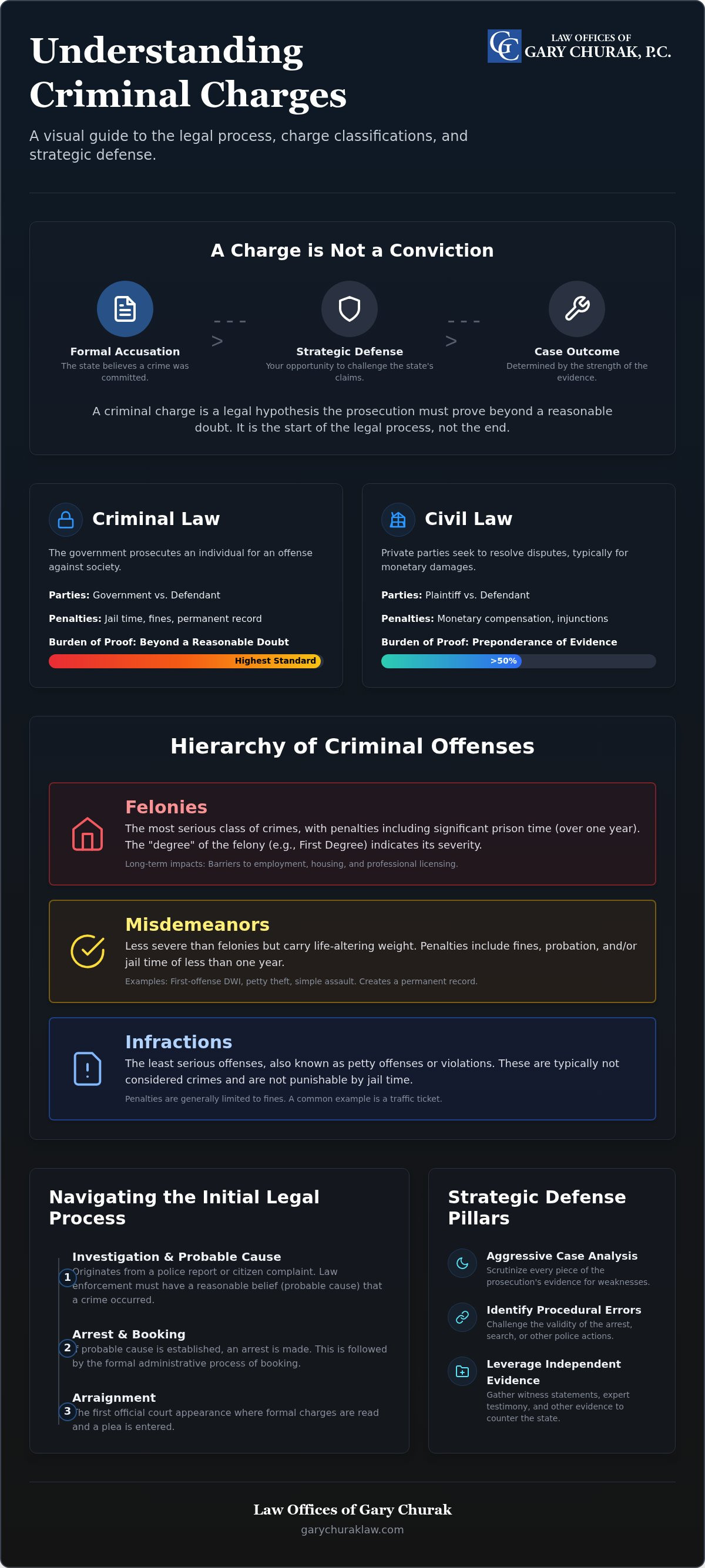
The distinction between criminal and civil law is fundamental to your defense strategy. Criminal cases involve the government prosecuting an individual for an offense against society. In contrast, civil litigation involves private parties seeking to resolve disputes. The most significant difference lies in the burden of proof. In criminal court, the prosecution must prove every element of the case beyond a reasonable doubt. This is the highest standard in our legal system. Civil cases only require a preponderance of the evidence, meaning it is more likely than not that the claim is true. While a civil loss might result in monetary damages, a criminal conviction carries the risk of jail time, significant fines, and a permanent criminal record.
Classifying Offenses: Infractions, Misdemeanors, and Felonies
The legal system organizes offenses into a clear hierarchy based on their perceived harm to society. Understanding where your case falls is the first step in building a resilient defense. Whether you face state or federal court, the classification of your criminal charges dictates the severity of the potential penalties and the complexity of the legal proceedings. Prosecutors often "stack" charges, filing multiple counts for a single incident to increase their leverage during negotiations. This tactic makes it vital to scrutinize every individual count to ensure the government isn't overreaching.
The "degree" of a charge, such as a First Degree or Second Degree Felony, serves as a shorthand for the maximum possible sentence. Higher degrees carry heavier mandatory minimums and longer periods of supervision. Beyond the immediate threat of jail, these classifications determine the long-term impact on your life. A criminal record can create invisible barriers to employment, professional licensing, and stable housing; it often persists long after you've completed your sentence.
Misdemeanors: More Than Just a "Minor" Offense
Many individuals mistakenly view misdemeanors as trivial. Examples like a first-offense DWI, petty theft, or simple assault still carry life-altering weight. While penalties typically involve fines, probation, or stays in county jail for less than a year, the consequences are far-reaching. A conviction creates a permanent record that can disqualify you from job opportunities or housing applications. Because the stakes remain high, you should seek a thorough case analysis to identify weaknesses in the prosecution's evidence before a plea is ever considered. Protecting your record at this stage is often the most cost-effective way to secure your future.
Felonies: High-Stakes Charges and Their Consequences
Felonies represent the most serious category of crimes. These include aggravated assault, drug distribution, and armed robbery. The process of how federal criminal cases are initiated often highlights the intensity of these investigations, which can lead to years in state or federal prison. Beyond incarceration, a felony conviction strips you of fundamental civil rights. You may lose your right to vote, serve on a jury, or possess firearms.
Some offenses are classified as "wobblers." This means the prosecutor has the discretion to charge the act as either a felony or a misdemeanor based on the specific facts and your prior history. Strategic negotiation and a proactive defense can often lead to a reduction of these criminal charges, preserving your rights and preventing a permanent felony label. We focus on identifying these opportunities early to mitigate the damage to your reputation and liberty.
The Anatomy of a Criminal Charge: What the Prosecution Must Prove
Behind every set of criminal charges lies a rigid framework known as the elements of a crime. The state cannot simply claim you are guilty; they must dismantle your presumption of innocence by proving every specific component of the statute beyond a reasonable doubt. If the prosecution fails to establish even one element, the entire case collapses. This structural requirement is where a strategic defense begins. We look for the gaps where the government's narrative fails to meet the legal standard, providing a steady hand to navigate the scrutiny of the court.
The first pillar of any charge is Actus Reus, or the physical act. This requires the government to prove that a voluntary act or a legal omission actually occurred. For example, in a drug crimes defense, the state must prove possession or distribution took place. The second pillar is Mens Rea, which focuses on your mental state at the time of the incident. Did you act with specific intent, or was the outcome the result of recklessness or simple negligence? Finally, the prosecution must establish Causation. They must link your actions directly to the resulting harm without intervening factors that break the chain of legal responsibility.
Understanding Intent and Strict Liability
Not all crimes require the same level of mental culpability. Specific intent crimes require the state to prove you intended a specific result, while general intent only requires proof that you intended to perform the act itself. Some offenses fall under strict liability, such as certain traffic violations or regulatory crimes. In these instances, the government doesn't need to prove what you were thinking; the mere fact that the act occurred is enough for a conviction. We often focus on challenging the mental state element because if we can show a lack of intent, we can frequently secure a reduction or dismissal of the criminal charges.
The Role of Evidence in Supporting Charges
Prosecutors rely on two primary types of evidence: direct and circumstantial. Direct evidence, like a high-definition video or an eyewitness statement, purports to prove a fact directly. Circumstantial evidence requires the jury to make an inference to reach a conclusion. While both are valid in court, circumstantial cases are often more vulnerable to a rigorous defense strategy that highlights alternative explanations. The Federal Rules of Evidence strictly govern what a jury is allowed to hear, ensuring that unreliable or unfairly prejudicial information stays out of the record. Throughout this entire process, the prosecution carries the entire burden of proof throughout the trial. You don't have to prove your innocence; we force the state to prove your guilt, and we hold them to that standard at every turn.
Navigating the Legal Process: From Arrest to Arraignment
The moment an officer places you in handcuffs, a complex administrative machine begins to move. The arrest is just the beginning. During booking, law enforcement officers record your personal data, take fingerprints, and photograph you for their records. This administrative processing can be a disorienting experience, but it's a standard procedure that leads directly to your first official encounter with the judiciary. Remaining calm and composed during this phase is essential for your future defense.
The arraignment is your first official appearance before a judge. At this hearing, the court formally reads the criminal charges filed against you. It's a high-stakes moment where you must enter an initial plea. We almost always advise a "not guilty" plea at this stage. This isn't a statement of fact; it's a legal placeholder that allows your defense team time to conduct a comprehensive case review and gather evidence. Entering a different plea without a full understanding of the state's case can lead to irreversible consequences.
Once the process moves forward, we enter the discovery phase. This is when the prosecution must turn over their "cards," including police reports, witness statements, and forensic data. We use this information to file pre-trial motions, which are formal requests for the judge to make a legal ruling. A successful motion can suppress evidence that was gathered illegally or even lead to a dismissal of the criminal charges before a trial ever begins. If you are facing an upcoming arraignment, secure a personalized consultation immediately to ensure your rights are protected from day one.
Bail, Bonds, and Pre-Trial Release
Judges determine bail based on factors like flight risk and community safety. A cash bond requires the full amount to be paid upfront, while a surety bond involves working with a bondsman for a percentage of the total. In some cases, you may be released on personal recognizance, which is a promise to return to court without a financial deposit. Maintaining strict compliance with all bond conditions is non-negotiable. Any violation can lead to immediate re-arrest and the forfeiture of your release privileges.
Your Rights During the Initial Stages
You have the absolute right to remain silent. Do not attempt to explain your way out of a situation with investigators; they are trained to use your words to build a case against you. The Fourth Amendment protects you from unlawful searches and seizures, and the Sixth Amendment guarantees your right to an attorney. Early intervention by a seasoned advocate changes the trajectory of a case, as it prevents law enforcement from overstepping their bounds during the most vulnerable hours of the process.
Strategic Defense: How Thorough Case Analysis Challenges Charges
A resilient defense is never passive. It requires an active, methodical deconstruction of the state's narrative from the moment the case begins. We don't simply accept the police report as the absolute truth; we conduct our own independent investigation to find the facts that law enforcement may have overlooked or intentionally ignored. This process involves a deep dive into the evidence to uncover hidden details that can fundamentally change the outcome of your case. By forcing the prosecution to justify every claim, we maintain a position of strength and preparedness. Aggressive advocacy is about more than just showing up in court; it's about persistent pressure and strategic scrutiny of the government's work.
Identifying procedural errors is a cornerstone of a high-quality defense. If the police failed to follow the law during your arrest or the gathering of evidence, that evidence should not be used against you. We scrutinize everything from the initial stop to the handling of forensic data. Labs make mistakes, and testing equipment can be faulty or poorly maintained. We also challenge the credibility of witnesses whose recollections may be biased, inconsistent, or physically impossible given the circumstances. When criminal charges are built on shaky foundations, we work to expose those cracks before a jury ever hears the prosecution's story. This level of technical scrutiny is a hallmark of specialized practices like Abogado Penal Temuco, which focus on uncovering procedural gaps that can change the course of a trial.
Common Defense Strategies and Justifications
In cases involving assault or domestic violence, we often explore self-defense or the defense of others. These are affirmative defenses that, when supported by evidence, can negate criminal liability entirely. We also focus heavily on constitutional violations. Moving to suppress evidence obtained through an illegal search or seizure can often gut the prosecution's case, leaving them with no choice but to drop the matter. Additionally, we utilize alibis and "mistaken identity" defenses when the evidence shows you weren't the individual involved. These strategies require a battle-tested guide who knows how to leverage the law to your advantage.
The Path Forward: Seeking Dismissals or Expungements
The ultimate goal of a thorough case analysis is to secure a dismissal or a significant downgrade of the criminal charges you face. We look for every available exit ramp in the legal system to protect your liberty. If your case is resolved without a conviction, our work continues into the next phase of protection. We help you navigate the process of record sealing and expungements to ensure your past doesn't dictate your professional future. Protecting your reputation is just as vital as protecting your freedom. Facing charges? Contact the Law Offices of Gary Churak for a strategic case analysis.
Protecting Your Future Against Legal Uncertainty
Navigating the legal system requires more than just understanding the terminology; it demands a proactive and strategic response. You now recognize that criminal charges are merely allegations that must withstand rigorous scrutiny before they can result in a conviction. By understanding the classification of your offense and the specific elements the prosecution must prove, you've taken the first step toward regaining control of your narrative. Knowledge is your foundation, but aggressive advocacy is your shield.
The Law Offices of Gary Churak provides the steady hand you need in high-stakes situations. With over 40 years of battle-tested legal experience, our firm delivers aggressive advocacy for both state and federal crimes. We emphasize a comprehensive case analysis to identify defense opportunities that others might overlook, focusing on prosecution weaknesses and procedural errors. We don't just manage your case; we fight for your resilience and your rights.
Don't allow the weight of the legal system to dictate your path forward. Secure Your Future with a Free Consultation today. You deserve a fierce protector who is committed to your defense and focused on achieving results. We're ready to stand with you and navigate these challenges together.
Frequently Asked Questions
What is the difference between a felony and a misdemeanor criminal charge?
The primary difference lies in the severity of the potential punishment and the long-term impact on your rights. Misdemeanors are less serious offenses that typically carry a maximum sentence of one year in a county jail. Felonies represent the most serious crimes, punishable by more than a year in state or federal prison. A felony conviction also results in the loss of civil liberties, such as the right to possess a firearm or vote.
Can criminal charges be dropped before the first court date?
Yes, it is possible for the prosecution to decline filing or to dismiss a case before the initial hearing. This often happens when a defense attorney intervenes early to highlight evidentiary gaps or procedural mistakes made by law enforcement. If the prosecutor realizes their case cannot meet the burden of proof, they may drop the matter to avoid a losing battle in court. Early advocacy is essential for this outcome.
What happens if I am charged with a crime but I am innocent?
Innocence does not stop the legal process; you must still actively defend yourself against the state's allegations. We focus on dismantling the prosecution's narrative by identifying factual inconsistencies, presenting alibis, or proving mistaken identity. Since the government carries the burden of proof, our role is to ensure that every doubt is brought to the forefront. An aggressive defense protects innocent individuals from the devastating consequences of a wrongful conviction.
How long do criminal charges stay on your permanent record?
In most jurisdictions, criminal charges remain on your permanent record indefinitely unless you take legal action to remove them. Even if your case was dismissed, the arrest record persists and can be seen by employers or landlords during background checks. We help eligible individuals navigate the process of expungement or record sealing. This strategic step is vital for clearing your name and ensuring that a past legal hurdle doesn't block your future opportunities.
What is an arraignment and what should I do during the hearing?
An arraignment is your first official appearance where the judge reads the formal accusations and you enter an initial plea. You should almost always enter a plea of "not guilty" at this stage. This isn't a claim of factual innocence; it's a legal move that preserves your rights while your attorney reviews the state's evidence. The court will also decide on bail or pre-trial release conditions during this hearing, making professional representation critical.
Is it possible to fight a criminal charge if the evidence seems strong?
Yes, even evidence that appears overwhelming can be challenged and suppressed if it was obtained illegally. We scrutinize the methods used by law enforcement to ensure your constitutional rights weren't violated during searches or interrogations. If the police acted without a valid warrant or failed to provide Miranda warnings, the court may rule that evidence inadmissible. Challenging the credibility of witnesses and the accuracy of forensic testing can also weaken a seemingly strong prosecution.
What is the difference between state and federal criminal charges?
How much does it cost to hire a criminal defense attorney for my case?
Legal fees depend on the complexity of the case, the severity of the charges, and the expected length of the proceedings. Most attorneys use either a flat fee for specific stages or an hourly rate for their services. While we don't provide specific pricing without a consultation, the cost of a defense should be viewed as an investment in your freedom. Quality representation focuses on achieving the best possible outcome to avoid the much higher costs of a conviction.


