

A single mistake on a Texas highway can cost you upwards of $15,000 before you even consider the long term impact on your professional reputation. You're likely feeling the heavy weight of a recent arrest and the crushing uncertainty of what happens next. It's natural to feel anxious about mandatory jail time or the sudden loss of your driving privileges. We understand that the Texas legal system often feels designed to overwhelm you, but you don't have to face this process without a shield. This guide provides the clarity you need to navigate the penalties for first time DWI in Texas, offering a strategic roadmap to protect your future and your freedom.
We'll break down the 2026 statutory fines, including the state's aggressive super fines, and explain the critical 15 day deadline for your Administrative License Revocation hearing. You'll gain expert insights into how a seasoned defense identifies weaknesses in the prosecution's evidence. Our goal is to help you minimize jail time, retain your license, and work toward avoiding a permanent criminal record. Knowledge is your first line of defense, and this methodical breakdown ensures you're prepared for the legal battle ahead.
Key Takeaways
- Understand that penalties for first time DWI in Texas depend heavily on your blood alcohol concentration (BAC), with levels at or above 0.15 significantly increasing potential jail time and fines.
- Act immediately to request an Administrative License Revocation (ALR) hearing within 15 days of your arrest to contest the suspension of your driving privileges.
- Prepare for the total financial impact of a conviction, which includes mandatory state "super fines" and the ongoing costs of SR-22 insurance filings.
- Identify opportunities to challenge the prosecution’s case by scrutinizing the legality of the initial traffic stop and the accuracy of field sobriety test administration.
- Assess the value of professional legal advocacy by comparing defense costs against the lifelong professional and financial burdens of a permanent criminal record.
The Legal Framework of a First-Time DWI in Texas
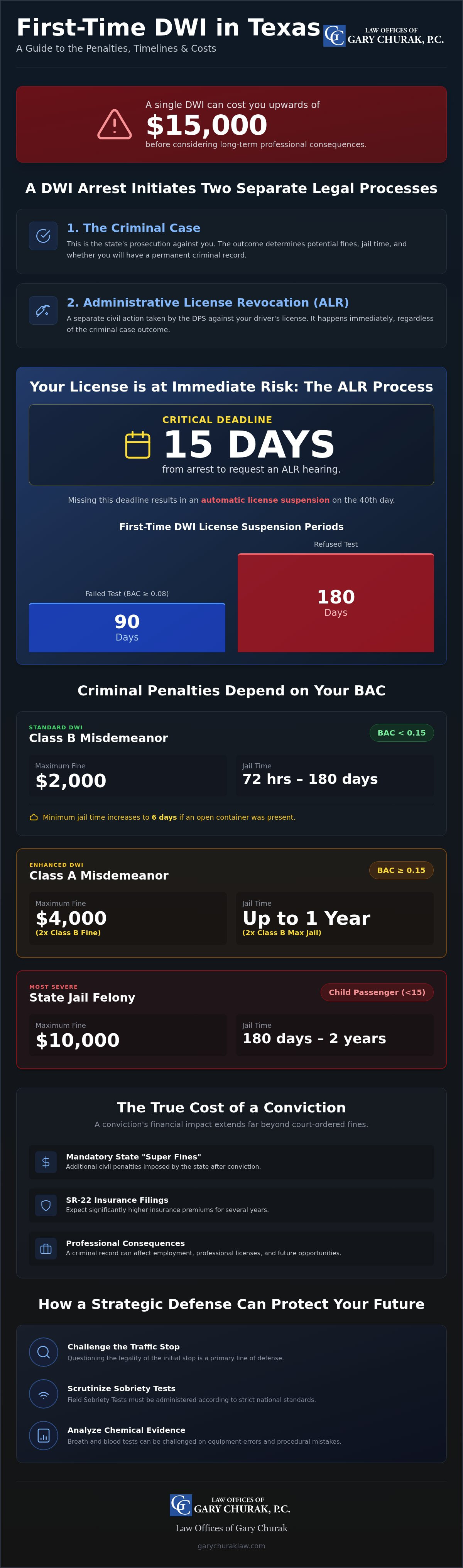
Under the Texas Penal Code, you commit the offense of Driving While Intoxicated (DWI) if you operate a motor vehicle in a public place while intoxicated. The state defines intoxication as either losing the normal use of mental or physical faculties due to alcohol or drugs, or having a blood alcohol concentration (BAC) of 0.08 or higher. For many, this arrest is their first interaction with the criminal justice system. It's a high-stakes situation where the penalties for first time DWI in Texas are designed to be punitive and life-altering. The law doesn't just look at whether you were drinking; it looks at specific aggravating factors that can turn a standard misdemeanor into a felony. For instance, if you're arrested with a passenger under the age of 15, the charge automatically escalates to a state jail felony. This specific enhancement carries a mandatory minimum of 180 days in state jail and a fine that can reach $10,000.
Class B vs. Class A Misdemeanor Distinctions
Most first-time arrests begin as Class B misdemeanors, but the prosecution closely examines chemical test results to determine if an escalation is warranted. If your BAC is measured at 0.15 or higher, the state elevates the charge to a Class A misdemeanor. This distinction is critical because it effectively doubles the potential financial and personal toll. A Class A conviction allows for a maximum fine of $4,000, compared to the $2,000 cap for Class B. Additionally, the maximum jail sentence jumps from 180 days to one full year. Because these Texas DWI laws rely so heavily on decimal points, our defense strategy involves rigorous scrutiny of the chemical testing equipment and the protocols used by the lab. A slight margin of error in a blood draw can be the difference between a standard charge and an enhanced Class A misdemeanor.
Mandatory Minimums and Statutory Maximums
Texas law is rigid regarding jail time. Even if you've never been in trouble before, a conviction for a first-time DWI carries a mandatory minimum of 72 hours in a county jail. This requirement increases to six days if an open container of alcohol was found in your vehicle at the time of the stop. While judges have the authority to sentence you up to the statutory maximums—$2,000 for Class B or $4,000 for Class A—they also have the discretion to offer community supervision or probation. However, probation doesn't erase the conviction from your record. With over 40 years of experience, Gary Churak understands that the goal isn't just to manage these penalties for first time DWI in Texas, but to challenge the evidence so aggressively that these mandatory minimums never become an issue. We analyze every detail of the police report to find the leverage needed to protect your future.
Administrative License Revocation (ALR) and Driving Privileges
Many drivers mistakenly believe that their driving privileges are safe until a judge decides their fate in a criminal courtroom. In reality, the state of Texas initiates an administrative process against your driver's license immediately upon your arrest. This process, known as Administrative License Revocation (ALR), is entirely separate from your criminal case. It's an action taken by the Department of Public Safety (DPS) based on the Texas Penal Code § 49.04 standards for intoxication. Under the state's implied consent laws, you've already agreed to provide a breath or blood sample simply by operating a vehicle on public roads. If you refuse to provide a specimen or if you provide one that shows a blood alcohol concentration (BAC) of 0.08 or higher, the penalties for first time DWI in Texas include an automatic license suspension.
Refusing a chemical test doesn't prevent the state from taking your license; it actually triggers a longer suspension period. For a first offense, a refusal typically leads to a 180 day suspension, whereas a failed test usually results in a 90 day suspension. Navigating this bureaucratic landscape requires a proactive approach to ensure you don't lose your ability to work or care for your family. If you're currently facing these timelines, it's wise to consult with an experienced advocate to protect your rights.
The 15-Day ALR Hearing Deadline
Failing to request an ALR hearing within exactly 15 days of your arrest results in the automatic suspension of your license on the 40th day following the incident. This deadline is absolute and represents your only opportunity to contest the suspension. A seasoned dwi defense attorney treats this hearing as a critical discovery tool rather than just a paperwork hurdle. We use this forum to subpoena the arresting officer and examine their testimony under oath. By doing so, we can identify inconsistencies in the police report or flaws in the stop's legality long before the criminal trial begins. The DPS must prove that the officer had reasonable suspicion for the stop and probable cause for the arrest; if they fail, we can often save your license.
Ignition Interlock Device (IID) Requirements
Judges often mandate the installation of an Ignition Interlock Device (IID) as a condition of your bond or probation, particularly if your BAC was 0.15 or higher. This device requires you to blow into a mouthpiece to verify you're sober before the engine starts. While an IID can be frustrating, it's often the key to securing an Occupational Driver’s License (ODL). An ODL is a restricted license that allows you to drive for "essential needs," such as commuting to work, school, or medical appointments. However, the costs associated with an IID add to the overall penalties for first time DWI in Texas. You should expect the following expenses:
- Installation fees ranging from $70 to $150.
- Monthly monitoring and rental fees between $60 and $80.
- Additional costs for calibration and data downloads.
While these requirements are demanding, they provide a path toward maintaining your daily life while your case moves through the system. We prioritize helping you meet these conditions while building a defense that challenges the underlying charges.
Calculating the True Financial Cost of a DWI Conviction
A DWI conviction is a financial predator that drains your resources long after the initial arrest. While many people focus on the immediate $2,000 criminal fine, that figure represents only a fraction of the total economic damage. The state of Texas imposes aggressive "super fines" that act as a civil penalty on top of your criminal punishment. For a first-time offender with a standard BAC, this state fine is $3,000. If your BAC was 0.15 or higher, that penalty doubles to $6,000. These amounts are mandatory and must be paid to the court to resolve your case. When you add up bond fees, mandatory education programs, and probation oversight, the total financial liability of a conviction often exceeds $10,000.
Beyond the court-ordered payments, you'll face significant hidden costs. Every court appearance requires time away from work, leading to lost wages that can total thousands of dollars depending on your career. If you're granted probation, you'll likely pay a monthly supervision fee of approximately $60. These recurring expenses, combined with the penalties for first time DWI in Texas, create a cascading financial crisis for the unprepared. Our firm prioritizes a thorough analysis of your case to identify any opportunity to avoid these crushing costs entirely.
State Surcharges and Court Fees
Court costs are separate from punitive fines and vary significantly by jurisdiction. These fees cover the administrative expense of processing your case through the system. While Texas has transitioned away from the old annual surcharge system in favor of the one-time super fine, the immediate cash requirement is much higher. You must also account for the $125 fee required to reinstate your driver's license once your suspension period ends. This administrative maze is designed to be expensive, making it vital to have an advocate who can identify opportunities to reduce or waive certain fees through strategic negotiation.
Insurance Hikes and SR-22 Filings
Your auto insurance provider will view a DWI conviction as a massive liability. Most carriers will require you to file an SR-22 certificate, which is a document that proves you carry the state-mandated minimum liability coverage. This filing flags you as a high-risk driver, often causing your premiums to double or even triple for a period of three to five years. In some cases, your current provider may simply cancel your policy, forcing you to seek coverage from specialized high-risk insurers at even higher rates. This multi-year impact is one of the most enduring penalties for first time DWI in Texas, potentially costing you an additional $5,000 to $10,000 in increased premiums over time.
Strategic Defense: How to Mitigate Mandatory Penalties
An arrest for DWI is merely an accusation, not a final judgment. To successfully mitigate the penalties for first time DWI in Texas, we must dismantle the state's case piece by piece. This begins with a rigorous examination of the initial traffic stop. If the officer lacked reasonable suspicion to pull you over, we can move to suppress all subsequent evidence. When the initial stop is ruled illegal, the entire case often collapses, leading to a dismissal of charges. We don't accept the police report as absolute truth; we scrutinize every detail to find where your rights were compromised.
We also look closely at the administration of Standardized Field Sobriety Tests (FSTs). These exercises are notoriously subjective and are often influenced by external factors such as uneven pavement, high winds, or the driver's pre-existing physical conditions. By questioning the accuracy of these tests, we challenge the officer's probable cause for the arrest. This assertive approach forces the prosecution to prove their case with more than just a subjective opinion from the side of the road.
Challenging Probable Cause and Evidence
A skilled criminal defense attorney meticulously reviews dashcam and bodycam footage to verify the officer's claims against the visual evidence. We look for procedural errors in how breath or blood samples were obtained, as even a minor deviation from state protocols can render the results inadmissible. During "No Refusal" weekends, law enforcement agencies expedite the warrant process for blood draws. The high volume of arrests during these periods frequently leads to technical mistakes in blood draw procedures or chain of custody issues. We also scrutinize the maintenance logs of breathalyzer machines to ensure they were properly calibrated and that the operator's certification was current at the time of your test.
Probation and Deferred Adjudication
If the evidence is strong, we shift our strategy toward minimizing the impact on your record through alternative sentencing. Texas law allows for deferred adjudication in certain first-time DWI cases, provided there was no accident involving another person. This path allows you to complete community supervision without receiving a final conviction on your record. While you'll still face conditions such as community service, mandatory alcohol education classes, and the installation of an Ignition Interlock Device, successful completion protects your future employment opportunities. It's vital to understand that while deferred adjudication avoids a final conviction, the arrest and the order of non-disclosure may still be visible on certain high-level background checks. To determine if your case qualifies for these protections, request a personalized consultation to discuss your specific circumstances.
Evaluating the Average Cost for a DWI Lawyer vs. Conviction
Deciding whether to hire a private attorney is often the most significant financial choice you'll make following an arrest. While some individuals consider representing themselves or accepting the first plea offer to save money, this approach often leads to much higher long term expenses. When you weigh the one time cost of a defense against the multi year penalties for first time DWI in Texas, the value of professional advocacy becomes clear. A conviction isn't just a fine; it's a financial drain that includes state super fines, insurance hikes, and potential loss of income that can easily exceed $15,000 over three to five years. Strategic legal intervention aims to eliminate or significantly reduce these burdens before they become permanent fixtures on your record.
Understanding Legal Fee Structures
Most experienced defense firms handle DWI cases on a flat fee basis. This structure provides you with cost certainty during an otherwise unpredictable time. A comprehensive flat fee typically covers the Administrative License Revocation (ALR) hearing, the filing of pre-trial motions, and all negotiations with the prosecution. Some cases involving high BAC levels or accidents may require more intensive work, which influences the total fee. Choosing the cheapest available option is often a trap; a high volume "plea mill" firm may not provide the meticulous case analysis required to spot procedural errors. We believe in a transparent approach where you understand exactly what your defense entails from the start.
The ROI of Aggressive Advocacy
The return on investment for high quality legal defense is measured in both dollars and freedom. By successfully challenging the state's evidence, a lawyer can save you from the $3,000 to $6,000 state super fines and the thousands of dollars in mandatory SR-22 insurance premiums discussed earlier. Beyond the immediate cash savings, professional advocacy protects your future earning potential. For those holding a professional license, a security clearance, or a corporate leadership position, a DWI conviction can be a career ending event. We frame our legal services as a protective shield for your reputation and your financial stability. When you evaluate what to look for in a criminal defense attorney, prioritize experience and a proven ability to navigate the complexities of the Texas court system.
Before making a final decision, use this checklist to ensure your advocate is prepared for the fight:
- Decades of Experience: Does the attorney have a deep history with Texas DWI statutes?
- ALR Focus: Will they handle the license hearing as part of the primary defense?
- Technical Knowledge: Can they challenge the science behind breathalyzers and blood draws?
- Personalized Strategy: Does the firm emphasize thorough case analysis over quick pleas?
- Assertive Presence: Is the attorney respected for their tenacity in the courtroom?
Investing in a seasoned guide like Gary Churak ensures that you aren't just another number in the system. We provide the steady hand and strategic mind necessary to mitigate the penalties for first time DWI in Texas and preserve your path forward.
Secure Your Future Against Texas DWI Consequences
The financial and legal weight of a conviction can feel insurmountable, but a strategic defense provides a clear path forward. You've seen how the state prioritizes aggressive prosecution through super fines and license suspensions; however, these outcomes aren't inevitable. By acting within the 15 day ALR window and challenging the technical evidence of your arrest, you can effectively mitigate the penalties for first time DWI in Texas. We focus on dismantling the prosecution's case through thorough case analysis and unwavering advocacy.
Gary Churak brings over 40 years of experience in Texas criminal law to act as your shield in the courtroom. Our firm provides the aggressive advocacy required to protect your professional reputation and your long term earning potential. Don't let a single mistake define the rest of your life. Protect your future with a strategic DWI defense consultation. You have the power to fight these charges, and we have the expertise to lead the way.
Frequently Asked Questions
Is jail time mandatory for a first DWI in Texas?
Texas law mandates a minimum of 72 hours in jail for a first-offense DWI conviction. If the police found an open container of alcohol in your vehicle, this mandatory minimum increases to six days. While these are the minimums, a judge can sentence you to up to 180 days for a standard Class B misdemeanor. We focus on challenging the evidence to help you avoid these mandatory stays entirely.
How long does a first-time DWI stay on your record in Texas?
A DWI conviction remains on your criminal record permanently in Texas. It doesn't "drop off" after several years like a traffic ticket. However, you may be eligible for a petition for non-disclosure if you meet specific criteria, such as completing a period of community supervision and having no prior convictions. This process seals the record from public view, which is essential for protecting your future employment opportunities and housing applications.
Can I get a first-time DWI dismissed in Texas?
You can have a first-time DWI dismissed if the prosecution cannot prove its case beyond a reasonable doubt. Common grounds for dismissal include an illegal traffic stop, improperly administered field sobriety tests, or technical errors in blood and breath sample collection. In some jurisdictions, completing a Pre-Trial Diversion program also leads to a dismissal. We conduct a thorough case analysis to identify these weaknesses and aggressively pursue a favorable outcome for every client.
What is the difference between a DUI and a DWI for adults in Texas?
In Texas, these terms aren't interchangeable. Adults aged 21 and older face a DWI (Driving While Intoxicated) charge if they have a BAC of 0.08 or higher. A DUI (Driving Under the Influence) is a specific charge reserved for minors under the age of 21 who have any detectable amount of alcohol in their system. The penalties for first time DWI in Texas are significantly more severe than those for a minor's DUI charge.
What happens if I refuse a breathalyzer test in Texas?
Refusing a breathalyzer test triggers an automatic 180 day suspension of your driver's license under Texas's implied consent laws. This suspension is an administrative penalty that occurs regardless of whether you're eventually convicted in criminal court. You have exactly 15 days from the date of your arrest to request an ALR hearing to contest this suspension. Refusal doesn't prevent a blood draw, as officers can often obtain a warrant quickly during "No Refusal" periods.
How much does a first-time DWI cost in total in Texas?
The total cost of a first-time DWI typically ranges from $7,000 to $15,000. This calculation includes the criminal fine of up to $2,000, state "super fines" ranging from $3,000 to $6,000, and administrative fees for license reinstatement. You must also account for the multi-year impact of increased insurance premiums and the costs of mandatory ignition interlock devices. Investing in a strategic defense can often save you thousands by avoiding these long-term financial burdens.
Can I still drive after my first DWI arrest in Texas?
You can typically drive for 40 days following your arrest using the temporary paper permit provided by the officer. After this period, your license will be suspended unless you successfully contested the revocation at an ALR hearing. If your license is suspended, we can help you apply for an Occupational Driver’s License (ODL). An ODL allows you to drive for essential needs, such as commuting to your job, school, or medical appointments.
Is it worth hiring a lawyer for a first-time DWI if I plan to plead guilty?
Hiring a lawyer is essential even if you intend to plead guilty. An experienced advocate can negotiate for deferred adjudication, which prevents a final conviction from appearing on your record. We also work to minimize the penalties for first time DWI in Texas by arguing for reduced fines or shorter probation periods. Without professional representation, you're at risk of accepting a plea that carries much harsher long-term consequences than what's actually required by law.


