

What if the most reassuring answer in a consultation isn’t the most useful one? When you’re facing criminal charges, confidence matters, but so do clear, case-specific explanations. The right questions to ask a criminal defense lawyer can help you understand whether the attorney has handled cases like yours and how they’ll assess the allegations, evidence, and immediate decisions ahead.
It’s reasonable to want straight answers about possible outcomes, what happens next, and who will work on your defense. No attorney can promise a particular result, but a focused conversation should clarify which issues they’ll investigate and what strategy they may consider as the case develops.
This guide offers practical questions to help you evaluate relevant experience, case strategy, communication, fees, and attorney involvement. You’ll also learn what to clarify before leaving the consultation so you can make a more informed decision about how to proceed.
Key Takeaways
- Ask about experience with charges and court processes relevant to your case, not just general criminal defense experience.
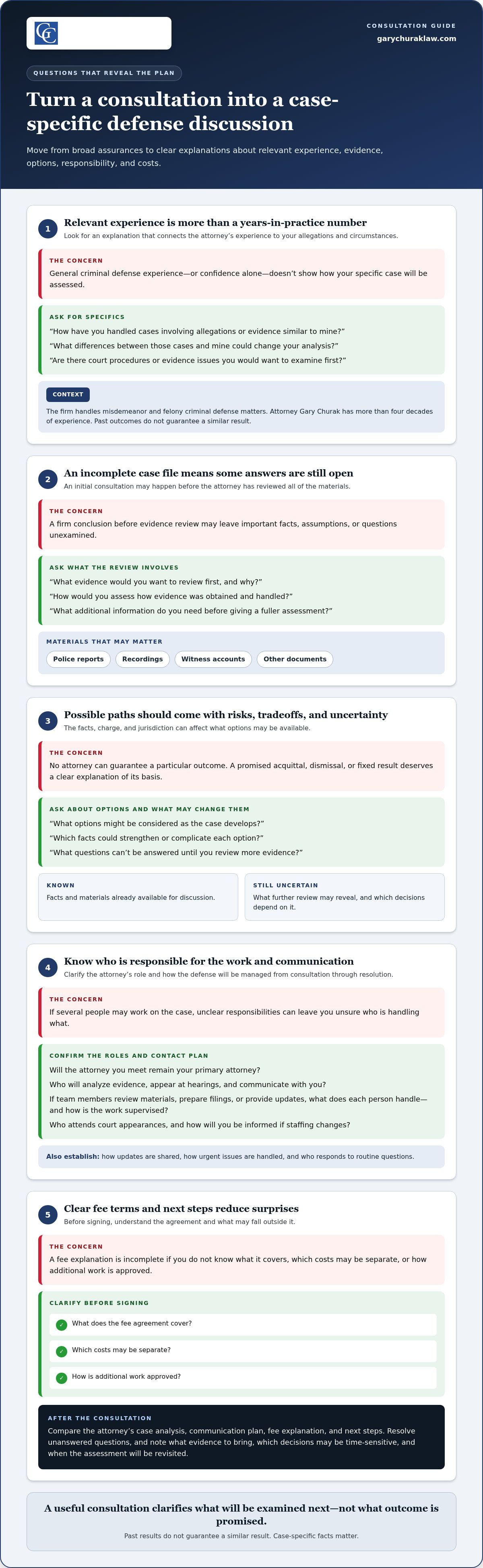
- Use questions to ask a criminal defense lawyer to clarify what evidence needs review, which decisions come first, and what remains uncertain.
- Establish how updates are shared, how urgent issues are handled, and who will respond to routine questions.
- Before signing, clarify what the fee agreement covers, which costs may be separate, and how additional work is approved.
- After the consultation, compare the attorney’s case analysis, communication plan, fee explanation, and next steps, then resolve any unanswered questions.
Questions to Ask a Criminal Defense Lawyer About Your Charges and Their Experience
Direct, respectful questions are a normal part of evaluating legal representation. You’re deciding who may guide you through a serious process, so ask the attorney to explain their experience in ways that relate to your circumstances. The right to an attorney reflects the importance of legal representation, but choosing someone to handle your case also calls for a clear discussion of fit, preparation, and responsibility.
Start with the charges and court processes the attorney handles. A broad criminal defense practice may include many kinds of cases, but relevant experience means understanding the issues raised by your specific allegations. Ask whether the attorney handles misdemeanor or felony cases like yours and whether they have worked with similar evidence or procedural questions. Attorney Gary Churak has more than four decades of experience, and the firm handles a range of misdemeanor and felony criminal defense matters. Years in practice alone, however, don’t show how an attorney would assess your case. Look for a thoughtful, individualized response.
How to ask about experience with your specific charge
Use the questions to ask a criminal defense lawyer to explore the attorney’s process, not to seek private details about other clients or a prediction based on someone else’s result. Ask:
- “How have you handled cases involving allegations or evidence similar to mine?”
- “What differences between those cases and mine could change your analysis?”
- “Are there court procedures or evidence issues you would want to examine first?”
A useful answer identifies relevant considerations while recognizing that the facts of your case matter. Past outcomes don’t guarantee a similar result.
Who will handle the case from consultation through resolution?
Clarify whether the attorney you meet will remain your primary attorney, analyze the evidence, appear at hearings, and communicate with you. If other team members may review materials, prepare filings, or provide updates, ask what each person handles and how the attorney supervises the work. Find out who attends court appearances and how you’ll be informed if staffing changes. Knowing who is responsible helps you understand how your defense will be managed.
Pay attention to the quality of the discussion. A careful attorney may identify questions that still need investigation rather than claim to know everything at an initial meeting. The goal is to leave with a clearer sense of the attorney’s relevant experience, their role, and how they’ll examine your allegations, not with a promised outcome.
Questions to Ask About Evidence, Defense Strategy, and Possible Outcomes
Once you understand an attorney’s relevant experience, focus on the facts of your case. Ask which allegations, deadlines, or immediate decisions need attention first. A court date, a request to provide information, or a decision about how to respond may require prompt attention, but the right priorities depend on the circumstances. Ask the attorney to explain what needs action now and what can wait.
Questions that uncover how the attorney will examine the evidence
An initial consultation may happen before the attorney has reviewed the full case file. Ask what materials could clarify the allegations and what remains unknown until those materials are available. Depending on the case, relevant records might include police reports, recordings, witness accounts, or other documents. You can ask:
- “What evidence would you want to review first, and why?”
- “How would you assess how evidence was obtained and handled?”
- “What additional information do you need before giving a fuller assessment?”
These questions invite the attorney to explain their analysis rather than offer a premature conclusion. The Federal Trade Commission’s guidance on questions to ask when hiring a lawyer also encourages people to discuss how a lawyer will handle their matter. A careful answer should distinguish known facts from assumptions and identify what further review may reveal.
How to discuss options without expecting a guarantee
Ask what paths may be available and which facts could affect them. Follow up about the risks and tradeoffs of each path, including what the attorney can’t yet determine. Procedures and potential consequences vary by jurisdiction, charge, and individual facts, so an explanation should be specific to your situation rather than presented as a universal outcome.
- “What options might be considered as the case develops?”
- “Which facts could strengthen or complicate each option?”
- “What questions can’t be answered until you review more evidence?”
Clear analysis includes uncertainty. If an attorney promises an acquittal, dismissal, or fixed result, ask what facts and reasoning support that statement. No attorney can guarantee a particular outcome, and past results don’t establish what will happen in your case. A measured discussion should help you understand possibilities without disguising risks.
Bring any documents you have and take notes on what the attorney wants to review, which decisions may be time-sensitive, and when you’ll revisit the assessment. The Law Offices of Gary Churak emphasizes thorough case analysis and personalized consultations. Learn about the firm’s criminal defense representation and the matters it handles.
Questions to Ask a Criminal Defense Lawyer About Communication and Case Management
A defense strategy depends on clear communication as the case moves forward. Before hiring an attorney, find out how updates work, who handles routine questions, and what to do if something urgent happens. The questions to ask a criminal defense lawyer should cover more than how to make initial contact. They should help you understand how you’ll stay informed and take part in decisions throughout the representation.
Set clear expectations for updates and urgent questions
Ask how the office typically shares meaningful developments, such as a new court date or a change that requires your attention. Clarify whether updates come by phone, email, or another channel, and whether the attorney or another team member usually provides them. Ask how often you can expect to hear from the legal team if there’s no major development. This helps distinguish routine updates from time-sensitive communication.
Make a plan for unexpected events, too. Ask whom to contact if you’re arrested again, contacted by law enforcement, or facing an urgent deadline. Find out what information to provide and what steps to avoid taking before you receive legal advice. Don’t assume the attorney personally handles every call or that messages are monitored at all times. Clear expectations help you respond more deliberately when pressure rises.
Understand how decisions and preparation will work
Representation involves ongoing decisions, not a single conversation at the start. Ask how the attorney will explain available options, their risks, and what information may still be needed before you decide how to proceed. You should understand how questions will be answered and how the attorney will help you understand the choices in front of you.
Clarify what preparation is expected from you. Depending on the case, the attorney may ask you to organize documents, provide a timeline, or identify potential witnesses. Ask which tasks are appropriate for you to handle and which actions should wait for legal guidance. For example, before responding to questions about the allegations or contacting someone connected to the case, ask the attorney what to do. Don’t guess when a decision could affect your defense.
- Who should I contact with a routine question, and who handles urgent issues?
- How will I receive updates about court dates and important developments?
- How will you explain my options before I make a decision?
- What should I prepare, and what should I avoid doing without your advice?
Before the consultation ends, summarize the communication plan in your own words and ask about anything unclear. A shared understanding of who does what can reduce confusion and help you stay engaged as the case progresses.
Questions to Ask About Legal Fees, the Representation Agreement, and Next Steps
Before you agree to representation, make sure you understand how the legal work will be billed and what the written agreement covers. Fees depend on the case and the specific engagement terms, so a clear explanation matters more than a vague estimate. The questions to ask a criminal defense lawyer should help you understand what you’re agreeing to, what could involve additional charges, and how to raise billing concerns.
Questions that make the fee arrangement clear
Ask the attorney to explain the fee structure in plain language and identify the work included in the agreement. Clarify whether representation covers particular stages or proceedings, and whether expenses or additional work are handled separately. If the case changes in scope, ask how that affects the agreement and whether you’ll receive an explanation before additional work is undertaken.
- How is the fee calculated, and which legal services does it cover?
- Are case-related expenses or additional proceedings handled separately?
- How are billing questions, payment schedules, and changes in scope addressed?
- How will I know if new work may affect the amount I owe?
Ask for the answers in writing or confirm where the agreement explains them. A useful discussion should leave you able to distinguish the attorney’s fee from any separately handled expenses and understand how to raise questions as the case progresses.
What to review before agreeing to representation
Read the engagement agreement carefully before signing. Check that its written terms match what you discussed, including who will represent you, what work is included, and how changes in the case may affect the scope of representation. If a phrase is unclear, ask for an explanation before you commit. Don’t assume an oral explanation changes the written terms.
Compare the complete picture, not just the fee. Consider whether the attorney has explained a case-specific approach, who will handle the work, how communication will function, and what the agreement includes. A lower price alone doesn’t show which arrangement best fits your needs. The Federal Trade Commission’s guidance on hiring a lawyer also recommends discussing fees and the terms of representation.
Once you understand the scope and terms, identify the next steps: what documents the attorney needs, what decisions require your attention, and when representation begins under the agreement. Consider the factors involved in choosing a criminal defense attorney alongside the written terms and the attorney’s explanation of strategy.
The Law Offices of Gary Churak provides criminal defense representation, including case analysis and courtroom advocacy. The firm’s criminal defense services cover a range of misdemeanor and felony matters.
How to Choose a Criminal Defense Lawyer and Move Forward
After a consultation, take time to assess the substance of the answers rather than relying on confidence, pressure, or a promised result. The questions to ask a criminal defense lawyer are useful only if the responses help you understand how the attorney would approach your specific circumstances. A sound decision rests on clear reasoning, relevant experience, and a working relationship you understand.
A simple way to assess the answers you received
Review your notes and compare each conversation against the same practical points. Did the attorney address your specific charges? Did they separate known facts from assumptions and explain what still needs investigation? Consider whether they discussed risks and possible next steps without presenting an uncertain outcome as guaranteed. Clear, balanced answers can help you judge how carefully the attorney considered your situation.
- Relevant experience: Did the discussion focus on matters and procedures connected to your charges?
- Case analysis: Did the attorney explain what they would examine and what remains unknown?
- Communication: Do you understand how updates and urgent questions will be handled?
- Fees and scope: Are the written terms understandable, including what work is covered?
- Next steps: Do you know what information or decisions may be needed next?
If an answer was vague or an agreement doesn’t match what you understood, request clarification before signing. A careful attorney should be able to explain the reasoning and terms in plain language. You don’t need to decide under pressure, and a guaranteed result isn’t a substitute for a sound, case-specific explanation.
Take the next step with a clearer understanding
Prepare for a follow-up conversation by gathering relevant paperwork and writing down your immediate concerns. Note any deadlines or upcoming court dates you know about, and list unanswered questions so you can address them directly. If your matter involves a DWI charge, learn more about strategic DWI defense guidance as you consider what information may be relevant to discuss.
The Law Offices of Gary Churak represents people facing criminal charges and emphasizes thorough case analysis and personalized consultations. The firm handles a range of criminal defense matters, including DUI/DWI, drug offenses, assault, domestic violence, sex crimes, and federal crimes. A conversation can help clarify the allegations, immediate concerns, and possible next steps, without promising a particular outcome.
Choose Your Next Step With Clearer Answers
The right questions to ask a criminal defense lawyer can help you assess more than years of practice. Focus on whether the attorney understands the charges, explains how they’ll examine the evidence, and gives you a clear picture of communication, fees, and next steps. A careful, case-specific discussion is more useful than pressure or promises about results.
Attorney Gary Churak has more than four decades of experience, and the Law Offices of Gary Churak emphasizes thorough case analysis across a range of criminal defense matters. A conversation about your circumstances can help clarify what needs attention and what information may be important to review. No particular outcome can be assured, but you can take a deliberate next step with a better understanding of the process.
Request a consultation with the Law Offices of Gary Churak to discuss your situation. Asking direct questions is a practical way to move forward with greater confidence.
Frequently Asked Questions
What questions should I ask a criminal defense lawyer during a consultation?
Ask whether the attorney handles charges and court processes like yours, what evidence they’d want to review, and what decisions or deadlines need attention first. Clarify who will work on the case, how updates are shared, and what the written fee agreement covers. These questions to ask a criminal defense lawyer should help you understand the attorney’s approach, communication expectations, possible next steps, and what remains uncertain.
How do I know if a criminal defense lawyer has experience with my type of case?
Ask about the attorney’s work with cases involving similar charges, evidence, or procedural issues. Then ask how differences in your facts might affect their assessment. Relevant experience is more useful than a general claim of criminal practice, but years in practice alone don’t establish fit. Listen for a case-specific explanation that distinguishes what the attorney knows from what requires further review, without disclosing confidential information about other clients.
Can I ask a criminal defense lawyer what the likely outcome of my case will be?
Yes. Ask what outcomes or paths may be possible, what facts could affect them, and what risks remain. A lawyer may not be able to assess the case fully before reviewing reports, recordings, or other evidence. Treat a guaranteed acquittal, dismissal, or fixed result as a reason to ask for the supporting analysis. Past results don’t guarantee what will happen in your case.
What should I ask a criminal defense lawyer about fees?
Ask how the fee is calculated and which services the written agreement includes. Clarify whether expenses, additional proceedings, or work caused by a change in case scope are handled separately. Ask how billing questions are addressed, whether there’s a payment schedule, and how additional work is approved. Review the agreement before signing and request clarification if its terms don’t match what you understood from the discussion.
Should I tell a criminal defense lawyer everything about my case?
Be candid and give the attorney a complete, truthful account, including facts that may seem unfavorable. Details you omit could affect how the lawyer evaluates evidence, risks, and next steps. Don’t alter or destroy documents or messages. Ask the attorney how confidentiality applies to your communications, especially if you’re still deciding whether to hire them, since protections can depend on the circumstances and relationship.
Can I change criminal defense lawyers after hiring one?
In many situations, a client can seek to change lawyers, but the process may depend on the case, timing, court requirements, and the representation agreement. Before taking action, discuss concerns with your current attorney and review any terms about fees or ending representation. If you decide to change counsel, plan the transition carefully so important dates, case information, and responsibilities are addressed without avoidable disruption.
What should I bring when meeting with a criminal defense lawyer?
Bring documents related to the case that you have, such as charging papers, court notices, release conditions, police reports, or relevant messages. Write down known dates, a brief timeline, and your questions. If you don’t have a document, don’t delay seeking guidance; tell the attorney what you know and what’s missing. Keep original materials intact, and ask how the attorney would like you to provide any additional records.


