

An investigation is not proof of a crime. If agents are reviewing your financial records, emails, or business decisions, it’s understandable to worry that ordinary actions may be viewed as evidence of wrongdoing. A strong defense for white collar crime charges starts with testing what the evidence actually shows, whether prosecutors can establish criminal intent, and whether investigators followed proper procedures.
You may not know whether an inquiry will lead to formal charges, but choices you make now can matter. A defense attorney can examine investigative steps, scrutinize financial and digital records, and identify legal or factual issues that may affect your options. The aim is to assess the case carefully, not jump to conclusions.
This article explains how white collar investigations may proceed, what evidence investigators may examine, and how a defense can address questions of intent, record interpretation, and procedure. You’ll also learn what to preserve, what to avoid doing without legal guidance, and what to discuss with defense counsel as you consider your next step.
Key Takeaways
- White collar allegations can involve different types of conduct, and the laws and procedures that apply depend on the case.
- Understand the general steps an investigation may take, from gathering evidence to a charging decision and court proceedings.
- A defense for white collar crime charges can examine intent, record reliability, attribution, completeness, and investigative procedures.
- Preserve relevant records and avoid deleting, altering, or selectively disclosing information. Get legal advice before discussing the facts.
- Assess whether your defense counsel clearly explains the evidence, legal issues, risks, and possible paths forward.
What Defense for White Collar Crime Charges Involves
White collar crime is a broad label for alleged financially motivated or business-related offenses. It can describe conduct involving financial transactions, workplace decisions, or business records, but the label alone doesn’t establish that a crime occurred. The White-collar crime overview provides background on the term and the types of offenses commonly associated with it.
It’s important to understand the status of a matter. An inquiry means authorities are examining possible conduct; it doesn’t necessarily mean anyone has been charged. An allegation is a claim of wrongdoing. An indictment is a formal accusation, not a finding of guilt. A conviction occurs only after a guilty plea or a finding of guilt in court.
An accusation may describe suspected conduct, but it does not prove that a person acted with criminal intent. Defense for white collar crime charges involves testing what the records and other evidence establish, and whether they support the required legal elements.
Which allegations are commonly described as white collar crimes?
Examples may include wire fraud, securities fraud, embezzlement, bribery, money laundering, and tax-related offenses. These labels involve different legal elements, and charging decisions depend on the applicable federal or state law. A disputed transaction, accounting error, or business disagreement does not automatically amount to a crime. The surrounding facts and evidence matter.
Why can these investigations affect more than the criminal case?
The stakes may extend beyond potential criminal penalties. Depending on the charges and facts, a person may face concerns about liberty, financial stability, professional standing, and public reputation. These are serious concerns, but no particular consequence is inevitable.
Separate processes can also arise. An employer may make its own decisions about a person’s role, while a regulator may examine related conduct under a different process and standards. Those actions are distinct from a criminal case, even when they involve some of the same events or records. A defense assessment should keep these possible tracks in view without treating one as proof of another. Careful analysis can clarify what is alleged, what the evidence supports, and which legal issues need attention.
How White Collar Investigations Build a Case
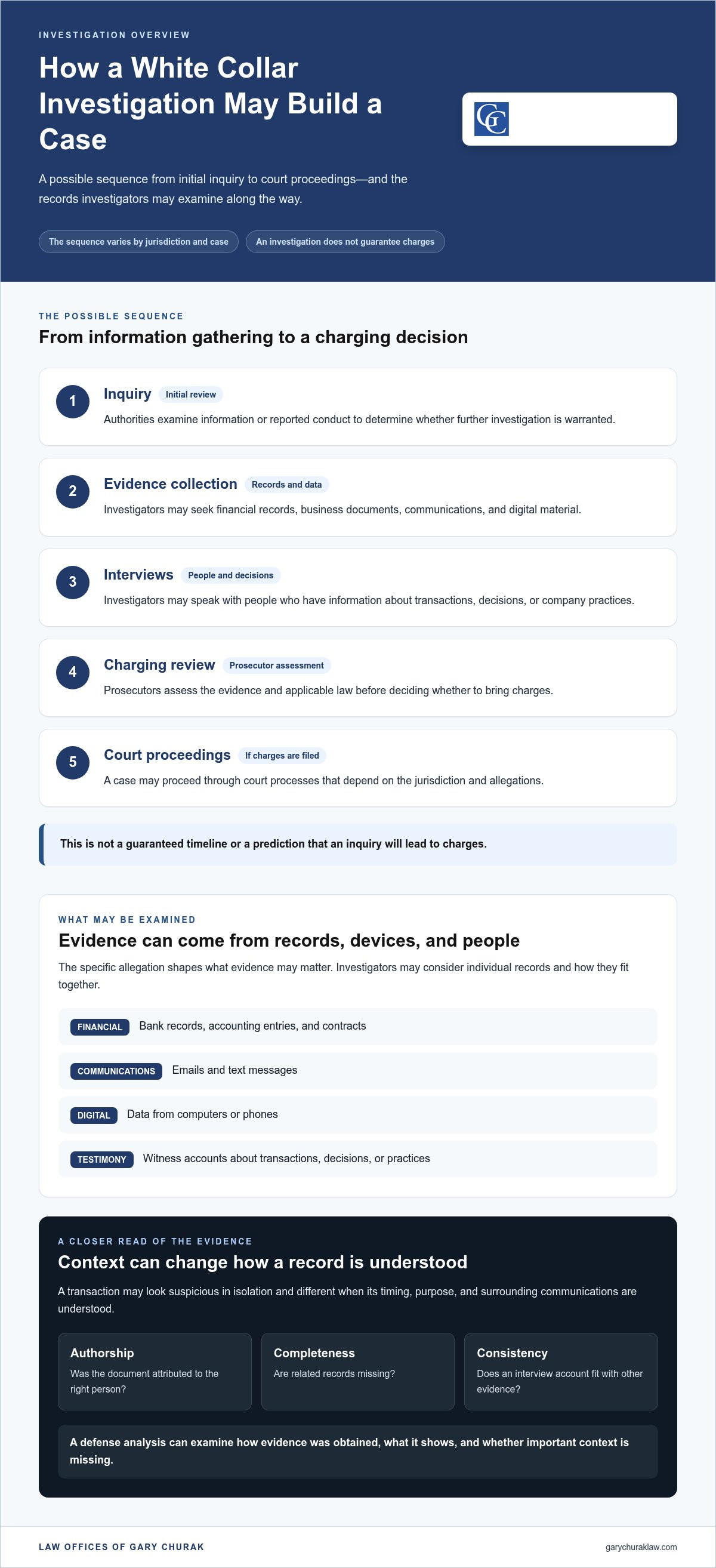
Financial investigations often take shape over time as authorities gather records, compare accounts, and assess whether the evidence supports a charge. The steps vary by jurisdiction and case, but an investigation may include:
- Inquiry: Authorities examine information or reported conduct to determine whether further investigation is warranted.
- Evidence collection: Investigators may seek financial records, business documents, communications, and digital material.
- Interviews: Investigators may speak with people who have information about transactions, decisions, or company practices.
- Charging review: Prosecutors assess the evidence and applicable law before deciding whether to bring charges.
- Court proceedings: If charges are filed, the case may proceed through court processes that depend on the jurisdiction and allegations.
This sequence is not a guaranteed timeline or a prediction that an inquiry will lead to charges. A defense for white collar crime charges can involve examining how evidence was obtained, what it shows, and whether important context is missing.
What evidence may investigators examine?
Potential evidence includes bank records, contracts, accounting entries, emails, text messages, and data from computers or phones. Investigators may also consider witness accounts and how different records fit together. The legal definitions of white-collar offenses vary with the conduct and applicable law, so the specific allegation shapes what evidence may matter. Depending on the suspected conduct, an investigation may involve agencies such as the FBI, SEC, or IRS.
A transaction can look suspicious in isolation and different when its timing, purpose, and surrounding communications are understood. Authorship, completeness, and context can affect how a record is interpreted. Defense counsel can assess whether a document is attributed to the right person, whether related records are missing, and whether an interview account is consistent with other evidence.
What changes when charges are federal?
Federal matters can involve federal investigative agencies, prosecutors, and federal court procedures. State cases follow the applicable state process, and some investigations may involve more than one authority. Federal cases also differ from one another, so the agency involved or the location of proceedings doesn’t, by itself, determine what the evidence proves or how a case will be resolved. For additional background, see “Defending Against Federal Charges: Navigating Complexity.”
Careful case analysis can clarify the records, investigative steps, and legal issues at stake. To discuss how those issues relate to your circumstances, you can arrange a personalized consultation.
How Defense Strategies Address Intent, Evidence, and Procedure
A useful defense analysis tests the prosecution’s theory against the evidence instead of assuming that dense paperwork tells the whole story. The legal definition of white-collar crime depends on the offense charged, and each case turns on its facts and applicable law. Complex records may raise questions, but complexity alone doesn’t prove criminal intent or establish who made a decision.
For defense for white collar crime charges, counsel may examine intent, reliability, attribution, completeness, and investigative procedure. This framework helps identify questions for further review. It does not mean a particular argument will apply or predict the outcome.
| Potential issue | Evidence to examine | Questions counsel may investigate |
|---|---|---|
| Intent and business context | Emails, messages, approvals, transaction records, and company practices | What was the person’s role? Do communications show knowledge, or do they support another reasonable interpretation? |
| Reliability and completeness | Accounting entries, spreadsheets, financial statements, and related records | Are the records accurate and complete? Are surrounding entries or explanations missing? |
| Attribution | Account access, document history, signatures, and device data | Who created, changed, or approved the material, and can that be reliably established? |
| Evidence handling or procedure | Collection records, search materials, and preservation information | How was the evidence obtained and preserved? Are there fact-specific authentication, search, or evidentiary issues? |
How can a defense examine intent and business context?
Intent is assessed in context, not from a single document viewed alone. Counsel may compare communications with a person’s responsibilities, decision-making authority, and the ordinary course of business. A mistake, disagreement over an accounting treatment, or poor business decision isn’t automatically criminal conduct, but no single fact proves or disproves intent. The defense examines how the pieces fit together.
When can evidence handling or procedure matter?
Review may focus on how records were obtained, preserved, interpreted, and tied to a specific person. Authentication concerns whether evidence is adequately identified; search issues and evidentiary objections depend on the circumstances and applicable law. These questions can affect whether or how particular material is considered, but they don’t automatically determine a case. For background on trial evidence, see Federal Rules of Evidence: How They Affect Your Trial.
What to Do if You Face a White Collar Investigation
Take deliberate steps, but don’t try to investigate or explain the matter on your own. Preserve potentially relevant material, keep track of official contacts, and get legal advice before discussing the facts with investigators or publicly. A defense for white collar crime charges should be shaped around the circumstances and applicable law, so avoid actions that could change, obscure, or selectively present the record.
What should you preserve and organize?
Gather existing materials without editing them. Relevant items may include notices, correspondence, contracts, transaction records, and documents about decisions or approvals. Make a factual chronology of significant events and contacts, noting dates, people involved, and any requests or stated deadlines. Keep observations separate from assumptions.
Preserve original digital files and devices that may contain relevant information. Don’t delete messages, revise records, rename files in a way that changes their context, or selectively disclose documents. Keep materials secure, and ask counsel how to provide them through an appropriate process. If you’re unsure whether something matters, preserving it is generally safer than deciding on your own to discard it.
How should you handle interviews, subpoenas, or document requests?
Don’t ignore a subpoena, formal notice, or document request, and don’t assume an informal request has no consequences. Record who contacted you, when, what they requested, and any response date they gave. Before answering questions or producing materials, have counsel assess the request, applicable obligations, and appropriate response. Avoid guessing, speculating, or volunteering explanations before receiving legal advice.
Don’t discuss the facts on social media or in public, and avoid coordinating accounts with colleagues or other potential witnesses. Even a well-intended effort to clarify events can create confusion or be misunderstood. Follow counsel’s direction about communications and preservation, since immediate steps depend on the facts and governing law.
For more on preparing for a legal discussion, see Criminal Defense Consultation: 2026 Strategic Guide. The Law Offices of Gary Churak provides criminal defense representation and can review the circumstances, examine relevant evidence, and discuss potential next steps in a personalized consultation. Arrange a consultation with defense counsel.
Choosing a White Collar Crime Defense Approach and Taking the Next Step
Choosing a defense approach starts with understanding the case, not with a promise about how it will end. Counsel should be able to explain the allegations, which evidence supports or challenges them, and what legal issues may affect the available paths. A clear discussion should also identify immediate priorities, known risks, and what remains uncertain.
Look for a case review that addresses the details of financial and business records rather than treating them as self-explanatory. Ask how counsel will assess the evidence, identify disputed issues, and explain potential next steps. In a defense for white collar crime charges, the strategy should respond to the specific allegations and evidence, and may change as more information becomes available.
What should an initial case discussion clarify?
Bring a concise account of what you know: the allegations or concerns raised, contacts with investigators, any deadlines or requests, and the documents already available. Distinguish firsthand facts from assumptions, and flag anything you don’t understand. Counsel can use these details to assess immediate priorities and determine what further information may be needed.
A productive discussion should help you understand the legal issues and the reasoning behind proposed next steps. For further guidance on evaluating counsel, see Choosing a Criminal Defense Attorney: 2026 Guide.
How can defense counsel build a case-specific response?
At the Law Offices of Gary Churak, case analysis and evidence review help identify what the available material does and does not establish. Counsel can examine disputed facts, assess investigative steps and potential procedural issues, and explain how those considerations may shape a response. Attorney Gary Churak has more than four decades of experience representing people facing criminal charges.
Depending on the case, representation may involve negotiation, preparation for court, or courtroom advocacy. These are possible parts of a defense, not guarantees of a particular resolution. Counsel should explain the reasoning, uncertainties, and potential tradeoffs behind available approaches in terms you can understand.
You don’t have to make sense of every document or investigative contact alone. The Law Offices of Gary Churak offers personalized consultations to discuss your circumstances and possible next steps. Arrange a consultation to have your situation reviewed with care and a focus on the evidence and legal issues that matter.
Take a Deliberate Step Toward a Clearer Defense
White collar investigations can turn on more than a single transaction or document. The meaning of financial records depends on their context, who created or approved them, and what other evidence shows. An inquiry, an allegation, and a conviction are distinct stages, and a careful review can help clarify what the evidence does and doesn’t establish.
Preserve relevant records, keep track of contacts and deadlines, and seek legal advice before discussing the facts with investigators. A defense for white collar crime charges should address the specific allegations, evidence, and legal issues in your case, without assuming that one strategy fits every situation.
Attorney Gary Churak has more than four decades of experience. The Law Offices of Gary Churak provides case analysis, evidence review, negotiation, and courtroom representation, with an approach shaped around the circumstances of each matter. No outcome can be promised, but informed guidance can help you understand your options and priorities.
Discuss your situation with the Law Offices of Gary Churak and take the next step with greater clarity and preparation.
Frequently Asked Questions
What is the best defense for white collar crime charges?
There’s no single best defense for every case; the right approach depends on the charge, evidence, and applicable law. Counsel may examine whether the evidence supports criminal intent, whether records are reliable and complete, and whether investigators followed proper procedures. A careful review can identify disputed facts and legal issues, then help you understand possible paths. No strategy guarantees a particular result.
Can white collar crime charges be dismissed?
Yes, charges may be dismissed in some circumstances, but dismissal depends on the facts, legal issues, and procedural posture. For example, counsel may assess whether the evidence supports the charged offense or whether a legal or procedural issue could affect the case. A weakness in one document doesn’t automatically require dismissal. An attorney can evaluate the record and explain which options may apply.
What happens if I am under investigation but have not been charged?
An investigation doesn’t necessarily mean charges will follow. Authorities may gather records, speak with witnesses, or assess whether the available evidence supports further action. Preserve relevant documents and digital material, keep a record of contacts and deadlines, and avoid discussing the facts publicly or with investigators before getting legal advice. Early guidance can help you understand requests and avoid preventable missteps.
How do prosecutors prove intent in a white collar case?
Prosecutors may rely on a combination of evidence, such as communications, transaction records, witness accounts, and a person’s role in business decisions, to argue that the required intent existed. The specific legal elements depend on the charge. A defense review may examine context, authorship, timing, and competing explanations. No single record necessarily proves or disproves intent; the evidence must be assessed as a whole.
Can emails and financial records be used as evidence?
Yes. Emails, messages, bank records, contracts, and accounting entries may be used as evidence, subject to applicable rules and the circumstances of the case. Their meaning can depend on who created or sent them, when they were made, whether they’re complete, and how they relate to other information. Counsel can examine reliability, attribution, context, and potential legal objections rather than treating a document as self-explanatory.
Do white collar crime charges always involve federal court?
No. White collar allegations may be handled under federal or state law, depending on the conduct, applicable statutes, and other case-specific factors. Some matters may involve more than one authority or process. Federal cases follow federal procedures, while state proceedings are governed by the relevant state system. The label “white collar” alone doesn’t determine which court will hear a case.
When should I contact a defense attorney about a white collar investigation?
Contact defense counsel promptly if investigators reach out, you receive a subpoena or document request, or you learn that your conduct is under review. Don’t wait for formal charges before seeking advice. Preserve relevant records, note requests and deadlines, and avoid giving explanations or producing materials without understanding the request and your obligations. Counsel can review the circumstances and discuss informed next steps.


