

If paying legal fees upfront feels difficult, it’s reasonable to ask, “how do lawyer payment plans work?” A payment plan changes when you pay, not the legal work your lawyer agrees to do. A law firm may accept installments directly, or a third-party lender may pay the firm while you repay the lender, potentially with interest. A retainer is different: it is an advance payment for legal work, not necessarily a payment plan.
Before you agree to any arrangement, understand the total amount due, the payment schedule, the services covered, and what may happen if a payment is late. These terms affect your budget and expectations, especially when you’re facing a criminal charge. This guide explains common fee structures, how installments differ from legal-fee financing, and what to review in a written fee agreement. With those details in hand, you can discuss fees clearly and assess your options.
Key Takeaways
- To understand how lawyer payment plans work, identify who receives your payments and which agreement sets the terms.
- Before agreeing, check which legal services are covered, what work is excluded, and how changes in the case may affect the scope.
- Review the written schedule, total amount due, payment methods, and consequences of late payment so you understand your obligations.
- Prepare for a fee discussion by summarizing your situation and urgent deadlines. Compare the scope and clarity of agreements, not only payment timing.
- Installments can make payments more manageable, but they don’t automatically lower the total fee or define the terms of representation.
How Lawyer Payment Plans Work and What They Change
Legal expenses can be difficult to plan for when a criminal case brings uncertainty and urgent decisions. Asking how do lawyer payment plans work starts with a simple distinction: a payment plan is an agreed schedule for paying legal fees over time instead of paying the full amount at once. The schedule changes when payments are due, not the legal work the lawyer has agreed to perform.
That distinction matters. Installments don’t automatically reduce the total fee, make representation free, or guarantee a particular case result. The representation agreement defines the work and its terms; the payment arrangement explains how the agreed fees are paid. Understanding both helps you plan without assuming that spreading payments changes what your lawyer will do or what will happen in court.
What does a lawyer payment plan usually include?
A payment arrangement may set out installment amounts, due dates, payment methods, and any remaining balance. For example, payments might be due monthly or at stages specified in the agreement. The structure depends on the terms you and the lawyer agree to. Refer to the written fee agreement rather than relying on a verbal summary.
Read the description of services alongside the payment schedule. In a criminal defense matter, the agreement should explain which work is included and how additional work or changes in the case may be handled. Fees and case expenses, such as costs incurred for particular legal work, may be treated separately. Check how the agreement distinguishes them and when each is payable.
Some arrangements involve a third party rather than installments paid directly under an agreement with the law firm. The overview of Legal Cost Finance describes ways legal costs may be spread over time. The practical questions are who receives your payments and which agreement controls your obligations.
Does every lawyer accept payment plans?
No single payment structure applies to every lawyer or case. A lawyer may use different fee arrangements depending on the work and the agreement. Don’t assume an installment schedule is available simply because another firm offers one. For your matter, the written terms are what count.
Before signing, make sure you can identify:
- The legal services covered and any work outside the stated scope.
- The payment amounts, due dates, and accepted payment methods.
- How expenses are handled and what happens if the case or work changes.
- Any terms that explain overdue payments or other consequences of missed installments.
Assess the full arrangement, not just whether the first payment seems manageable. A thorough discussion of the case and proposed work can make the fee terms easier to understand. If a clause is unclear, resolve that uncertainty before signing so your expectations about payment and representation match the agreement.
How Are Lawyer Payment Plans Set Up and Paid?
Once you understand the arrangement, clarify how it will work in practice. If you’re wondering how do lawyer payment plans work from the first discussion to the final installment, take the steps in order. Each one helps connect the payment schedule to the legal work and gives you a written record to refer to.
- Discuss the scope. Describe the case and clarify which legal services the proposed fee covers, along with work that may fall outside it.
- Review the written terms. Read the fee agreement and payment schedule together. Check whether legal fees and case-related expenses are treated separately.
- Agree on the schedule. Confirm the amount due, installment dates, payment methods, and how the remaining balance is calculated.
- Track payments. Keep the signed agreement, receipts, and statements together. Compare each payment with the schedule and follow up promptly about discrepancies.
A schedule may divide a defined total fee into installments, or set recurring payments while fees accrue under another billing structure. These approaches can make the balance more or less predictable. The agreement should explain how payments are applied and what information you’ll receive about amounts paid and still owed. Payment timing and methods are governed by the agreement and applicable professional rules, so get the terms in writing instead of relying on an informal understanding.
What should the written payment schedule explain?
Check that the document identifies each amount due, the due dates, accepted payment methods, and how the balance is calculated. It should also describe the legal services covered and explain how case-related expenses are treated. Fees for legal work and expenses connected to a case may be handled separately, but the agreement determines the arrangement. Keep a signed copy and save payment confirmations so you can reconcile your records with account statements.
How can payment terms vary by fee structure?
With hourly billing, the total can change as legal work is performed and time is recorded. A flat fee sets a defined fee arrangement, but its scope still matters. The written terms should say which services it covers and how additional work is handled. Cornell Law School’s overview of attorney’s fees describes common fee structures, including hourly and flat fees.
Keep two questions separate: How is the fee calculated? and When is it paid? Either fee structure may have its own payment terms. Don’t assume that recurring installments mean the total is fixed or that a flat fee must be paid all at once. Read the fee terms and payment schedule together, and raise unclear language before signing. In a criminal defense matter, a focused discussion of the case can help clarify the work described in the agreement. You can discuss your case and next steps as you prepare to review the terms.
Payment Plans, Legal-Fee Financing, and Other Fee Structures Compared
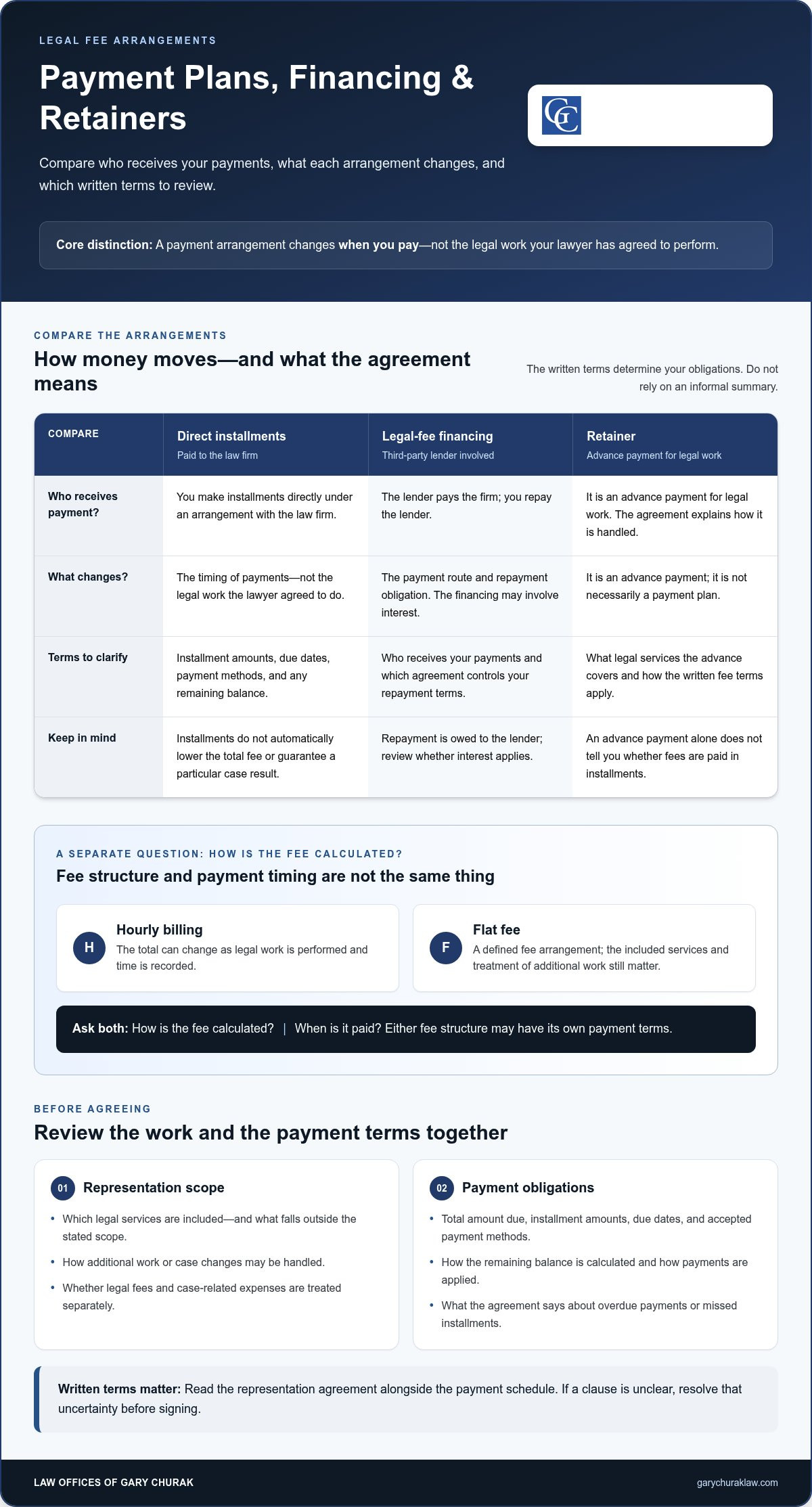
These terms describe different parts of a legal bill. Mixing them up can make it harder to understand what you owe and to whom. To understand how do lawyer payment plans work, identify who receives each payment, who sets the terms, and which written agreement governs. A firm installment arrangement divides payments under its fee agreement. Legal-fee financing involves borrowing through a separate provider, while hourly, flat, and contingency fees describe how a fee may be calculated.
| Arrangement | Who receives payment? | Who sets the terms? | What agreement governs? |
|---|---|---|---|
| Firm installment plan | The law firm | The client and firm agree on the schedule | The fee agreement and payment terms |
| Legal-fee financing | A financing provider receives repayment; it may pay the firm | The provider sets financing terms, subject to its contract | The financing contract, plus a separate agreement for legal services |
| Hourly fee | The law firm | The fee agreement sets the rate and billing terms | The legal-services agreement and applicable billing terms |
| Flat fee | The law firm | The client and firm agree on a defined fee and scope | The legal-services agreement |
| Retainer | The law firm, with handling governed by the agreement and applicable rules | The fee agreement specifies how the advance is handled | The retainer and legal-services agreement |
How does legal-fee financing differ from installments?
With direct installments, you pay the firm under the agreed schedule. Financing adds another party: a provider may pay the firm, then collect repayment from you under a separate contract. That can mean two sets of terms to understand, one covering the legal work and another covering the debt. Review the financing contract for the repayment schedule, interest or other charges, and consequences of missed payments. The firm’s fee agreement does not set out the lender’s obligations.
How do retainers and hourly fees fit into the comparison?
A retainer generally describes an advance payment arrangement, not a billing method or installment plan by itself. The written agreement and applicable professional rules govern how it is held, applied, and accounted for. Hourly charges, by contrast, depend on time recorded and the billing terms you agreed to. A flat fee sets a defined fee for specified work, but the scope remains essential. Cornell Law School’s overview of attorney fee structures provides further context.
Contingency fees are different again: the lawyer’s fee is tied to a recovery rather than paid as ordinary installments. Their use may be restricted by professional rules or unsuitable in some matters, including criminal defense. Don’t treat one structure as interchangeable with another. Compare the agreements, payment recipient, and obligations to understand what the terms mean for your case.
What to Review Before Agreeing to a Lawyer Payment Plan
Before signing, separate the payment schedule from the representation itself. Installments may spread legal fees over time, but they don’t automatically reduce the total amount owed, expand the work covered, or guarantee a particular case result. The written agreement should make clear which legal services are included, what falls outside the scope, and how the fee or schedule may change if the case requires additional work.
Read the terms with your specific case in mind. If a matter becomes more complex or requires work beyond what the agreement describes, look for language explaining how that change will be handled. Don’t rely on assumptions about expenses, payment deadlines, or what happens if you can’t pay on time. Fee and client-fund rules can vary by jurisdiction, so verify the current rules that apply to your situation if you have questions about those provisions.
What happens if a scheduled payment is late?
The agreement and applicable professional obligations shape what may happen after a missed payment. Don’t assume representation automatically ends or that a lawyer can withdraw immediately. Read any late-payment terms carefully, including how the firm communicates about a missed installment and what steps may follow. If a payment problem arises, contact the lawyer promptly and request written clarification of any revised arrangement. Clear communication can help you understand your options before the issue escalates.
Which questions help clarify the agreement?
Before signing, make sure you can answer these questions from the written terms:
- Which legal services are covered, and what work is excluded?
- How will additional work or a change in case scope affect fees and payments?
- What are the due dates, accepted payment methods, and stated consequences of late payment?
- How are case-related expenses handled, and how can you track payments and the remaining balance?
Keep a copy of the signed agreement and save receipts, statements, and written communications about payment terms. If a clause is unclear, ask for an explanation in writing before you commit. This gives you a reliable reference if questions arise later and helps you understand how the payment terms relate to the work being done.
Prepare for a meeting by organizing your case documents, noting urgent deadlines, and listing questions about the proposed scope and fee terms. The criminal defense consultation guide can help you plan that discussion. For a clearer view of your case and next steps, discuss your criminal defense matter.
How to Discuss Legal Fees and Choose Your Next Step
A focused fee conversation starts with the facts of your case, not a promise about what will happen. If you’ve been asking how do lawyer payment plans work, use the discussion to understand both the proposed payment terms and the legal work involved. Payment timing matters, but it shouldn’t be the only factor in deciding whether an arrangement fits your needs.
Prepare in a clear order:
- Summarize the situation. Briefly explain the charge or legal issue, key events, and any steps already taken.
- Identify urgent deadlines. Note upcoming court dates, required responses, or other time-sensitive matters so they can be considered alongside the case.
- Review the fee terms. Ask what the proposed representation covers, how the fee is calculated, and what payment obligations the written agreement sets out.
Understanding the work is essential. A criminal defense attorney’s role may involve analyzing the case and representing you in court, but the engagement agreement should describe the specific services covered in your matter. Compare that scope and the clarity of the agreement, not just how soon or often payments are due.
How can you prepare for a legal-fee conversation?
Gather relevant case documents, write down your immediate questions, and list important dates before the meeting. Explain your financial concerns plainly, without assuming a particular payment arrangement is available. Take time to read the engagement agreement carefully. If a term is unclear, ask for an explanation before signing so you understand the commitment you’re making.
What should guide your decision to move forward?
Look for a clear connection between the work described, the billing structure, and your payment obligations. Consider whether the agreement explains what is included, how additional work is addressed, and when payments are due. Weigh those terms against the legal representation you need. A manageable schedule alone isn’t enough if the scope or obligations remain confusing, and no fee structure should be treated as a promise of a particular case outcome.
Take the next step with a clear record of your questions and priorities. A consultation can help you discuss the circumstances of your criminal case, understand the work it may involve, and review the terms of representation. Request a consultation to discuss your case and make your decision with a fuller understanding of your legal needs and the written terms.
Take the Next Step with Clarity
Cost concerns shouldn’t keep you from getting a clear picture of the legal decisions ahead. Bring your questions, share what you’re worried about, and ask for the proposed scope and fee terms in writing. Understanding how do lawyer payment plans work is part of that preparation, but the next step is a direct discussion of your case and the representation it may require.
At the Law Offices of Gary Churak, personalized consultations and thorough case analysis help frame that discussion. Attorney Gary Churak brings more than four decades of criminal defense experience, including courtroom representation. A free initial meeting is often available. The focus is on helping you understand the legal issues and next steps, not promising a particular outcome.
Request a consultation to discuss your case and take a steady, informed step forward.
Frequently Asked Questions
Do lawyers offer payment plans?
Some lawyers may agree to installments, while others use different fee structures. There’s no universal requirement or standard schedule. If you’re asking how do lawyer payment plans work in practice, check the engagement agreement for payment dates, covered services, and any stated late-payment terms. Don’t assume installments are available because another firm offers them. Compare the written terms with what you discussed, and resolve any differences before committing.
Can I hire a lawyer without paying the entire fee upfront?
That depends on the lawyer’s fee structure, your matter, and the agreement offered. An arrangement might divide payments over time, require an advance payment, or use another billing approach. Before deciding, compare the due dates with your expected income and other obligations. Also account for expenses if the agreement treats them separately. The goal is to understand the full financial commitment, not just whether the first payment seems manageable.
What happens if I miss a lawyer payment plan payment?
The consequences depend on the written agreement and applicable professional rules. A missed payment doesn’t automatically mean representation ends, and you shouldn’t assume a lawyer can withdraw without following required procedures. If you’re at risk of missing a due date, contact the lawyer promptly. Explain which payment is affected, ask what the agreement requires, and keep written records of any response or schedule changes.
Are lawyer payment plans the same as legal-fee financing?
No. An installment arrangement is generally a schedule for paying fees under an agreement with the law firm. Legal-fee financing may add a separate provider, contract, and repayment obligations. Before accepting financing, identify who receives your payments, when repayment begins, and what charges or missed-payment terms the contract states. Keep the financing documents separate from the legal-services agreement so you can review each set of obligations accurately.
Does a lawyer payment plan include court costs and other expenses?
Not necessarily. The agreement should tell you whether the schedule applies to legal fees, case-related expenses, or both. Expenses may include filing charges or costs for outside services, depending on the matter and the written terms. Check how each category is billed and when payment is expected. For example, a fee schedule may not explain whether a separate expense is due when it arises, so review that language before signing.
Can I negotiate a lawyer’s payment schedule?
You can raise your preferred timing, but any arrangement depends on what you and the lawyer agree to in writing. Prepare a realistic proposal based on the dates you can meet, then compare it with the offered schedule and total obligation. If terms change during discussion, make sure the final document reflects the updated agreement. A clear record helps prevent later confusion about which schedule applies.
Are payment plans available for criminal defense lawyers?
Criminal defense lawyers use different fee structures, and payment arrangements vary by lawyer and case. During a consultation, explain the charge, upcoming court dates, and immediate concerns so the discussion can address the legal work involved as well as the fee terms. Review the agreement before deciding whether to proceed. A payment arrangement doesn’t define the case outcome, so focus on understanding the representation and obligations documented in writing.


