

Your future in Texas can change in less than 15 days, regardless of whether you've ever been in legal trouble before. Most people assume a first-time arrest is a minor setback, but the reality of a dwi in texas first offense is a high-stakes forensic battle that begins the moment the handcuffs click. You're likely feeling the weight of potential jail time and the crushing anxiety of losing your right to drive. It's a heavy burden to carry, especially when your employment and reputation are on the line. I understand the fear that comes with facing a system that feels designed to work against you.
This guide provides the strategic roadmap you need to challenge the state's evidence and protect your livelihood. You'll learn how to manage the complex 2026 legal standards, including the critical steps to request an ALR hearing before your license is automatically suspended. We will explore the technical scrutiny required to fight for a dismissal and how the expanded SB 731 legislation may offer a path to sealing your record. By understanding the logical path forward, you can move from a state of uncertainty toward a clear, aggressive defense of your freedom.
Key Takeaways
- You must act within 15 days of your arrest to request an Administrative License Revocation hearing, or you face the automatic suspension of your driving privileges.
- A dwi in texas first offense is a serious Class B misdemeanor, but strategic legal intervention can help you avoid maximum fines and jail time.
- Effective defense involves a technical scrutiny of the state's evidence, specifically challenging the legality of the traffic stop and the reliability of field sobriety tests.
- New legislative updates in 2026 provide clearer pathways for record sealing and non-disclosure, potentially protecting your career from a permanent criminal record.
The Legal Landscape of a First DWI in Texas
Texas law is unforgiving when it involves operating a vehicle under the influence. Texas Penal Code Section 49.04 serves as the primary authority, defining Driving While Intoxicated as the act of operating a motor vehicle in a public place while intoxicated. Under current Texas Alcohol Laws, the definition of a "public place" is surprisingly broad. It extends far beyond state highways and city streets to include any location where a substantial group of the public has access, such as shopping center parking lots, apartment complex driveways, or even some private roads. Understanding this scope is vital, as it limits the common defense that the vehicle wasn't on a main road.
The state establishes intoxication through two distinct standards. The first is the "per se" limit, which is a Blood Alcohol Concentration (BAC) of 0.08% or higher. However, the law also allows for prosecution based on the subjective "loss of the normal use of mental or physical faculties" due to alcohol or drugs. This means you can face a dwi in texas first offense charge even if your BAC is below the legal limit if an officer decides your coordination or judgment appears impaired. This subjective standard is often where the most aggressive legal challenges are mounted, as it relies heavily on an officer's individual perception.
Class B vs. Class A Misdemeanor DWI
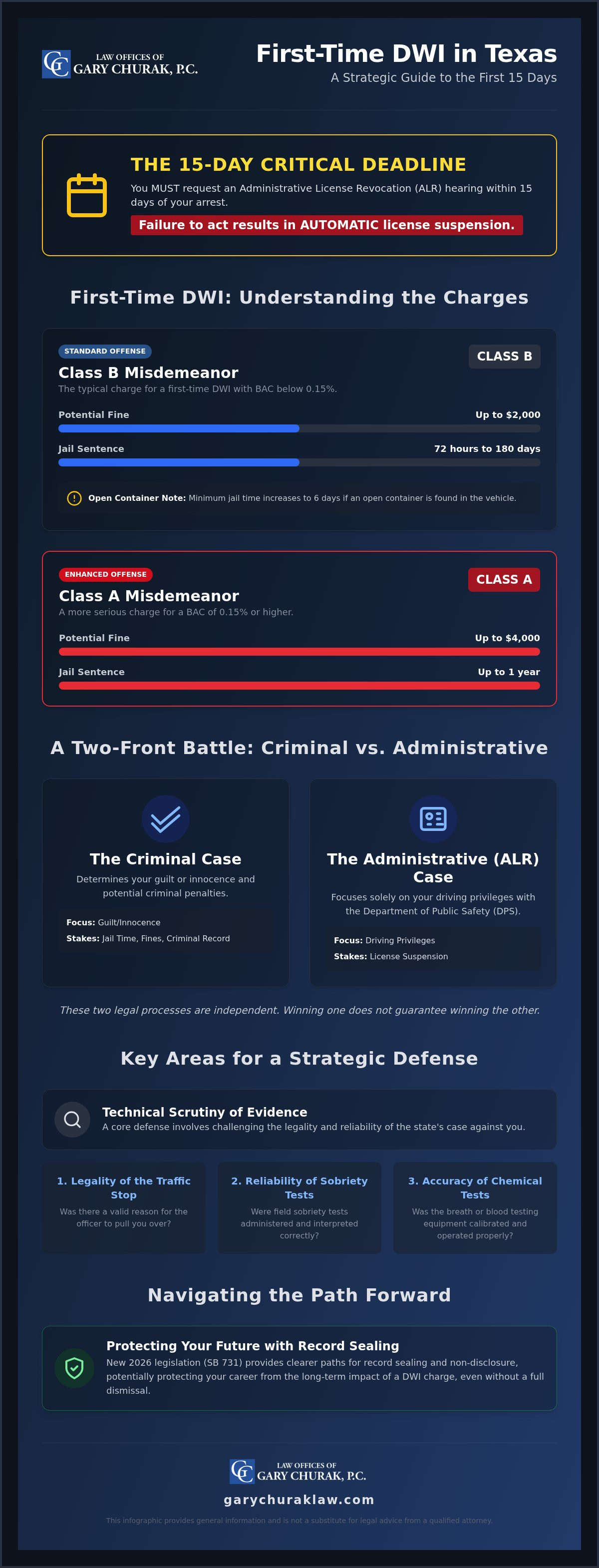
Most first-time arrests are classified as Class B Misdemeanors. This standard charge carries a potential fine of up to $2,000 and a jail sentence ranging from 72 hours to 180 days. If the police find an open container in your vehicle, the minimum jail time increases to six days. It's a serious situation that demands immediate action to prevent these maximum penalties from becoming your reality.
The stakes escalate if your BAC is measured at 0.15% or higher. In these cases, the state enhances the charge to a Class A Misdemeanor. A conviction at this level doubles the potential fine to $4,000 and extends the maximum jail sentence to one full year. Protecting your future against an enhanced charge requires a methodical scrutiny of the chemical testing equipment and the protocols followed during your arrest.
The Two-Front Battle: Criminal vs. Administrative
An arrest triggers two separate legal battles that move on different tracks. The criminal case handles your guilt or innocence and potential jail time. Simultaneously, the Department of Public Safety (DPS) initiates an administrative case known as Administrative License Revocation (ALR). This second case focuses solely on your driving privileges.
Winning your criminal trial doesn't automatically stop the DPS from suspending your license. Conversely, keeping your license at an ALR hearing doesn't guarantee a dismissal in criminal court. These systems operate independently with different rules. A seasoned protector must manage both timelines at once, ensuring that the evidence gathered in one case can be strategically used to strengthen your position in the other.
Immediate Deadlines: The 15-Day ALR Hearing Rule
The clock begins ticking the moment an officer serves you with a notice of suspension. This document, often a yellow piece of paper known as a DIC-24, signifies that the state intends to revoke your driving privileges regardless of what happens in criminal court. For anyone facing a dwi in texas first offense, this is the first critical hurdle. You have exactly 15 days from the date of that notice to request an Administrative License Revocation (ALR) hearing. If you fail to act within this narrow window, your license will be automatically suspended 40 days after the arrest, leaving you with few options to regain your mobility.
While the criminal definitions of intoxication are found in Texas Penal Code Chapter 49, the ALR process is an administrative function of the Department of Public Safety. It is a separate battleground where specific procedural rules apply. Requesting this hearing is not just a formality; it is a defensive maneuver that stays the suspension of your license until the hearing occurs, often buying you months of legal driving time while your case is prepared.
How to Request an ALR Hearing in 2026
Submitting a request requires precision. You can complete this through the Texas DPS portal or by certified mail. You must provide your full name, driver's license number, the date of your arrest, and the county where the incident occurred. Any error in these details can lead to a denial of your request, resulting in an automatic loss of your license. Many individuals find that having an attorney handle this filing ensures no technical mistakes forfeit their rights. If you need assistance managing these early deadlines, a personalized case review can help secure your standing with the DPS.
The Discovery Advantage of ALR Hearings
The ALR hearing serves as a strategic "mini-trial" that offers a significant advantage for your criminal defense. It provides the first opportunity to obtain the evidence the state plan to use against you, including police reports and dashcam or bodycam footage. This discovery process allows your attorney to scrutinize the state's narrative before you ever set foot in a criminal courtroom.
Perhaps most importantly, the hearing allows for the cross-examination of the arresting officer under oath. If the officer's testimony at the ALR hearing contradicts their written report or their later testimony in criminal court, that inconsistency can be used to impeach their credibility. This tactical preview of the prosecution's case is a cornerstone of a robust defense for a dwi in texas first offense. It forces the state to show its hand early, allowing for a more calculated and effective response during the criminal trial.
Criminal Penalties and Enhancements for First-Time Offenders
A standard conviction for a dwi in texas first offense is categorized as a Class B Misdemeanor. This classification carries significant consequences that can disrupt your life, including a potential jail sentence of up to 180 days and a fine that can reach $2,000. Your driver's license may also be suspended for a period ranging from 90 days to one full year. Beyond these immediate penalties, the state imposes a mandatory State Traffic Fine upon conviction. This administrative penalty ranges from $3,000 to $6,000, typically assessed over a three-year period. It is a heavy financial burden that many drivers overlook until the court mandates it as a permanent part of their record.
Specific aggravating factors can drastically alter the severity of the charge and the resulting punishment. If an officer finds an open container of alcohol in your vehicle at the time of the stop, the minimum jail time increases from 72 hours to six days. Causing an accident while intoxicated also invites harsher scrutiny from prosecutors, even if no injuries occurred. Most severely, driving while intoxicated with a passenger under the age of 15 is a state jail felony, which is punishable by up to two years in a state jail facility and a fine of up to $10,000. These enhancements reflect the state's aggressive stance on public safety. Reviewing the official Texas DWI penalties highlights how quickly a misdemeanor can escalate into a felony based on these narrow criteria.
The 0.15 BAC Enhancement
When a chemical test reveals a BAC of 0.15% or higher, the charge jumps from a Class B to a Class A Misdemeanor. This shift doubles the potential jail sentence to one full year and increases the maximum fine to $4,000. At this level, the legal system views the offense with heightened scrutiny, often requiring more intensive probation terms and community service. A strategic defense must focus on the technical accuracy of the breath or blood test to prevent such a severe enhancement from sticking to your record.
Ignition Interlock Device (IID) Requirements
Under 2026 regulations, the court often mandates the installation of an Ignition Interlock Device (IID) as a condition of bond or probation, particularly for high-BAC offenses. You should expect an installation cost between $50 and $150, followed by monthly monitoring fees ranging from $60 to $100. While these costs are an added burden, the IID can be a vital tool in your defense strategy. Installing the device early can often help your attorney secure an Occupational Driver’s License (ODL). This allows you to maintain your employment and daily responsibilities while your dwi in texas first offense case moves through the system, providing a logical path to reclaiming your independence.
Proven Defense Strategies for Challenging Evidence
Evidence is not an absolute truth. It is a collection of observations and measurements that must meet strict legal and scientific standards to be admissible in court. The first line of defense often begins with the traffic stop itself. Under the Fourth Amendment, an officer must have reasonable suspicion that a crime or traffic violation occurred before pulling you over. If the initial stop lacked a valid legal basis, any evidence obtained afterward, including breath tests or incriminating statements, may be suppressed. This effectively halts the prosecution's case before it gains momentum.
Another powerful strategy involves the concept of "rising blood alcohol." The defense of rising blood alcohol highlights that your BAC may have been below the legal limit while you were behind the wheel, only peaking later during the police station's testing process. Because the law focuses on your level of impairment at the exact time of driving, this scientific reality can create the reasonable doubt necessary for a dismissal of a dwi in texas first offense.
Challenging Field Sobriety Tests
Officers rely on three Standardized Field Sobriety Tests (SFSTs) to build probable cause for an arrest. These include:
- Horizontal Gaze Nystagmus (HGN): Tracking involuntary eye movement.
- Walk and Turn: A divided-attention task involving walking a straight line.
- One Leg Stand: A balance and counting test.
These tests are only valid if administered under strict, standardized conditions. Environmental factors such as high winds, uneven pavement, or poor lighting can easily invalidate the results. Furthermore, medical conditions like inner ear issues, back injuries, or even certain vision impairments can cause "false positives" that look like intoxication to an untrained eye. We scrutinize the officer's training and the dashcam footage to identify every deviation from the required protocols.
Forensic Scrutiny of Blood and Breath Tests
Breath-testing machines used in Texas have inherent margins of error and require constant maintenance. If the machine's logs show it was out of calibration or if the operator failed to observe a 15-minute waiting period before the test, the results become unreliable. Blood tests are equally vulnerable to technical errors. We examine the 'Chain of Custody' to ensure the sample wasn't tampered with or mislabeled. In some cases, blood vials that are not properly refrigerated can undergo "fermentation," a process where the sample produces its own alcohol, leading to a falsely high BAC reading.
Protecting your record from a dwi in texas first offense requires an advocate who understands these technical vulnerabilities. You can contact the Law Offices of Gary Churak to begin a thorough review of the evidence in your case.
Navigating the Outcome: Probation, Dismissal, and Record Sealing
The resolution of your case defines the trajectory of your professional and personal life for years to come. While a dismissal through aggressive advocacy is always the primary objective, understanding the alternative outcomes for a dwi in texas first offense is essential for long-term protection. For individuals concerned about how these legal matters might affect their business or legacy, Massingill Attorneys & Counselors at Law offers specialized counsel in Texas business law and estate planning. Texas law provides specific mechanisms designed to prevent a single mistake from becoming a permanent stain on your criminal history. You need a strategic approach to ensure that the final judgment reflects the best possible scenario for your future.
A conviction is a permanent mark, but a successfully completed probation or a dismissal can lead to a much different future. The strategic choice between fighting for a "not guilty" verdict and negotiating for a specialized program depends entirely on the specific weaknesses identified in the state's evidence during the initial case review. We focus on identifying the path that offers the most resilience against future background checks.
Deferred Adjudication vs. Straight Probation
Deferred Adjudication is a strategic option that allows you to avoid a formal conviction. Unlike straight probation, where a judge finds you guilty but suspends the sentence, deferred adjudication involves the court postponing a finding of guilt while you complete the requirements of your supervision. If you successfully finish the program, the case is dismissed. This means you don't have a final conviction on your record, though the arrest record itself requires additional steps to seal.
This path is often the preferred strategic outcome for eligible clients who want to protect their careers. It requires strict adherence to court mandates, including the mandatory installation of an ignition interlock device and the completion of a 12-hour DWI education program. Choosing this route provides a logical path toward a clean slate while minimizing the risk of a high-stakes trial. It offers a sense of order and control in a process that often feels chaotic.
Sealing Your Record: Orders of Non-Disclosure
An Order of Non-Disclosure serves as a legal shield that seals your record from public view. This is critical for maintaining your standing in the community and passing background checks for housing or professional licensing. Eligibility for sealing a dwi in texas first offense generally requires that your BAC was below 0.15 and that the incident didn't involve an accident with injury to another person. Successfully obtaining this order means private entities cannot see the arrest or the court case during a standard search.
If an accident did involve significant injuries, the legal process becomes considerably more complex, often involving civil litigation for negligence. In such instances, Rad Law Firm provides specialized representation for victims of catastrophic accidents and negligence, addressing the serious civil implications that can arise.
Legislative trends in 2026, including the expansion of SB 731, have created more streamlined pathways for the automatic sealing of eligible first-time offenses. The waiting period to become eligible for non-disclosure can be as short as two years if an ignition interlock device was installed for at least six months, and five years otherwise. You should contact the Law Offices of Gary Churak to discuss your eligibility for record sealing and ensure your future remains protected from the lasting effects of a criminal record.
Take Decisive Action to Shield Your Future
Facing a dwi in texas first offense is undoubtedly one of the most stressful experiences you'll encounter. However, you don't have to navigate this complex legal landscape alone. By acting within the 15-day ALR deadline and applying technical scrutiny to the state's evidence, you can significantly alter the outcome of your case. Whether we are challenging the reliability of field sobriety tests or pursuing an order of non-disclosure to seal your record, every decision must be strategic and deliberate. This methodical approach is the only way to move from a state of uncertainty toward a clear resolution.
You deserve a battle-tested protector who understands the logical path forward. With over 40 years of experience in aggressive DWI defense, I provide the personalized case analysis and strategic planning required to fight for a dismissal or reduction of charges. My firm has a proven record of advocating for first-time offenders to ensure their future remains intact. Protect your future with a free consultation from Gary Churak. There is a clear way through this challenge, and with the right advocate, you can regain your peace of mind.
Frequently Asked Questions
Is jail time mandatory for a first DWI in Texas?
Texas law mandates a minimum of 72 hours in jail for a Class B misdemeanor conviction. However, a judge can often grant community supervision, also known as probation, which suspends the actual time you spend behind bars. If an officer found an open container in your vehicle, the mandatory minimum incarceration increases to six days. A strategic defense aims to secure probation or a dismissal to prevent any additional time in custody beyond the initial arrest.
Can I refuse a breathalyzer or blood test in Texas?
You have the legal right to refuse a breath or blood test, but doing so triggers immediate administrative penalties. Under Texas's implied consent laws, refusal results in an automatic 180-day driver's license suspension. While refusal prevents the state from obtaining immediate chemical evidence, officers can often secure a search warrant from a judge to perform a forced blood draw anyway. It's a high-stakes decision that requires an immediate defensive response to protect your driving privileges.
How long does a first-offense DWI stay on your record in Texas?
A dwi in texas first offense remains on your criminal record permanently unless you successfully petition for an Order of Non-Disclosure. Convictions are generally not eligible for expunction, which completely erases a record, but sealing is an option for many first-time offenders. Eligibility for sealing typically begins after a waiting period of two years if you used an ignition interlock device, or five years if you didn't, provided you meet all other legal requirements.
What is an Occupational Driver’s License (ODL) and how do I get one?
An Occupational Driver's License is a restricted permit that allows you to drive for work, school, or essential household duties during a suspension. To obtain one, your attorney must file a formal petition with the county or district court to demonstrate an essential need for driving. You'll likely need to provide proof of SR-22 insurance and, in many cases, install an ignition interlock device as a condition of the court's approval. It's a vital tool for maintaining your livelihood while your case is pending.
Will I lose my job if I am charged with a first-offense DWI?
Texas is an at-will employment state, meaning an employer can legally terminate your contract due to a criminal charge or conviction. Whether you lose your job often depends on your specific company policy or professional licensing requirements. If your role involves driving a company vehicle or requires a clean background check, the impact of a dwi in texas first offense can be immediate. Taking aggressive steps to challenge the charge is the best way to protect your professional reputation.
What happens if I missed the 15-day ALR hearing deadline?
If you miss the 15-day window to request an ALR hearing, your driver's license will be automatically suspended 40 days after your arrest. You forfeit the right to challenge the officer's testimony or the legality of the stop in an administrative setting. In this situation, your only option for legal driving is to apply for an Occupational Driver's License through the court system. Missing this deadline makes the process of retaining your mobility much more difficult and expensive.
How much does a typical first-time DWI defense cost?
The total cost of a defense varies based on the complexity of the evidence and whether the case proceeds to a jury trial. You should account for court costs, administrative fees for license reinstatement, and mandatory state traffic fines that range from $3,000 to $6,000 upon conviction. Investing in a thorough evidence review is a strategic choice aimed at avoiding these heavy financial burdens and the long-term costs associated with a permanent criminal record.
Can a first-offense DWI be dismissed in Texas?
Yes, a first-offense DWI can be dismissed if your attorney identifies significant flaws in the prosecution's evidence. Common grounds for dismissal include a lack of reasonable suspicion for the initial traffic stop, improperly administered field sobriety tests, or technical errors in the blood and breath testing procedures. Identifying these case-specific weaknesses through technical scrutiny is the most effective way to secure a dismissal or a reduction of the charges against you.


