

What if the "scientific" evidence used to arrest you for a DUI is actually based on flawed assumptions rather than absolute certainty? It's natural to feel overwhelmed when facing a flashing light and a breathalyzer. You likely feel that once a machine displays a number at or above the 0.08% legal limit, your future is already decided. The anxiety of losing your driver's license, facing jail time, or losing your job can be paralyzing when you're navigating a legal system that feels designed to work against you.
Experienced drunk driving lawyers understand that a criminal charge is a legal challenge to be dissected, not an automatic conviction. We agree that the stakes are high, but a breathalyzer reading isn't the final word on your guilt. This article will show you how strategic advocacy can expose the weaknesses in the prosecution's case, from faulty equipment calibration to improper police procedures. We'll debunk common myths about chemical tests and field sobriety exercises, providing a clear path toward protecting your rights and your career. You'll learn how even the most seemingly airtight evidence can be challenged by a seasoned legal professional who knows where to look for errors.
Key Takeaways
- Recognize that Blood Alcohol Concentration (BAC) results are legal estimates that can be challenged based on equipment calibration and forensic testing standards.
- Understand that while politeness is important, your statements to law enforcement are primary tools used to build a prosecution case rather than prevent an arrest.
- Identify how experienced drunk driving lawyers provide a strategic alternative to "pleading out" by conducting a thorough, personalized analysis of the evidence.
- Learn the necessary steps to protect your driving privileges by challenging Administrative License Revocation instead of accepting it as a final outcome.
- Discover why a battle-tested defense strategy is essential for mitigating the long-term impact of a charge on your employment and criminal record.
Debunking the Myth of the 'Infallible' Breathalyzer and Blood Test
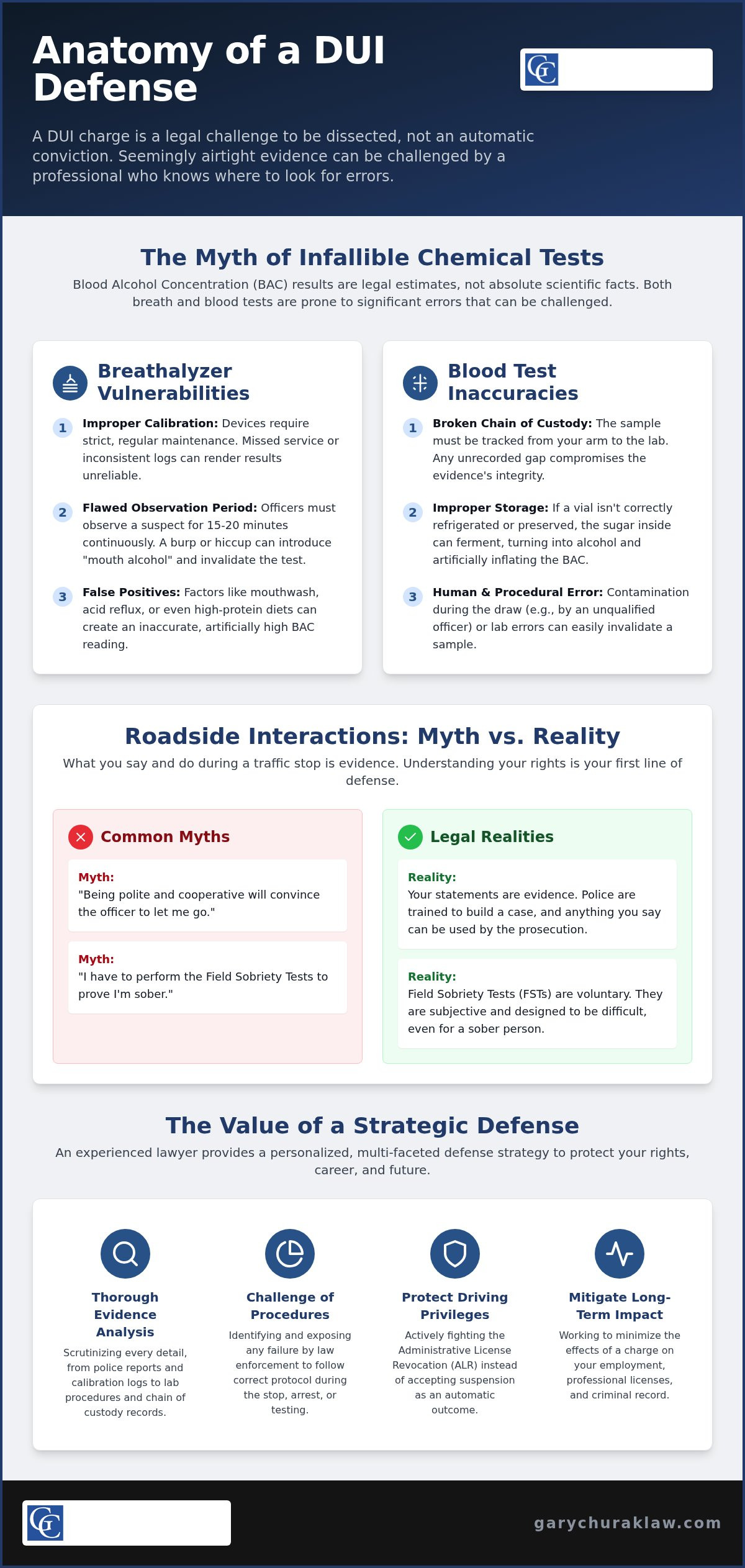
Many people assume that a Blood Alcohol Concentration (BAC) reading is an indisputable scientific fact. In reality, BAC is a legal estimate used to enforce DUI laws in the United States. It isn't an absolute truth. Breathalyzers are essentially calculating machines. They don't measure the alcohol in your blood directly; instead, they measure the alcohol in your breath and use a mathematical formula to estimate what's in your veins. This process is prone to significant error. Factors like mouth alcohol from recent use of mouthwash, medical conditions like acid reflux, or even a high-protein diet can lead to false positives. When these variables are ignored, an innocent person can face life-altering charges based on a flawed number.
The Fallibility of Breath Testing Equipment
Breath testing devices rely on fuel cell or infrared sensors to detect alcohol molecules. These sensors are delicate. They require perfect calibration and regular maintenance to remain even remotely accurate. If a device hasn't been serviced according to strict state-mandated schedules, its results are questionable. Law enforcement must maintain detailed logs for every device. If those logs show a pattern of inconsistency or missed maintenance, the evidence may be unreliable. Additionally, officers must observe a suspect for a continuous 15 to 20 minute period before taking a sample. This ensures the suspect doesn't burp, vomit, or consume anything that could introduce "mouth alcohol" into the machine. A single lapse in this observation period can invalidate the entire test result.
Challenges to Blood Draw Procedures
While blood tests are often viewed as the gold standard, they are far from 100% accurate. Human error in the laboratory or during the collection process can easily invalidate a sample. Drunk driving lawyers often scrutinize the "chain of custody" for these samples. This record tracks every person who handled the blood from the moment it left your arm until it reached the testing machine. If there's a single unrecorded gap, the integrity of the evidence is compromised. Beyond that, improper storage can lead to fermentation. If a blood vial isn't refrigerated correctly or lacks the proper preservatives, the sugar in the blood can turn into alcohol inside the tube. This artificially inflates the BAC level, making a sober person appear intoxicated.
Strategic drunk driving lawyers look beyond the initial police report to find these technical failures. They understand that a blood draw performed by a police officer instead of a qualified medical professional can lead to contamination. By investigating the specific procedures used in your case, a defense team can challenge the prosecution's narrative and protect your future from flawed data. A charge is only as strong as the evidence supporting it, and science is only reliable when the rules are followed perfectly.
Myth vs. Reality: Should You Cooperate Fully with Law Enforcement?
Many drivers believe that being helpful and polite will convince an officer to let them go with a warning. This is a common trap. While maintaining a professional demeanor is wise, excessive "cooperation" often provides the prosecution with the very evidence they need to convict you. Police officers are highly trained evidence gatherers. Their primary goal during a stop isn't to be your friend; it's to build a case that justifies an arrest.
Every statement you make and every test you perform is being documented. If you're worried about the long-term consequences of a DUI, you must understand that the roadside is a stage for the prosecution's opening act. You have the right to protect yourself from self-incrimination before the situation escalates. You don't have to provide the ammunition used to take away your license.
The Dangers of Voluntary Field Sobriety Tests
Most people don't realize that Field Sobriety Tests (FSTs) are voluntary in most jurisdictions. Officers rarely mention this fact. They present the tests as a standard, mandatory part of the stop, but "passing" these tests is entirely subjective. An officer decides if you swayed too much or started the "walk and turn" too early. Physical conditions like back pain, inner ear issues, or even wearing the wrong footwear can cause you to "fail" even if you're stone-cold sober. Uneven road surfaces and flashing patrol lights also create an environment where failure is almost guaranteed.
The Horizontal Gaze Nystagmus (HGN) test, where an officer follows your eye movement with a penlight, is particularly unreliable. It's meant to detect involuntary jerking of the eye, but improper lighting or the officer's lack of medical training can lead to misinterpretation. You can respectfully decline these physical tests. Declining a voluntary test isn't an admission of guilt; it's a strategic decision to prevent the creation of subjective evidence against you. Drunk driving lawyers often find that without these test results, the prosecution's case loses its foundation.
Your Right to Remain Silent During a Traffic Stop
You're legally required to provide identification, registration, and proof of insurance. You aren't required to answer questions about where you've been, what you've eaten, or how much you've had to drink. Admitting to "just a couple of drinks" is often the most damaging admission a driver can make. This statement provides the officer with the "probable cause" needed to move forward with an arrest and a chemical test. It essentially hands the state a confession before you've even left your vehicle.
Experienced drunk driving lawyers use your silence as a shield. If you don't provide incriminating statements, the prosecution's case relies solely on the officer's observations and mechanical tests, which are often easier to challenge in court. By staying quiet, you limit the narrative the state can build. Discussing the specifics of your stop during a personalized consultation allows a legal team to analyze whether the officer had a valid legal reason to detain you in the first place. Your silence preserves your options for a stronger defense later.
The Misconception That All Drunk Driving Lawyers Offer the Same Defense
Clients often assume that all legal representation follows a standard, predictable template. This misconception leads many to hire high-volume firms that prioritize quick settlements over a comprehensive defense strategy. In reality, the difference between a generalist and specialized drunk driving lawyers can determine whether you keep your license or lose your livelihood. Pleading guilty at the first opportunity is rarely the best path forward. While you may be distracted by common alcohol myths regarding how to "beat" a test, a seasoned attorney focuses on the constitutional reality of your arrest. Your lawyer isn't there to simply file the paperwork of a conviction; they're there to dismantle the state's case from the ground up.
The Role of Thorough Case Analysis
Effective advocacy begins with a microscopic look at the evidence. We scrutinize the initial stop to determine if the officer actually had reasonable suspicion to pull you over. If the officer lacked a valid legal reason for the stop, every piece of evidence gathered afterward may be suppressed. We meticulously review dashcam and bodycam footage, looking for discrepancies between what the officer wrote in their report and what actually happened on the side of the road. A generalist might miss a technical flaw in a lab report or a missed step in a field sobriety test. Over 40 years of experience allows us to recognize patterns of police misconduct that others might ignore, identifying constitutional violations that lead to dismissed charges.
Negotiation vs. Litigation: A Strategic Balance
Strategic defense requires a balance between forceful litigation and calculated negotiation. There are times when aggressive litigation is necessary to expose the prosecution's weaknesses and force a dismissal. By filing motions to suppress evidence or challenging the officer's training, we project a position of strength and preparedness. This battle-tested reputation ensures that when we do negotiate, prosecutors take our proposals seriously. They know we are prepared to take the case to trial if they don't offer favorable terms. This proactive approach aims to minimize the long-term impact on your criminal record rather than simply accepting a conviction as an inevitability. When drunk driving lawyers show they're ready for a fight, the prosecution is often more willing to discuss reduced charges or alternative sentencing.
'My Life is Over': Debunking the Finality of a Drunk Driving Charge
The weight of a criminal charge can feel crushing, leading many to believe their professional and personal lives are permanently damaged. This is a myth. An arrest is a starting point, not a final judgment. While the prosecution wants you to believe a conviction is inevitable, various legal mechanisms exist to protect your future. First-offense programs and diversion agreements often allow individuals to avoid a permanent criminal record entirely. By completing specific requirements, you can ensure the charge never results in a conviction. Skilled drunk driving lawyers focus on these long-term outcomes to protect your employment prospects and reputation.
Protecting Your Driver's License
The loss of driving privileges is often the most immediate concern after an arrest. Many people don't realize that the Administrative License Revocation process is separate from your criminal case. You have a very limited window, often just 15 days, to request a hearing to challenge an automatic suspension. Missing this deadline means you forfeit your right to contest the suspension. During these hearings, your attorney can cross-examine the arresting officer and scrutinize the evidence used to justify the seizure of your license. Even if a suspension occurs, we can often secure an occupational or hardship license. This allows you to continue driving to work, school, and essential appointments, ensuring your life remains functional while the legal process unfolds.
Expungement and the Path to a Clean Record
A permanent record is not a foregone conclusion. Depending on the outcome of your case, you may be eligible for record sealing or a full expungement. Record sealing, or non-disclosure, hides the arrest from public view, including most private employers. A full expungement goes further; it effectively erases the record as if the arrest never happened. Eligibility for these options depends on the specific details of your case and how it was resolved. Investing in a defense that prioritizes these "clean slate" options is an investment in your future job prospects and housing opportunities. Having professional representation at these administrative and judicial stages is vital to ensure no procedural errors block your path to a clear record.
You don't have to accept a one-size-fits-all conviction that follows you for decades. A battle-tested guide knows how to navigate these complex procedures to find the best possible resolution for your specific situation. If you are ready to take control of your future, you should discuss your case with an experienced attorney to see which record protection options apply to you. Drunk driving lawyers provide the steady hand needed to navigate from a state of uncertainty toward a clear understanding of the next steps.
Strategic Advocacy: Why a Battle-Tested Defense is Your Best Asset
Anxiety often stems from a lack of information, but it shouldn't dictate your legal strategy. Many drivers feel pressured to accept a plea deal immediately, fearing that a trial will only make matters worse. This is where drunk driving lawyers prove their worth by providing a shield against the state's aggressive tactics. A strategic defense isn't about hiding facts; it's about ensuring that every piece of evidence used against you was obtained legally and analyzed accurately. We move you from a state of fear to a position of informed strength by identifying the specific procedural errors that can lead to a reduction or dismissal of charges. By conducting a personalized analysis of your stop, we shift the momentum back in your favor.
The Gary Churak Advantage: 40 Years of Protection
The Law Offices of Gary Churak leverages over 40 years of experience to protect clients facing life-altering consequences. High-stakes criminal defense requires a professional who is equally comfortable negotiating in a judge's chambers and litigating in front of a jury. Our firm maintains a deep understanding of the interplay between state and federal law, which is critical when cases involve complex jurisdictional issues or federal properties. Our approach is a deliberate blend of strategic wisdom and forceful action designed to dismantle the prosecution's narrative before it gains momentum. We provide the resilient defense necessary to challenge the state's assumptions and ensure your voice is heard throughout the legal process.
Taking the First Step Toward Your Defense
Moving from a state of uncertainty toward a position of strength starts with a clear understanding of your legal options. We offer free initial consultations to help you identify the best path forward for your specific situation. During this meeting, we'll review the details of your arrest and determine which evidence can be challenged based on current legal standards. To make the most of this time, you should bring any documents provided by law enforcement, including:
- The citation or formal charging document
- Bail or bond paperwork
- Any information regarding chemical test results or refusals
- A written account of your recollection of the stop and arrest
Expert drunk driving lawyers turn confusion into a concrete plan of action. You don't have to face the legal system alone or accept a conviction as a foregone conclusion. Taking a proactive stance today is the most effective way to protect your license, your career, and your reputation. Secure your future-schedule your free defense consultation today.
Take Control of Your Legal Future
A drunk driving arrest is a high-stakes challenge, but it doesn't have to define your future. We've explored how breathalyzer results are often just estimates and why your right to remain silent is your most effective tool during a traffic stop. You now understand that a charge is not a final conviction and that legal pathways exist to protect your driver's license and your criminal record. Navigating these complexities requires a steady hand and a deep knowledge of the law; a charge is merely a legal hurdle that can be dismantled with the right strategy.
The Law Offices of Gary Churak provides aggressive advocacy in both state and federal courts, backed by over 40 years of defense experience. Our firm focuses on thorough case analysis to uncover the procedural errors that generalists might overlook. When you work with seasoned drunk driving lawyers, you gain a fierce protector who knows when to negotiate and when to take a forceful stance. We offer free initial consultations for all new cases to ensure you understand every option available to you. Protect your rights with a free consultation from Gary Churak. You have the power to challenge the evidence and move forward with confidence.
Frequently Asked Questions
Do I have to take a breathalyzer test if I'm pulled over?
You aren't physically forced to blow into a roadside breathalyzer, but refusal carries immediate legal consequences. All states have implied consent laws that require you to submit to a chemical test if an officer has probable cause. Refusing a test typically results in an automatic license suspension, often for a year or more. It's a strategic decision that impacts both your driving privileges and the evidence available to the prosecution during your trial.
Can a drunk driving charge be reduced to a lesser offense?
Drunk driving charges can often be reduced to lesser offenses like reckless driving through strategic negotiation. This outcome depends on the strength of the evidence and the presence of procedural errors during your arrest. Experienced drunk driving lawyers analyze the prosecution's case for weaknesses in breathalyzer calibration or field test accuracy. Identifying these flaws provides the leverage needed to convince a prosecutor that a reduced charge is the most appropriate resolution for your case.
What happens if this is my first time being arrested for a DUI?
First-time offenders typically face a mix of administrative penalties and criminal proceedings that can be overwhelming. You may be eligible for diversion programs or first-offender initiatives that can prevent a permanent conviction from appearing on your record. However, you still face high fines, mandatory alcohol education classes, and potential license suspension. Protecting your future requires immediate action to challenge the administrative suspension and negotiate the criminal charges to minimize long-term damage to your career.
Is it worth hiring a private lawyer if I think I'm guilty?
Hiring a private attorney is essential even if you believe you're guilty because a lawyer's job is to protect your constitutional rights. The prosecution must prove its case beyond a reasonable doubt using evidence that was legally obtained. A battle-tested guide can identify if your rights were violated during the stop or if the testing equipment was faulty. This scrutiny often leads to better outcomes, such as dismissed charges or significantly reduced penalties, that you wouldn't achieve alone. Furthermore, if your arrest followed a traffic incident, a car accident lawyer Florida can assist you in handling any related personal injury claims that may arise.
How long does a drunk driving case typically take to resolve?
Most cases take anywhere from three months to a year to reach a final resolution in court. The timeline depends on the complexity of the evidence, the court's schedule, and whether the case goes to trial. Administrative hearings regarding your driver's license usually happen much faster, often within weeks of your arrest. We manage these timelines methodically to ensure every piece of evidence is analyzed while keeping your case moving toward a strategic and favorable conclusion.
Will I automatically lose my driver's license after an arrest?
License suspension isn't always automatic, but you must act quickly to prevent it. Most states initiate an administrative suspension immediately after an arrest or a chemical test refusal. You typically have a strict window, often just 15 days, to request an administrative hearing to challenge this action. If you miss this deadline, your license will be suspended regardless of the outcome of your criminal case. We prioritize these hearings to keep you on the road for work and family.
Can a lawyer help if I already admitted to drinking?
A lawyer can still build a powerful defense even if you admitted to consuming alcohol during the traffic stop. An admission of "having a couple of drinks" doesn't prove that you were legally impaired or that your BAC was above the 0.08% limit. Skilled drunk driving lawyers scrutinize the legality of the stop and the accuracy of subsequent tests. If the officer lacked probable cause to arrest you or the breathalyzer was improperly calibrated, your statements might be suppressed or deemed insufficient for a conviction.
What is the difference between a DUI and a DWI?
The difference between a DUI and a DWI usually comes down to state-specific terminology rather than the severity of the offense. In some jurisdictions, a DUI refers to impairment by any substance, while a DWI specifically relates to alcohol intoxication. Other states use the terms interchangeably or use one as a more serious charge based on the level of intoxication. Regardless of the label, both charges carry heavy penalties that require a personalized and aggressive defense strategy to overcome successfully.


